
Answer Engine Optimization Orange County
Table of Contents
- What Is Answer Engine Optimization — and Why Orange County Founders Can’t Ignore It
- How Answer Engines Work: The RAG Pipeline Explained
- Answer Engine Optimization vs. Traditional SEO: What’s Different for OC Businesses
- Why AEO Matters Right Now for Orange County Startups and Brands
- Answer Engine Optimization in Irvine: The Tech Hub Opportunity
- AEO for Founders in Newport Beach, Costa Mesa, and the Airport Corridor
- Answer Engine Optimization in Anaheim, Santa Ana, and Central Orange County
- AEO in South Orange County: Mission Viejo, Lake Forest, and Beyond
- The Founder’s Step-by-Step AEO Framework
- The Media Spotlight as an AEO Asset — The Spotlight on Startups Difference
- The AEO Authority Engine: Done-For-You Execution for Orange County Brands
- How to Measure Your AEO Performance
- Common AEO Mistakes Orange County Founders Make
- FAQ: Answer Engine Optimization in Orange County
1. What Is Answer Engine Optimization — and Why Orange County Founders Can’t Ignore It
Answer Engine Optimization (AEO) is the practice of structuring your brand’s content and expertise so that AI-powered platforms — ChatGPT, Perplexity, Google AI Mode, Claude, and Gemini — select your brand as a cited source when generating answers to buyer questions.
If you run a business in Orange County, California, this matters more than almost any other digital marketing development of the past decade. Here’s why: the buyers evaluating your services in Irvine, Newport Beach, Anaheim, or Costa Mesa are no longer just Googling you. They’re asking AI. They’re typing questions like “Who are the best B2B consultants in Orange County?” or “What startup PR firms serve Orange County founders?” into ChatGPT and Perplexity — and expecting direct, cited answers.
If your brand isn’t structured to be cited, it isn’t being mentioned. And if it isn’t being mentioned, those buyers are choosing someone else before they ever visit your website.
The scale of this shift is significant. ChatGPT now handles over 2 billion queries daily, and AI-referred sessions to websites grew more than 500% year-over-year through mid-2025, according to research cited by Frase.io’s AEO Complete Guide. Meanwhile, Google AI Overviews now appear in nearly 55% of all Google searches — and when an AI Overview is present, the click-through rate for the top organic result drops by 58%.
For Orange County founders who have spent years building expertise and credibility, this creates a specific and urgent problem: your insights may exist somewhere online, but without intentional optimization, AI systems overlook you as a source worth referencing.
This guide fixes that. It covers exactly how answer engines work, how AEO differs from traditional SEO, and the specific steps Orange County founders and brands can take to get cited by the AI tools their buyers are already using — including one execution path that most AEO guides never mention.
“If search engines and AI systems can’t clearly understand, trust, and reference your brand, you don’t exist where decisions are made.” — Gregg Kell, Founder, Spotlight on Startups
2. How Answer Engines Work: The RAG Pipeline Explained
Before you can optimize for answer engines, you need to understand how they select sources. The process is called Retrieval-Augmented Generation (RAG), and it unfolds in five stages every time someone asks an AI a question.
Stage 1: Query Interpretation When a buyer types “best tech PR firm in Irvine” into ChatGPT, the AI doesn’t do keyword matching. It interprets the underlying intent: find a trusted, locally relevant public relations firm serving the technology sector in Irvine, California. It parses entities — people, companies, locations, industries — and relationships between them.
Stage 2: Retrieval The system searches its index for documents semantically relevant to the query. This is not a keyword search. A page about “startup media strategy for Southern California founders” can surface for a query about “PR firms in Orange County” if the semantic overlap is strong enough.
Stage 3: Ranking and Selection Retrieved documents are scored on relevance, authority, recency, and structural quality. Research analyzing millions of AI citations found that AI-surfaced content is approximately 25% fresher than traditional search results, meaning answer engines actively favor recently updated content. The AI doesn’t just reward the biggest domain — it rewards the most credible, structured, and current source for a specific query.
Stage 4: Answer Generation The AI reads the top-ranked source documents and synthesizes a response in natural language. It doesn’t copy text verbatim. It extracts key facts, named experts, statistics, and explanations — then rewrites them as a coherent answer.
Stage 5: Citation The engine attributes specific claims to their source documents. This is the moment that matters for your brand. Content that provides clear, citable facts with supporting data — and that names specific experts, locations, and outcomes — is far more likely to be cited than content that buries insights in long narrative paragraphs.
What this means for an Orange County founder: Every published piece about your brand enters this pipeline. A press release, a founder interview, a Business Spotlight article, a well-structured service page — all of it gets evaluated at each stage. The question is not whether your content exists online. The question is whether it is structured to survive the ranking and citation stages.
3. Answer Engine Optimization vs. Traditional SEO: What’s Different for OC Businesses
Orange County businesses have invested significantly in traditional search engine optimization over the past decade — and that investment isn’t wasted. But AEO requires a meaningfully different approach that most SEO agencies aren’t yet equipped to deliver.
Here’s the key distinction: traditional SEO optimizes at the page level — getting a full web page to rank for a target keyword. AEO optimizes at the fact level — making individual claims, definitions, statistics, and expert quotes extractable and citable by AI systems operating at high speed across millions of queries.
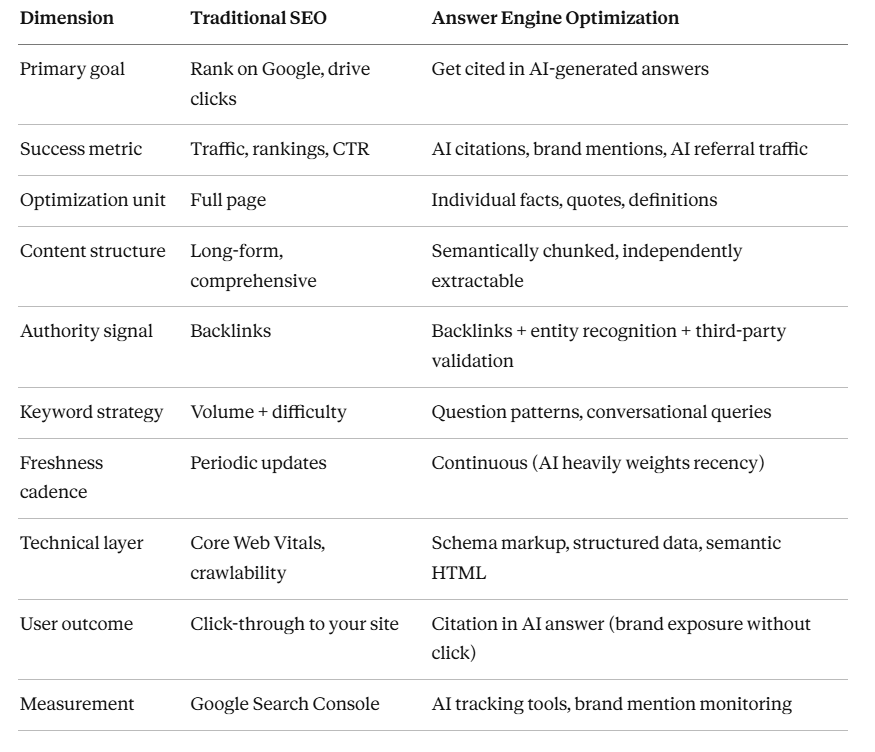
The good news for Orange County businesses: most AEO best practices also strengthen traditional SEO. Well-structured, authoritative, data-backed content ranks better on Google and gets cited more frequently by AI engines. You don’t have to choose — but you do have to evolve your approach.
Where they converge: both SEO and AEO reward genuine expertise, consistent content, authoritative backlinks, and clear topical focus. The difference is the additional layer AEO requires: making every key section independently understandable, and every key fact independently citable.
For a deeper dive into the foundational AEO vs. SEO comparison, see the original framework from Frase.io’s Complete AEO Guide, which informed the table above.
4. Why AEO Matters Right Now for Orange County Startups and Brands
Orange County is home to more than 3.1 million residents, a labor force exceeding 1.6 million people, and the seventh-largest economy in the United States. The region spans thriving business corridors from Anaheim and Santa Ana in the north, through the tech and finance hub of Irvine, to the coastal enclaves of Newport Beach, Laguna Beach, and Huntington Beach, and south into Mission Viejo, Lake Forest, and San Clemente.
That concentration of economic activity means intense competition for buyer attention — and buyer attention is now increasingly mediated by AI.
The numbers that should change your strategy:
- AI referral traffic is compounding. AI now accounts for approximately 1% of total website traffic across all domains — growing at roughly 1% per month, according to a study of 3.3 billion sessions across nearly 14,000 domains. That compounds to a doubling roughly every quarter.
- Zero-click is the new baseline. More than 58% of U.S. Google searches now end without a click to any external website (SparkToro, 2024). Google AI Overviews and AI Mode accelerate this further by answering queries directly in the results.
- AI visitors are higher-intent. Studies show that visitors arriving via AI citations convert at 4.4 times the rate of standard organic visitors and spend 68% more time on-site. These are not casual browsers — they’re buyers who have already been pre-qualified by the AI’s answer.
- The adoption gap is your window. Approximately 70% of organizations believe AEO will significantly impact their digital strategy within the next one to three years — but only 20% have begun implementing it (Acquia). In a competitive market like Orange County, being among the first 20% is a structural advantage.
The B2B context specific to Orange County: across the region’s dominant industries — technology, financial services, life sciences, professional services, and healthcare — buying decisions are high-trust and often long-cycle. Buyers research extensively before contacting vendors. They now do that research with AI. If your expertise isn’t structured for citation, you’re invisible at the most critical stage of the buyer journey.
“If you’re not building authority intentionally, you’re training the algorithms to overlook you.” — Gregg Kell, Founder, Spotlight on Startups
5. Answer Engine Optimization in Irvine: The Tech Hub Opportunity
Irvine is Orange County’s premier technology and professional services hub — home to the University of California, Irvine; major tech campuses for companies like Blizzard Entertainment and Broadcom; and a rapidly growing ecosystem of B2B startups across SaaS, cybersecurity, biotech, and fintech.
For Irvine founders and agencies, the AEO opportunity is outsized precisely because the buyer population is highly AI-native. UC Irvine graduates entering the workforce, tech professionals evaluating vendors, and investors conducting due diligence all use AI tools as a first-pass research layer.
What AEO looks like for Irvine businesses:
An Irvine-based SaaS startup, for example, wants to appear when a potential customer asks ChatGPT: “What are the best project management tools for mid-market tech teams in Southern California?” That citation requires the brand to have:
- A clearly structured, answer-first content presence that names the company, its expertise, and its location
- Third-party mentions from credible sources that reference the brand’s expertise in context
- Schema markup that tells AI engines the brand is a verified organization in Irvine, California, serving the technology sector
- Named founder or leadership quotes that appear in published, indexed media
Answer Engine Optimization in Irvine is not about gaming a system. It’s about making genuine expertise legible to AI at the speed AI operates.
Book an AEO Authority Assessment for your Irvine business →
6. AEO for Founders in Newport Beach, Costa Mesa, and the Airport Corridor
The Airport Area — spanning Newport Beach, Costa Mesa, and the western edge of Irvine — is home to some of Orange County’s most established professional services firms, financial institutions, and growth-stage companies. Pacific Life, Samsung North America, and Ford Motor Company‘s North American headquarters all operate in this corridor.
For Newport Beach financial advisors, investment firms, and high-end professional services practices, AEO addresses a specific and urgent problem: buyers in high-trust categories research online with extraordinary thoroughness before making contact — and that research now begins with AI.
The Newport Beach financial services case: When a high-net-worth individual asks Perplexity “Who are the most trusted independent financial advisors in Newport Beach?” the AI synthesizes an answer from the sources it finds most credible and structured. Firms with a strong AEO foundation — published expert commentary, structured service pages with schema markup, third-party media citations naming their principals — appear in those answers. Firms without it don’t.
Costa Mesa and the creative/retail sector: Costa Mesa’s South Coast Plaza corridor and its concentration of design, branding, and creative firms face a parallel dynamic. As AI tools become the first stop for business owners searching for creative partners, agencies that have invested in structured media presence pull ahead of equally talented competitors who haven’t.
AEO for Newport Beach, Costa Mesa, and the Airport Corridor starts with the same foundation as everywhere else: structured content, entity recognition, and third-party validation from credible media sources. Learn how Orange County tech startup brand strategy intersects with this approach.
Start with a free Founder Spotlight Interview →
7. Answer Engine Optimization in Anaheim, Santa Ana, and Central Orange County
Anaheim is Orange County’s largest city — anchored by the Disneyland Resort, Honda Center, Angel Stadium, and the Anaheim Convention Center, which attracts millions of visitors and business travelers annually. Santa Ana is the county seat and home to a vibrant entrepreneurial ecosystem, particularly in the small business, professional services, and cultural industries.
For businesses in Central Orange County, AEO presents both a challenge and an opportunity. These markets are often more competitive at the local search level, and the businesses that establish AI citation authority early will dominate a growing share of buyer discovery.
Industries in Anaheim and Santa Ana where AEO pays highest dividends:
- Hospitality and event services — buyers increasingly use AI to research vendors before booking
- Legal and professional services — trust is the buying criteria, and AI citation is a trust signal
- Healthcare and wellness — patients and corporate HR teams research providers with AI
- Manufacturing and B2B services — procurement teams use AI to shortlist vendors
The local entity signal matters here. When a founder or business owner in Anaheim has their expertise published in a structured, journalist-authored media spotlight that names their company, their location, and their specific area of expertise, AI engines register that as a credible local entity signal. That’s the difference between showing up when a buyer asks “Who handles commercial HVAC contracting in Anaheim?” and being invisible.
Book a Strategy Call to discuss AEO for your Anaheim or Santa Ana business →
8. AEO in South Orange County: Mission Viejo, Lake Forest, and Beyond
South Orange County — encompassing Mission Viejo, Lake Forest, Laguna Niguel, San Clemente, Dana Point, Laguna Hills, Aliso Viejo, Rancho Santa Margarita, and San Juan Capistrano — is one of the fastest-growing areas in the county for professional services, healthcare, and real estate businesses.
These communities are characterized by high household incomes, high educational attainment, and a business population that skews toward established professional practices, boutique agencies, and growth-stage B2B firms. The buyers in these markets are sophisticated — and they use AI.
The South Orange County opportunity: Because these cities are somewhat less digitally competitive than Irvine or Newport Beach, the AEO window is especially wide. A financial planning firm in Mission Viejo, a physical therapy practice in Lake Forest, or a construction management company in Rancho Santa Margarita that establishes a structured AI citation presence now will hold that ground against later-moving competitors.
Answer Engine Optimization in South Orange County follows the same principles as the rest of the region — but the local entity signals need to name specific cities, submarkets, and community contexts. AI engines don’t just identify industries; they identify locations. “Trusted estate planning attorney in Mission Viejo” and “best IT managed services in Lake Forest” are real queries that real buyers are submitting to AI right now.
Get your South Orange County business cited by AI — start here →
9. The Founder’s Step-by-Step AEO Framework
The following six-step framework applies to any Orange County founder or brand leader who wants to move from being invisible to AI systems to being actively cited by them. It is adapted from the foundational framework developed in Frase.io’s Complete AEO Guide and extended here with founder-specific execution guidance.
Step 1: Write Answer-First Content
Every section of your content needs to lead with a direct answer. AI engines evaluate the first one to two sentences of each section to determine whether it answers a relevant query. If your opening is vague setup or generic context-setting, the AI moves to a competitor who answered directly.
The answer-first rule for founders:
- Start each major section with a 40–60 word direct answer to the question implied by the heading
- Define your expertise in “[Your brand] is [clear definition]” format in your About page, bio, and service pages
- Use the inverted pyramid: most important claim first, supporting detail second
- Write for extraction: assume the AI will take only your first two sentences. Make those two sentences count.
Before and after:
- ❌ “In today’s rapidly evolving business landscape, many Orange County companies are wondering about their digital visibility…”
- ✅ “Spotlight on Startups publishes structured, AI-optimized Business Spotlight articles for Orange County founders — creating durable third-party authority signals that help brands get cited by ChatGPT and Perplexity.”
Step 2: Structure Content for AI Parsing
AI systems parse content section by section, not as a whole page. Each section must be independently understandable and citable — as if it could be read in complete isolation.
Structural rules:
- Use H2 and H3 headings as questions wherever possible (“What is AEO?” ranks better than “Overview”)
- Keep each section to 200–400 words covering exactly one concept
- Use bullet lists for features, processes, and lists of examples
- Use comparison tables for side-by-side evaluations
- Never bury a key statistic inside a long narrative paragraph — give data its own sentence
The semantic chunking test: could this section stand alone as a complete answer if ripped out of context? If yes, it will be cited. If no, restructure it until it can.
Step 3: Add Authoritative Citations and Data
Answer engines trust content that cites its own sources. Articles with inline citations to research studies, industry reports, and verified data score higher in the retrieval and ranking stages of the RAG pipeline.
Citation rules for founders:
- Include a specific statistic or data point every 150–200 words
- Link directly to the original source — not to a blog post summarizing it
- Name the organization, study, or dataset behind every claim
- Use specific numbers: exact percentages, specific dollar figures, named cities — not “significant growth” or “many businesses”
- If you’ve published research, surveys, or case studies, cite those as primary sources
The founder advantage: direct quotes attributed to named founders in published media function exactly like inline citations. When a journalist-authored Business Spotlight article quotes you by name on a specific claim — “According to [Founder Name], CEO of [Company Name] in Irvine, California…” — that becomes a citable, verifiable data point that AI engines treat as a credible source.
Step 4: Implement Schema Markup
Schema markup provides machine-readable context that helps AI engines understand your content type, your entity identity, and your key claims. Most Orange County business websites have little or no schema implemented — which is a silent barrier to AI citation eligibility.
Three schema types matter most for founders:
Article/BlogPosting schema marks your published content as authored expertise with a named author, publication date, and topic. Required for any blog post or article targeting AI citations.
FAQPage schema marks up your FAQ sections so AI engines can directly extract question-answer pairs. FAQ content maps directly to how users query AI — making FAQPage schema one of the highest-impact single AEO optimizations available.
Organization and Person schema establishes your brand and its leadership as recognized entities in the Google Knowledge Graph. This includes your official business name, location (including city within Orange County), founding date, and area of expertise.
Note for founders who aren’t developers: schema errors silently suppress AI citation eligibility. This is one of the primary areas where the AEO Authority Engine handles implementation — schema is audited, implemented, and validated as part of the technical foundation pillar.
Step 5: Build Entity Recognition
AI engines don’t just match keywords — they identify entities: named people, companies, locations, products, and the relationships between them. Getting your name, your brand, and your expertise recognized as a verified entity is foundational to AEO. Without it, even excellent content gets overlooked.
How to build entity recognition:
- Use your official business name consistently across your website, Google Business Profile, LinkedIn, press releases, and all published media
- Define your expertise explicitly: “We are an Orange County-based [category] serving [audience] in [specific cities]”
- Get your founder name and company name published by third-party sources — not just on your own site
- Link from your content to authoritative external sources that define the same entities (Google, industry associations, university research)
- Maintain an active and complete Google Business Profile — it’s a primary entity signal for local AI queries
The Google Knowledge Graph context: Google’s Knowledge Graph contains hundreds of billions of facts about billions of entities. Getting your brand, founder name, and expertise registered in that graph dramatically increases your AI citation potential across all major platforms. The most efficient path to registration is structured, corroborated, third-party media coverage — exactly what a Business Spotlight article provides.
Step 6: Build Topical Authority Through a Content Cluster
AI engines favor sources that demonstrate deep, consistent expertise across a topic — not a single well-written piece. A pillar article surrounded by supporting cluster content covering the subject from multiple angles signals domain authority in a way that standalone content never can.
How to build topical authority:
- Publish a comprehensive pillar article on your core expertise area
- Surround it with supporting articles covering related subtopics, specific use cases, and local market angles
- Interlink all related articles with descriptive anchor text
- Update high-value content quarterly with new data, examples, and statistics
- Cover subtopics that competitors in your Orange County market haven’t addressed
AI citations decay. Research indicates that AI citation rates drop meaningfully after approximately 13 weeks without freshness updates. Content authority must be maintained, not just established once.
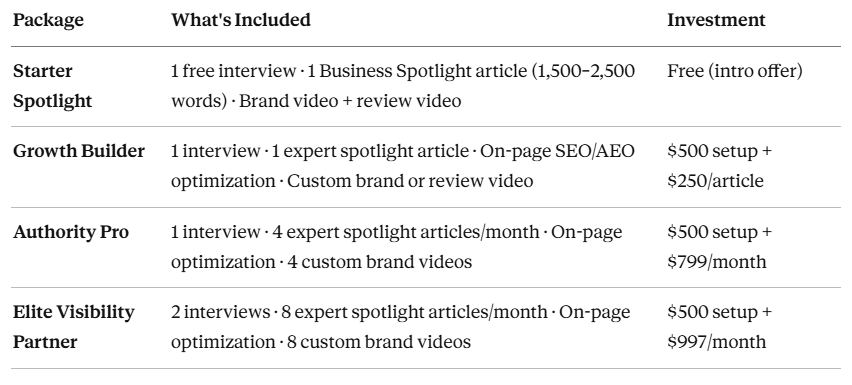
For founders with limited bandwidth: the Spotlight Journalist packages — starting with a free 15-minute founder interview — generate four to eight AEO-optimized expert articles per month, published to an indexed media domain. For founders who are running a business, not a content operation, this is topical authority at scale without writing a single word yourself.
10. The Media Spotlight as an AEO Asset — The Spotlight on Startups Difference
Most AEO guides tell you what to do: structure your content, build entity signals, publish consistently, earn citations. What they don’t address is the operational reality that most Orange County founders face — they are running a business, not a publishing operation. They don’t have time to write four keyword-optimized articles a month, implement schema markup, and manage a content calendar while also serving clients and closing deals.
This is the gap that Spotlight on Startups was built to fill.
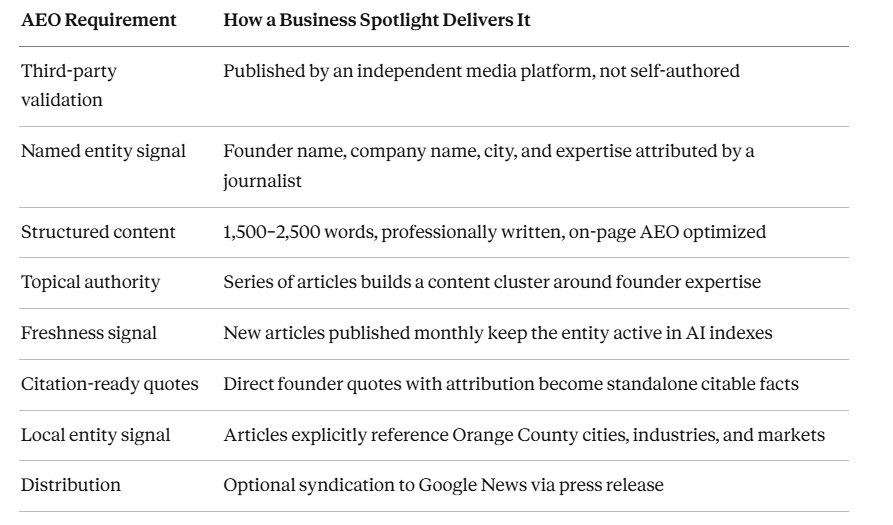
The unique value of a Business Spotlight as an AEO asset:
A Business Spotlight article published by Spotlight on Startups is not a guest post, a press release, or a paid advertisement. It is a professionally written, journalist-authored article of 1,500–2,500 words that documents a founder’s expertise, their company’s differentiation, and the specific problems they solve. It is published to an indexed media domain, optimized for both SEO and AEO, and structured precisely so AI systems can trust and cite it.
The Founder Spotlight Interview Process:
- A 10–20 minute guided interview extracts your story, expertise, and key differentiators
- A journalist crafts a 1,500–2,500 word Business Spotlight article capturing your expertise in structured, AI-readable form
- The article is published, on-page AEO optimized, and distributed
- You receive usage rights to publish it on your own site, LinkedIn, and marketing channels
- The result is a durable, machine-readable authority signal across AI discovery engines and sales conversations
Why this matters specifically for AI citation: When Perplexity or ChatGPT evaluates sources for a query like “Who are the leading SaaS founders in Irvine, California?” it looks for named entities in credible, structured, third-party-published content. A Business Spotlight that says “Gregg Kell, founder of [Company] in Irvine, California, specializes in…” satisfies every criterion: named person, verified location, clear expertise, third-party source, structured format.
The article doesn’t just talk about your brand. It becomes the structured, indexed asset that teaches AI what your brand is, where it operates, and why it deserves to be cited. See real examples of Orange County startup founder stories that have built this kind of presence.
“A Founder Spotlight Interview is designed to produce clear, attributable context about what the company does and who it serves — making the information easier for both humans and AI systems to trust and index.” — Spotlight on Startups
Packages and pricing:
Start with a free Founder Spotlight Interview →
11. The AEO Authority Engine: Done-For-You AEO Execution for Orange County Brands
For founders and brand leaders who want a complete, ongoing answer engine optimization system — not just individual media assets — the AEO Authority Engine is Spotlight on Startups’ flagship done-for-you service.
It is, as the name suggests, not a collection of tasks. It is a structured authority build-out that makes your brand machine-readable, entity-recognized, and citation-eligible across Google Search, AI Overviews, ChatGPT, Gemini, Perplexity, and local search.
Pillar 1: Authority Infrastructure
Technical SEO + AEO Foundation
Before any content or outreach is effective, the technical foundation must be right. The Authority Infrastructure pillar eliminates every structural issue that prevents search engines and AI systems from trusting and referencing your site.
What gets implemented:
- Full technical SEO and AEO blockage audit and remediation
- Optimized titles, meta descriptions, and keyword targeting
- Schema markup implementation and validation (including Organization, Person, FAQPage, Article, and BreadcrumbList schemas)
- Semantic HTML and heading structure corrections
- Canonical links and URL structure optimization
- Indexability and crawl path resolution
- Open Graph and social metadata
- Knowledge Graph trust and factual alignment enhancements
- Internal linking optimization
Outcome: Your site becomes machine-readable, entity-recognized, and citation-eligible across search and AI platforms.
Pillar 2: Knowledge and Topical Authority Build-Out
Content Engine
Authority isn’t built by volume. It’s built by depth, consistency, and strategic coverage of the topics your buyers care about. The content engine pillar delivers:
- Topical maps aligned to buyer intent and OC market context
- Comprehensive keyword and entity research
- Four authority-focused blog posts per month, each written to satisfy search intent, answer extraction, and AI citation likelihood
- Ongoing gap analysis and missing keyword integration
Outcome: Your content compounds authority month over month, positioning your brand as the answer — not just another result. See how optimizing content for AI search works in practice.
Pillar 3: Local Trust and Visibility Engine
For Orange County and Multi-Location Brands
Local visibility in Orange County is no longer about proximity alone. AI systems evaluate trust signals and expertise markers when determining which local businesses to surface in geographically scoped queries.
What gets managed:
- Full Google Business Profile optimization for Orange County presence
- Eight GBP authority posts per month
- Local citation enhancement across directories that AI systems index
- GBP Q&A strategy and management
- Review response handling to reinforce expertise signals
Outcome: Your brand dominates high-intent local searches — in Irvine, Newport Beach, Anaheim, Santa Ana, Costa Mesa, Mission Viejo, Lake Forest, and across Orange County — with structured authority rather than proximity luck.
Pillar 4: Authority Amplification
Selective Acceleration
When faster authority velocity is required — for a new product launch, a competitive market push, or an initial entity establishment — amplification is deployed strategically:
- Press release distribution to indexed outlets
- CloudStack deployment
- Authority signal reinforcement across indexed properties
Outcome: Accelerated trust signals, faster entity recognition, and expanded AI visibility on a compressed timeline.
Who the AEO Authority Engine is built for:
- Founders and OC brands serious about long-term AI visibility
- Local leaders competing in markets where AI is reshaping buyer discovery
- Companies being impacted by AI Overviews and declining organic click-through rates
- B2B firms whose buyers research with AI before ever booking a call
Book an AEO Authority Assessment for your Orange County business →
12. How to Measure Your AEO Performance
Answer engine optimization produces measurable results — but you have to know what to measure. The metrics are different from traditional SEO, and most standard analytics dashboards don’t surface them by default.
What to track:
AI citation appearances. Manually query ChatGPT, Perplexity, and Google AI Mode for the queries your buyers are asking — including location-specific queries that reference Orange County cities. Track which queries return citations that include your brand. Do this monthly and log the results.
AI referral traffic. In Google Analytics 4, create a custom segment for referral traffic from chatgpt.com, perplexity.ai, claude.ai, and gemini.google.com. This traffic is growing rapidly and is notably high-intent — tracking it separately from generic organic traffic shows you the direct value of your AEO investment.
Knowledge panel appearance. Search your brand name on Google. The presence of a knowledge panel — the structured information box on the right side of results — indicates that Google’s entity graph has recognized your brand. This is a leading indicator of broader AI citation eligibility.
AI Overview appearances. Search your core topic queries and local service queries in Google. Note when your content appears in AI Overview citations. Screenshot and log these appearances as they represent zero-click visibility that doesn’t appear in click-based analytics.
Content freshness cadence. Track the publication and last-updated dates of your highest-performing content. AI citation rates decline after approximately 13 weeks without updates — set a quarterly review schedule for high-value pages.
Benchmarks to know:
- 38% of Google AI Overview citations come from pages already ranking in the top 10 organic positions — strong SEO and strong AEO reinforce each other
- AI referral traffic currently converts at 4.4 times the rate of standard organic traffic
- The first-mover advantage in OC markets is real — brands that establish citation authority now will be significantly harder to displace as AI search matures
13. Common AEO Mistakes Orange County Founders Make
Most founders and agencies in Orange County make the same predictable mistakes when first engaging with answer engine optimization. Recognizing them accelerates results significantly.
Assuming social proof equals authority. Follower counts, likes, and general press mentions feel impressive — but they don’t translate into structured entity signals that AI engines can cite. Authority is technical and measurable. Attention is not the same thing as authority.
Treating AEO as separate from SEO. They compound each other. Approximately 38% of AI Overview citations still come from pages ranking in Google’s top 10. Abandoning SEO fundamentals in favor of AEO-only tactics reduces both. The goal is a unified strategy where both reinforce each other.
Skipping schema markup. Most OC business sites have no schema implemented, or have errors in what they do have. Schema errors silently block AI citation eligibility. This is invisible to the naked eye but highly impactful in the RAG pipeline.
Publishing without citations. Unsupported claims don’t get cited by AI engines. If your content states “we are Orange County’s leading [category]” without linking to a verifying source, the AI treats the claim as unverifiable and prefers a source that cites evidence.
Publishing once and stopping. A single well-structured article doesn’t build topical authority. AI citation rates decay after approximately 13 weeks without fresh content. Consistency and recency are non-negotiable in AEO.
Not structuring the founder’s own expertise. The most underutilized AEO asset in Orange County is the founder’s own knowledge — years of experience, case studies, methodologies, and outcomes that exist in conversations and decks but have never been published in a structured, indexed, AI-readable format. A Founder Spotlight Interview exists specifically to capture and publish that expertise before a competitor does it first.
Optimizing only for company-level keywords. AI engines surface individual experts, not just companies. Queries like “Who is the best [expertise] founder in Newport Beach?” or “Who should I talk to about [topic] in Irvine?” target named people. Founders who have their personal expertise structured and published — with their name, their location, their specific area of knowledge — appear in those answers. Founders who don’t, don’t. Read more about overcoming Orange County tech startup challenges in the AI era.
14. FAQ: Answer Engine Optimization in Orange County
What is Answer Engine Optimization? Answer Engine Optimization (AEO) is the process of structuring your brand’s content and expertise so that AI-powered platforms — including ChatGPT, Perplexity, Google AI Mode, Claude, and Gemini — select your brand as a cited source when generating answers. It is distinct from traditional SEO in that it optimizes at the fact and section level rather than the page level, and prioritizes entity recognition and third-party validation alongside technical structure.
How is AEO different from traditional SEO? Traditional SEO optimizes a full web page to rank in Google for target keywords and drive clicks. AEO optimizes individual claims, definitions, quotes, and data points to be extracted and cited by AI systems that generate direct answers. Both are important — they reinforce each other — but AEO requires additional structural and technical layers that most SEO strategies don’t address.
How do I get my Orange County business cited by ChatGPT? Getting cited by ChatGPT requires three foundational elements: structured content that answers specific questions directly; third-party, journalist-authored media coverage that establishes your brand as a named, verifiable entity; and technical schema markup that makes your content machine-readable. The AEO Authority Engine and the Founder Spotlight Interview are both designed to build these elements for Orange County brands.
What is a Business Spotlight and how does it help with AEO? A Business Spotlight is a professionally written, journalist-authored article of 1,500–2,500 words published by Spotlight on Startups that documents a founder’s expertise, company differentiation, and key outcomes. It serves as a structured, indexed, third-party authority signal — exactly the kind of content that AI systems are trained to trust and cite. It begins with a free 15-minute Founder Spotlight Interview at spotlightonstartups.com/journalist.
Which Orange County cities do you serve? Spotlight on Startups serves founders and brands across all of Orange County, including Irvine, Newport Beach, Anaheim, Santa Ana, Costa Mesa, Huntington Beach, Laguna Beach, Laguna Niguel, Mission Viejo, Lake Forest, Rancho Santa Margarita, Aliso Viejo, San Clemente, Dana Point, San Juan Capistrano, Fullerton, Garden Grove, Orange, Tustin, and Yorba Linda.
How long does AEO take to produce results? Entity recognition and AI citation authority build over three to six months of consistent structured publishing and technical optimization. Initial signals — knowledge panel appearances, AI Overview citations — often emerge within the first 60–90 days when a solid technical foundation is combined with active third-party media coverage. Content freshness must be maintained for citations to persist.
Do I need technical skills to do AEO? The content strategy elements of AEO — writing answer-first content, adding citations, structuring headings — require no technical skills. The technical elements — schema markup implementation, semantic HTML corrections, crawl path optimization — require development expertise. The AEO Authority Engine handles the technical implementation entirely, so founders can focus on their business while the authority infrastructure is built for them.
What is the AEO Authority Engine? The AEO Authority Engine is Spotlight on Startups’ flagship done-for-you answer engine optimization service for Orange County founders and brands. It is a four-pillar system covering technical AEO infrastructure, topical content authority, local trust and visibility, and authority amplification — designed to make your brand machine-readable, entity-recognized, and citation-eligible across Google, AI Overviews, ChatGPT, Gemini, and Perplexity. Learn more about the knowledge graph optimization technology behind it.
Ready to Become the Brand AI Cites in Orange County?
Answer Engine Optimization isn’t a future trend — it’s the current competitive landscape for Orange County founders. The buyers in Irvine, Newport Beach, Anaheim, Costa Mesa, Mission Viejo, and across the county are already using AI to find, evaluate, and shortlist vendors. The brands that show up in those AI-generated answers are winning deals at a stage they’d otherwise never see.
The adoption gap is real. Most of your competitors haven’t started. The window is now.
Start with a free 15-minute Founder Spotlight Interview. No obligation — one conversation produces a structured, journalist-authored Business Spotlight article that begins building your AI citation authority immediately.
Claim Your Free Founder Spotlight Interview →
Or, if you’re ready for a complete AEO system:
Book an AEO Authority Assessment for Your Orange County Business →
This guide was developed by Gregg Kell at Spotlight on Startups and draws on the foundational AEO research and framework published by Shegun Otulana at Frase.io. Statistics cited within were sourced from Ahrefs, SparkToro, SearchEngineLand, Gartner, Acquia, ExposureNinja, and additional primary research referenced in the Frase.io guide. The Frase.io Complete AEO Guide is recommended reading for teams seeking a software-assisted AEO workflow.