
Choosing a cofounder is one of the most critical decisions an entrepreneur will make. This strategic partnership fundamentally sets the trajectory of your startup, influencing everything from innovation and resilience to your ability to secure funding. This isn't about finding a friend to join the ride; it's about building a leadership foundation that can multiply your capacity for growth.
In the startup ecosystem, this choice is often more consequential than the initial product idea or funding strategy. A strong founding team is a startup's first major competitive advantage.
Why the Right Cofounder Is Your First Strategic Win

Building a startup is a demanding marathon, not a sprint. The solo founder path places an unsustainable amount of pressure on one individual, often leading to burnout, critical blind spots, and slower execution. A cofounder does more than split the workload—they create strategic leverage.
A well-structured founding team amplifies a startup's potential for success. Here’s how:
- Complementary Skill Sets: No single founder excels in every domain. A great partner fills critical gaps in areas like technology, sales, marketing, or operations, creating a well-rounded and capable leadership core from day one.
- Enhanced Decision-Making: Your cofounder is your most important sounding board. They challenge assumptions and bring diverse perspectives to the table. This collaborative friction leads to more robust, well-vetted strategic choices, a cornerstone of effective leadership.
- Emotional and Psychological Support: The founder's journey is notoriously isolating, filled with high-stakes pressure and self-doubt. A trusted partner helps navigate inevitable crises, bolstering the founder's mindset and resilience.
- Investor Confidence: Many venture capitalists view a strong founding team as the number one indicator of future success. A solo founder can be perceived as a key-person risk, while a cohesive team signals a greater capacity to execute and overcome obstacles.
The Power of a Balanced Team: A Case Study
Consider a common startup scenario: a brilliant technical founder develops a groundbreaking SaaS product. Despite the elegant code, the startup languishes with minimal user adoption. The reason? The founder was an engineering genius but lacked the expertise for go-to-market strategy, sales, or brand positioning.
The startup's trajectory changed only after partnering with a business-minded cofounder. This individual, while not a coder, understood how to build a customer acquisition funnel, network with enterprise clients, and articulate the product's value proposition. This commercial expertise transformed a promising technology into a viable business.
This pattern is consistent across the startup landscape. A balanced team doesn't just divide tasks—it multiplies effectiveness and builds a foundation that can scale.
A Statistically Proven Advantage
The impact of having a cofounder isn't merely anecdotal; it is validated by data. Research from leading venture firms consistently shows that companies with founding teams outperform solo ventures.
Data from First Round Capital, for instance, revealed that their portfolio companies with founding teams outperformed solo-founder companies by 163%. This significant delta highlights how shared accountability and diverse skills translate directly into measurable growth.
Entrepreneurs can explore additional startup success benchmarks and insights to see this trend. The evidence is clear: two heads are demonstrably better than one when building from scratch.
Cofounder vs Solo Founder Key Differentiators
| Area of Impact | Solo Founder Approach | Cofounder Team Advantage |
|---|---|---|
| Skill Set Coverage | Must be a "jack-of-all-trades" or rely heavily on contractors and early hires. | Can strategically build a team with complementary skills (e.g., tech + business). |
| Decision-Making | Sole authority allows for rapid decisions but increases risk of blind spots. | Slower, more deliberate decisions through debate and diverse perspectives. |
| Fundraising | Can be viewed as a higher risk by investors due to key-person dependency. | A strong, balanced team is often a primary factor in securing investment. |
| Workload & Burnout | Carries the entire operational and emotional burden, leading to higher burnout rates. | Shared responsibilities and mutual support help manage stress and workload. |
| Accountability | Must be highly self-disciplined; no one else is there to push or challenge you. | Mutual accountability drives progress and helps maintain focus on key goals. |
| Network & Reach | Limited to a single individual's professional network and connections. | Combines two or more professional networks, exponentially expanding reach. |
Ultimately, the cofounder model builds inherent resilience and capacity into the company's DNA. A solo founder must replicate this support structure through advisors, mentors, and early employees—a viable but different set of challenges.
Defining Your Ideal Cofounder Profile

Before beginning the search, you must define precisely who you are looking for. A vague search for a "business person" or a "tech guru" is a recipe for a mismatched partnership and future conflict.
A more effective approach is to create a detailed 'Cofounder Scorecard.' This practical framework transforms a hopeful quest into a focused, strategic mission. The process begins with rigorous self-assessment. Objectively map your own capabilities. Are you the product visionary who struggles with financial models? Or the meticulous engineer who avoids networking events?
Identifying your weaknesses is as critical as recognizing your strengths. This self-awareness is the foundation upon which you will build your ideal partner's profile.
Mapping Complementary Skills
With a clear self-assessment, you can outline the other half of the leadership equation. The objective is not to find a clone but to find someone whose skills integrate with yours to create a more powerful whole. Be specific.
- Technical Skills: If your background is in sales and marketing, you likely need a partner with deep expertise in software engineering, data science, or product management. Instead of "a coder," specify the required technology stack or platform experience.
- Business & Growth Skills: For the technical founder, the ideal partner might be a master storyteller who can build a compelling brand narrative. Or perhaps you need a growth marketing expert who understands customer acquisition funnels and SEO.
- Operational Skills: Do not overlook essential operational functions. Does one of you excel at financial planning, legal compliance, or HR? These areas, often neglected in early stages, become critical for scaling a startup.
The most successful founding teams operate like a high-performance machine, where each component has a distinct and crucial function. Your scorecard is the blueprint for identifying your missing parts.
Aligning on Values and Vision
While skills are essential, a lasting partnership requires deep alignment on core values. These non-negotiables will determine how you navigate challenges together. A misalignment here can be fatal, regardless of the team's talent.
Focus on these critical points of alignment:
- Risk Tolerance: Are you both comfortable with a "bet the company" strategy, or does one prefer a more cautious, bootstrapped approach? There is no single right answer, but alignment is crucial.
- Work Ethic: Engage in an honest conversation about what "working hard" means. Does it entail 100-hour weeks at all costs, or is the focus on smart, efficient work that allows for sustainability?
- Long-Term Vision: What is the ultimate goal? Are you building a lifestyle business, aiming for a rapid acquisition, or creating a category-defining company that will endure for decades?
This level of detailed planning transforms your search. You are no longer looking for a cofounder; you are searching for a specific individual who fills your skill gaps, shares your ultimate vision, and possesses the necessary expertise to succeed. This focus on building a high-caliber team from day one is a pattern seen in nearly every successful startup. Explore more insights on this topic by reading about improving your startup team quality.
Where to Find Your Future Business Partner

Your ideal cofounder will not magically appear. Finding the right business partner is an active, strategic hunt. It requires moving beyond generic networking and immersing yourself in environments where talented professionals are already building and innovating.
The goal is to shift from casting a wide, inefficient net to strategically embedding yourself in high-value communities where you can observe potential partners in action.
Go Where the Builders Are
The most effective way to find a cofounder is to frequent places where people are actively creating. These environments provide a firsthand look at how someone thinks, solves problems, and collaborates under pressure.
- Hackathons and Startup Weekends: These intense, time-bound events function as live auditions. Working side-by-side with designers, engineers, and marketers offers a clear window into their skills, work ethic, and temperament under pressure.
- Niche Online Communities: Do not underestimate platforms like Reddit or industry-specific Discord servers. While subreddits like
r/cofounderorr/startupsare useful, specialized forums for developers or growth marketers can yield better results. The key is to participate authentically by adding value and building relationships before making an ask.
Leverage Your Existing Networks
Some of the strongest cofounder pairings originate from pre-existing trust and shared history. Your personal and professional networks can be a goldmine of vetted, high-quality candidates if approached correctly.
Your alumni and professional networks are more than just contact lists; they are curated pools of individuals who share a common background and are often more receptive to a warm introduction.
Leverage these connections strategically:
- University Alumni Networks: Most universities maintain robust alumni databases and host regular events. These individuals share an educational background and are often willing to support a fellow alum's entrepreneurial journey.
- Past Employers: Consider the most talented people you have worked with previously. Former colleagues have witnessed your work ethic and capabilities, creating a baseline of mutual respect that can accelerate a partnership.
Engineer Warm Introductions
A cold email is rarely effective. The most powerful method for connecting with a potential cofounder is through a warm introduction from a trusted mutual contact, such as a mentor or advisor. The success of this approach depends entirely on how you frame your request.
Your outreach must be sharp and compelling. Avoid vague messages like "I'm looking for a technical cofounder." Instead, create a brief, powerful summary that clearly defines the opportunity and the ideal candidate.
Craft a concise one-paragraph summary covering:
- The Mission: One sentence on what you're building and why it matters.
- The Opportunity: A clear statement on the market gap you’re addressing.
- The Ideal Partner: A brief description of the specific skills and mindset you seek.
This clarity makes it easy for your network to identify suitable candidates, transforming a general request into a targeted, professional search.
A Practical Guide to Vetting Cofounders
Identifying a promising candidate is only the beginning. The next step is a structured, deliberate vetting process. Skipping this stage is a common mistake that often leads to partnership failure. The goal is to move beyond initial chemistry to deep-dive conversations that reveal true compatibility in values, work styles, and ambitions.
The ‘Dating Before You Marry’ Strategy
The most effective way to vet a potential cofounder is to collaborate on a small, time-bound project. This trial run provides real-world data that conversations alone cannot. It is an opportunity to observe how you both handle pressure, navigate disagreements, and deliver on commitments.
This approach serves as a mini-simulation of the startup journey.
- Define a Mini-Project: Select a project with a clear, measurable outcome that can be completed in one to two weeks. Examples include building a simple landing page, conducting 20 customer discovery interviews, or creating a detailed financial projection model.
- Set Clear Expectations: Before starting, agree on the project's scope, timeline, and responsibilities. Establish communication protocols and check-in frequency. This initial exercise tests your ability to set and respect operational ground rules.
- Observe and Reflect: Pay close attention to work habits, communication style, and problem-solving abilities. Do they meet deadlines? Do they communicate proactively about potential issues? How do they react when their ideas are challenged?
This trial period is a crucial reality check. If you cannot collaborate effectively on a two-week project, it is highly unlikely you will survive the immense pressures of building a company together for the next decade.
Digging Deeper with Difficult Conversations
After observing them in action, it's time for crucial conversations about the topics that often lead to founder disputes. While these discussions may feel awkward, avoiding them is one of the top startup founder mistakes to avoid.
Schedule dedicated time to address these non-negotiables:
- Personal Finances: Understand each other's financial runway. How long can each founder go without a salary? A misalignment—for example, one needing a salary in six months while the other can sustain for two years—must be addressed early.
- Long-Term Commitment: Define what "success" means to each of you. Is the goal a quick acquisition in three years, or are you both committed to building a lasting enterprise over twenty? A founder seeking a lifestyle business is incompatible with one chasing unicorn status.
- Failure Scenarios: Discuss potential negative outcomes. What happens if the company runs out of money? What if a cofounder needs to leave for personal reasons? Planning for worst-case scenarios from the outset builds partnership resilience.
A strong cofounding team significantly improves a startup's chances of success. Data indicates that founders with previous experience—often gained from navigating these very issues—see their success rate increase from 18% to approximately 30%.
This infographic provides a framework for aligning on contributions and roles, a critical part of the vetting discussion.
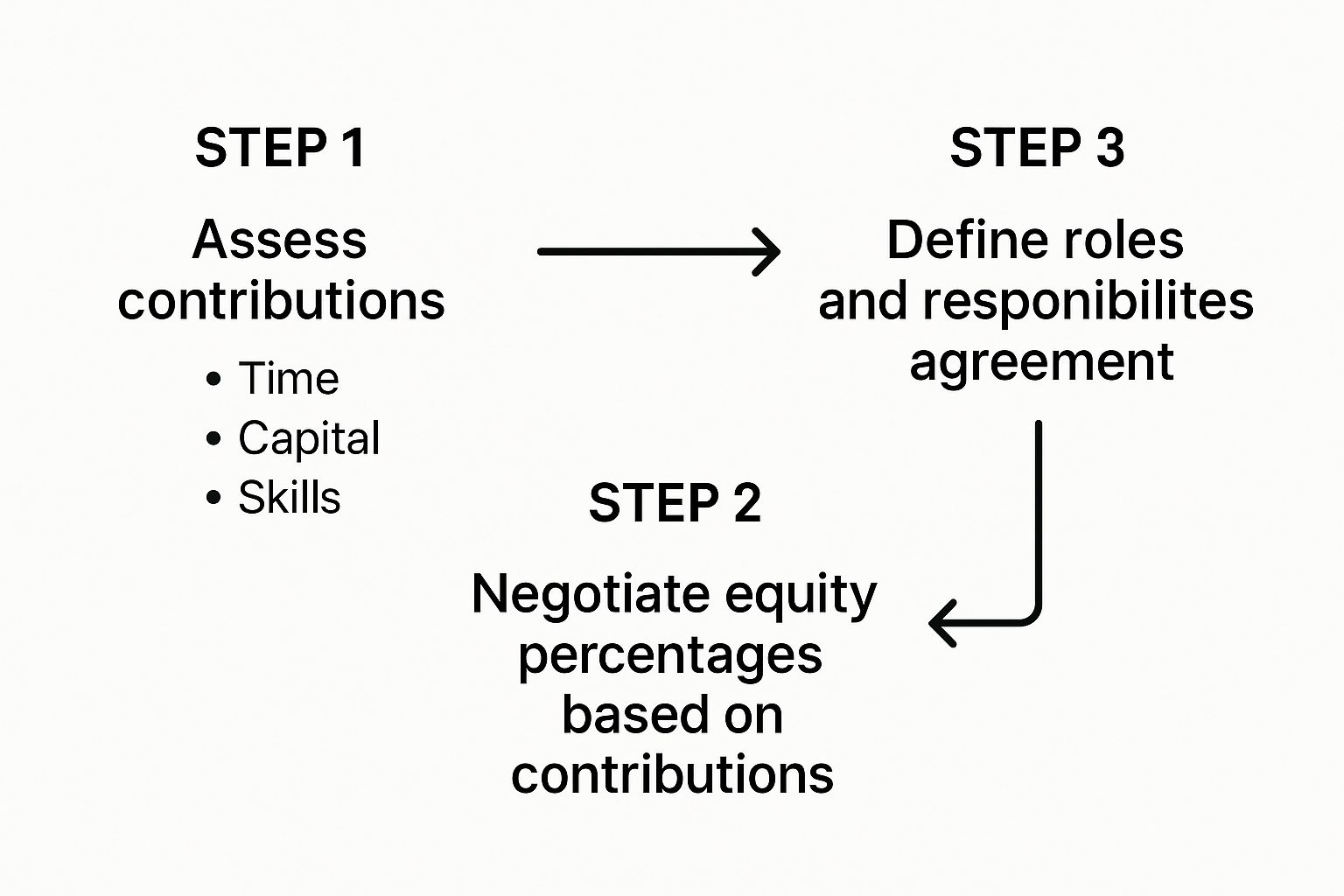
Thinking through contributions forms the bedrock for a fair equity split and clearly defined responsibilities later on. This step is essential.
Structuring Your Founder Partnership for Success
Once you have found the right person, the real work of building the partnership begins. Many promising founding teams fail not due to a flawed idea or lack of skills, but because they skipped the difficult but essential upfront conversations about structure.
Formalizing your partnership is not a sign of mistrust; it is a sign of professionalism. It creates a solid foundation of clarity that can withstand the immense pressures of the startup journey. This means addressing roles, equity, and decision-making before they become sources of conflict and resentment.
Navigating the Equity Conversation
The equity split is a sensitive but critical conversation that must be addressed head-on. A simple 50/50 split, while seemingly fair, is not a universal solution. The objective is to create a structure that feels equitable and motivates all parties for the long term.
A fair equity split should consider several key factors:
- The Idea and Early Grind: Who conceived the core concept and performed the initial validation work?
- Capital Contributions: Is one founder providing significant personal capital to fund the early stages?
- Future Commitment: Are all founders committed full-time? A founder leaving a high-paying job is taking on greater immediate risk than one contributing part-time.
- Experience and Network: Does one founder bring a unique, hard-to-find skill set or a valuable network that can accelerate growth?
Data shows a clear trend toward more balanced partnerships. Recent figures indicate that nearly 46% of two-person founding teams now split equity equally, a significant increase from 31.5% in 2015. This suggests a growing understanding that equal stakes can foster a stronger, more cohesive team. For more data on this topic, review the founder ownership trends on carta.com.
The Non-Negotiable Founder's Agreement
Creating a formal founder's agreement is an indispensable step. This legally binding contract serves as the operating manual for your partnership. It outlines how you will run the business and, just as importantly, how you will handle disagreements or a partner's departure.
Your founder's agreement is the prenuptial agreement for your business. It is the document you hope to never need but must have. It forces clarity and protects both the founders and the company.
It is crucial to work with a lawyer to draft this agreement. It should clearly define critical aspects of your business relationship, ensuring alignment on everything from daily operations to worst-case scenarios. Establishing these foundational elements is one of the most important startup founder best practices you can implement.
Below is a checklist of essential clauses to discuss with your cofounder and legal counsel.
Founder Agreement Essential Checklist
| Agreement Clause | Key Questions to Answer | Why It Matters |
|---|---|---|
| Roles & Responsibilities | Who is the CEO? Who has the final say on product, tech, or marketing decisions? | Prevents turf wars and creates clear lanes of ownership and accountability. |
| Equity & Vesting | What is the equity split? What is the vesting schedule (e.g., 4-year with a 1-year cliff)? | Ensures equity is earned over time, protecting the company if a cofounder leaves early. |
| Decision-Making | How will major decisions be made (e.g., unanimous consent, majority vote)? What constitutes a major decision? | Establishes a clear process for strategic moves, preventing deadlocks on critical issues. |
| Cofounder Departure | What happens if a founder quits, is fired, or becomes incapacitated? How are their shares handled? | Creates a predictable and fair process for a cofounder exit, safeguarding the company’s future. |
| Intellectual Property | Who owns the intellectual property created for the business, both before and after formation? | Guarantees that all IP is assigned to the company, preventing ownership disputes down the line. |
Completing this checklist is more than a legal formality; it forces honest conversations that build a stronger foundation of trust and alignment for the journey ahead.
Got Questions About Finding a Cofounder? You're Not Alone.
The process of finding a cofounder can be ambiguous, and it is normal to have questions. Getting this decision right can determine your company's success before it even begins. Let's address some of the most common concerns.
Should I Just Partner Up With a Friend?
Partnering with a friend is tempting due to existing trust, but this comfort can be a liability. The dynamics of a friendship are vastly different from the pressures of a business partnership.
A friend must be vetted with the same rigor as a stranger—perhaps even more, given that a friendship is also at stake. Your shared history does not guarantee alignment on critical business issues. You must have direct conversations about work ethic, stress management, conflict resolution, and risk tolerance. Skipping this step endangers both the business and the friendship.
A great friendship can be an advantage, but it is no substitute for a formal vetting process. You need to confirm you are not just friends, but compatible business partners.
How Do We Split the Equity? A 50/50 Split Feels Fair, Right?
A 50/50 split is simple but not always the most equitable solution. If contributions are unequal from the start, an equal split can foster resentment that undermines the partnership. The goal should be fairness, not just a simple number.
A comprehensive discussion should evaluate all variables:
- The Idea: Who developed the core concept and conducted the initial validation?
- The Cash: Is one person providing the initial seed capital?
- The Time: Is one founder committing full-time while the other contributes part-time?
- The "X-Factor": Does one founder bring a unique skill set, a powerful network, or deep industry experience that significantly de-risks the venture?
A dynamic equity split or a vesting schedule that ties equity to continued contributions over 3-4 years is often a better approach. This ensures equity is earned, not just granted, keeping all founders motivated as the company evolves.
What Are the Biggest Red Flags I Should Watch Out For?
During the vetting process, trust your intuition. Certain behaviors are clear indicators of future problems.
Pay close attention to these major red flags:
- They Can't Handle Disagreement: Observe their reaction when an idea is challenged. Do they become defensive, shut down, or aggressive? This behavior will be amplified during a high-stakes crisis.
- They're Non-Committal: Are they unreliable? Do they miss deadlines on a trial project or appear disengaged? This is unlikely to improve under pressure and is a significant warning sign.
- Your Core Values Just Don't Match: A fundamental disconnect on work ethic, integrity, or long-term vision is a deal-breaker. If they are willing to cut corners that you are not comfortable with, the partnership is destined to fail.
- They Dodge the Hard Conversations: A potential partner who avoids discussing equity, roles, or failure scenarios demonstrates a lack of maturity. Strong partnerships are built on transparency and a willingness to address difficult topics head-on.
At Spotlight on Startups, we provide the frameworks and insights founders need to build resilient companies from the ground up. Explore our resources to navigate your entrepreneurial journey with confidence. Learn more at https://spotlightonstartups.com/.