
For a startup, building out a new office, lab, or retail space is more than a construction project—it’s a high-stakes business decision that directly impacts your runway. The framework you choose to manage it all, what the industry calls a construction project delivery method, is the operational blueprint that will make or break your timeline, budget, and risk exposure.
Get this right, and you demonstrate strong operations management and protect your capital. Get it wrong, and you could burn through cash needed for core growth strategies. This guide provides the practical insights founders need to make a smart, strategic choice.
Why Your Delivery Method Defines Project Success
Deciding how to build your space is one of the most important operational calls a founder can make. This isn’t a technical detail to hand off to architects and contractors. It's a strategic choice that plugs directly into your startup's financial health and ability to scale quickly.
When every dollar and every day is critical, the wrong approach can trigger crippling delays and budget overruns that torch your precious capital. Understanding your options is the first step to building a solid foundation—for your space and your business.
The global construction industry is valued at over $16 trillion in 2024. But as McKinsey reports, it's also ripe for disruption. New technologies and more collaborative delivery methods are shaking up old habits, and the data is clear: projects using integrated approaches and modern digital tools see 30% fewer cost overruns and delays. For a founder, this is an opportunity for a competitive advantage.
The Blueprint for Your Bottom Line
Think of a delivery method as the operating system for your build-out. It defines the rules of engagement between you (the owner), the architect, and the builder, setting up everything from team structure to financial risk.
A mismatched method creates friction and miscommunication, leading to a death-by-a-thousand-cuts scenario of costly change orders that bleed your bank account. For founders, carefully managing your startup's runway isn't just a good idea; it's the key to survival.
This framework is what determines:
- Risk Allocation: Who’s on the hook financially when things go sideways? This is a key part of financial management.
- Collaboration: How closely will your design and construction teams actually work together?
- Cost Control: Will you lock in a fixed price upfront or work with a more flexible budget?
- Project Timeline: Will you design everything first and then build, or will you overlap the two to move faster?
For a startup, the chosen delivery method is less about construction and more about risk management. It’s a strategic tool that, when selected correctly, preserves capital, accelerates speed to market, and aligns the entire project team with your ultimate business goals—a core attribute of founder excellence.
At the end of the day, the right construction delivery method isn't just about putting up walls. It's about building tangible value, efficiently. By getting a handle on the core differences between these approaches, you can make an informed choice that protects your resources and sets your project up for success from day one.
Understanding the Traditional Design-Bid-Build Method
The Design-Bid-Build (DBB) method is the classic, established approach to construction. It’s a linear and straightforward framework. Think of it like a relay race: one person runs their leg and then passes the baton to the next. You can't have everyone running at the same time.
First, you, the founder, hire an architect or designer. Their job is to create a 100% complete set of plans and specifications for your project. Every detail, from the structural layout to the finish on the doorknobs, is decided and documented.
With those finished blueprints in hand, you move to the bidding stage. You shop those plans around to multiple general contractors, who then compete for the job. This competitive pressure is where DBB shines, as it creates a clear, fixed price before construction begins. For founders who need to lock down a budget for investors or boards, that kind of cost certainty is incredibly appealing. Usually, the lowest qualified bid wins the contract.
The Sequential Process and Its Trade-Offs
The name really says it all. Design-Bid-Build unfolds in three distinct, sequential phases that never overlap:
- Design Phase: You work exclusively with a design firm to get the construction documents to 100% completion.
- Bidding Phase: The finished design is sent out, and general contractors submit sealed bids to build the project exactly as drawn.
- Construction Phase: You award the contract to a builder, who then executes the plans.
This rigid, step-by-step structure is both its greatest strength and its biggest weakness. On the plus side, the separation between the designer and the builder is crystal clear. Responsibilities are neatly defined, which can simplify contracts. But this is also where operational silos emerge.
The real challenge with Design-Bid-Build is that the builder—the person with practical knowledge about costs and buildability—doesn't join the team until after every single design decision has been made.
This disconnect is a notorious source of friction. When a contractor discovers a design flaw on-site or knows a more efficient way to achieve the same result, the only path forward is a formal—and often expensive—change order. This reactive process can quickly erode any savings gained from competitive bidding, impacting your financial management.
While DBB is a popular choice, industry data shows that these projects can face schedule overruns of 20-40% compared to more integrated delivery methods, mostly because of these mid-project changes. You can dig deeper into the numbers with Procore’s comprehensive analysis. It's this siloed workflow that has pushed many startups to look for alternative methods that get everyone talking to each other much earlier, aligning with modern best business practices.
Exploring the Collaborative CMAR Approach
For founders seeking more collaboration, the Construction Manager at Risk (CMAR) model is a significant step up from the rigid nature of Design-Bid-Build. This approach brings a construction expert—the Construction Manager (CM)—into the conversation during the design phase, not after all decisions have been finalized.
Think of the CM as your startup's in-house construction advisor. While your architect focuses on the vision and function, the CM provides real-time feedback on buildability, material costs, and scheduling. This early partnership is a game-changer for catching expensive design flaws that only surface mid-construction in a DBB project, demonstrating a proactive startup growth strategy.
The Value of a Guaranteed Maximum Price
The "at Risk" part of the CMAR title is where this method becomes particularly valuable for a founder. As the design solidifies, the CM provides a Guaranteed Maximum Price (GMP). This is the absolute ceiling for what your project will cost.
This means a huge chunk of the financial risk gets shifted from your company’s books to the Construction Manager.
If material prices suddenly skyrocket or unforeseen problems pop up, the CM is contractually obligated to cover those extra costs, not you. For a startup trying to manage its financial runway and report to investors, that kind of budget certainty is invaluable for funding and investment planning.
Imagine a biotech startup building a specialized lab. The exact price of a complex HVAC system may be unknown during initial design. With a CMAR, the manager can provide solid cost estimates early and then lock in the GMP, protecting the startup from a massive, unexpected bill later.
CMAR Advantages for Startups
For founders juggling complex projects with tight deadlines, the CMAR method strikes a fantastic balance between expert guidance and financial security.
- Early Cost Control: The CM’s input during design guides decisions toward more cost-effective materials and methods before they are set in stone.
- Faster Timelines: Because the builder is involved from day one, they can pre-order long-lead materials and line up subcontractors before the design is 100% finished. This overlap, often called "fast-tracking," can accelerate your time to market.
- Less Conflict: The often-adversarial relationship between a designer and a low-bid contractor is replaced with a unified team, fostering a collaborative culture more aligned with the startup mindset.
The CMAR model is a strategic move for startups that need a predictable budget and an aggressive schedule without compromising on quality. It provides the collaborative brainpower of an early-stage builder while putting a firm cap on financial risk—a powerful combination for any growing company.
What Is Integrated Project Delivery?
While CMAR brings the team closer, the Integrated Project Delivery (IPD) model takes partnership to the next level. It dissolves the traditional lines between the owner, architect, and contractor. Instead of separate entities, everyone joins a single, unified team bound by one multi-party contract.
This isn’t just a handshake agreement; it’s baked into the project's financial DNA. IPD is built on a foundation of shared risk and reward. If the project comes in under budget, everyone—the startup, the designer, and the builder—shares in the savings. But if it goes over, everyone feels the pain together. This flips the script, creating a "we're all in this together" culture that eliminates the finger-pointing common in other delivery methods.

A Framework Built for Innovation
For a startup tackling a complex, one-of-a-kind project, IPD is an incredibly powerful tool. Think about building a bleeding-edge R&D facility, a data center, or any space with highly specialized technical needs where innovation is key. The IPD structure is designed to foster creative problem-solving and efficiency.
By getting all key players around the table before a single line is drawn, the team can spot and solve challenges from every angle. The builder’s on-the-ground knowledge informs the architect’s design, while the founder’s vision keeps everyone aligned. It's a continuous feedback loop that unlocks efficiencies you can't get when everyone is working in a silo.
The core idea behind Integrated Project Delivery is simple but profound: When every party’s success is contractually tied to the project's success, the focus shifts from individual gains to collective outcomes. This alignment drives innovation, cuts waste, and ultimately delivers a better building.
The Real-World Benefits of a United Team
IPD is more than a concept; it's a genuine shift in how construction gets done, and the results speak for themselves. According to market analysis from 360iResearch, the IPD market is growing as more owners recognize its benefits. Studies have shown projects using this model see significant cost and schedule improvements compared to traditional methods.
The gains come from catching problems early and constantly fine-tuning the process. For founders who live and breathe collaboration and want a project team that operates with the same spirit as their own startup, IPD is a natural fit. It effectively turns the project into a joint venture where every person is invested in knocking it out of the park—on time and on budget.
How to Choose the Right Method for Your Startup
Knowing the difference between construction delivery methods is one thing, but picking the right one for your startup is where strategy comes in. This is a critical decision that directly shapes your budget, timeline, and risk exposure. For a founder, this is less about construction and more about aligning the project with core business goals.
The right choice boils down to your startup’s unique situation. You must weigh key factors to find the perfect fit, because there’s no single “best” method—only the one that achieves your objectives.
Key Questions Every Founder Must Answer
Before you can confidently pick a path, you need to be honest about your project and your company’s resources. The answers to these questions will build a framework that points you toward the most logical approach.
- How complex is this project? Are we talking about a straightforward office refresh, or are you building a specialized R&D lab with unique technical challenges?
- How critical is budget certainty? Do you need a locked-in price to satisfy investors and manage your burn rate? Or can you handle some cost flexibility for benefits like speed or higher quality?
- How fast do you really need to open? Is speed the absolute top priority? Overlapping design and construction can shave months off a schedule but demands a more collaborative setup.
- How much of your own time can you commit? Can you be deeply involved in day-to-day decisions, or do you need a structure that allows for delegation while maintaining control?
Answering these questions provides the data you need to evaluate your options. For example, a founder who needs absolute cost certainty for a simple project might prefer the traditional Design-Bid-Build model. On the other hand, a founder building a complex facility on an aggressive timeline would find CMAR or IPD a much better fit.
The decision tree below is a great visual guide for figuring out if a highly collaborative approach like Integrated Project Delivery is the right move, based on your project's complexity and your team’s willingness to share risk.
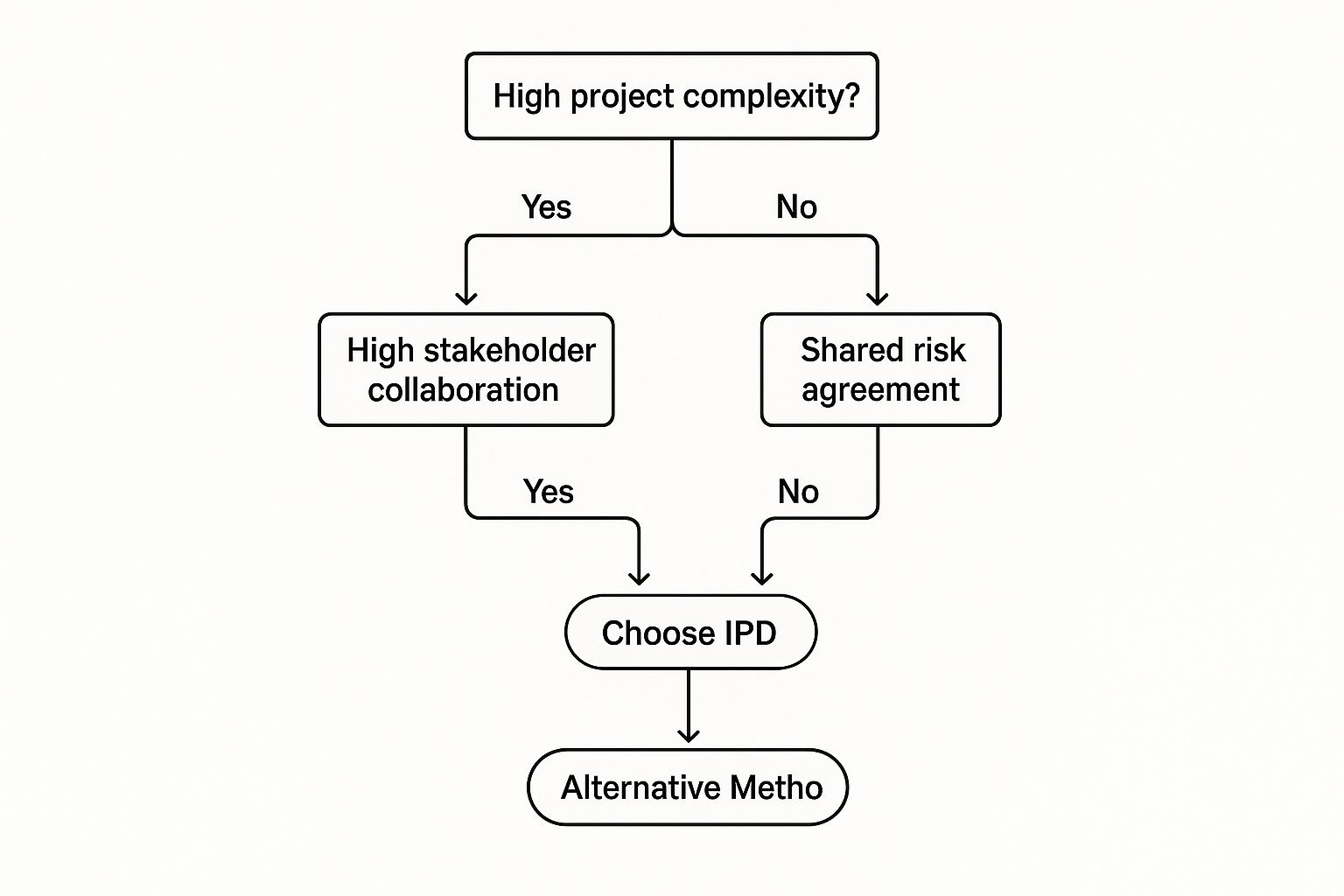
As you can see, IPD really shines on projects with high complexity where everyone involved is truly committed to collaboration and a shared-risk, shared-reward model.
Matching the Method to Your Startup's Priorities
Once you’re clear on your priorities, you can map them against each method. The table below is a simple decision matrix to help you move from a gut feeling to a data-driven choice.
Decision Matrix for Startup Construction Projects
This tool helps you quickly see how each delivery method aligns with common startup priorities like speed, cost control, and your ability to make changes on the fly.
| Startup Priority | Design-Bid-Build (DBB) | CMAR | Integrated Project Delivery (IPD) |
|---|---|---|---|
| Speed to Market | Slowest (Sequential phases) | Faster (Overlapping phases possible) | Fastest (Fully integrated design/build) |
| Cost Certainty | High (Fixed price from bids) | Moderate (GMP provides a ceiling) | Variable (Shared risk/reward model) |
| Flexibility for Changes | Low (Changes are costly/slow) | High (Collaborative change orders) | Very High (Built for iteration) |
| Founder Involvement | Low during construction | Moderate (Key decision points) | High (Deeply involved in the team) |
| Risk Management | Owner holds most design risk | Shared risk with the CMAR | Collective risk shared by all parties |
This matrix isn’t about finding a perfect score, but about identifying the best overall match for your specific goals.
Ultimately, this all comes down to protecting your startup's financial health. A well-chosen delivery method is a powerful tool for achieving the kind of capital efficiency that investors love to see. Getting this right from the start sets your project—and your business—up for success.
Common Questions from Founders
Navigating construction delivery methods for the first time always brings up questions for founders. Getting the right answers is critical—it helps you sidestep expensive mistakes and get your project started on the right foot.
Let's dive into some of the most common questions we hear from entrepreneurs in the trenches.
What Is the Biggest Mistake Startups Make When Choosing a Method?
The single biggest misstep is defaulting to the traditional Design-Bid-Build (DBB) model without evaluating other options. It’s an easy trap. Founders see competitive bidding and assume it guarantees the lowest price, but that’s often an illusion.
That initial low bid can quickly spiral out of control with change orders and conflicts once construction starts. For a startup, where every dollar and day counts, failing to consider collaborative methods like CMAR or IPD can be a fatal error. Your choice has to match your project’s real-world needs for speed, budget control, and complexity.
How Does Project Complexity Impact the Best Choice?
Project complexity is arguably the most important factor in this decision. If you’re doing something straightforward—like a standard office refresh with a well-defined scope—the linear process of DBB might work just fine. There’s little room for surprises.
But as soon as complexity ramps up, a more collaborative approach is essential. Think about building a specialized lab, a unique manufacturing facility, or any project where you can’t predict every detail from the start. In those cases, you need your construction experts in the room during the design phase.
CMAR and IPD are designed to bring that critical buildability insight to the table from day one. This allows the team to solve problems before they happen and forecast costs with much greater accuracy. The more ambitious your vision, the more you’ll get out of early team integration.
Can I Switch Delivery Methods After a Project Has Started?
Trying to switch methods mid-stream is a logistical and legal nightmare. It’s incredibly difficult, expensive, and almost never a good idea. Each delivery method is built on a specific contractual foundation that defines roles, risks, and payment structures.
Tearing that up after contracts are signed means heading back to lawyers for painful negotiations, triggering massive delays and disputes no startup can afford. This is exactly why doing your homework upfront is non-negotiable. The choice you make at the beginning sets the operational and legal roadmap for your entire project.
For more in-depth advice on making these crucial early-stage decisions, check out our complete startup playbook.
At Spotlight on Startups, we're here to help founders build with confidence. We provide the practical insights and credible resources you need to make smart decisions that protect your capital and drive growth. Explore more of our content on Best Practices and Funding by visiting https://spotlightonstartups.com/.