
Finding the right Orange County Tech Startup Investors for your hot new startup doesn’t start with a flashy pitch deck. It begins by building a business that is genuinely investable. An investable business has a validated market, a clear path to profitability, and a defensible advantage. For founders in Orange County and beyond, the hard work you put into building a solid operational and financial foundation is what transforms a compelling concept into an irresistible opportunity in an investor’s eyes.
Build an Investable Business Before You Pitch
Before asking for a check, you must prove you have a real business, not just a clever idea. This critical preparation is what makes or breaks a fundraising round. It’s about moving from theory to practice: validating your solution with actual customers, crafting a narrative that resonates, and building financial models grounded in reality. Think of it as your best defense against the tough, incisive questions that are sure to come from seasoned investors.
This process ensures your startup is ready for intense scrutiny.
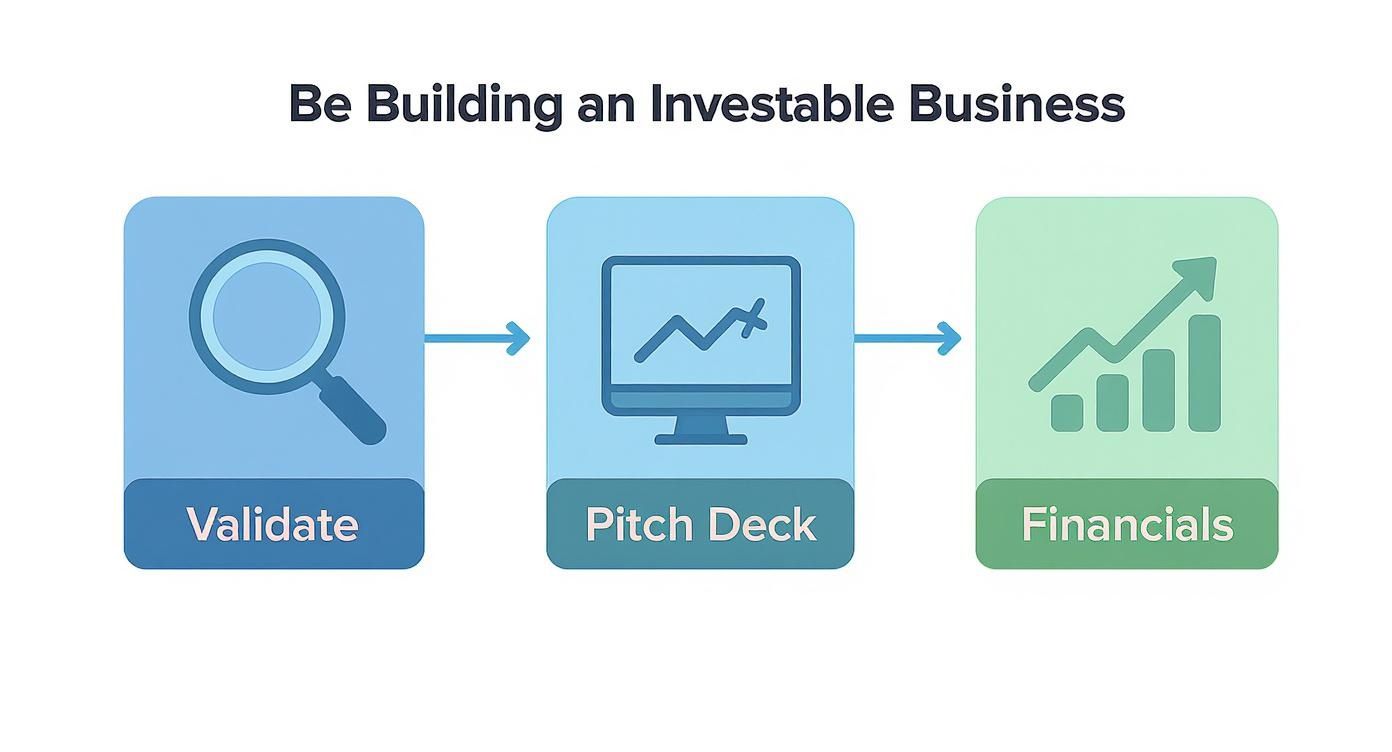
A powerful story is essential, but it’s the solid data and proof of concept that truly build investor confidence and de-risk the venture in their minds.
Before you start outreach, your house must be in order. This checklist covers the core materials and validation points that investors will expect to see. It’s your framework for ensuring you’re truly prepared for those crucial conversations.
Orange County Tech Startup Investor Readiness Checklist
| Checklist Item | Description | Why It Matters to Investors |
|---|---|---|
| Market Validation | Evidence that a specific market needs and will pay for your solution. | Shows you’ve reduced market risk and are solving a real, painful problem. |
| Unfair Advantage | Your unique, defensible edge (e.g., proprietary tech, key partnerships). | Answers the “Why you?” question and proves you can beat the competition. |
| Pitch Deck | A concise, visual story of your business (problem, solution, market, team). | This is your first impression. It must be compelling enough to secure a meeting. |
| Financial Projections | A 3-5 year forecast of revenue, expenses, and key financial metrics. | Demonstrates your understanding of the business model and potential for high returns. |
| Business Plan | A detailed document outlining your strategy, operations, and market analysis. | Provides the deep-dive evidence and strategic thinking behind your pitch. |
| Key Team Bios | Summaries of the founding team’s relevant experience and expertise. | Investors bet on people first. A strong team de-risks the entire venture. |
Having these assets prepared doesn’t just make you look professional; it forces you to think through every critical aspect of your business, which is exactly what an experienced investor does.
Validate Your Market and Solution
An idea is merely a starting point. Market validation is where you prove it has commercial viability. Investors demand hard evidence that you’re solving a real problem for a specific group of people who are willing to pay for your solution. The good news is that you can gather this proof with a lean budget.
Start by talking to potential customers. Run surveys, create a simple landing page to collect email sign-ups, or conduct one-on-one interviews. The objective is to gather real-world data—both qualitative and quantitative—that proves market demand. If you’re building a SaaS tool for small businesses in Orange County, for instance, interview local shop owners in Irvine or Costa Mesa before writing a single line of code.
Articulate Your Unfair Advantage
Every successful startup has an “unfair advantage”—a moat that competitors cannot easily cross. This might be your proprietary technology, an exclusive partnership with a major distributor, deep industry expertise on your founding team, or a fanatical brand community.
Your unfair advantage is the heart of your investment thesis. It’s the answer to the all-important question: “Why will you win when others try to do this?” You absolutely must have a clear, convincing answer.
For example, a founder with a decade of logistics experience at the Port of Long Beach has a built-in advantage when launching a supply chain startup. That background provides instant credibility and a nuanced understanding of the industry’s most pressing pain points.
Craft a Compelling Narrative and Pitch Deck
Your pitch deck is more than a slideshow; it’s a story. It must visually and emotionally connect your vision, traction, and potential. It should be concise, data-rich, and incredibly persuasive. Investors review hundreds of decks, so yours must capture their attention in the first 30 seconds. Nail the key points: the problem, your unique solution, the market opportunity, your business model, and why your team is the one to execute.
Understanding the broader funding landscape is also crucial. For instance, according to Crunchbase, fintech and AI startups have attracted significant global investment. Knowing these trends helps you frame your company within a high-growth sector, which can seriously boost your fundraising odds.
A polished deck is just one part of your arsenal. It must be supported by a much deeper strategy, which is where your business plan comes in. To dive deeper, check out our complete guide on how to write a winning startup business plan investors actually read.
Navigating the Orange County Tech Startup Investor Landscape from Angels to VCs
Finding the right investor isn’t just about the money. It’s about bringing a strategic partner into your corner—someone who understands your vision and has the experience to help you navigate the inevitable challenges of scaling a company. The funding world is a complex ecosystem, and each type of investor operates with different motivations and rules. You must understand what drives them before you can successfully pitch them.

Here’s a hard truth: a pitch that excites an angel writing a $50,000 personal check will fall flat with a multi-billion dollar venture fund. You must tailor your approach. Let’s break down who these key players are.
Angel Investors: The First Believers
Angels are often the first individuals outside your founding team to write a check. They provide critical seed capital during the earliest stages when your business might be little more than a powerful idea and a prototype.
These investors are typically successful entrepreneurs or executives investing their own money. Consequently, their decisions are often personal, blending a desire for a financial return with a genuine passion for mentoring the next generation of founders.
What excites an angel investor?
- A Personal Connection: They invest in people. They want to see your passion and believe in you as a founder.
- Hands-On Mentorship: Many are not passive investors. They want to roll up their sleeves, open their networks, and offer guidance.
- Big Swings: Angels understand early-stage risk. They seek startups with the potential for a massive 10-20x return on their investment.
An angel investor is betting on the jockey, not just the horse. Your passion, expertise, and resilience are often more important than your initial financial model.
When pitching an angel, focus on the narrative. Sell the vision, explain the problem you’re solving with conviction, and demonstrate why your team is uniquely qualified to succeed.
Venture Capital: The Institutional Powerhouse
Venture Capital (VC) firms are an entirely different beast. They aren’t investing their own cash; they’re investing Other People’s Money (OPM) from large institutions like pension funds and university endowments. This fundamentally changes their approach.
Because they are accountable to their own investors (Limited Partners), VCs are driven by a rigid investment thesis and the need to generate enormous returns. They typically invest later than angels, at the Series A stage and beyond, once a startup has demonstrated product-market fit and measurable traction. Their checks are much larger—often in the millions—and they will almost always take a board seat to help steer the company toward a massive exit, such as an IPO or a major acquisition.
Despite market fluctuations, there remains a massive appetite for great companies. Early-stage funding globally hit $103 billion in 2023. In the first half of 2025 alone, U.S. venture capital activity accounted for nearly $70 billion, with huge deals showing that capital is ready to be deployed for game-changing tech. You can dig into more of these trends on Startus Insights.
Comparing Orange County Tech Startup Investor Types: Angel vs. VC vs. Corporate
Choosing between an angel, a VC, or a corporate investor can be daunting. Each offers a different value proposition, from the size of their investment to their level of involvement. This table breaks down the key differences to help you determine which path is right for your startup at its current stage.
| Characteristic | Angel Investors | Venture Capital (VC) | Corporate Venture Capital (CVC) |
|---|---|---|---|
| Source of Capital | Individual’s personal funds | Pooled funds from Limited Partners (LPs) | Parent corporation’s balance sheet |
| Typical Stage | Pre-seed, Seed | Seed, Series A, B, and beyond | Varies, often Seed through late stage |
| Investment Size | $25k – $250k | $500k – $50M+ | $250k – $20M+ |
| Decision-Making | Fast, personal, informal | Slower, committee-based, formal diligence | Slower, involves strategic and financial review |
| Primary Motivation | Financial return, mentorship, personal interest | Massive financial returns (10x+ fund return) | Strategic alignment, M&A potential, market insight |
| Involvement | Often hands-on mentorship, network access | Formal board seat, active governance | Strategic guidance, access to corporate resources |
Ultimately, the right choice depends on your specific needs. If you need early capital and experienced guidance from a fellow entrepreneur, an angel is a fantastic starting point. If you have traction and are ready to scale rapidly, a VC is built for that purpose. And if a corporate partnership could unlock distribution or technology, a CVC might be the perfect fit.
Beyond the Usual Suspects: CVCs and Family Offices
While angels and VCs dominate the headlines, two other players are worth understanding.
Corporate Venture Capital (CVC): These are the investment arms of large corporations, like GV (Google) or Salesforce Ventures. Their goal is often more strategic than purely financial. They seek startups whose technology can support the parent company’s business. A CVC investment can be a game-changer, providing instant credibility and access to massive distribution channels, but may come with expectations of an eventual acquisition.
Family Offices: These private firms manage the wealth of a single ultra-high-net-worth family. Their investment style varies widely. Some operate like disciplined, mini-VC funds, while others are more opportunistic and relationship-driven. The key is to do your homework and understand that specific family’s interests, industry focus, and risk appetite.
Knowing who to approach, when, and how is half the battle. Your goal isn’t just to get a check; it’s to find smart money—capital that comes with the right expertise, network, and strategic vision to help you win.
Getting Warm Intros That Actually Get Replies
Forget cold emails. They are a founder’s lottery ticket with terrible odds. In the world of fundraising, relationships are paramount. A trusted introduction isn’t just a nice-to-have; it’s the currency that gets deals done.
Successful fundraising is a surgical process, not a shotgun blast. It requires identifying the right investors and then finding a credible path to get their attention. The most effective way to secure a meeting is through someone the investor already knows and trusts. This transforms your outreach from a cold call into a peer-to-peer recommendation, granting you instant credibility.
Master the Double Opt-In Introduction
Before asking for an introduction, you must master the double opt-in. This is non-negotiable professional etiquette in the investment world, and mishandling it is a major red flag.
Here’s the framework: first, you ask your mutual connection if they are willing to make the introduction. Only after they agree do you provide them with a concise, forwardable email they can send to the investor.
This two-step process is effective for several reasons:
- It protects your connector. You are not putting them in an awkward position by asking them to vouch for you without their consent.
- It respects the investor. They get a chance to accept or politely decline, which keeps their inbox manageable and preserves their relationship with your mutual contact.
Never ambush someone with a surprise three-way email introduction. It’s a rookie mistake that can burn bridges before you have a chance to pitch.
How to Map Your Path to an Investor
Your first move is to pull up your target list and map out who in your network can connect you. LinkedIn is your best friend here. Use its search filters to find second-degree connections to partners at the firms you’re targeting.
Look for connections through these channels:
- Fellow Founders: Other entrepreneurs, especially those who have successfully raised capital, are often your most powerful advocates.
- Advisors and Mentors: Your own advisors should be actively opening doors for you. If they are not, that’s a problem.
- University Alumni Networks: A shared alma mater is a surprisingly strong connection point that many founders overlook.
- Startup-Focused Service Providers: The right lawyers and accountants, particularly those in tech hubs like Orange County, have incredibly deep networks.
The goal isn’t just to find any connection; it’s to find the strongest one. A referral from a founder whose company the investor backed is worth ten times more than one from a casual acquaintance.
Once you identify a strong connector, your outreach must be sharp and specific. Don’t send a lazy, “Can you intro me to some investors?” email.
Instead, try this: “I see you’re connected to Jane Doe at OC Ventures. Her firm’s focus on B2B SaaS is a perfect fit for us. Would you be open to making a double opt-in intro?” This shows you’ve done your homework and makes it incredibly easy for them to say yes.
Crafting the Perfect Forwardable Email
When your connector agrees, your job is to make their part effortless. You need to provide them with a short, data-packed, and personalized email they can simply copy and paste or forward. This “blurb” should be no more than a few punchy paragraphs.
Here’s what it absolutely must include:
- A Killer One-Liner: “We’re a B2B SaaS platform that helps e-commerce brands reduce shipping costs by 15% using AI.”
- Hard Traction Metrics: Provide impressive numbers like 25% month-over-month growth, $10k in MRR, or a recent enterprise customer win.
- The Specific Ask: “We are raising a $750k seed round to expand our sales team.”
- A Link to Your Deck: Include a link to your crisp, compelling pitch deck.
Personalization separates the pros from the amateurs. Research the investor and their portfolio. Find a reason why your startup is a fit. For example: “I saw you invested in Company X, and we’re solving a similar problem in an adjacent market.” This level of detail proves you are not just spamming.
A strong narrative and public validation are critical. As we cover in our guide, you can learn how to use media coverage to accelerate fundraising rounds to build this kind of credibility before you even hit send.
Winning the Pitch and Surviving Due Diligence
Getting the meeting is a significant achievement, but it’s just the beginning. The pitch is where you earn an investor’s belief, and the subsequent due diligence is where you prove you’re worthy of their capital. This is where the rubber meets the road—a high-stakes phase that will test your preparation, transparency, and resilience under a microscope.
A great story gets you in the door, but it’s meticulous preparation and unflinching honesty that gets a deal across the finish line.

This is your moment to demonstrate that your startup is not just a promising idea, but a well-oiled machine poised for explosive growth.
Mastering the Art of the Pitch Meeting
Think of your pitch meeting as live theater with you in the lead role. Investors are assessing more than your slides; they are evaluating you. They want to see how you handle pressure, field tough questions, and articulate your vision with both passion and a deep command of the facts.
The best pitches feel more like a conversation than a monologue. Your deck provides the structure, but your delivery brings it to life. Focus on the story—weave together the problem, your elegant solution, and the massive market opportunity into a narrative that is impossible for them to ignore.
Don’t just rattle off features. Translate them into tangible impact.
- Instead of: “Our platform uses a proprietary algorithm.”
- Try: “Our algorithm cuts our customers’ processing time by 40%, saving them an average of $15,000 a year.”
Be prepared for interruptions. Expect to be challenged on your market size, customer acquisition costs, and competitive moat. A founder who can think on their feet and respond with data-driven confidence builds an incredible amount of trust in the room.
Navigating the Due Diligence Gauntlet
If the pitch goes well and investors express serious interest, they will likely issue a term sheet and commence due diligence. This is an exhaustive audit of your entire business—financials, legal structure, tech stack, team, customer contracts, and more. Its purpose is simple: to verify every claim you have made.
Due diligence is where deals go to die. It’s a test of your organization and, frankly, your integrity. Total transparency isn’t just a best practice here; it’s the only way to build the trust required to close a round.
The secret to surviving this process is to prepare for it before your first meeting. You should have a secure, meticulously organized virtual data room ready to share at a moment’s notice. This single repository, containing every document an investor might request, signals professionalism and prevents the deal from losing momentum.
Building Your Bulletproof Data Room
A clean, well-organized data room signals to investors that you are a serious, detail-oriented founder. It anticipates their questions and provides the answers before they even have to ask, which can dramatically speed up the closing process.
Structure your data room with clear, intuitive folders. Here’s a quick rundown of what you’ll absolutely need:
- Corporate Docs: Your articles of incorporation, bylaws, up-to-date cap table, and any stock purchase agreements.
- The Numbers: Historical financial statements, detailed multi-year projections (with your assumptions clearly laid out), and the current budget.
- Team Info: Key employee agreements, founder and key hire resumes, and a simple organizational chart.
- Product & Tech: Any patents or IP assignment agreements, plus a high-level overview of your technology.
- Go-to-Market: Key customer contracts, sales pipeline data, and your marketing strategy documents.
Having this ready allows you to grant access the second they ask, showing you’re prepared and confident. Investors are evaluating hundreds of deals; they appreciate founders who respect their time. This is just one of many signals they look for, so to learn more, check out what venture capitalists look for beyond the pitch deck in our dedicated guide.
Exploring Funding Beyond Traditional Venture Capital
When people discuss fundraising, the conversation almost always defaults to venture capital. But the reality is that VCs are just one piece of a much larger funding ecosystem. For many startups, especially those outside major tech hubs or in niche markets, the traditional VC route may not be the right fit.
The most successful founders are those who look beyond the obvious. They tap into a diverse ecosystem of alternative funding that provides the capital they need without the intense, often misaligned pressures that can accompany a VC partnership.

Exploring these other avenues isn’t a backup plan; it’s a strategic move. It demonstrates creativity and a focus on finding the right partner for your specific growth path and vision.
The Power of the Crowd
Equity crowdfunding has democratized startup investing. Platforms like Wefunder and Republic allow you to raise capital from a large pool of smaller, everyday investors. This does more than just fund your operations; it transforms your earliest customers and biggest fans into true stakeholders who are financially invested in your success.
A great campaign is built on a compelling story, a strong community, and radical transparency. Think of it as a public-facing fundraiser that doubles as a massive marketing blitz, creating buzz and validating your concept in the open market.
Accelerators and Incubators as Launchpads
Accelerators and incubators offer a unique combination of seed funding, intensive mentorship, and instant network access. Renowned programs like Y Combinator and Techstars provide a small check for an equity stake, but the money is often the least valuable part of the deal.
The real prize is the bootcamp-style program that condenses years of learning into a few months. You gain direct access to seasoned founders, domain experts, and a cohort of peers facing the same challenges. Graduating from a top-tier accelerator provides a stamp of approval that can be far more valuable than the initial check, signaling to other investors that your startup is worth a serious look.
For many founders, an accelerator isn’t just a source of capital—it’s a validation engine. The acceptance and subsequent network access can unlock doors that would otherwise remain closed.
While the VC world continues to grow, it is also becoming increasingly top-heavy. In Q3 2025, global VC funding hit a staggering $97 billion—a 38% year-over-year increase. However, a significant portion of that capital went into mega-deals for AI giants. With the United States still commanding about two-thirds of that capital, the competition is fierce. You can explore these global funding trends over at Crunchbase News.
Non-Dilutive Capital: Your Untapped Toolkit
Perhaps the best funding is the kind that doesn’t require you to give up a piece of your company. This is non-dilutive capital, and it allows you to maintain your equity while fueling growth.
Here are a few of the best options to investigate:
- Government Grants: Programs like the Small Business Innovation Research (SBIR) grants can be a goldmine for startups working on deep tech with commercial potential. They are competitive, but they provide “free” money to fund R&D.
- Revenue-Based Financing (RBF): This is a fantastic option for SaaS or e-commerce companies with predictable revenue streams. RBF firms provide upfront cash in exchange for a percentage of your future revenue until a predetermined amount is repaid. It is a flexible form of debt tied directly to your business performance.
- Strategic Partnerships: Don’t overlook the major players in your industry. A larger corporation might offer capital or key resources in exchange for access to your technology or market. This can be a brilliant way to secure funding and land a major distribution partner or anchor customer simultaneously.
Ultimately, knowing how to find investors is about understanding all the tools in your toolkit. When you look beyond the VC bubble, you open up a world of possibilities to find a funding strategy that fits your startup’s unique needs and long-term goals.
Answering the Tough Fundraising Questions
Every founder reaches a point where the questions feel bigger than the answers. How much of my company am I really giving up? What landmines will blow up a deal? When is the actual right time to ask for money? Let’s cut through the noise and get to the real answers I’ve seen play out time and time again.
How Much Equity Should I Give Early-Stage Investors?
There’s no magic formula, but a good rule of thumb for a seed round is parting with 15-25% of your company. Of course, that number moves around based on your valuation, how much you’re raising, and whether the market is hot or cold.
If you’re doing an even earlier pre-seed or angel round, you should aim for something closer to 10-15%. The real goal here isn’t just about the money; it’s about securing just enough capital to hit your next big milestones. Nail those, and your valuation for the next round will be that much stronger. It’s a constant balancing act between fueling growth now and keeping enough equity to make the long haul worth it.
One of the most critical mistakes a founder can make is giving away too much equity too early. It kills morale, creates headaches for future funding rounds, and makes it nearly impossible to offer meaningful stock options to the key hires you’ll need to win.
Think of it this way: the cash you raise should buy you a solid 12 to 18 months of runway. In that time, your job is to make the company significantly more valuable. That’s what makes the equity trade-off a smart bet.
What Are the Biggest Red Flags for Investors?
Investors are professional pattern-matchers. They’ve seen thousands of pitches, and they can smell a problem from a mile away. Certain issues are immediate deal-killers, so you need to know what they are and get ahead of them.
Here are some of the fastest ways to get a “no”:
- A Murky Problem-Solution Fit: If an investor has to squint to understand the pain point you solve, you’ve already lost. Your value prop needs to be so sharp it hurts.
- Fantasy Financials: Everyone knows projections are just educated guesses, but a wild hockey-stick curve with zero grounding in reality just makes you look naive. Investors want to see that you actually understand the levers of your business.
- “We Have No Competition”: This is probably the single biggest red flag. It tells an investor you’re either clueless about your market or just plain arrogant. Every great idea has competition, even if it’s just the old, clunky way of doing things.
- Gaps on the Team: Is your founding team missing deep industry expertise? Are you a software company without a technical co-founder? Investors see that as a massive, flashing warning sign.
Also, a sloppy, jargon-filled deck or a valuation that seems plucked from thin air will get your email sent straight to the trash.
When Is the Right Time to Start Fundraising?
Simple: The right time to raise money is when you have a great story backed by proof. That proof doesn’t always have to be revenue, but it absolutely has to show that you’re building something people genuinely want.
You’re likely ready when you can check these boxes:
- A Working MVP: You have a real, functional product in the hands of users, and they’re giving you feedback that’s not just positive, but also actionable.
- Early Signs of Life (Traction): You can point to real metrics that are heading up and to the right. This could be user growth, high engagement, a fast-growing waitlist, or even signed letters of intent from B2B customers.
- A Clear Use of Funds: You can explain precisely how you’ll spend their money to hit specific, measurable goals over the next 12-18 months.
Trying to raise before you have this kind of evidence usually leads to terrible terms or a whole lot of rejection. It’s almost always better to bootstrap just a little longer to get those proof points locked down.
How Do I Find Angel Investors in Orange County?
Finding local capital requires a boots-on-the-ground strategy. While large Silicon Valley funds get the headlines, your first check is often written by someone in your own community. For founders in OC, that means diving headfirst into the local ecosystem.
Your first stop should be established angel networks. A group like Tech Coast Angels is one of the largest and most active in the country, and they are based right here. Attend their events. Show up at demo days and startup meetups in Irvine, Newport Beach, and other local innovation hubs.
Next, leverage LinkedIn with precision. Don’t just search for “angel investor” and send cold messages. Filter your search by the “Orange County, California Metropolitan Area” and look for shared connections. A warm, double opt-in introduction is a thousand times more effective.
Finally, connect with the ecosystem’s facilitators: the lawyers, accountants, and successful founders who focus on startups. They know who is actively writing checks and can make an introduction that carries real weight. At the end of the day, investors often prefer to fund companies they can meet for coffee, making your local presence a significant advantage.
At Spotlight on Startups, we provide the frameworks and insights you need to navigate every stage of the founder’s journey with confidence. From validating your idea to closing your first round, our platform delivers the actionable knowledge to help you build an enduring business. Explore more at https://spotlightonstartups.com/.