
Choosing a name for your startup is a critical early decision, blending creativity with market awareness and legal diligence. The goal is to land on a name that does more than just sound good—it must communicate your mission, resonate with customers, and be legally defensible. Think of names like Slack or Shopify. They are simple, memorable, and immediately signal what the company does. That’s the strategic sweet spot you're aiming for.
This guide provides a practical framework for navigating the naming process, from brainstorming concepts that reflect your founder vision to securing your brand’s digital and legal footprint.
Why Your Startup's Name Is Its First Investor Pitch

Many founders treat naming as an afterthought—the "fun" part after the "real" work is done. This is a strategic misstep. Your startup's name is your hardest-working asset, shaping perceptions long before you ever present your pitch deck. It operates 24/7, making your first impression on potential investors, customers, and talent. A powerful name is a strategic advantage from day one, setting the tone for your brand and differentiating you in a crowded market.
It Shapes Initial Perceptions
Before anyone reads your business plan or visits your website, they encounter your name. A sharp, compelling name implies professionalism and a clear vision. A confusing or generic one can suggest a lack of preparedness.
Consider the first impression you want to make:
- Memorability: Will an investor or potential customer remember it after hearing it once at a networking event?
- Clarity: Does it hint at the problem you solve or the value you provide?
- Positioning: Does it sound like a disruptive technology company or a small local business?
That first impression is incredibly powerful. A name like Shopify instantly conveys the idea of an online shop—its purpose is embedded in the name itself. This built-in clarity is a massive advantage when you only have seconds to capture someone's attention.
Your name is the first line of your story. It’s the hook that either draws people in or lets them pass by. Make sure it’s working for you, not against you.
It Builds Credibility and Trust
The right name is also a core part of your company's story. It should feel like a natural extension of your founder journey, reflecting the mission that drives your venture. A name that aligns with your purpose helps build an authentic connection with stakeholders, from early adopters to venture capitalists.
Ultimately, naming a startup is about choosing a strategic tool. It's your first and best opportunity to tell the world who you are, what you stand for, and why they should care. This isn't just a branding exercise—it's your very first pitch.
Brainstorming Beyond the Whiteboard

If your brainstorming sessions yield only bland, forgettable names, it’s time to move beyond the whiteboard. A truly great name rarely emerges from a simple list of keywords. The most successful founders use structured, creative frameworks to develop a portfolio of potential names to test and validate. The goal is not to find the "perfect" name immediately but to create a rich pool of possibilities, from the descriptive to the abstract.
According to Crunchbase, there are thousands of active startups globally, with new ventures launching daily. In such a competitive landscape, a powerful name is an essential tool for differentiation.
Associative Word Mapping
Start with your core mission. What is the central problem you are solving? Write that concept in the middle of a page, then branch out with related words, feelings, and ideas. This exercise is less about being literal and more about capturing the ethos of your brand.
For example, if your startup is building an AI-powered productivity tool, your core concept might be "efficiency."
- Feelings: Calm, focused, clear, accomplished.
- Actions: Flow, streamline, accelerate, connect.
- Metaphors: Compass, lighthouse, catalyst, orbit.
Now, combine these concepts. "Orbit" and "Flow" could spark the name Orbitflow. "Catalyst" might lead to Catalyst AI. This framework pushes you beyond generic terms and toward evocative ideas that are deeply connected to your brand’s DNA.
The Intuitive Verb and Noun Model
Many successful tech companies use a simple "Verb + Noun" formula because it’s intuitive and often explains what the product does. Think of names like Dropbox (drop files in a box) or Salesforce (a force for your sales team).
To apply this model, create a list of verbs related to your service and a list of nouns tied to your industry or the benefit you provide.
- Verbs: Launch, Grow, Build, Connect, Spark, Drive.
- Nouns: Path, Hub, Grid, Rocket, Lab, Base.
Mix and match to see what resonates. You could generate names like LaunchPad, GrowthBase, or SparkGrid. It’s a straightforward framework for creating names that are both memorable and descriptive, making it easy for customers to understand your value proposition.
Founder Takeaway: Don’t treat AI naming tools as a magic bullet. Think of them as an ideation launchpad. Feed them the results from your associative word maps and brand metaphors. You'll get far more nuanced and creative suggestions than if you just plugged in generic keywords.
Securing Your Digital Footprint
You have a shortlist of names you love. Before moving forward, you must verify that you can own the name where it counts. This is the first practical test for any contender, and it is non-negotiable. Finding a great name is one thing; ensuring its availability across essential digital channels is another.
The Domain Name Dilemma
Your domain name is the most critical piece of digital real estate you will own. It’s where customers will find you, investors will research you, and your brand will live.
Despite the proliferation of new domain extensions, .com remains the gold standard. It signals credibility and is what users instinctively type into their browsers. Data from TechCrunch and other industry sources consistently shows that a significant majority of top-funded startups use a .com domain because it builds immediate trust.
If your ideal .com is unavailable, consider these powerful alternatives gaining traction in the tech ecosystem:
- .io: A favorite among tech and SaaS companies, it’s shorthand for input/output and signals industry knowledge.
- .ai: The essential choice for any startup focused on artificial intelligence, immediately communicating your niche.
- .co: A respected and widely accepted alternative when the .com is taken or prohibitively expensive.
Startup Naming Trends at a Glance
The table below breaks down some of the most common characteristics of startup names and domains. Use this as a guide to see how your ideas stack up against current market trends for memorability and digital presence.
| Characteristic | Prevalence/Data |
|---|---|
| Name Length | A majority of startup names are one or two words for recall. |
| Domain Length | Most successful startup domains are between 5 and 11 characters. |
| Primary TLD | .com remains the most trusted and sought-after domain extension. |
| Popular TLDs (Tech) | .io and .ai are top choices for SaaS and AI startups. |
This data confirms that short, memorable names with a trusted domain extension are the winning formula. Straying too far from these norms can make it harder for customers and investors to find and remember you.
Beyond the Domain: Social Handle Consistency
After securing a domain, your next immediate check is social media. Inconsistent handles across platforms create friction and dilute your brand. Aim to lock down the exact same username on all relevant channels. For most startups, the core platforms are:
- LinkedIn: Essential for B2B engagement, hiring, and professional networking.
- X (formerly Twitter): Ideal for real-time updates, industry conversations, and PR.
- Instagram/TikTok: Key for visual branding, community building, and direct-to-consumer strategies.
A fragmented digital identity forces your earliest fans and potential customers to work harder to find you. Secure your name everywhere to create a seamless brand experience from day one.
The chart below illustrates how challenging it can be to find a name available across all platforms.
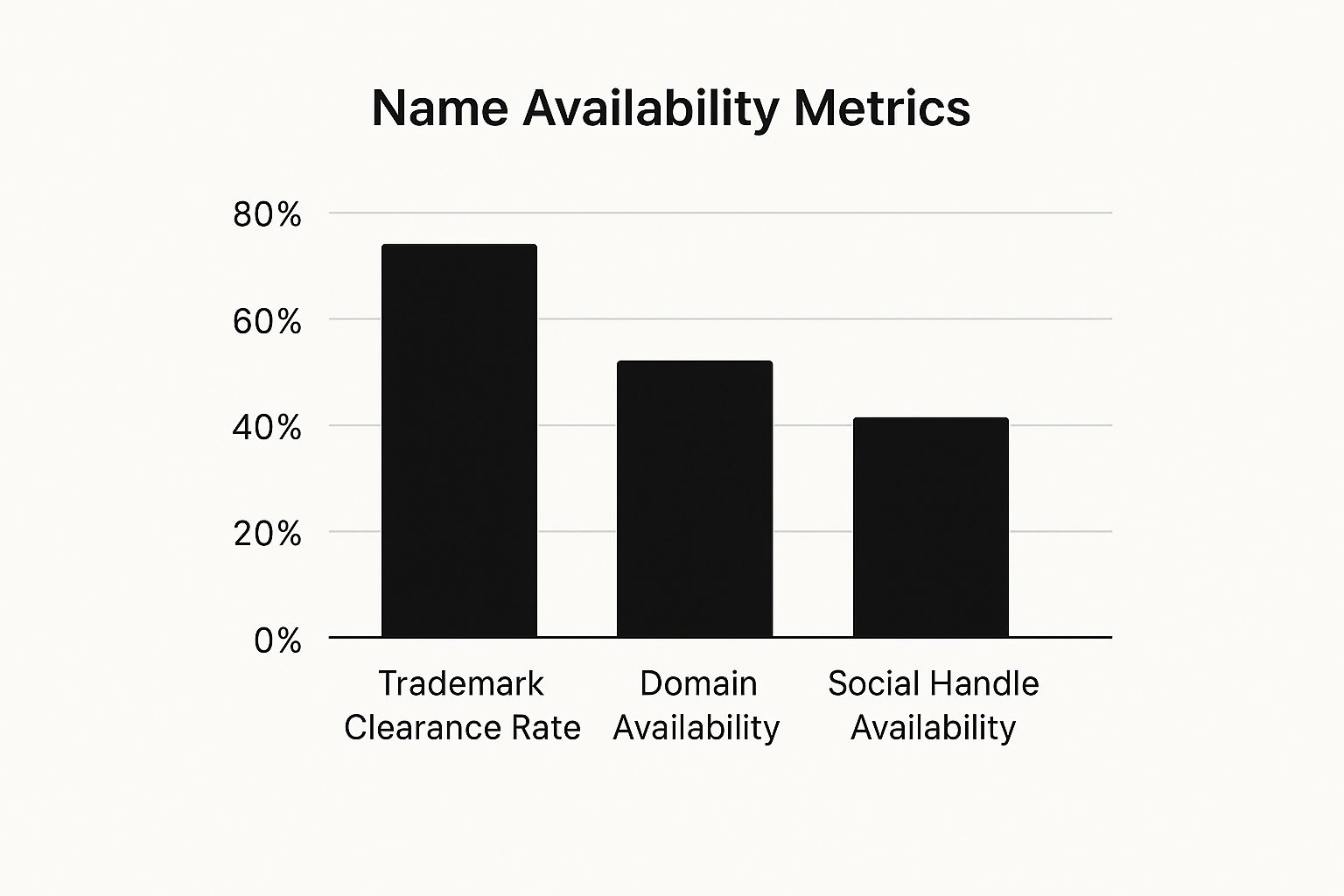
This visual underscores a critical point: even if a name is legally clear, securing an open domain and matching social handles is often the greatest hurdle.
Manually checking every platform is inefficient. Use tools like Namechk or KnowEm to run your name against hundreds of platforms in seconds. This allows you to quickly disqualify names with digital conflicts and focus on viable contenders.
How to Avoid Common Trademark Pitfalls

A great name can become a significant liability if it’s not legally yours to use. Many founders make the classic mistake of assuming an available domain name means the name is free to use. This assumption can lead to costly rebranding efforts or, worse, a cease-and-desist letter. While you don’t need a law degree, understanding the basics of trademark law is essential for protecting your brand.
Your First Line of Defense: A Preliminary Search
Before you get too attached to a name, conduct a preliminary trademark search. This initial screening can help you weed out high-risk names from the start. Your primary tool for this is the U.S. Patent and Trademark Office's (USPTO) Trademark Electronic Search System (TESS), a free public database of registered and pending trademarks.
A TESS search is your first step to see if another company in your industry is already using your desired name. However, your search shouldn't stop at an exact match. You should also check for:
- Phonetic Similarity: Does another name sound like yours, even if spelled differently (e.g., "Rite" vs. "Right")? Trademark examiners look for anything that could cause consumer confusion.
- Common Law Usage: A company can have legal rights to a name without a registered trademark. Conduct a thorough Google search to find businesses in your niche using the name, even if they don’t appear in the TESS database.
Founder Takeaway: A clear TESS search is a promising sign, but it's not a green light. The legal standard is "likelihood of confusion." If there's a reasonable chance a customer could mistake another brand for yours (or vice versa), you’ve got a potential conflict.
When to Call in a Trademark Attorney
While DIY searches are useful for initial screening, they are not a substitute for professional legal advice. Understanding when to engage a trademark attorney is a critical part of the legal compliance for startups that will protect your brand's long-term value.
Consider hiring an attorney in these key situations:
- You've Found "The One": Before investing in a logo, website, or marketing, have an attorney conduct a comprehensive search. They have access to more powerful databases and can provide a formal legal opinion on the name's viability.
- Your Search Was Ambiguous: If your preliminary search revealed something that feels too close for comfort, an attorney can analyze the nuances and assess the risk involved.
- You Have Global Ambitions: Trademark law varies by country. If you plan to operate internationally, an expert can help you navigate the complexities of securing your brand name in different markets.
Investing in legal counsel at this stage is not just an expense—it's an insurance policy. The cost of a professional search and filing is minimal compared to the financial and reputational damage of a forced rebrand.
Making the Final Call and Securing Your Brand
You have brainstormed, vetted the digital landscape, and completed legal checks. Now, with a shortlist of strong contenders, it’s time to make the final decision. This is where many founders get stuck, often falling into the "design by committee" trap that results in a safe but forgettable name.
The goal isn't to find a name everyone likes; it's to gather targeted feedback. Instead of polling your entire network, consult a small, trusted circle of potential customers, a respected mentor, and perhaps a key investor. Their perspectives can help identify hidden flaws or confirm a name's impact.
Last-Minute Sanity Checks
Before you commit, run your top two or three names through these final filters to avoid future branding headaches.
- The Pronunciation Test: Say the name aloud to someone unfamiliar with it. Can they pronounce it easily? Can they spell it back to you? If it requires explanation, it will create friction every time a customer tries to find you.
- The "Radio" Test: Imagine hearing your startup mentioned on a podcast. Is the name clear and distinct? Names that sound like common words often fail this test.
- Global Connotation Screening: Conduct a quick Google search to ensure your chosen name doesn't have an awkward or negative meaning in other languages or cultures, especially if you have global aspirations.
Founder Takeaway: Feedback is crucial for perspective, but at the end of the day, you have to trust your gut. As the founder, you have the deepest connection to the vision. Pick the name that you can stand behind and champion with genuine passion for years to come.
The Immediate Action Plan
Once you've made your decision, speed is critical. Hesitation can cost you your brand identity. Execute these steps immediately to secure your name across all essential channels.
- Register the Domain Name: This is your top priority. Purchase the primary domain (.com, .io, or .ai) you validated earlier. Consider acquiring common variations or likely misspellings to prevent cybersquatting.
- Secure All Social Media Handles: Lock down your brand name on every relevant platform—LinkedIn, X, Instagram, TikTok, etc. Brand consistency is non-negotiable for a professional presence.
- File Your Trademark Application: Immediately engage your attorney to file the trademark application. This is the first official step in legally protecting your brand name and logo.
- Register Your Business Entity: Make it official by registering your business name with the appropriate state or federal authorities as an LLC, C Corp, or another entity. This step solidifies your legal claim to the name and is a crucial foundation for future operations.
Common Questions About Naming a Startup
Even with a solid framework, specific questions will arise. Here are answers to some of the most common challenges founders face during the naming process.
Should I Use My Own Name for My Startup?
Using your personal name (e.g., Ford, Dell) can build an authentic brand, especially for consultants, creators, and service-based businesses where you are central to the company. It signals trust and personal accountability. However, a personal brand can be difficult to scale if you plan to bring on partners or pivot your product line. It can also complicate a future sale of the company.
What Are the Biggest Mistakes to Avoid When Naming a Business?
Beyond legal and domain issues, several common mistakes can undermine a startup's success.
- Getting Too Clever: A name that is hard to spell or pronounce creates a marketing obstacle. If you constantly have to explain it, word-of-mouth marketing becomes nearly impossible.
- Being Too Generic: Names like "Tech Solutions" or "Marketing Group" may sound professional, but they are unmemorable and difficult to trademark, causing you to blend in with the competition.
- Forgetting Global Context: A name that is innocuous in English could have an embarrassing or offensive meaning in another language. A quick search can prevent future international branding issues.
How Much Should I Budget for a Domain Name?
You can register an available, non-premium domain for under $20 per year. The challenge arises when you desire a short, memorable .com that is already owned. These premium domains can cost thousands, or even tens of thousands, of dollars. For a bootstrapped startup, this is rarely a wise use of capital. It's better to get creative and find a great, available name. If you have secured funding and the perfect premium domain is core to your brand strategy, you can consider it a long-term marketing investment.
Is It Better to Use a Trendy Name or a Timeless One?
Trendy naming conventions (e.g., ending in "-ify" or "-ly") can signal that you are part of a current movement but risk sounding dated quickly, potentially forcing a future rebrand.
A timeless name provides longevity and stability. It may not scream "hot new startup" today, but it will grow with your business for years without becoming stale. For most founders with long-term ambitions, timelessness beats trendiness every single time.
At Spotlight on Startups, we provide the clarity, inspiration, and authority you need to move forward with confidence. Explore our resources to master everything from funding to founder excellence. https://spotlightonstartups.com/