
It's a common misconception that entrepreneurs are driven solely by the pursuit of wealth. In reality, the motivation to build a company from the ground up is a complex blend of deep-seated personal desires—like the need for autonomy and a sense of purpose—and more tangible goals, such as achieving financial freedom or earning industry recognition. Understanding this motivational framework is essential for grasping the founder mindset and navigating the challenges of scaling a startup.
Decoding the Entrepreneurial Drive
What compels someone to trade the security of a stable career for the high-stakes, uncertain journey of launching a new venture? It comes down to a powerful combination of intrinsic passion and the promise of extrinsic rewards.
At its core, entrepreneurship is a personal quest. It's often sparked by a persistent problem that demands a solution, a desire to create something genuinely meaningful, or the fundamental urge to be your own boss. This "why" is the rocket fuel that sustains founders when the inevitable challenges of growing a business emerge.
These motivations can be categorized into two primary types. Each plays a critical role in shaping a founder's resilience, leadership style, and the strategic decisions they make along the way.
Intrinsic vs Extrinsic Drivers
An entrepreneur’s motivation is rarely a single impulse; it’s a strategic mix of internal passions and external goals. The infographic below provides a clear breakdown of how these drivers interact.
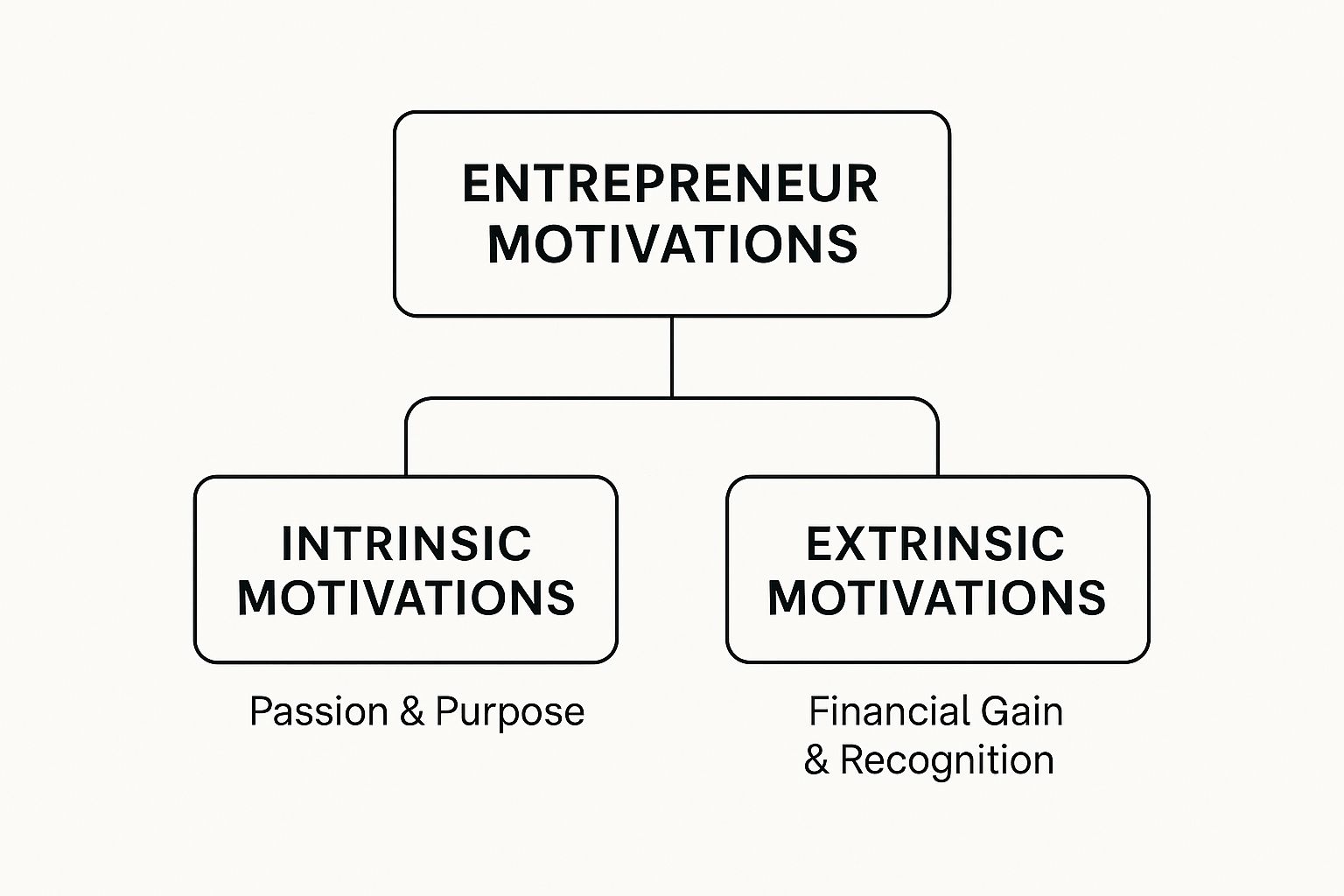
As you can see, both personal fulfillment and market success are foundational to the entrepreneurial journey. While one founder might be driven by a powerful mission, another may be laser-focused on achieving market leadership. The most successful founders draw energy from both sides.
Global data confirms this dynamic. A significant 65.8% of entrepreneurs start a business to make a positive difference in the world. At the same time, financial ambition remains a key motivator—72.2% of U.S. entrepreneurs cite building significant wealth as a primary reason for their venture. You can discover more insights from the Global Entrepreneurship Monitor report to see how these trends are shaping the startup ecosystem.
Let's break down these two types of motivation further.
Intrinsic vs Extrinsic Motivations of Entrepreneurs
This table summarizes the primary internal and external drivers that fuel entrepreneurial ventures, providing a clear framework for understanding their diverse goals.
| Motivation Type | Core Driver | Example in Action |
|---|---|---|
| Intrinsic (Internal) | Personal satisfaction, passion, and purpose. | A software engineer founds a company to build the project management tool she always needed, driven by the challenge and joy of creating the optimal solution. |
| Extrinsic (External) | Financial rewards, public recognition, and market status. | An entrepreneur launches a direct-to-consumer brand with the clear strategic goal of achieving a high-valuation exit to a major CPG company within five years. |
While both are powerful, intrinsic motivation often provides the resilience required for long-term success.
Your personal motivation is a critical strategic asset. It's the story you tell yourself during setbacks, the narrative that persuades early hires to join your mission, and the conviction that wins over investors.
Ultimately, a founder's core motivation becomes the bedrock of their company’s brand and culture. This personal "why" is more than a backstory; it is a powerful tool for building authority and trust. Knowing how startup founders can craft a compelling origin story is essential for connecting with customers, talent, and investors who resonate with your vision.
The Unyielding Pursuit of Autonomy

Ask ten founders why they started their business, and you may get ten different answers. But a common thread almost always emerges: the relentless drive to control their own destiny.
This isn't merely about escaping a difficult boss or tedious corporate meetings. For most entrepreneurs, it's a fundamental need for autonomy. They willingly trade the predictability of a 9-to-5 for the chaotic, high-stakes environment of a startup because it offers the one thing a corporate job rarely can: the freedom to build something entirely on their own terms.
From Frustration to Freedom
Often, this powerful drive is forged by professional frustration. Many founders can pinpoint a moment in a previous job when a valuable idea was lost to bureaucracy or when their ability to make a meaningful impact was diluted. They looked at the existing system and concluded, "There has to be a better way."
That feeling of being constrained becomes a potent catalyst, turning a stable career from a source of security into a gilded cage. This pursuit of freedom fundamentally shapes an entrepreneur's leadership style and operational approach:
- Decisive Leadership: With full ownership of outcomes, founders learn to execute with conviction. There is no committee to consult or management hierarchy to appease—only action.
- Ultimate Accountability: True autonomy means owning every result, both successes and failures. This radical responsibility builds resilience and a powerful problem-solving capability.
- Visionary Control: Founders can infuse their personal vision into every aspect of the company, from its mission and values to its culture and product roadmap.
This is not driven by ego but by a deeply held belief that their approach to solving a problem, building a team, or creating a product will generate superior value.
The autonomy to make key decisions, build a team you believe in, and steer your own ship is often the most valuable compensation an entrepreneur receives, long before any financial returns materialize.
This internal reward system is critical for survival. When inevitable setbacks occur, the freedom to pivot, adapt, and iterate provides the fuel to persevere. Without this deep-seated need for control, quitting would often be the most logical choice. For a true entrepreneur, however, the ability to direct their own course is non-negotiable.
The Obsession with Solving a Problem

While the pursuit of autonomy often ignites the entrepreneurial journey, it is the obsession with solving a specific problem that dictates the path. At the heart of many disruptive companies is a founder who was frustrated with an inefficient process, a broken system, or an obvious market gap.
They experienced a problem so personally that solving it became an obsession.
This is not about chasing the latest trend; it is a powerful, persistent belief that the status quo is inadequate. That personal frustration becomes the engine, driving founders to build solutions that others may have dismissed as impossible or not commercially viable.
This pattern is evident in many well-known origin stories. Dropbox was not born from a complex market analysis; its founder was simply tired of emailing files to himself. Slack was created by a team developing a different product—they just needed a better internal communication tool. These ventures were elegant solutions to deeply felt pain points.
The Innovator's Mindset in Action
This drive to fix what’s broken is more than an origin story; it is an operational philosophy. When you are obsessed with a problem, you naturally build a company that is deeply attuned to its users, because you were the first user. This fosters a culture built around several key principles:
- Relentless Iteration: The first product is never the final version. A true obsession with the problem means constantly testing, refining, and improving based on real-world user feedback.
- Deep Customer Empathy: These founders intuitively understand their customers' frustrations, allowing them to build features that solve problems users may not even be able to articulate yet.
- Authentic Value Creation: When the primary goal is to solve a real problem, the business creates genuine value. Profit becomes the natural result of successfully making a customer's life better or more efficient.
This intense focus keeps the company grounded. During difficult periods, the team can always return to a simple, guiding question: are we solving the problem for our customer?
An entrepreneur’s obsession with a problem is the ultimate anchor. It keeps the team focused, guides product development, and creates a powerful narrative that resonates with both customers and investors.
From Problem to Product
Of course, obsession alone does not build a business. That passion must be channeled into a structured process of validation and development. This begins with listening to ensure that a personal frustration is shared by a large enough market to sustain a company.
This is where creating direct lines of communication becomes critical. For instance, establishing effective customer advisory boards can provide the raw, structured insights needed to transform a personal pain point into a market-ready solution. Ultimately, this motivation gives a startup its soul, separating a fleeting idea from a venture that creates lasting change and a loyal community.
Balancing Financial Ambition with Sustainable Growth

While autonomy and problem-solving are powerful intrinsic drivers, financial ambition is an equally valid and critical component of entrepreneurship. The desire to build wealth is a significant motivator for many founders.
However, for most successful leaders, financial success serves as the ultimate validation—proof that their vision created real value in the marketplace. Wealth often represents something more significant: the freedom to chart their own course, provide security for their families, or fund their next venture without seeking external permission.
The danger arises when the pursuit of short-term profit becomes the sole objective. That tunnel vision can lead to chasing unstable trends, compromising product quality, or fostering a "growth at all costs" culture that leads to burnout. This approach often results in a business that fails to achieve long-term viability.
Aligning Profit with Purpose
Founders who build enduring companies understand a crucial principle: sustainable profit is the byproduct of a well-executed mission. They view profit and purpose not as conflicting forces but as aligned objectives where one reinforces the other.
When this alignment is achieved, it fundamentally changes how the business operates:
- You adopt a customer-first mindset. The primary question shifts from, "How do we maximize quarterly profit?" to "How do we solve our customer's problem so effectively that revenue growth is the inevitable outcome?"
- You reinvest strategically. Profits are not just extracted; they are reinvested to improve the product, enhance the customer experience, and develop your team.
- You build for long-term value. The goal is not a quick exit but the creation of a resilient company capable of weathering market cycles and achieving sustained growth.
Financial ambition provides the destination, but sustainable growth strategies create the map to get there. Without a solid plan, even the most powerful motivations can lead a founder astray.
Navigating this path requires a firm grasp of business fundamentals. A founder must connect their vision to a viable market, which is why understanding startup founder best practices is crucial for scaling your company is non-negotiable.
Financial success is a powerful validator of the entrepreneurial journey. When balanced with a deep commitment to sustainable growth, it becomes more than a reward—it becomes a tool for creating a lasting legacy.
Building a Legacy Through Social Impact
Alongside the traditional drivers of financial goals and personal freedom, a new motivation is gaining prominence: the desire to build a business that leaves a positive impact on the world.
This is not a fringe idea but a significant shift in the definition of entrepreneurial success. Modern business leadership is increasingly about weaving purpose directly into a company's DNA. The goal is to create a lasting legacy—a venture that continues to contribute to society or the environment long after its founder has exited.
The Rise of the Purpose-Driven Venture
This focus on legacy is manifesting in tangible business models that are gaining significant market traction. Founders are building companies that prioritize impact alongside financial returns from day one.
This trend is evident in several key areas:
- B Corporations (B-Corps): These are for-profit companies legally certified to meet high standards of social and environmental performance, accountability, and transparency. Leading brands like Patagonia have embedded their mission into their corporate identity.
- Sustainability-Focused Startups: From companies creating plant-based alternatives to meat to those developing renewable energy solutions, these ventures are born from a desire to solve major environmental challenges. For these founders, the business is the mission.
This movement toward responsible business is reshaping the startup landscape. As entrepreneurship expands globally, sustainability has become a key factor for success, with over 50% of founders prioritizing it alongside profitability. You can explore comprehensive entrepreneurship statistics for a deeper look at these trends.
For a purpose-driven founder, profit is not the destination; it's the fuel. It enables the company to scale its mission, expand its impact, and build a legacy that outlasts quarterly earnings reports.
Why a Strong Mission Is a Strategic Advantage
Building a legacy is not just an altruistic goal; it is a sound strategy for thriving in today's market. A business built on a clear, authentic mission possesses a significant competitive advantage.
Modern consumers, particularly younger generations, actively seek brands that align with their values. A powerful social mission can forge a loyal customer base that remains steadfast through market fluctuations.
This advantage extends to talent acquisition and retention. The most skilled professionals want to work for companies making a tangible difference. A compelling mission often proves more effective at attracting and retaining top talent than a marginal increase in compensation. When employees believe in the "why" behind their work, they are more engaged, innovative, and committed to the company's long-term success.
No discussion of entrepreneurial motivation is complete without addressing the primary deterrent: the fear of failure. This paralyzing concern can stifle a brilliant idea before it has a chance to be tested.
This is not just an anecdotal observation; it is a global phenomenon. A report from the Global Entrepreneurship Monitor revealed that nearly half of all adults surveyed—a staggering 49%—cited fear of business failure as the main reason they would not start a company. This figure is rising, indicating that even when opportunities are present, the anxiety about potential negative outcomes is more powerful than ever. You can find detailed data by reading the full report on entrepreneurial attitudes.
For founders already leading a venture, this fear manifests in various ways: hesitation on calculated risks, second-guessing key decisions, or delaying a product launch in pursuit of perfection. Successful entrepreneurs do not eliminate this fear; they learn to manage it strategically.
Building Resilience, Not Fearlessness
Overcoming the fear of failure is not about becoming fearless; it is about becoming resilient. Founders who build lasting companies learn to manage this fear by adopting mindsets and strategies that turn potential setbacks into strategic advantages.
A crucial component of this is adopting a growth mindset—the core belief that abilities can be developed through dedication and hard work. Founders with this perspective do not view failure as a definitive judgment on their capabilities but as part of the learning process.
Failure is not the opposite of success; it is a stepping stone. Every mistake, failed prototype, and rejected pitch contains invaluable data for the next attempt.
Instead of allowing fear to dictate strategy, resilient founders utilize rapid, controlled experiments. They employ frameworks like the Minimum Viable Product (MVP) to test ideas on a small scale. This approach mitigates the impact of "failure" by lowering the stakes and reframing it as essential market feedback.
By adopting this methodology, entrepreneurs transform the narrative. Fear ceases to be a stop sign and instead becomes a signal to gather more intelligence and learn. It becomes another tool for building a more durable, adaptable, and ultimately successful business.
Got Questions? Let's Talk Entrepreneurial Motivation
To conclude, let's address some of the most common questions about the motivations of entrepreneurs. This section connects these core concepts to your own entrepreneurial journey.
What Is the Single Most Common Motivation for Entrepreneurs?
While every founder's journey is unique, a clear pattern has emerged. The drive to make a positive difference is now the primary motivation for over 65% of founders globally. This does not replace the timeless goals of achieving autonomy and financial freedom, which remain foundational.
Today's entrepreneurs are driven by a hybrid motivation. They aim to build businesses that not only achieve financial targets but also contribute something meaningful to society. This integration of profit and purpose is becoming the hallmark of companies built for long-term success.
How Do Founder Motivations Change Over Time?
A founder's motivations are not static; they evolve with the business.
- Early Stage: In the beginning, motivation is driven by raw passion, an obsession with solving a specific problem, and an intense desire for autonomy. Survival and proof of concept are the primary objectives.
- Growth Stage: Once the company achieves product-market fit, the focus often shifts. Founders become motivated by building a lasting company culture, mentoring a growing team, and establishing a strong market position.
- Mature Stage: For founders of established companies, the drive often turns toward legacy. This may involve creating broader social impact, driving innovation beyond the core business, or mentoring the next generation of entrepreneurs.
Can You Succeed Without Being Motivated by Money?
Absolutely. In fact, many of the world's most disruptive companies were founded on a mission to innovate or create social change, not solely to generate wealth.
A powerful non-financial driver—such as an obsession with solving a customer's problem—can provide the deep resilience needed to overcome the significant challenges of a startup. When a founder is intensely focused on the mission, financial success often becomes a natural byproduct of exceptional execution rather than the primary goal itself.
At Spotlight on Startups, we provide the clarity, inspiration, and trusted insights entrepreneurs need to move forward with confidence. Explore our platform to understand the DNA of entrepreneurial success. You can learn more about our mission.