
In 2026, startups don’t just “rank” in Google anymore, they get summarized, cited, and recommended by AI systems. The win condition is shifting from blue-link positions to being the source an answer engine chooses when it generates a response.
That’s what Answer Engine Optimization (AEO) is about: engineering your content, entities, and credibility so AI-driven search experiences can confidently pull your information, cite it, and surface your brand inside the answer itself.
If you’re a startup, this shift is an advantage: incumbents have more backlinks, but you can move faster, publish clearer content, and become the best answer for specific high-intent questions.
What follows is a practical, startup-ready guide to winning AEO in 2026.
What Is Answer Engine Optimization?
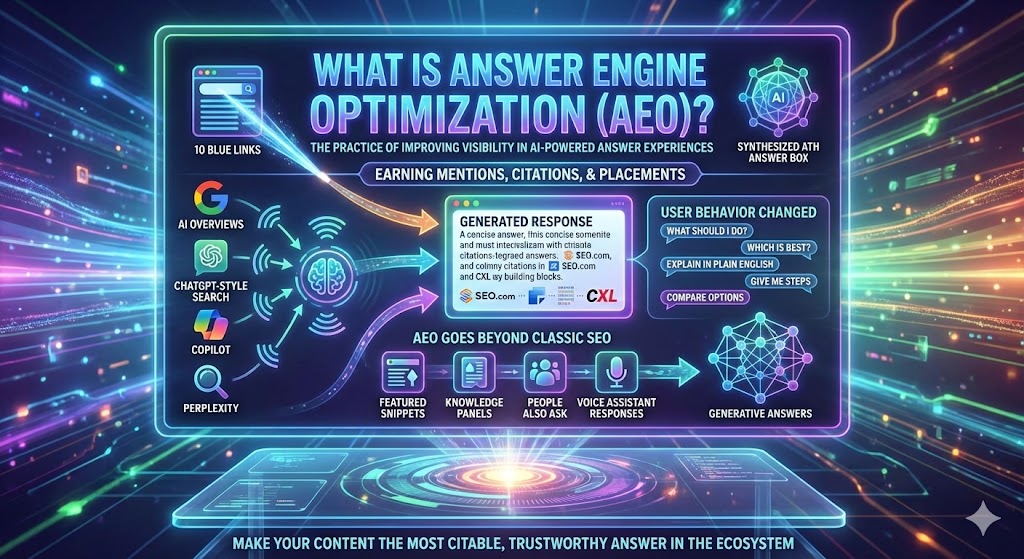
Answer Engine Optimization (AEO) is the practice of improving your brand’s visibility inside AI-powered answer experiences, like Google’s AI Overviews, ChatGPT-style search, Microsoft Copilot, and Perplexity, by earning mentions, citations, and placements in their generated responses.
Unlike traditional SEO, AEO is not only about getting someone to click your result. It’s about making your page (and your brand) extractable and credible enough that an answer engine uses it as a building block for its answer.
The “AEO moment” is happening because user behavior changed
Users now ask:
- “What should I do?”
- “Which is best?”
- “Explain this in plain English”
- “Give me steps”
- “Compare options”
AI search responds by synthesizing a single answer, then citing sources. That means the primary competition isn’t “10 blue links,” it’s which sources get chosen to build the answer.
AEO includes, but goes beyond, old “answer features”
Classic SEO answer surfaces included:
- featured snippets
- knowledge panels
- “People also ask”
- voice assistant responses
AEO still benefits from those, but now extends into generative answers where engines merge multiple sources into a response.
AEO in one line:
Make your content the most citable, trustworthy answer in the ecosystem.
How Is AEO Different From SEO in 2026?
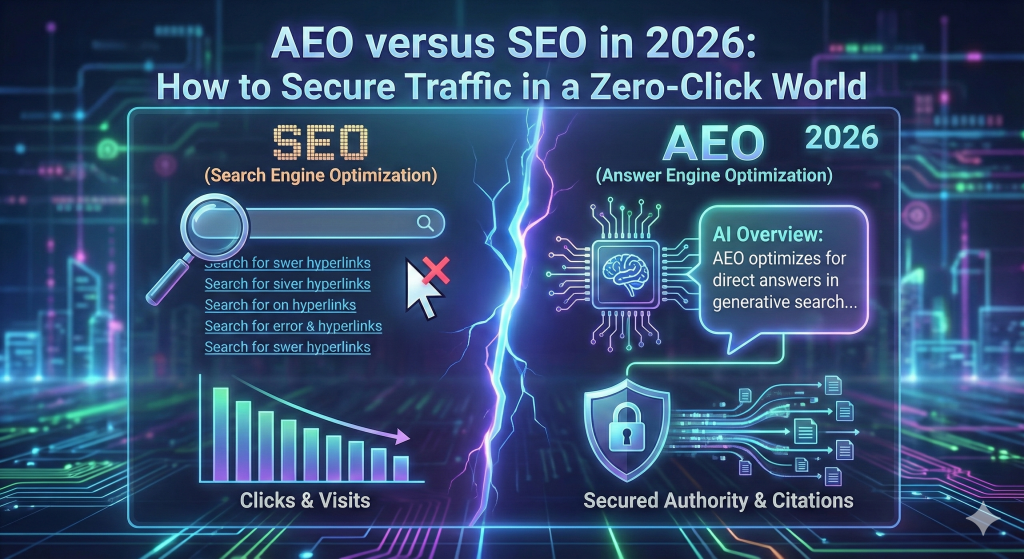
AEO and SEO overlap, but their goals and optimization levers differ.
SEO goal: rank pages
SEO is primarily about winning positions for queries in classic search results.
AEO goal: win citations and inclusion inside the answer
AEO is about being selected, summarized, and linked by AI-driven systems.
A useful way to think about it:
- SEO asks: “How do I rank higher than the pages above me?”
- AEO asks: “How do I become the source an AI chooses to cite?”
AEO is more sensitive to clarity than keyword density
Many AEO guides emphasize that structure beats fluff, because answer engines prefer content that is easy to extract, validate, and attribute.
That means the new winners tend to:
- answer the question quickly
- support the answer with specifics (examples, steps, data)
- show who wrote it and why they’re qualified
- reinforce entities consistently (brand, product, people, definitions)
AEO also raises the bar for trust
AI answer systems can surface misinformation, which has increased scrutiny around source quality and safety, especially for “Your Money or Your Life” topics (health, finance). That reality increases the value of credible sources and transparent attribution.
For startups, this is a strategic cue: if you want to be cited, act like a source worth trusting.
Why AI Search Changes How Startups Get Discovered
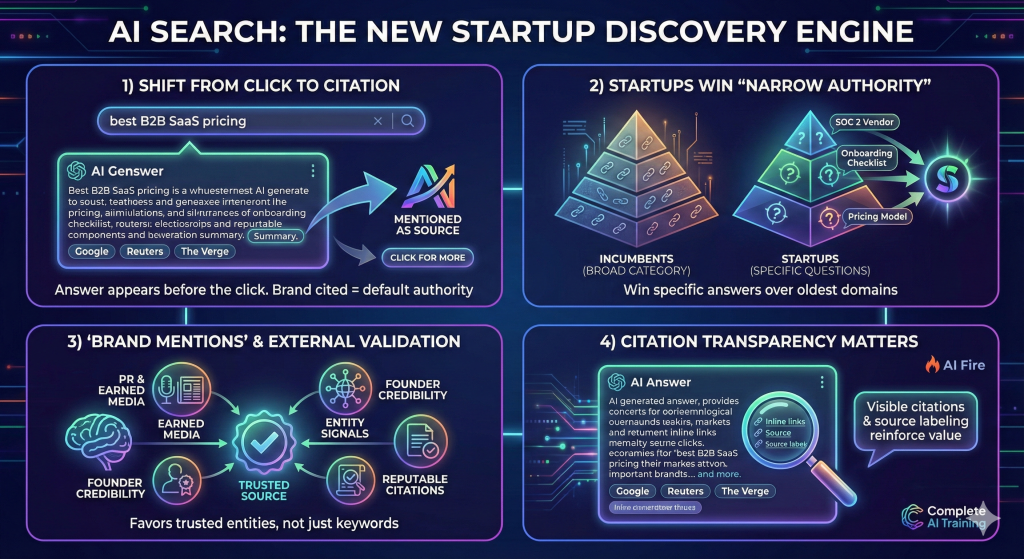
AI search changes discovery in three big ways: where the click happens, how the “best” result is decided, and what success looks like.
1) The answer appears before the click
Google’s AI Overviews and similar experiences appear above traditional listings and try to satisfy the query immediately. That can reduce downstream clicks for many informational queries, which has triggered publisher concerns and regulatory scrutiny. Reuters+1
That sounds scary until you see the opportunity: the brand that’s cited in the answer becomes the default authority for the user, even if they never click.
In other words, visibility is shifting from:
- “Did they click my link?”
to - “Did the AI mention me as a source?”
2) Startups can win “narrow authority” faster than incumbents
Incumbents win broad categories (more backlinks, longer history). Startups can win specific questions:
- “How to choose a SOC 2 vendor for early-stage startups”
- “Best onboarding checklist for a seed-stage SaaS”
- “Pricing model examples for B2B SaaS in 2026”
AEO rewards the best answer to the question, not the oldest domain.
3) “Brand mentions” and external validation matter more
Across AI search discussions, a repeated theme is that engines increasingly favor trusted sources and recognizable entities, not just pages optimized for keywords. Complete AI Training+2AI Fire+2
For startups, that means AEO is not only content. It’s also:
- PR and earned media
- founder credibility
- consistent entity signals across the web
- citations and references in reputable places
4) Citation transparency is becoming more important
Google has signaled movement toward adding more inline links and better source labeling in AI experiences, reinforcing that citations are a core layer of the product. The Verge
This matters because if citations become more visible and interactive, being cited becomes even more valuable.
How Do AI Answer Engines Choose What to Cite?
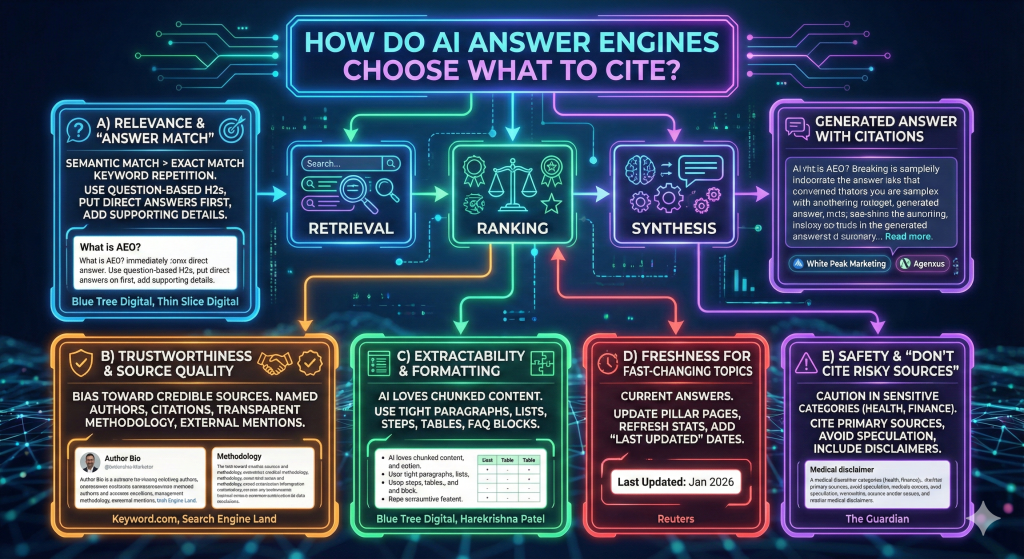
The short version: answer engines tend to use a retrieval + ranking + synthesis approach. They pull candidate sources, score them for relevance and trust, then generate an answer that includes citations where possible.
The practical version: if you want to be cited, make it easy for the system to:
- find you
- understand you
- trust you
- extract the answer cleanly
- attribute it safely
A) Relevance and “answer match”
Your page needs to match the query intent precisely. In 2026, “semantic match” matters more than “exact match keyword repetition.”
What to do:
- Use question-based H2s mirroring real user queries
- Put the direct answer immediately after the heading
- Add supporting details, steps, examples, and definitions
This aligns with multiple AEO optimization guides emphasizing answer-first structure.
B) Trustworthiness and source quality
Multiple analyses of AI citation behavior, especially for systems like Perplexity, point to a strong bias toward credible sources and trust signals over pure popularity. Keyword.com+2Search Engine Land+2
For startups, credibility is built through:
- named authors and bios
- citations to reputable references
- transparent methodology
- up-to-date content
- external mentions (press, podcasts, reputable guest posts)
C) Extractability and formatting
AI systems love content that’s easy to chunk:
- tight paragraphs
- lists
- steps
- definitions
- tables
- FAQ blocks
AEO guides repeatedly highlight that structure improves the likelihood of being pulled into AI answers and Overviews.
D) Freshness for fast-changing topics
For anything that evolves quickly, freshness can influence selection. AI tools often aim to produce current answers, and publishers are actively debating how AI summaries affect traffic and attribution, which is tied to the “currentness” of results and sources.
For your startup content:
- update pillar pages quarterly
- refresh stats and examples
- add “last updated” dates
- expand FAQs based on new queries
E) Safety and “don’t cite risky sources”
AI summaries have been criticized for hallucinations and misleading information, especially in sensitive categories. That makes engines more cautious about what they cite, and it makes your clarity and sourcing even more important.
If your content touches health, finance, or legal:
- cite primary sources
- avoid speculative claims
- keep advice general and include disclaimers
- emphasize who the author is and their expertise
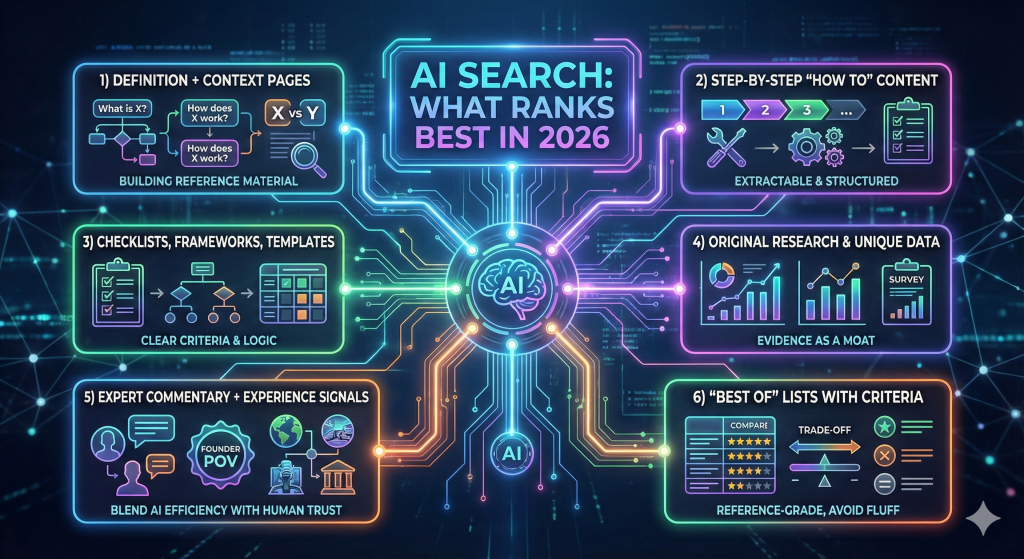
What Types of Content Rank Best in AI Search?
In 2026, answer engines reward content that behaves like reference material, not marketing copy.
1) “Definition + context” pages
These win because they answer questions like:
- “What is X?”
- “How does X work?”
- “X vs Y”
You’re reading one now. AEO guides consistently recommend building high-quality definition and comparison content.
2) Step-by-step “How to” content
How-to content is naturally extractable and often aligns with HowTo schema.
Examples:
- “How to structure content for AI citations”
- “How to implement FAQ schema”
- “How to update a page for AEO”
3) Checklists, frameworks, and templates
AI engines love:
- numbered steps
- clear criteria
- decision frameworks
- “if/then” logic
This is why “checklist” pages often perform well in snippet-like placements and AI citations.
4) Original research and unique data
If everyone can generate generic AI content, then original evidence becomes a moat.
Original research can be:
- survey results
- benchmark data
- experiments
- proprietary analysis
- annotated examples
Many 2026 SEO/AEO trend discussions emphasize original research and authority as a differentiator.
5) Expert commentary + “Experience signals”
A recurring recommendation across AI search strategy commentary is to blend AI efficiency with real human experience and real stories, because trust is the scarce resource. Complete AI Training+1
For startups, “experience signals” can be:
- founder POV on what worked
- specific implementation notes
- screenshots (when appropriate)
- “we tried X, here’s what happened”
- constraints you faced and how you solved them
6) “Best of” lists with clear criteria
AI answers frequently include comparisons. A list can be cited if it:
- defines criteria
- explains trade-offs
- stays neutral
- includes clear recommendations by scenario
Avoid affiliate fluff. Aim for “reference-grade.”
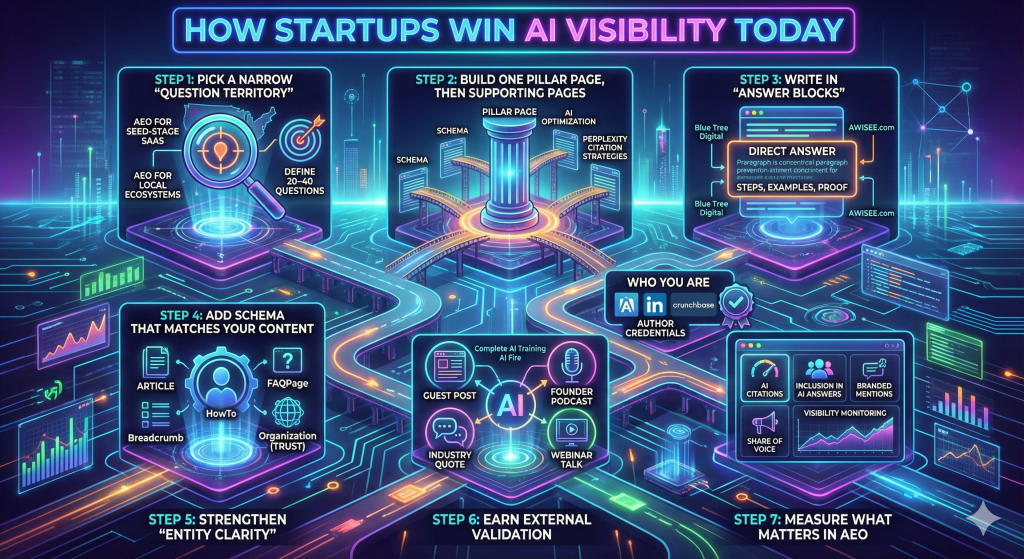
How Startups Can Start Winning AI Visibility Today
Here’s a practical plan startups can implement without a massive SEO budget.
Step 1: Pick a narrow “question territory”
Don’t try to own “AEO” broadly right away. Own a slice:
- AEO for startups in your niche
- AEO for seed-stage SaaS
- AEO for local startup ecosystems
- AEO for a specific product category
Define 20–40 target questions you want to be “the source” for.
Step 2: Build one pillar page, then supporting pages
The pillar should:
- define the concept
- answer the top 10–15 questions
- link out to deeper posts
Then supporting pages go deeper:
- schema implementation
- AI Overviews optimization
- Perplexity citation strategies
- measurement and monitoring
This cluster approach helps engines understand topical authority.
Step 3: Write in “answer blocks”
For every key section:
- include a one-paragraph direct answer
- follow with steps, examples, and proof
AEO resources repeatedly recommend answer-first formatting and question-based headings to improve citation likelihood.
Step 4: Add schema that matches your content
You don’t need every schema type. Start with:
- Article (baseline)
- FAQPage (for Q&A sections)
- HowTo (for steps/checklists)
- Breadcrumb (site structure)
- Organization (trust)
Many AEO guides stress schema and structured data as a backbone for answer visibility.
Step 5: Strengthen “entity clarity”
AI systems rely heavily on entity understanding:
- who your company is
- what you do
- who you serve
- how you’re different
Quick wins:
- consistent company description everywhere (site, LinkedIn, Crunchbase, bios)
- an “About” page with clear positioning
- author pages with credentials
- internal links that reinforce key concepts
Step 6: Earn external validation
AI search visibility is increasingly influenced by what the web says about you, not just what you publish.
Practical startup-friendly moves:
- guest posts on reputable niche blogs
- founder podcast appearances
- quotes in industry articles
- partnerships and co-marketing
- community talks or webinars
This aligns with broader 2026 SEO/AEO commentary emphasizing authority and off-site signals.
Step 7: Measure what matters in AEO
Classic SEO metrics:
- rankings
- impressions
- clicks
AEO metrics:
- citations in AI Overviews
- inclusion in AI answers
- branded mentions inside summaries
- referral traffic changes from AI surfaces
- “share of voice” in answer engines
Tracking is still emerging, but visibility monitoring is becoming a common recommendation in AI search strategy guidance.
Is SEO Still Relevant in 2026?
Yes, SEO is still relevant in 2026, but it’s no longer the whole game.
Think of SEO as the infrastructure layer:
- it helps engines crawl, index, and understand your content
- it builds authority through links and topical coverage
- it captures classic search traffic
AEO is the distribution layer inside AI experiences:
- it helps engines select and cite you in generated answers
- it increases brand exposure even when clicks decline
- it positions you as the default authority for a topic
Many modern AEO guides frame AEO as an evolution, not a replacement: you still need strong SEO foundations, but you optimize toward answer inclusion.
The practical stance for startups
- Keep doing SEO basics: technical health, indexing, internal linking, content quality
- Layer AEO on top: question-led structure, answer blocks, schema, entity clarity, credibility
If SEO is “ranking,” AEO is “being cited.”
Q&A Block for AEO Impact
Q: What is Answer Engine Optimization (AEO) in 2026?
AEO in 2026 is the practice of making your content easy for AI search systems to understand, trust, and cite inside generated answers, not just rank as a link.
Q: How is AEO different from SEO?
SEO focuses on ranking pages in search results, AEO focuses on earning citations and inclusion inside AI-generated answers across platforms like Google AI Overviews and Perplexity.
Q: How do AI answer engines choose what to cite?
They typically retrieve candidate sources, rank them by relevance and trust, then synthesize an answer while citing sources that are clear, credible, and easy to extract.
Q: What content performs best for AEO?
Content that answers questions directly, uses clear structure, supports claims with evidence, and demonstrates expertise tends to be easier for AI systems to cite.
Q: Is SEO still worth doing in 2026?
Yes, SEO remains foundational for crawlability, indexing, and authority, but AEO is increasingly necessary to win visibility in AI-generated answers.