
You have a powerful idea and the drive to build something new. But how do you transform that initial spark into a real, fundable company? Welcome to the seed stage—the critical proving ground for every great startup.
This is where the vision meets reality. A seed stage startup has moved beyond a concept and is now singularly focused on validation. It’s the make-or-break period where founders must build a working model of their product, prove a market is hungry for their solution, and demonstrate the potential for scalable growth. This is the first, most crucial step in building a business that lasts.
What Exactly Is a Seed Stage Startup?

To successfully navigate the seed stage, you must understand its purpose. Think of a founder as a scientist with a hypothesis about a market problem. The seed stage is their laboratory—the experiment designed to test that hypothesis with real-world data before seeking significant investment.
Imagine an architect designing a skyscraper. They don't begin by pouring concrete for 100 floors. They first build a detailed, functional model—a living blueprint—to prove the design is sound and viable. For a startup, this model is the Minimum Viable Product (MVP). The goal isn't perfection; it’s about proving the core solution works and that a specific group of customers will use it and, ideally, pay for it.
Distinguishing the Seed Stage
Understanding how the seed stage differs from what comes before and after is critical for setting the right goals. The startup journey is a marathon, and each phase has a distinct finish line.
Pre-Seed Stage (The Idea): This phase is all about ideation, initial market research, and assembling a founding team. Funding, if any, typically comes from the founders' own capital or from friends and family to develop a basic prototype. The primary output is a well-researched, compelling concept, not a market-tested product.
Seed Stage (The Validation): The objective here is to achieve product-market fit (PMF)—a term coined by Marc Andreessen to describe having solid evidence that your product satisfies strong market demand. The team is still small, and the company has likely secured its first formal funding from angel investors or early-stage VC funds to validate its business model.
Series A Stage (The Scaling): A startup advances to this stage only after validating its model. The focus shifts from proving the concept to scaling it aggressively. With a proven business model and clear customer demand, the company raises a significant funding round to expand its team, marketing efforts, and operations.
Core Characteristics of a Seed Stage Startup
What does a seed-stage company look like in practice? While each startup is unique, they share common traits that signal readiness to investors and the market.
A typical seed stage startup has:
- A functional MVP being tested by a core group of early adopters.
- A small, dedicated team—often just the founders and a few key hires.
- Early evidence of market demand, such as initial user sign-ups, positive engagement metrics, or the first paying customers.
- A relentless focus on gathering customer feedback to iterate on the product.
- Its first external funding, providing a runway of 12-18 months to achieve key growth milestones.
The central question a seed stage startup must answer is not "Can we build this?" but "Should we build this?" Success at this stage is measured by the strength of the evidence proving a real market need exists, not by product polish.
This period is defined by intense learning and rapid adaptation, all centered on the customer. By understanding that the core mission is validation, founders can navigate this critical phase with the clarity needed to build a strong foundation for future growth.
How to Secure Your First Round of Funding
Funding is the fuel that turns a brilliant blueprint into a real-world product. For most seed stage startups, securing this first round is a defining moment. A great idea is the starting point, but without the capital to build, test, and acquire customers, even the most promising ventures can stall.
This process is more than just financial modeling; it’s about telling a compelling story, presenting a rock-solid strategy, and finding investment partners who believe in your team’s ability to execute. Let’s break down how to find the right investors, craft a powerful pitch, and secure the capital needed to bring your vision to life.
Understanding Your Funding Options
At the seed stage, capital typically comes from a few key sources. Each has different expectations, risk tolerances, and brings unique value beyond a check. Understanding these distinctions is the first step toward crafting a pitch that resonates.
Angel Investors: These are typically high-net-worth individuals, often successful entrepreneurs, who invest their personal funds. They often bet on the founder as much as the idea, with investments ranging from $10,000 to $250,000. The best angels also provide invaluable mentorship and industry connections.
Venture Capital (VC) Firms: While known for later-stage investments, many VCs now operate dedicated seed funds. As professional investors managing others' money, they seek startups with the potential for exponential growth. Expect rigorous due diligence on your market size, scalability, and team.
Accelerator Programs: Renowned programs like Y Combinator and Techstars offer a set amount of funding (often $50,000 to $500,000) and intensive mentorship over several months in exchange for equity. The primary value lies in their network, structured coaching, and the credibility their endorsement provides.
According to data from Investopedia, running out of capital is a leading cause of startup failure. This underscores the importance of early funding. While the median seed round sits between $500,000 and $1.5 million, angels and accelerators often provide the initial capital needed to reach that point.
Crafting a Pitch That Resonates
A compelling pitch deck is not about slick design—it's about a clear, powerful narrative. Investors have seen countless "hockey stick" growth projections. They are looking for a story grounded in reality that demonstrates a deep understanding of a problem and a credible plan to solve it.
Your pitch must effectively answer a few core questions:
- The Problem: What specific, painful problem are you solving? Show that you have unique insight into your customer's world.
- The Solution: How does your product uniquely solve this problem? Articulate your innovation and competitive differentiation.
- The Market Opportunity: How big is the addressable market for your solution? Investors need to see a market large enough to generate venture-scale returns.
- The Team: Why are you the only team that can win in this market? Highlight your unique skills, experience, and relentless drive.
At the seed stage, an investor’s primary bet is on the founders. A brilliant idea with a mediocre team is far riskier than a good idea with an exceptional team that can pivot, learn, and execute under pressure.
What Investors Really Look For
Your pitch deck outlines the "what," but investors are digging deeper for the "who" and "why." They are assessing your founder-market fit—the authentic connection between your team and the problem you're solving. They look for signs of resilience, the ability to attract top talent, and coachability.
They are also searching for early traction. This doesn't necessarily mean revenue. It could be a passionate user base, a rapidly growing waitlist, or letters of intent from potential customers. This early proof demonstrates that you are solving a real, urgent need.
Ultimately, securing funding is about more than a business plan. Our guide on what venture capitalists look for beyond the pitch deck explores these intangibles. It’s about building a relationship founded on trust and a shared vision for the future.
Hitting Your Seed Stage Milestones
Securing your first investment is a monumental achievement. But it’s not the finish line—it’s the starting gun. That capital is the fuel, and now it’s time to execute and prove you can transform a promising idea into a viable business.
The seed stage is all about achieving critical milestones that demonstrate undeniable momentum. Success is measured by tangible progress across three core pillars: your product, your market, and your operations. Excelling in these areas will position you for your next funding round, while neglecting them can lead to failure.
Think of these as interconnected gears: product development is informed by market feedback, and market growth is supported by solid operations. All three must advance in unison.
Honing Your Product with User Feedback
Your Minimum Viable Product (MVP) is not a final product; it's a conversation starter. The single most important product milestone is establishing a tight feedback loop with your first real users. You must get out of the building and into your customers' world—actively seeking their opinions, observing their behavior, and iterating on your product with relentless speed.
The mission is to systematically de-risk your venture by confirming you are solving a painful, urgent problem.
- Implement Analytics: Use tools to track user engagement, identify friction points, and understand which features deliver the most value. Data tells a story that opinions cannot.
- Talk to Your Users: Conduct interviews and usability tests. Ask open-ended questions to uncover their core motivations and frustrations.
- Prioritize Ruthlessly: You cannot build every requested feature. Your engineering resources are finite. Focus only on updates that deliver the highest impact for your target customer.
This process is not about blindly following feature requests. It's about a disciplined search for an elegant solution that a specific group of people can't imagine living without.
Gaining Real Market Traction
Early traction is not about vanity metrics. It's about proving genuine demand for what you've built. Investors are skeptical of hockey-stick charts that can be easily manipulated; they seek authentic signals of product-market fit.
Your goal should be to find your first 100 true fans—customers who don't just use your product but advocate for it. They would be genuinely disappointed if it ceased to exist.
A flashy growth chart might grab attention, but savvy investors scrutinize retention and engagement metrics. These are the indicators of a sticky product, not just a leaky bucket.
To find these advocates, you must do things that don't scale. Attend industry events, participate in online communities where your ideal customers gather, and personally onboard your first users. Their success stories become powerful case studies that attract the next wave of customers and prove you have a repeatable growth model.
Solidifying Your Operational Foundation
While product and market get the spotlight, a weak operational foundation can silently undermine your startup. Establishing sound business practices is a non-negotiable milestone.
This includes proper legal incorporation, clean capitalization table management, and basic financial controls. Many founders view this as administrative overhead, but it is the bedrock of a professional, investable company. A clean cap table and the right legal structure signal to future investors that you are a serious founder building a sustainable business. Ignoring these fundamentals creates expensive, time-consuming problems later.
To help you stay on track, we've developed a checklist of core objectives to achieve before seeking a Series A.
Seed Stage Startup Milestone Checklist
This table outlines the essential milestones across product, market, and operations. Use it as your roadmap for converting seed capital into a compelling case for your next funding round.
| Category | Key Milestone | Success Metric Example |
|---|---|---|
| Product | Achieve strong user retention with a core group of users. | 40% of new users are still active 30 days after signing up. |
| Product | Establish a repeatable user feedback and iteration cycle. | Shipping 2-3 significant product updates per month based on user data. |
| Market | Acquire the first 100 highly engaged, paying customers. | 10% of early users refer at least one new customer. |
| Market | Validate at least one scalable customer acquisition channel. | Cost to acquire a customer (CAC) is less than 1/3 of their lifetime value (LTV). |
| Team | Hire 1-2 critical team members in engineering or sales. | New hires are ramped up and contributing to key metrics within 90 days. |
| Finance | Develop a financial model with a clear 12-18 month runway. | Monthly burn rate is tracked and stays within 10% of the budget. |
| Legal | Finalize all founder agreements and IP assignments. | All intellectual property created by founders is legally owned by the company. |
Successfully achieving these milestones demonstrates that you're not just building a product; you're building a business. It shows investors you can execute, learn, and create a foundation strong enough to support exponential growth.
Building an Unstoppable Founding Team
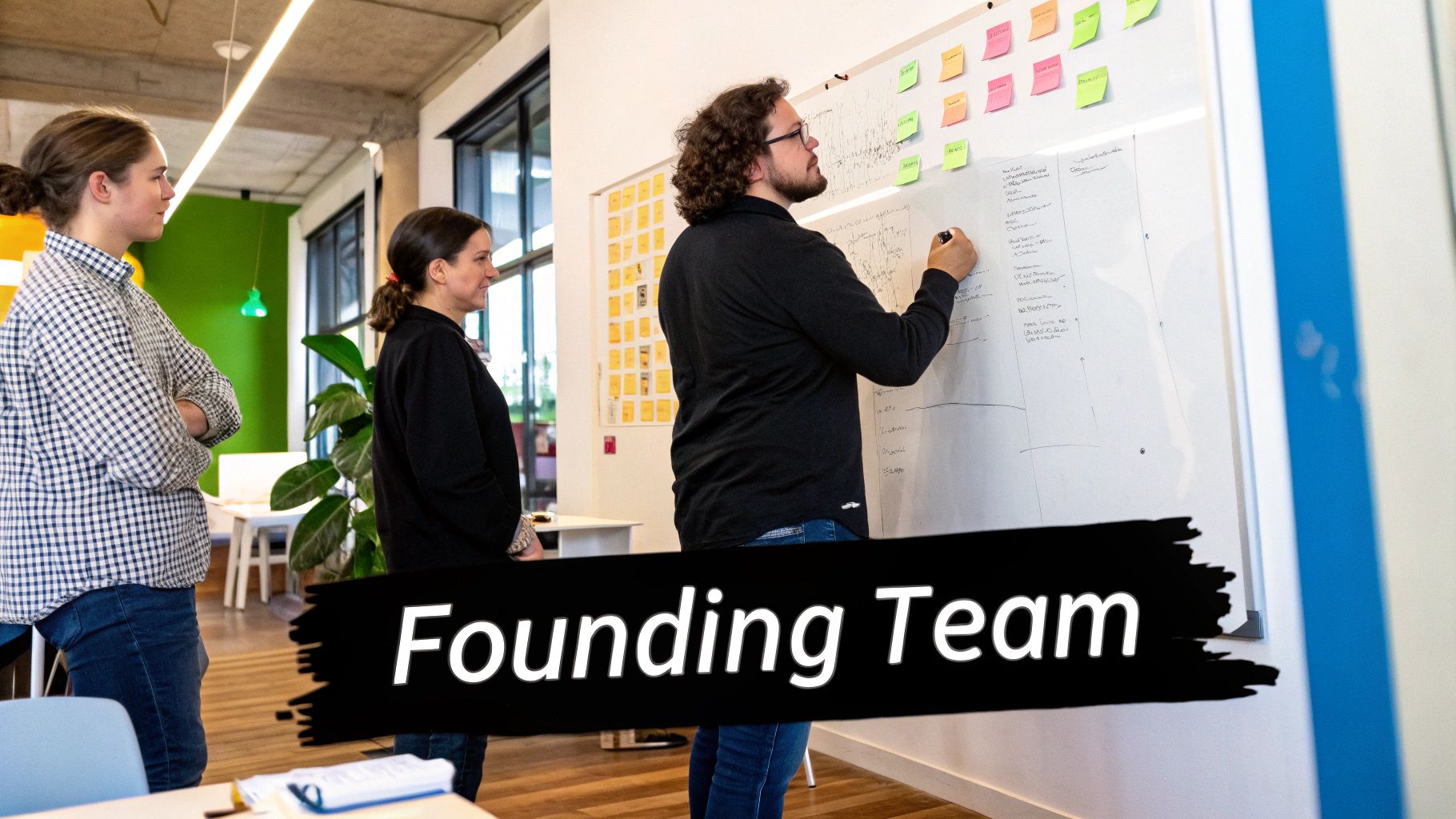
Seasoned investors often say they bet on the jockey, not the horse. For a seed stage company, this adage is paramount. Your product will pivot. Your market will shift. The one constant that must navigate every challenge is the founding team.
A brilliant idea with a dysfunctional team is a non-starter for most VCs. In contrast, a resilient, cohesive team can transform a good idea into a market-defining company.
Building this core group is less about credentials and more about chemistry, shared resilience, and complementary skills. Investors are not just reviewing your professional history; they are assessing your ability to execute, adapt, and lead under immense pressure.
The Three Essential Founder Archetypes
A successful founding team can be compared to a three-legged stool. Whether these roles are filled by one person or three co-founders, the absence of any one leg will cause the entire structure to collapse.
- The Visionary: This is the storyteller-in-chief. They articulate the company's long-term vision, inspiring the team, investors, and customers to believe in the future you are building.
- The Builder: This is the product-obsessed executor. The Builder translates the grand vision into a tangible product that customers love. They own the technical and product development execution.
- The Seller: This is the market-facing champion. The Seller is focused on customer acquisition, partnerships, and revenue generation. They build the relationships that transform a great product into a profitable business.
If any of these pillars are missing, you have a critical vulnerability. A Visionary and a Builder may create an amazing product that no one discovers. A Seller and a Visionary might sell a promise they cannot deliver.
Defining Roles and Equity Splits
Ambiguity is the silent killer of founding teams. Before writing a single line of code or accepting any investment, you must have transparent conversations about roles, responsibilities, and equity.
Friction over roles and equity is one of the top reasons founding teams fail. Addressing these issues early is not pessimistic—it’s professional. It builds a foundation of trust essential for the road ahead.
The objective is to eliminate overlap and establish clear ownership. Who has the final say on the product roadmap? Who is leading the next fundraising effort? Document these decisions. This prevents destructive power struggles when the pressure mounts. Equity discussions should be equally structured, based on tangible contributions, commitment, and experience—not a default 50/50 split.
Making Your First Critical Hires
Your first few employees do more than fill roles; they establish the company's cultural DNA. At this stage, you are not hiring for a narrow job description. You are recruiting adaptable problem-solvers who thrive in uncertainty.
Look for individuals who are energized by your mission, not just the potential compensation. Your first hires must be comfortable wearing multiple hats—the engineer who contributes to customer support or the marketer who analyzes product data.
These early team members are your front-line intelligence, often closest to your first customers. They gather the raw, unfiltered feedback that is vital for iteration. This is the perfect group to help formalize your feedback loops, perhaps by learning how to build powerful customer advisory boards to keep your strategy aligned with customer needs.
Ultimately, an unstoppable team is built on a shared vision, complementary skills, and deep mutual respect. It is this resilient unit that investors trust to turn inevitable setbacks into opportunities for growth.
Finding Your Place in the Global Startup Ecosystem
No startup exists in a vacuum. The old real estate mantra "location, location, location" applies to founders as well. Where you choose to build your company can significantly impact your access to capital, talent, and mentorship. It's about strategically positioning your startup in an increasingly interconnected world.
This doesn't mean you must relocate to Silicon Valley. The rise of remote work has rewritten the rules, enabling founders to build world-class companies from anywhere. However, ignoring the unique advantages and disadvantages of different startup ecosystems would be a mistake. Understanding the global landscape—from established hubs to emerging markets—is key to making smart decisions and leveraging the right resources.
The Power of Proximity and People
There's a reason hubs like Silicon Valley, New York, and London became epicenters of innovation. They are dense networks of talent, capital, and ambition. Physical proximity creates opportunities for the serendipitous encounters that can change a company's trajectory—meeting a future co-founder at a local event or a key investor at a coffee shop.
These ecosystems benefit from powerful network effects:
- Deep Talent Pools: They attract experienced engineers, marketers, and product managers who have scaled companies before.
- Concentrated Capital: A high density of VC firms and angel investors increases the opportunities to secure funding.
- Specialized Expertise: They offer access to lawyers, accountants, and other professionals with deep experience in the startup world.
This concentration fuels a virtuous cycle: major successes attract more talent and capital, which in turn fosters the next generation of ambitious startups.
Mapping the Global Landscape
While established hubs remain dominant, the global startup map is being redrawn. The Global Startup Ecosystem Report 2025 reveals that while Silicon Valley, New York City, and London still lead, they face growing competition from emerging ecosystems. For instance, Bengaluru-Karnataka's rapid ascent into the Top 20 highlights the rise of new innovation centers.
There are over 5 million startups across more than 350 ecosystems globally, but only a fraction secure seed funding. You can explore more data on the global startup ecosystem on Startup Genome.
This evolving landscape offers founders more choices than ever. Building in an emerging hub can mean lower operational costs, less competition for talent, and a close-knit community invested in local success.
Strategies for Any Location
Whether you're in a major tech hub or building remotely, you can make your environment work for you. Success depends not just on where you are, but how you connect.
Your ecosystem is not just your zip code; it's the network you intentionally build. A founder in a smaller city with deep global connections can often outperform a disconnected founder in a major hub.
Here are actionable strategies to thrive, no matter your location:
- Go Deep on Local Resources: Every region has something to offer. Explore university innovation centers, small business development programs, and industry-specific meetups. Become a known entity in your local community.
- Build a Digital-First Network: Use platforms like LinkedIn to connect with mentors, investors, and peers globally. Join niche online communities where your future partners and customers congregate.
- Be a Big Fish in a Small Pond: In an emerging ecosystem, you have an opportunity to stand out. By getting involved locally—mentoring other founders, speaking at events—you can build a powerful personal brand that attracts talent and investment.
- Travel with Purpose: If you're building a remote company, be strategic with your travel. Plan trips to major hubs for key conferences, investor meetings, or team off-sites to build critical in-person relationships.
Ultimately, success comes down to leveraging the right resources for your startup's specific needs. By understanding the global landscape and deliberately building your network, you can position your company for success from anywhere in the world.
Avoiding Common Seed Stage Pitfalls

The path from a great idea to a thriving business is rarely a straight line. It is a journey filled with predictable traps, and a founder's ability to anticipate them is a critical survival skill.
This section serves as a field guide to the most common—and often fatal—mistakes that derail promising seed stage startups. Understanding these risks can mean the difference between navigating a challenge and succumbing to an avoidable failure.
Premature Scaling
One of the most seductive traps for any founder is scaling too soon. The moment that first round of funding hits the bank, the pressure to grow is immense. It's tempting to start hiring aggressively and pouring cash into marketing before you’ve truly nailed product-market fit.
This is like building a skyscraper on a foundation of wet cement; the structure is destined to crumble. Premature scaling burns through capital at an alarming rate by acquiring customers who churn quickly. This creates a vicious cycle of high costs and a rapidly shrinking runway.
Scaling is not growth. Growth is the outcome of a validated, repeatable business model. Scaling is the process of pouring resources into that proven model to accelerate its expansion.
Instead of immediately hiring a large sales team, founders should be deeply involved in the first 100 customer conversations. This hands-on approach delivers priceless insights that ensure growth is built on a rock-solid understanding of your users. We explore this critical mindset further in our guide on common founder mistakes.
Ignoring Financial Discipline
At the seed stage, cash is oxygen. Running out of it is the number one reason startups fail. Poor financial planning, often driven by over-optimism or inexperience, is a self-inflicted wound that is entirely avoidable.
Founders must become masters of their burn rate and runway. This requires a lean mindset and a ruthless focus on spending only on activities that directly contribute to validation and learning.
Common financial mistakes include:
- Underestimating Expenses: Founders consistently miscalculate the true costs of hiring, marketing, and operations.
- Hiring Too Quickly: Each new salary dramatically increases the monthly burn rate, shortening the time available to hit critical milestones.
- Neglecting a Financial Model: A basic financial model is not just for investors; it is an essential tool for making informed operational decisions.
The fundraising climate has also become more demanding. Recent data indicates the average time between a seed round and a Series A often exceeds 18 months. Investors expect to see significant traction before writing larger checks, reinforcing the absolute need for lean operations and disciplined spending.
Mismanaging Founder Relationships
You can fix bugs in your code and pivot your go-to-market strategy, but a broken founding team is nearly impossible to repair. Co-founder conflict is the silent killer of many startups, typically stemming from unresolved issues that were present from day one.
Unclear roles, mismatched expectations, and disagreements over the company's vision can fester until they paralyze the business or lead to a contentious split. A formal co-founder agreement is not just legal paperwork; it is a vital framework that forces you to have the tough but necessary conversations about equity, responsibilities, and decision-making, ensuring the team is built to withstand pressure.
Common Questions About the Seed Stage
Diving into the early stages of a startup can feel like navigating a maze. Founders are constantly bombarded with questions, and good answers are hard to come by. Let's clear up a few of the most common ones that pop up around the seed stage.
How Much Money Should a Seed Stage Startup Raise?
There isn't a one-size-fits-all answer here, but a solid rule of thumb is to raise enough capital for a 12 to 18-month runway. That's the sweet spot.
This timeline should give you enough breathing room to hit the critical milestones that Series A investors will be looking for. Think of it as your window to find early product-market fit, nail down a reliable customer acquisition channel, and really prove your model.
Raising too little puts you under immediate pressure and might force you back into fundraising mode when you're desperate—not a good look. On the other hand, raising too much can saddle you with a sky-high valuation that becomes a real albatross, making your next funding round incredibly difficult to close.
What Is the Difference Between Seed and Pre-Seed Funding?
The easiest way to think about it is by looking at the startup's maturity.
Pre-Seed: This is essentially "idea funding." It's the capital you need to test a core concept, build a rough prototype, or just do the initial market research to see if you're onto something. The team is usually just the founders, and the money often comes from personal savings, friends, and family.
Seed: This is "validation funding." By now, you should have an MVP out in the wild with some early users. You've got data—even if it's messy—that suggests you've found a real pain point. Seed money is for pouring gas on that initial spark to find true product-market fit, make your first key hires, and prove the business can actually work.
When Should a Founder Start Paying Themselves a Salary?
Once you’ve banked that seed funding, you absolutely should—and are expected to—pay yourself a salary. Your investors want you 100% focused on building the company, and it’s impossible to do that if you're constantly worried about paying your rent.
This isn't the time to cash in, though. Think "survival" wage, not a competitive market-rate salary. It should be just enough to cover your basic living expenses without putting a major dent in the company's cash reserves. This shows investors you have financial discipline and are prioritizing growth above all else.
At Spotlight on Startups, we’re focused on giving you the actionable knowledge to walk the founder journey with confidence. From deep dives into funding pathways to expert insights on building a resilient team, we deliver the clarity you need to succeed. Explore our resources today.