
The enterprise technology landscape is undergoing a seismic shift. As we head into the future of enterprise AI and automation 2026, the focus has moved from “AI for AI’s sake” to practical, agentic, and highly secure infrastructure. At this year’s TechCrunch Disrupt Startup Battlefield, 200 of the world’s most promising early-stage companies gathered, but it was the enterprise cohort that truly signaled where the “smart money” is moving.
In this deep dive, we explore the 32 top enterprise tech startups that are at the forefront of the future of enterprise AI and automation 2026. These companies are redefining productivity, cybersecurity, and operational efficiency by moving beyond simple chatbots to autonomous agents that can execute complex workflows with minimal human oversight.
Future of Enterprise AI and Automation 2026: The New Agentic Layer
The most significant trend from the Top AI IPOs to watch in 2026 is the transition from “copilots” to “agents.” Companies are no longer looking for tools that merely suggest text; they want systems that execute workflows autonomously.
1. Unthread
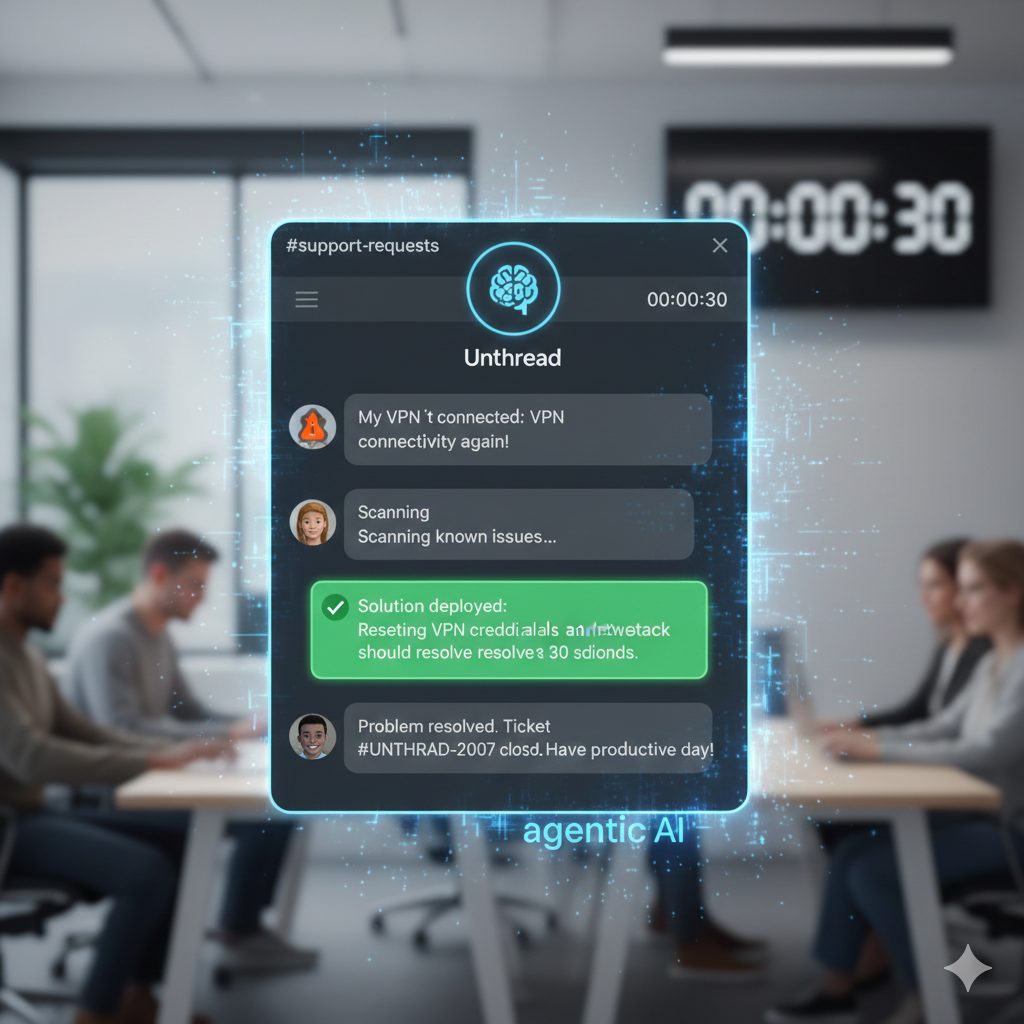
Unthread is a Slack-native, AI-powered support ticketing system designed for modern IT, HR, and RevOps teams. Unlike traditional helpdesks, Unthread uses agentic AI to resolve approximately 40% of all incoming tickets instantly without human intervention. By integrating directly into Slack, it meets employees where they already work, slashing resolution times and operational overhead.
2. Mbodi
Mbodi is tackling the global labor crisis in manufacturing by making industrial robots learn like humans. Their platform allows non-technical workers to teach robots new skills using natural language and quick demonstrations. This “language-to-action” pipeline turns robots into versatile assets that can be repurposed in minutes rather than weeks.
3. CampusAI
CampusAI is an immersive learning ecosystem designed to facilitate “Human+AI collaboration.” Through its virtual 3D campus and “AI Gym,” it helps organizations train their workforce to use generative AI tools and agents in real-world professional scenarios. With over 35,000 people already trained, they are bridge the gap between AI potential and human proficiency.
4. Dobs.AI
Dobs.AI builds AI agents specifically for the Office of the CFO to handle document-heavy operations. Their platform extracts data from millions of unstructured documents—like invoices and contracts—to identify overpayments and recover revenue. Trusted by Fortune 500 teams, it represents the next wave of “autonomous accounting.”.
Enterprise Cybersecurity Trends 2026: Defense in the Age of Deepfakes
Cybersecurity remains the top priority for enterprise buyers. The 2025 Battlefield showcased a shift toward “digital immune systems” that are proactive and resilient against AI-generated threats.
5. Polygraf AI
Polygraf AI provides a zero-trust governance layer for enterprise AI usage. Their specialized Small Language Models (SLMs) detect deepfakes, synthetic voices, and PII (Personally Identifiable Information) in real-time. By sitting between the user and external models like ChatGPT, they ensure that sensitive corporate data never leaks into the public cloud.
6. CyDeploy
CyDeploy offers an intelligent, automated testing system that creates a “digital twin” of a company’s network environment. Before security patches or system updates are deployed, CyDeploy’s AI tests them in the sandbox to predict how they will affect stability and compliance, ensuring uninterrupted operations for B2B and government agencies.
7. Corgea
Corgea is an AI-driven vulnerability remediation tool that doesn’t just find bugs—it fixes them. It scans source code for security flaws and automatically generates high-quality code patches. This allows engineering teams to shift from manual triage to one-click remediation, significantly hardening the enterprise software supply chain.
8. SentinelAI
Focused on predictive endpoint security, SentinelAI (recently integrated with SentinelOne’s agentic ecosystem) uses generative AI to forecast breach patterns based on behavioral data. Their “Wayfinder” suite combines AI with human expertise to provide proactive defense against sophisticated “shadow AI” threats.
9. QuantumShield
As quantum computing threatens traditional encryption, QuantumShield provides automated cryptography discovery. It allows organizations to inventory their cryptographic landscape and identify vulnerabilities to quantum-level attacks, helping enterprises transition to “quantum-safe” migration strategies today.

SaaS Scalability and Infrastructure: Building the 2026 Stack
The infrastructure of the enterprise is becoming more decentralized yet more connected. These startups are bridging the gap between legacy systems and modern AI.
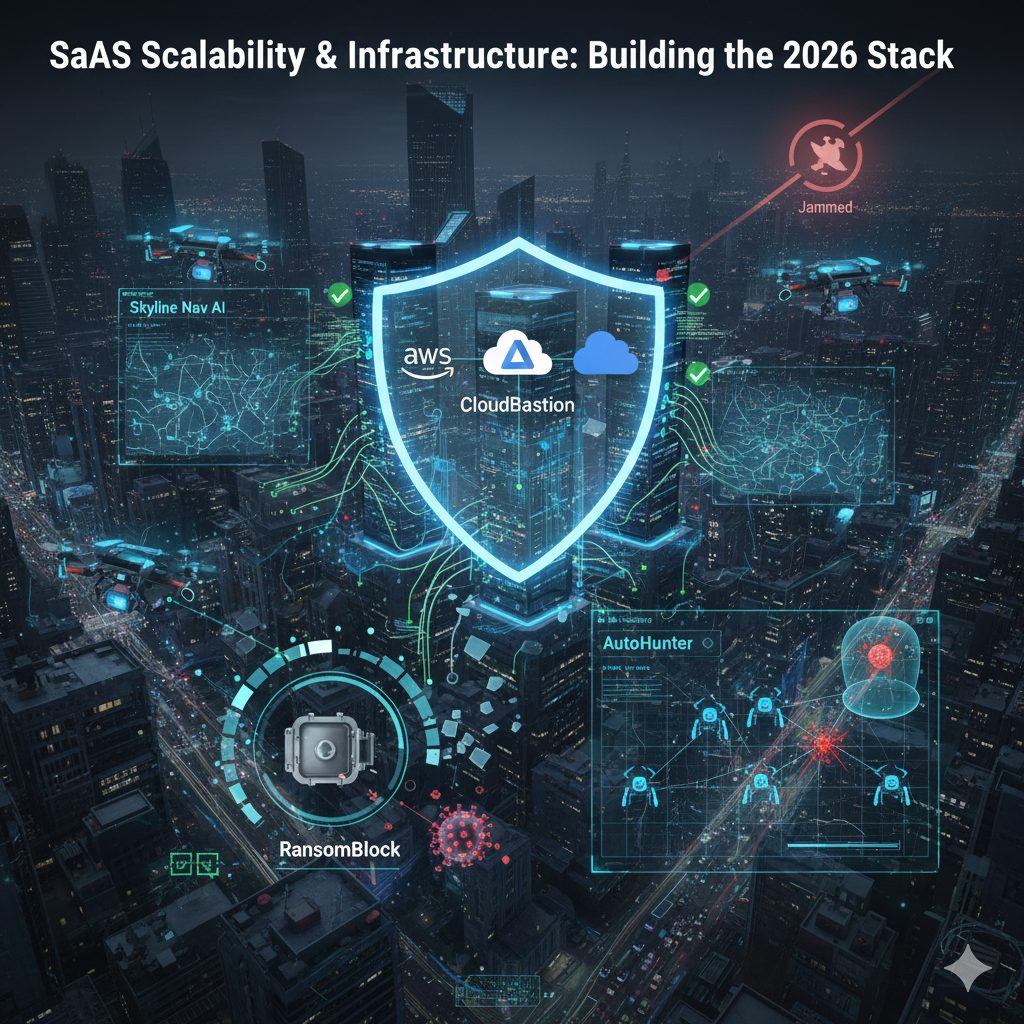
10. Skyline Nav AI
Skyline Nav AI has developed “Pathfinder,” a GPS-independent navigation system. In an era where GPS jamming and urban signal blockage are increasing, their technology uses computer vision and geospatial datasets to provide absolute location coordinates for drones and ground vehicles without satellite reliance.
11. CloudBastion
CloudBastion automates multi-cloud security and compliance across AWS, Azure, and Google Cloud. It provides a unified zero-trust framework that verifies every access request dynamically, ensuring that as enterprises scale their cloud footprint, their security posture scales with it.
12. RansomBlock
RansomBlock utilizes decentralized storage to provide an “unhackable” backup layer. By shredding and encrypting data across a peer-to-peer network, they ensure that even if a central system is hit by ransomware, the data remains accessible and restorable for the organization.
13. AutoHunter
AutoHunter (not to be confused with the EV marketplace) is an autonomous threat-hunting platform that deploys specialized bots to “patrol” internal networks. These bots identify and isolate anomalies and lateral movement before they can escalate into full-scale data breaches.
Behavioral Intelligence and HR Tech: The Human Element of Enterprise
Startups are now using AI to understand the “soft” side of business—team dynamics, compatibility, and mental well-being.
14. Mappa
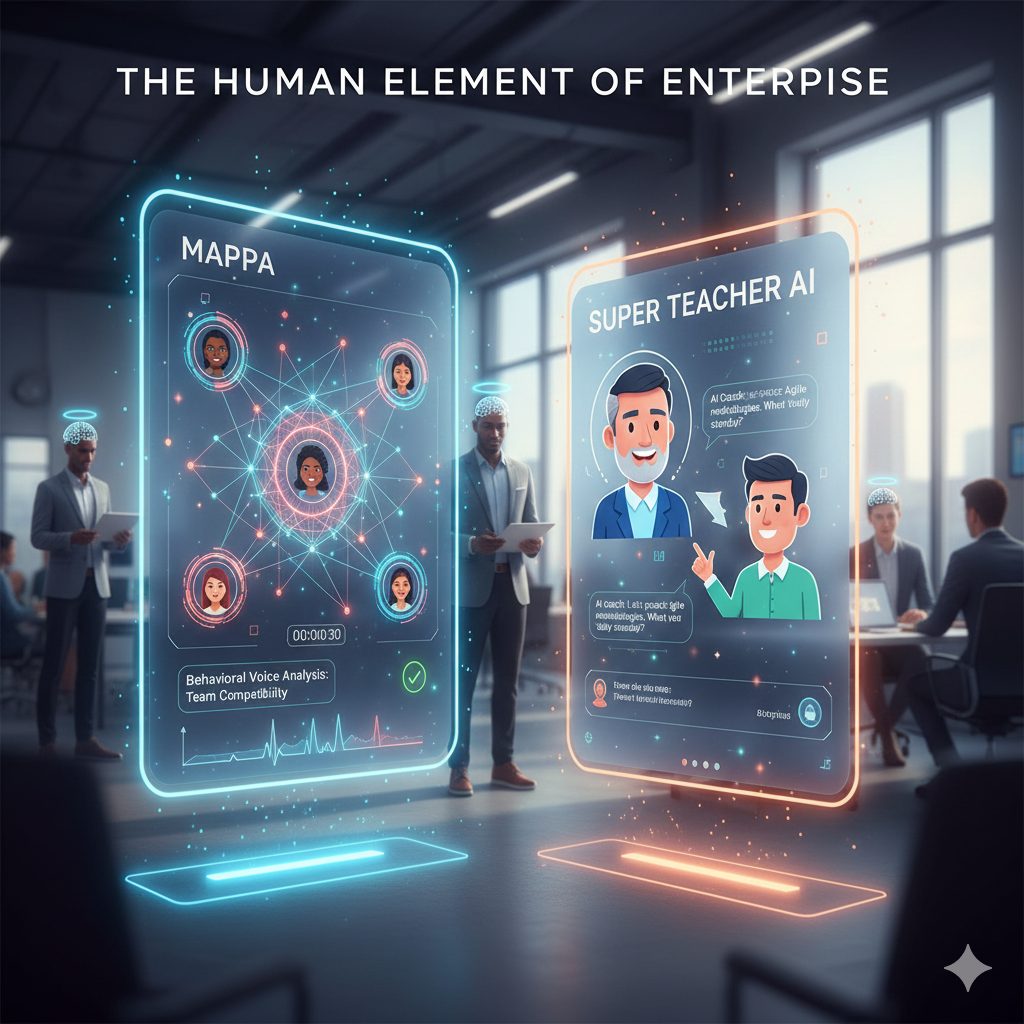
Mappa uses behavioral voice analysis to help companies understand people more deeply. By decoding voice patterns in 30 seconds, Mappa predicts real-world compatibility for teams. This reduces turnover by ensuring that hiring and project matching are based on behavioral fit rather than just a resume.
15. Super Teacher
While Super Teacher is an AI-powered tutoring platform for children, its underlying “adaptive instruction” engine is being adapted for enterprise Learning and Development (L&D). It uses synthetic voice and NLP to provide personalized, conversational training that evolves based on the learner’s responses.
Industry-Specific Enterprise Solutions: Vertical AI
Vertical AI—AI built for a specific industry—is where we are seeing the most immediate ROI and market adoption.
16. Glīd (The 2025 Battlefield Winner)
Glīd is a logistics startup that has developed autonomous electric vehicles capable of traveling on both roads and railways. By enabling seamless “transloading,” Glīd helps enterprises bypass congested highways and utilize the massive, underused rail infrastructure to move freight more efficiently and sustainably.
17. Charter Space
Charter Space is building the “operating system” for the space economy. Their software manages complex satellite mission data and integrates it with an AI-powered underwriting tool. This allows them to offer fintech-style insurance products for spacecraft, a critical need as commercial space exploration scales.
18. Nephrogen
Nephrogen is a biotech firm using an AI-driven platform called NeFIND to engineer novel gene delivery vectors. Their focus is on kidney and pancreatic diseases, using high-throughput screening to solve delivery challenges that have previously made genetic medicine for these organs nearly impossible.
19. COI Energy
COI Energy provides an AI-driven “Excess Energy Exchange” (E2X). Their platform allows large facilities to eliminate energy waste and monetize their excess capacity by buying and selling flexible energy capacity back to the grid, turning ESG targets into a revenue stream.

The “Next 13” Innovators: Rounding Out the Battlefield 32
To round out our list of 32, we look at the companies that are filling the critical gaps in the modern enterprise workflow:
- AIM Intelligence: Focuses on red-teaming LLMs to ensure they don’t leak sensitive corporate data during employee prompts.
- Zencoder AI: AI coding agents that automate the “idea to production” cycle for software teams, writing documentation as they code.
- HACKERverse: A simulation platform that tests if a company’s current security vendors are actually delivering on their promises via live “cyber-range” attacks.
- ZEST Security: An AI platform that unifies vulnerability management across disparate cloud and on-prem environments into a single risk score.
- TruSources: Specialized in real-time deepfake detection for high-stakes video calls and identity authentication.
- Mill Pond Research: A “shadow AI” detector that finds unmanaged AI tools being used by employees and monitors for data exfiltration.
- IdentityForge: Biometric authentication enhanced by blockchain for tamper-proof verification in sensitive financial environments.
- PrivacyNet: Privacy-preserving protocols that allow organizations to share threat intelligence without exposing sensitive customer data.
- Cashew Research: Uses AI to deliver expert customer insights and market research 90% faster than traditional human agencies.
- Investwise: AI-driven compliance and energy optimization specifically for commercial real estate owners and managers.
- JustiGuide: Converts the bureaucratic nightmare of corporate immigration and visa processing into a seamless digital infrastructure.
- AWEAR: Ear-worn EEG technology that acts as an AI coach for employee focus and stress management in high-pressure environments.
- HomeBoost: While consumer-facing, their AI energy assessment models are being licensed by enterprise real estate firms to hit mandatory net-zero targets.
Strategic Takeaways for 2026
The “future of enterprise AI and automation 2026” is not about replacing humans, but about building an agentic infrastructure that allows humans to focus on high-level strategy.
For founders and investors, the message from the 2025 Disrupt Startup Battlefield is clear: the most valuable startups of the next decade will be those that provide defensibility, autonomy, and deep integration.
Whether it’s Glīd’s physical logistics or Unthread’s digital triage, the winners are those solving the most “boring” (and therefore most critical) problems in the enterprise.
For more insights on the startup ecosystem and founder interviews, visit Spotlight on Startups. Here’s the link to the full TechCrunch article.