
You Don’t Have a Marketing Problem, You Have a Language Problem
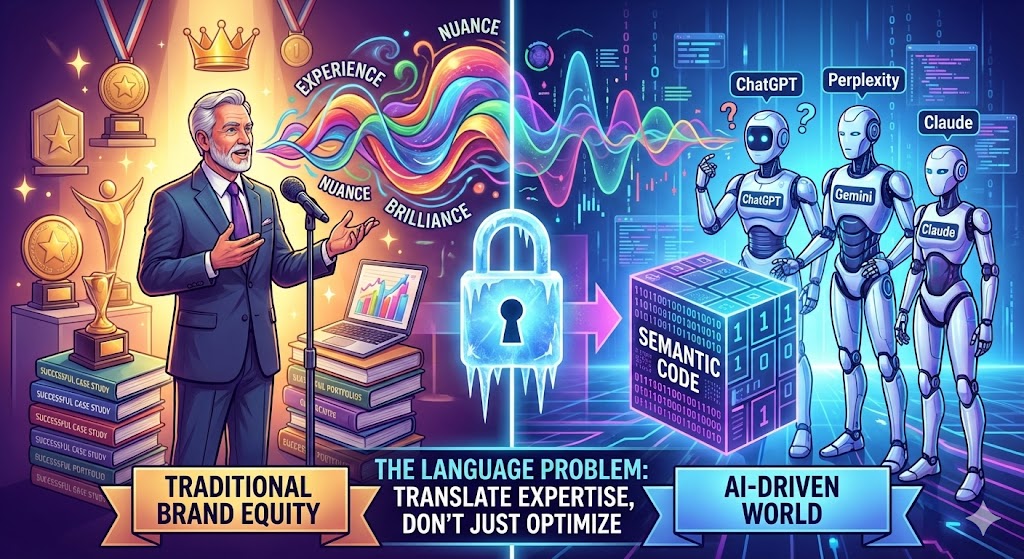
If you are reading this, you likely already have the “raw materials” of a market leader. You have the case studies. You have the decades of experience. You have the happy clients. In the traditional world, this is called “Brand Equity.”
But in the AI-driven world we have entered, this equity is currently frozen.
Why? Because the machines that now control the flow of information—ChatGPT, Gemini, Perplexity, and Claude—speak a fundamentally different language than you do.
We have spent twenty years “optimizing” content for Google. We stuffed keywords into H1 tags. We built backlinks. We tweaked meta descriptions. That was the era of Search Engine Optimization.
We are now in the era of Answer Engine Optimization.
Learning how to optimize for AI search in 2026 requires a fundamental shift. You must stop trying to “rank” documents and start trying to translate your expertise. You must take the messy, nuanced, brilliant reality of your career and convert it into the structured, semantic code that machines trust.
This article is the blueprint for that translation process. It moves beyond theory and explains exactly how we turn a human expert into a digital entity that AI platforms can read, verify, and recommend.
The Great Misunderstanding: How AI “Reads” Your Content
To understand the mechanics of how to optimize for AI search, we first have to look at the world through the eyes of a Large Language Model (LLM).
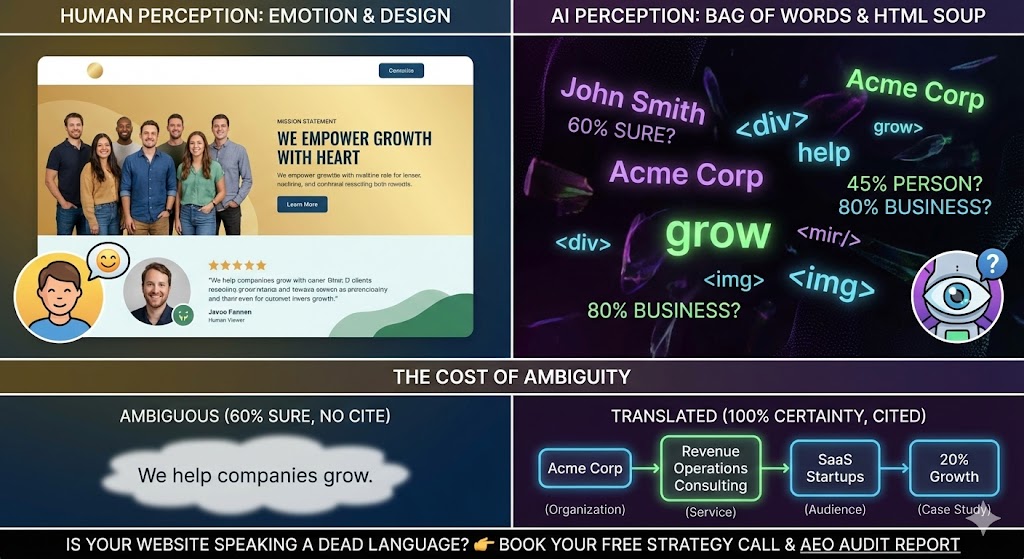
When a potential client visits your website, they see a beautiful design, a photo of your team, and a heartfelt mission statement. They feel emotion.
When an AI crawls that same page, it sees a “Bag of Words.” It sees unstructured text strings floating in HTML soup. It might guess that “John Smith” is a person and “Acme Corp” is a business, but it doesn’t know for sure. It operates on probability, not certainty.
The Cost of Ambiguity
If the AI is only 60% sure that you are the author of a specific framework, it will not cite you. It has a “safety threshold” to prevent hallucinations.
- Ambiguous: “We help companies grow.” (Who is ‘we’? Grow how? Proof?)
- Translated: “Acme Corp (Organization) provides Revenue Operations Consulting (Service) to SaaS Startups (Audience), resulting in a verified 20% growth for Client X (Case Study).”
The difference isn’t just copywriting; it’s data structure. To optimize for AI search, you must strip away the ambiguity and present your value in a format that leaves zero room for algorithmic doubt.
Is your website speaking a dead language? If you aren’t using Schema and Entity mapping, you are invisible to the modern web. 👉 Book Your Free Strategy Call & AEO Audit Report
The “Rosetta Stone” of the Internet: JSON-LD Schema
So, how do we translate? The primary tool we use to optimize for AI search is JSON-LD (JavaScript Object Notation for Linked Data).
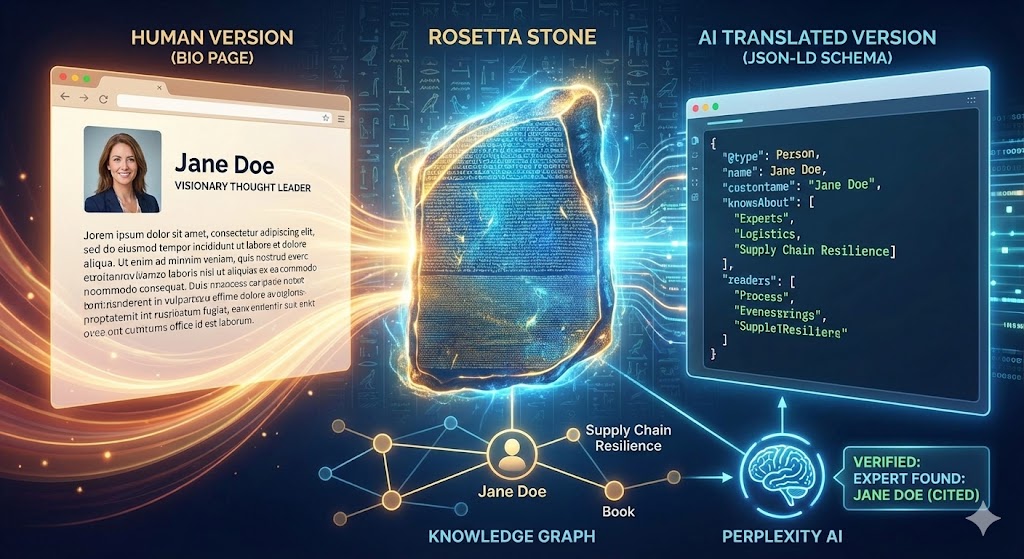
Think of JSON-LD as the “Rosetta Stone” for the internet. It is a standardized code that sits silently in the background of your website. It doesn’t change what humans see on the screen, but it completely changes what machines see in the code.
A Practical Example of Translation
Let’s look at how a human biography is translated into machine authority.
The Human Version (Your Bio Page):
“Jane Doe is a visionary thought leader who has spent 20 years revolutionizing the logistics industry. She is the author of the best-selling book ‘Moving the World’ and speaks globally on supply chain resilience.”
The AI Translated Version (JSON-LD Schema):
JSON
{
  "@context": "https://schema.org",
  "@type": "Person",
  "name": "Jane Doe",
  "jobTitle": "CEO",
  "knowsAbout": ["Logistics", "Supply Chain Resilience", "Freight Tech"],
  "author": {
    "@type": "Book",
    "name": "Moving the World",
    "isbn": "123-456-789"
  },
  "sameAs": [
    "https://www.linkedin.com/in/janedoe",
    "https://en.wikipedia.org/wiki/Jane_Doe"
  ]
}
Do you see the difference?
- The human version is inspiring but vague (“visionary,” “revolutionizing”).
- The translated version is fact-based and interconnected. It explicitly links “Jane Doe” to the topic “Supply Chain Resilience” and the object “Book.”
When an AI like Perplexity is asked, “Who is an expert in supply chain resilience?”, it scans its Knowledge Graph. If Jane’s site has this code, the AI has a “verified path” to connect her to the topic. It cites her not because it likes her prose, but because it understands her entity.
Step 1: Mapping Your “Knowledge Domain”
The process of learning how to optimize for AI search begins before we write a single line of code. It starts with mapping your territory.
AI models organize information into “clusters.” You cannot be an authority on everything. You must define the specific boundaries of your expertise.
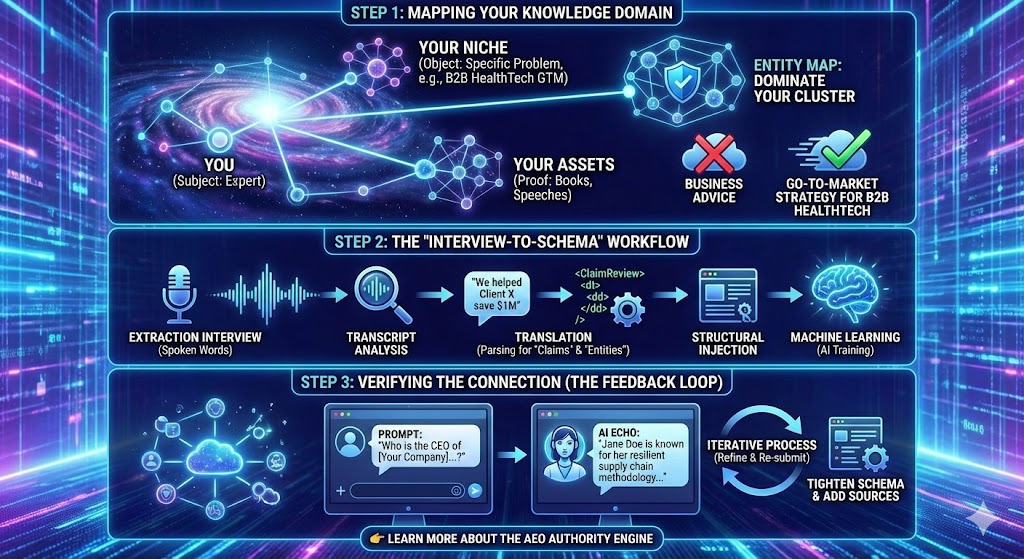
The Entity Map
We work with founders to create an “Entity Map.” This connects three core elements:
- The Subject (You): The expert.
- The Object (Your Niche): The specific problem you solve (e.g., “Forensic Accounting for Crypto”).
- The Proof (Your Assets): The books, whitepapers, and speeches that validate the link between Subject and Object.
If you try to rank for “Business Advice,” you will fail. The AI sees that topic as owned by massive entities like Harvard Business Review or Forbes. But if you translate your expertise into a specific vector—”Go-to-Market Strategy for B2B HealthTech”—you can dominate that cluster in the Knowledge Graph.
Step 2: The “Interview-to-Schema” Workflow
One of the biggest friction points for founders is time. You don’t have time to write 2,000-word SEO articles every week.
The good news is that translation is more efficient than creation.
At the AEO Authority Engine, we use a workflow designed to optimize for AI search using your spoken words:
- The Extraction Interview: We interview you on a specific topic. We record the audio.
- The Transcript Analysis: We don’t just transcribe; we parse the text for “claims” and “entities.”
- You said: “We helped Client X save $1M.”
- We translate:
<ClaimReview>Schema linked to a Case Study entity.
- The Structural Injection: We publish the content, but we wrap the key insights in semantic HTML tags (like
<dt>for definition terms and<dd>for definition descriptions).
This means your natural conversation is automatically converted into a format that trains the AI. You speak; we translate. The machine learns.
Tired of creating content that goes nowhere? Stop writing for algorithms and start feeding them structured knowledge. 👉 Learn more about the AEO Authority Engine
Step 3: Verifying the Connection (The Feedback Loop)
You cannot simply optimize for AI search once and walk away. It requires verification.
How do we know the AI understood the translation? We check the “echo.”
The “Reverse Query” Test
After we implement the translation layer (Schema, Semantic HTML, Entity Linking), we wait for the major indices to update. Then we test:
- Prompt: “Who is the CEO of [Your Company] and what are they known for?”
- Prompt: “What are the core principles of [Your Proprietary Framework]?”
If the translation was successful, the AI will recite your structured data back to you. It will say, “Jane Doe is known for her ‘resilient supply chain’ methodology, as outlined in her book…”
If it fails (hallucinates or gives a generic answer), we know the translation was “noisy.” We go back, tighten the schema, add more corroborative sources (like a Crunchbase link or a guest post on a high-authority site), and re-submit.
This iterative process is what separates true AEO from basic SEO. SEO ends when you hit “publish.” AEO ends when the machine recites the truth.
The “Silo” Problem: Why Your LinkedIn Isn’t Enough
A common question we hear is: “My LinkedIn is up to date. Isn’t that enough?”
No. LinkedIn is a “Walled Garden.” Microsoft owns that data. While it feeds into Bing/ChatGPT, it is often blocked or throttled for other crawlers like Google or Apple.
To truly optimize for AI search, you must own the Source of Truth. This must be a domain you control (your website).
Your website acts as the “Hub.” LinkedIn, YouTube, and X are “Spokes.”
- The Translation Strategy: The Schema on your website points to LinkedIn (
sameAs). This tells the AI: “The data on this website is the primary truth. The data on LinkedIn is a reflection of this truth.”
If you rely solely on social media, you are renting your authority. If the algorithm changes, you disappear. By translating your expertise onto your own platform, you build a permanent asset.
The Universal Translator for Your Brand
The shift from Search to Answer Engines is terrifying for those who rely on tricks. But it is liberating for those who have genuine expertise.
For the first time, quality actually matters more than quantity. You don’t need more blog posts. You need better translation of the genius that already exists in your head.
The AEO Authority Engine is that universal translator. It takes the raw signal of your career—your insights, your stories, your hard-won lessons—and converts them into the clean, structured, irrefutable data that the future of the internet is built upon.
You have already done the hard work of becoming an expert. Now, let’s make sure the machines recognize it.
Ready to Translate Your Legacy?
Your expertise is an asset. Don’t let it get lost in the noise of the unstructured web. We are offering a complimentary AEO Audit Report to analyze your current “translation score.” We will show you exactly which parts of your story the AI understands, and which parts are currently invisible.
👉 Click here to book your Strategy Call and claim your free AEO Audit Report.