
AI search is no longer a “future trend” for startups, it’s the default way people discover answers. Founders, buyers, journalists, candidates, and investors are increasingly asking conversational questions in tools like ChatGPT, Google’s AI experiences (AI Overviews and AI Mode), Microsoft Copilot, and Perplexity. And those tools don’t “rank a page,” they assemble an answer from sources they trust, can parse cleanly, and can cite confidently.
That shift forces a mindset change:
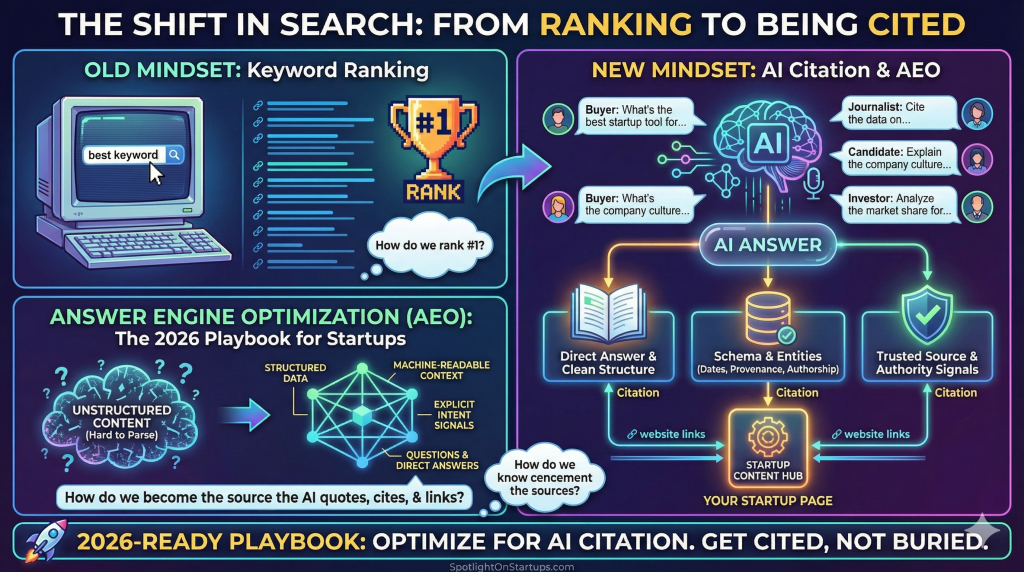
- Old mindset: “How do we rank #1 for a keyword?”
- New mindset: “How do we become the source the AI quotes, cites, and links?”
This is where AEO (Answer Engine Optimization) comes in: shaping your content so answer engines can extract, verify, and attribute it. Neil Patel frames AEO as making your content easy for AI tools to find and use as a direct answer, emphasizing question-based intent and authority signals. Neil Patel SEO.com similarly defines AEO as improving visibility across AI platforms by earning mentions, citations, and placements in conversational responses.
The good news: you don’t have to “game” AI. Google’s own guidance says the fundamentals of SEO still apply for AI features like AI Overviews and AI Mode, and there are no special extra requirements, but best practices matter.
What has changed is what “best” looks like: direct answers, clean structure, explicit intent signals, and machine-readable context (schema, entities, authorship, dates, and provenance).
Below is a startup-friendly, 2026-ready playbook for how to optimize content for AI search so your pages get cited by AI tools like ChatGPT and Google AI Mode, not buried under them.
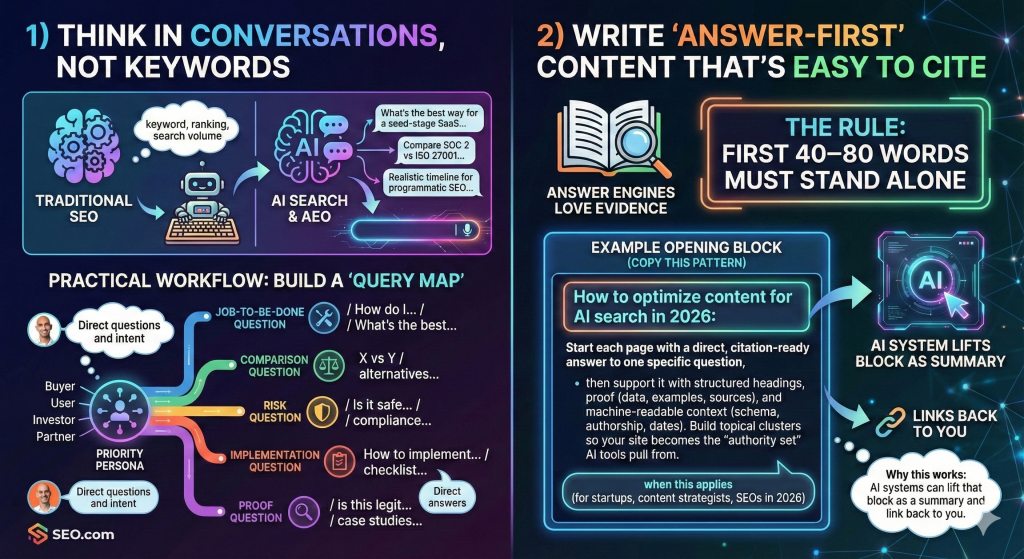
1) Think in conversations, not keywords
The biggest mistake founders make is treating AI search like traditional SEO with a new coat of paint.
In AI search, queries are more like:
- “What’s the best way for a seed-stage SaaS to reduce churn without adding headcount?”
- “Compare SOC 2 vs ISO 27001 for a B2B startup selling to healthcare.”
- “What’s a realistic timeline to see results from programmatic SEO for fintech?”
These queries have constraints (stage, industry, compliance, budget, team size) and usually imply an outcome (reduce churn, ship faster, pass procurement). Neil Patel highlights this move toward optimizing for direct questions and intent, because that’s what answer engines can return immediately.
Practical workflow: build a “query map”
For each priority persona (buyer, user, investor, partner), map:
- Job-to-be-done question: “How do I…” / “What’s the best…”
- Comparison question: “X vs Y” / “alternatives to…”
- Risk question: “Is it safe…” / “compliance…” / “what are the downsides…”
- Implementation question: “How to implement…” / “checklist…”
- Proof question: “Is this legit…” / “case studies…” / “ROI…”
Then create content that answers those questions in the exact way the question is asked.
2) Write “answer-first” content that’s easy to cite
Answer engines love content that behaves like evidence: clear, unambiguous, and chunked into extractable blocks.
The rule: first 40–80 words must stand alone
For your primary question, open with:
- A direct answer (1–2 sentences)
- A short bulleted expansion (3–6 bullets)
- A “when this applies” qualifier (who it’s for, who it’s not)
This matches the “direct answers” emphasis you’ll see repeated in AEO guidance.
Example opening block (you can copy this pattern):
How to optimize content for AI search in 2026: Start each page with a direct, citation-ready answer to one specific question, then support it with structured headings, proof (data, examples, sources), and machine-readable context (schema, authorship, dates). Build topical clusters so your site becomes the “authority set” AI tools pull from.
Why this works: AI systems can lift that block as a summary and link back to you.
3) Structure your pages for “chunk retrieval,” not scrolling
Google’s AI features often work by extracting content blocks and summarizing them, not “reading your whole article like a human.” Many practitioners describe AI Overviews as pulling from multiple sources and combining the best chunks.
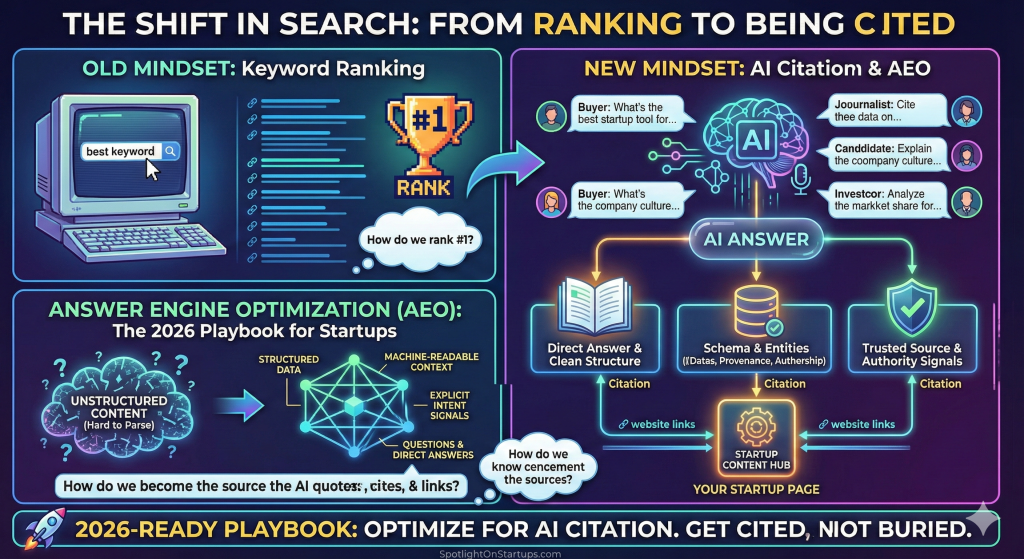
Your page should look like a set of “mini-answers”
Use:
- Question-based H2s/H3s (mirror conversational queries)
- Short paragraphs (2–4 lines)
- Bullets and numbered steps
- Definitions and glossaries
- Decision tables (especially for comparisons)
Great AEO structure looks like:
- H1: The main question
- TL;DR answer block
- H2: “What it means” (definition)
- H2: “When it matters” (use cases)
- H2: “How to do it” (steps)
- H2: “Common mistakes”
- H2: “FAQs” (each is its own mini-answer)
This makes your content easy for AI to:
- retrieve,
- validate,
- summarize,
- cite.
4) Make your content verifiable (AI prefers sources it can trust)
In 2026, citation is the new ranking.
If AI systems worry your claim is vague, ungrounded, or salesy, they’ll quote someone else. Worse, the AI may answer without you, reducing your traffic. Even mainstream reporting has highlighted how AI summaries can affect clickthrough and publisher outcomes.
Add “evidence hooks” throughout the piece
Instead of:
- “This improves conversion.”
Write:
- “Teams typically see conversion lift when the page answers pricing objections directly above the fold, because it reduces follow-up searches.”
Even better: add your own data:
- benchmarks from your product analytics,
- anonymized survey results,
- a small internal study (“We analyzed 143 onboarding calls…”),
- quotes from domain experts,
- screenshots are fine for humans, but also add a text explanation for machines.
Use explicit sourcing habits
AI tools tend to prefer pages that have:
- clear author attribution,
- update dates,
- referenced sources (where relevant),
- consistent definitions.
Google specifically advises that standard SEO best practices still matter for AI features.
5) Implement schema that supports “direct answers” and intent signals
Schema doesn’t magically force citations, but it removes ambiguity. It tells machines:
- what the page is,
- what entities are involved,
- what questions are answered,
- what the canonical version is.
Search Engine Journal has also covered Google’s messaging that structured data remains important even in the AI-search era.
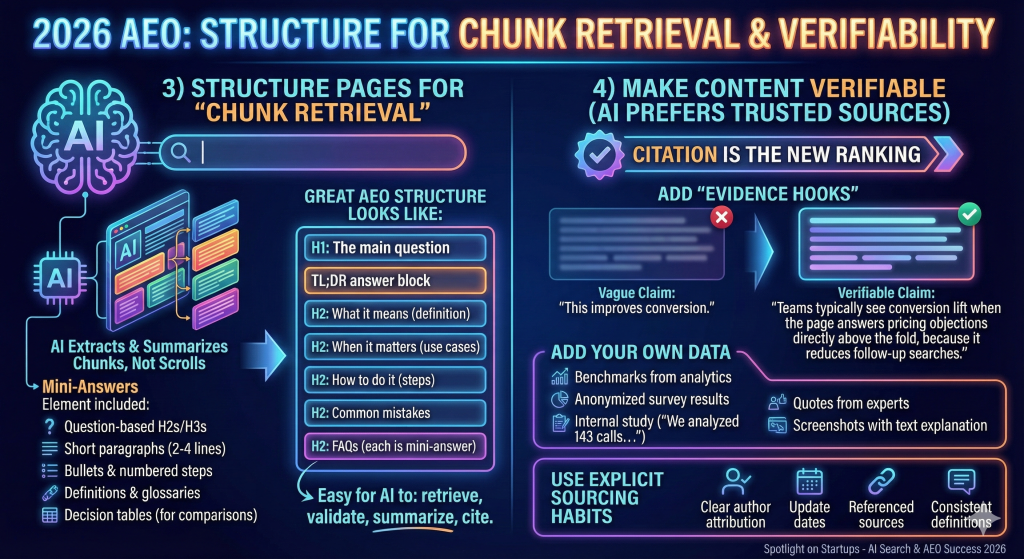
Priority schema for startups (in order)
- Article / BlogPosting (with author, datePublished, dateModified)
- Organization (logo, sameAs profiles, contact info)
- Person (for founders/expert authors)
- FAQPage (only if you truly have Q&A content)
- HowTo (for step-by-step guides)
- BreadcrumbList (context and hierarchy)
Here’s a clean, lightweight JSON-LD pattern you can adapt:
<script type="application/ld+json">
{
  "@context": "https://schema.org",
  "@type": "BlogPosting",
  "headline": "How to Optimize Startup Content for AI Search & AEO Success in 2026",
  "datePublished": "2026-01-06",
  "dateModified": "2026-01-06",
  "author": {
    "@type": "Person",
    "name": "Your Name",
    "jobTitle": "Founder, Your Startup",
    "url": "https://yourdomain.com/about"
  },
  "publisher": {
    "@type": "Organization",
    "name": "Your Startup",
    "logo": {
      "@type": "ImageObject",
      "url": "https://yourdomain.com/logo.png"
    }
  },
  "mainEntityOfPage": "https://yourdomain.com/ai-search-aeo-2026"
}
</script>
Key point: Schema is not a substitute for clarity. It’s an amplifier for content that’s already structured and accurate.
6) Engineer “citation-friendly” passages (this is the secret sauce)
If you want to win AI visibility, write passages that are quotable.
A citation-friendly passage has:
- a clear claim,
- a constraint (when/for whom it applies),
- a measurable detail,
- neutral wording (not hype),
- a defined term.
The “Citable Block” template
Use this anywhere you want to be cited:
Definition:
X is… (one sentence)
Why it matters:
It matters because… (one sentence)
How to do it:
- Step 1
- Step 2
- Step 3
Pitfall:
Avoid… (one sentence)
This is exactly the kind of structure AEO guides recommend: direct answers plus supportive formatting.
9) Ensure ChatGPT can crawl and cite you (don’t block the bots by accident)
If your startup wants to show up as a cited source in ChatGPT’s web-connected experiences, you need to allow the right crawler access.
OpenAI’s publisher guidance notes that public websites can appear in ChatGPT search, and specifically flags that blocking OAI-SearchBot can prevent your content from being included in summaries and snippets. OpenAI Help Center OpenAI also documents its crawlers and how robots.txt controls can differ by bot (for example, OAI-SearchBot vs GPTBot). OpenAI Platform
Quick technical check (do this today)
- Confirm your
robots.txtis not blockingOAI-SearchBot. - Confirm you’re not unintentionally blocking key sections of your site behind scripts or auth walls.
- Make sure your canonical tags are correct, avoid duplicate URLs competing with each other.
This is boring, but it’s the fastest “AI visibility win” most startups miss.
10) Create “AI-first” page types startups underuse
Most startup blogs are “thought leadership essays.” AI engines prefer pages that resolve a query.
Here are page types that consistently perform well in conversational AI search:
A) “Best practices” pages (with constraints)
Example:
- “Best practices for onboarding in PLG SaaS under $100k MRR”
Add: target persona, stage, and what “good” looks like.
B) “X vs Y” comparison pages
These are citation magnets if done honestly:
- who wins for which use case
- tradeoffs
- cost, complexity, risk
- decision table
C) Checklists and templates
AI loves structured lists:
- “AI search optimization checklist for startup blogs”
- “Schema checklist for AEO”
- “Content brief template for conversational queries”
D) Glossaries (but only if they’re opinionated and useful)
Not a dictionary, a startup operator’s glossary:
- definitions plus why it matters plus example usage.
E) “Troubleshooting” pages
- “Why your AI citations dropped”
- “Why Google AI Overviews isn’t citing you”
These map tightly to query intent.
11) Measure what matters: AEO metrics (not just rankings)
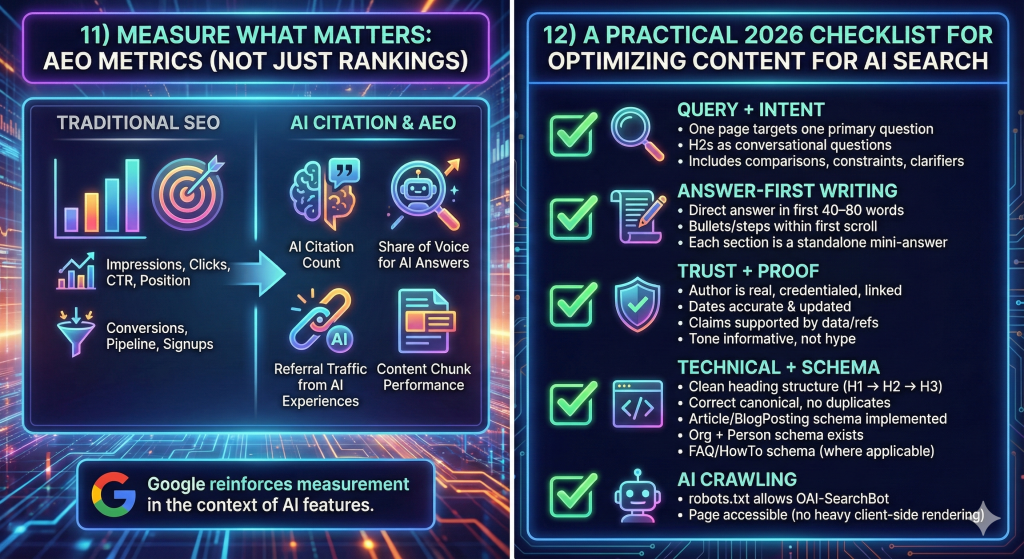
Traditional SEO dashboards won’t fully capture AI visibility.
You still track:
- impressions, clicks, CTR, average position
- conversions, pipeline, signups
But add:
- AI citation count (manual checks + tooling where available)
- Share of voice for AI answers on your priority questions
- Referral traffic from AI experiences (watch referrers and UTM patterns)
- Content chunk performance (which sections get linked or quoted)
Google’s documentation includes guidance on measuring performance in the context of AI features, reinforcing that measurement remains part of the workflow. Google for Developers
12) A practical 2026 checklist for “how to optimize content for AI search”
Use this as a pre-publish checklist:
Query + intent
- One page targets one primary question
- H2s are phrased as conversational questions
- Includes comparisons, constraints, and “when it applies” clarifiers
Answer-first writing
- Direct answer in the first 40–80 words
- Bullets/steps within the first scroll
- Each section can stand alone as a mini-answer
Trust + proof
- Author is real, credentialed, and linked
- Dates are accurate and updated
- Claims are supported with data, examples, or references
- Tone is informative, not hype
Technical + schema
- Clean heading structure (H1 → H2 → H3)
- Correct canonical, no duplicate versions
- Article/BlogPosting schema implemented
- Org + Person schema exists somewhere on the site
- FAQ/HowTo schema only where truly applicable
AI crawling
robots.txtdoes not block OAI-SearchBot (if you want ChatGPT visibility) OpenAI Help Center+1- Page is accessible without heavy client-side rendering
13) Common mistakes that quietly kill AI citations
Mistake 1: Writing “marketing copy” instead of answers
AI engines tend to cite the clearest explanation, not the loudest promise.
Mistake 2: Burying the answer under a long intro
Humans tolerate story. Machines want the point.
Mistake 3: One giant paragraph per section
Chunking matters. If the AI can’t cleanly extract a passage, it may skip you.
Mistake 4: No author, no date, no provenance
Authorship and freshness cues help AI systems decide if you’re safe to cite.
Mistake 5: Blocking crawlers unintentionally
Especially relevant for ChatGPT visibility via OAI-SearchBot.
14) The Orange County Tech Startup in 2026 advantage: you can move faster than incumbents
Big companies are slow to:
- update content weekly,
- publish original data,
- ship structured templates,
- add founder expertise and real-world learning.
Startups can win AI search by being:
- more specific (niche + constraints),
- more current (frequent updates),
- more useful (actionable steps),
- more verifiable (proof and transparency).
And because AI experiences increasingly surface and link sources directly, being the cited source compounds over time.
15) A simple editorial plan for the next 30 days
If you want traction quickly, do this:
Week 1: Fix foundations
- implement/update Article + Org + Person schema
- validate crawl accessibility
- ensure OAI-SearchBot is allowed (if desired) OpenAI Help Center+1
- refresh your top 5 traffic pages with answer-first intros
Week 2: Publish 2 citation magnets
- one “best practices” page
- one “X vs Y” comparison page
Make them structured, neutral, evidence-based.
Week 3: Build the cluster
Publish 3 supporting articles that link back to the pillar and to each other.
Week 4: Add proof and differentiation
- publish a small dataset, benchmark, or teardown
- add quotes from experts or internal learnings
- add an FAQ section with direct answers
That’s a real AEO baseline.
Closing thought
In 2026, optimizing isn’t about tricking AI. It’s about becoming the most useful, structured, trustworthy “evidence” on the internet for a specific set of startup questions.
If you consistently publish pages that:
- answer real conversational questions directly,
- structure content into extractable blocks,
- reinforce trust with authorship + proof,
- add schema and intent signals,
- stay crawlable for the platforms you care about,
…you’ll win more citations, more brand mentions, and more qualified clicks, even as AI summaries take up more screen space.
That’s how to optimize content for AI search without chasing gimmicks.