
The Hollow Victory of the First Page
For the last decade, “Ranking Number One” was the ultimate digital trophy. It was the promise of guaranteed traffic, the validation of your marketing budget, and the primary driver of lead generation. If you were at the top of Google, you won.
But recently, you may have witnessed a disturbing trend. You are still ranking. You are still on page one. But the traffic is thinning. The leads are getting quieter.
You are witnessing the “Hollow Victory” of traditional SEO in the age of Artificial Intelligence.
The digital world has undergone a quiet but violent revolution. We have transitioned from an era of Search (hunting for links) to an era of Answers (demanding synthesis). In this new reality, being on a list of “Ten Blue Links” is no longer enough. The user isn’t clicking ten links anymore. They are asking ChatGPT, Claude, or Perplexity a question, and receiving a single, synthesized answer.
If you are the third link on Google, you might as well be invisible. In fact, even if you are the first link, if the AI summarizes your content without citing you—or worse, cites a competitor who structured their data better—you lose the customer before they ever visit your website.
This article explores the critical paradigm shift every founder must understand: The transition from the passive goal of Being Found to the active, urgent necessity of Being Chosen. We will dissect why your current SEO metrics are misleading you and outline specific AI search optimization strategies to ensure your brand survives the shift.

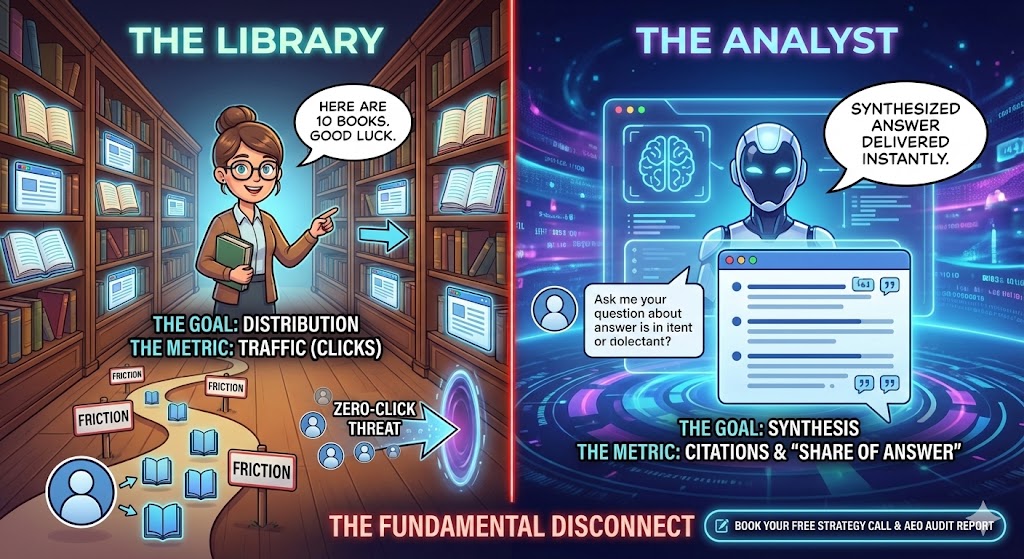
The Fundamental Disconnect: “The Library” vs. “The Analyst”
To understand why ranking #1 is no longer sufficient, we have to look at the fundamental architecture of how information is delivered.
The Google Model: The Librarian
Google’s traditional search engine acts like a librarian. You ask for a topic, and it points you to an aisle. “Here are 10 books (websites) that might have what you need. Good luck.”
- The Goal: Distribution.
- The Metric: Visibility (Impressions) and Traffic (Clicks).
- The User Experience: Friction. The user must click, read, filter, back-button, click again, and synthesize the answer themselves.
The AI Model: The Expert Analyst
AI Answer Engines (like Perplexity or Google’s AI Overviews) act like a high-level research analyst. You ask a question, and it reads the books for you. It synthesizes the data, cross-references claims, and delivers a conclusion.
- The Goal: Synthesis.
- The Metric: Citations and “Share of Answer.”
- The User Experience: Immediate gratification. The answer is served instantly.
The “Zero-Click” Threat
This shift creates the “Zero-Click” phenomenon. Gartner predicts that by 2026, traditional search engine volume will drop by 25%, with search marketing losing market share to AI chatbots and virtual agents.
If your strategy is purely SEO, you are optimizing for a user behavior (clicking links) that is rapidly going extinct for informational queries. You are fighting for real estate in a library that fewer people are visiting.
Is your business optimized for a vanishing era? Don’t wait until your traffic zeroes out. 👉 Book Your Free Strategy Call & AEO Audit Report
Why “Being Found” Is No Longer Enough
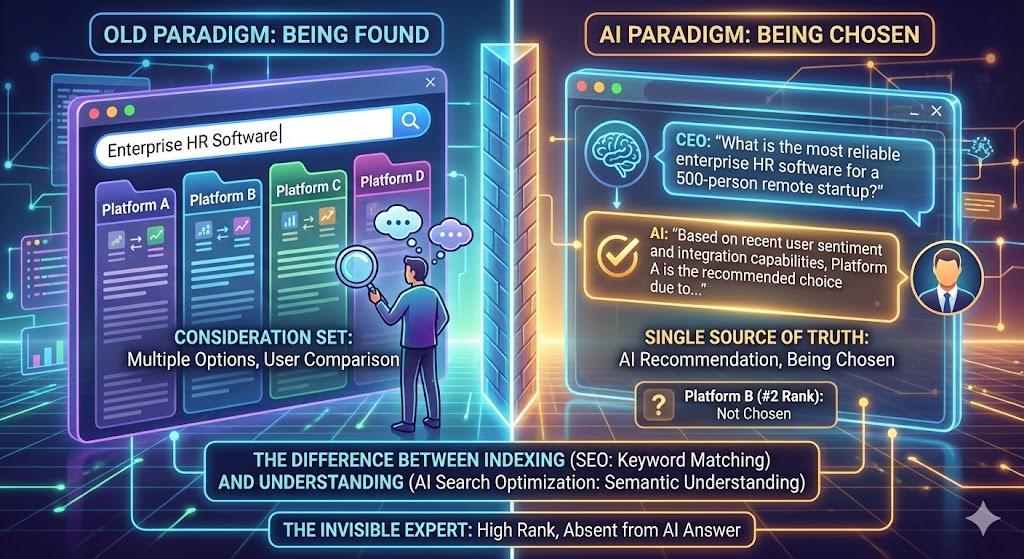
In the old paradigm, “Being Found” meant appearing in the consideration set. If a user searched for “Enterprise HR Software,” and you were in the top 5 results, you had a fighting chance. The user would likely open multiple tabs and compare features.
In the AI paradigm, the “consideration set” collapses into a Single Source of Truth.
When a CEO asks an AI, “What is the most reliable enterprise HR software for a 500-person remote startup?”, the AI does not list 10 options. It likely recommends one or two, providing a rationale for the choice.
- “Based on recent user sentiment and integration capabilities, Platform A is the recommended choice due to…”
If you are Platform B, and you ranked #2 on Google, you just lost the sale. You were found (technically, the AI saw you), but you were not chosen.
The Difference Between Indexing and Understanding
This is where technical founders often get frustrated. “But we have better content! We have more features!”
The AI doesn’t care about your features if it cannot understand them structurally.
- SEO is about keywords matching.
- AI Search Optimization strategies are about semantic understanding.
If your competitor has weaker content but better Knowledge Graph Entrenchment (clearer connections between entities), the AI will “trust” their data more. It will choose them because it understands them. You are left being the “Invisible Expert”—ranking high on a search page, but absent from the AI’s generated answer.
Vanity Metrics vs. Verified Authority
The shift to “Being Chosen” requires a painful breakup with your favorite metrics.
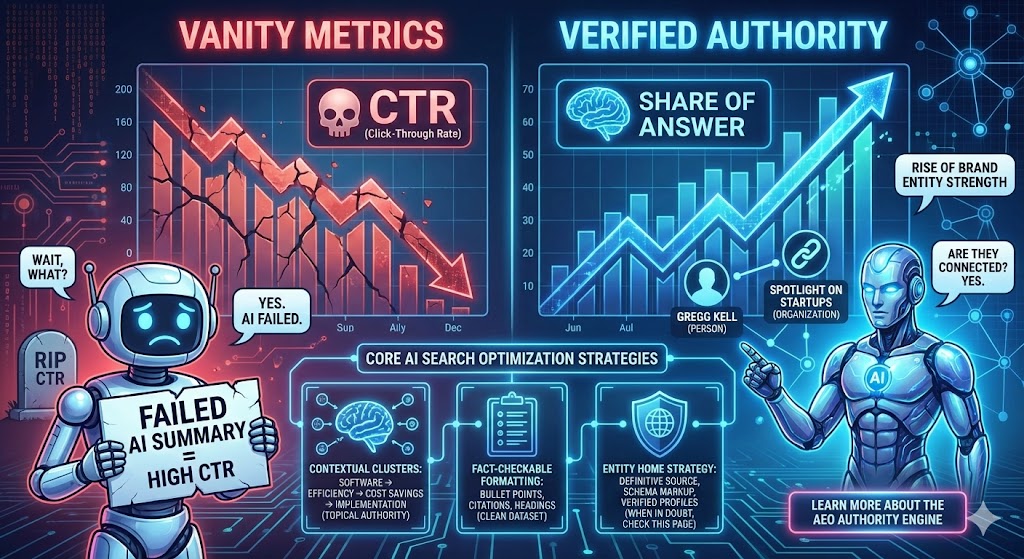
The Death of CTR (Click-Through Rate)
For years, marketing teams have obsessed over CTR. In an AEO world, a high CTR might actually be a sign of failure.
- Wait, what?
- Yes. If a user has to click your link to understand your offer, the AI failed to summarize it for them.
- The new metric is “Share of Answer.” How often is your brand mentioned in the generated response?
The Rise of “Brand Entity Strength”
Google and OpenAI measure your “Entity Strength.” This is a measure of how well the system can identify you as a distinct object in the real world.
- Does the AI know Gregg Kell is a Person?
- Does it know Spotlight on Startups is an Organization?
- Does it know they are connected?
If these connections are fuzzy, you are not “Chosen.” You are just text strings.
Core AI Search Optimization Strategies
So, how do you move from the blue links to the generated answer? It requires a strategic pivot in how you present your digital assets.
1. Move from “Keywords” to “Contextual Clusters”
Don’t just write a blog post about “Software.” Write a cluster of content that links “Software” to “Efficiency” to “Cost Savings” to “Implementation.” The AI looks for depth of coverage (Topical Authority).
2. Implement “Fact-Checkable” Formatting
AI hallucinations are a major problem for platform owners (like Microsoft and Google). They prioritize content that looks fact-checkable.
- Use clear bullet points for data.
- Cite your own sources.
- Use distinct headings for specific questions.
- Why? Because this structure mimics the training data the AI prefers. It looks like a “clean dataset.”
3. The “Entity Home” Strategy
You must have one single page on the internet that serves as the definitive source of truth about your brand. This is your “Entity Home.” It should contain verified data, structured Schema markup, and links to all your verified profiles (LinkedIn, Crunchbase, etc.). This tells the AI: “When in doubt, check this page.”
Is your website structurally ready for RAG? Most aren’t. We can help you build the data layer that makes you “choosable.” 👉 Learn more about the AEO Authority Engine
The “Winner Takes All” Dynamic of AI Search
The most frightening aspect of this paradigm shift is the consolidation of winners.
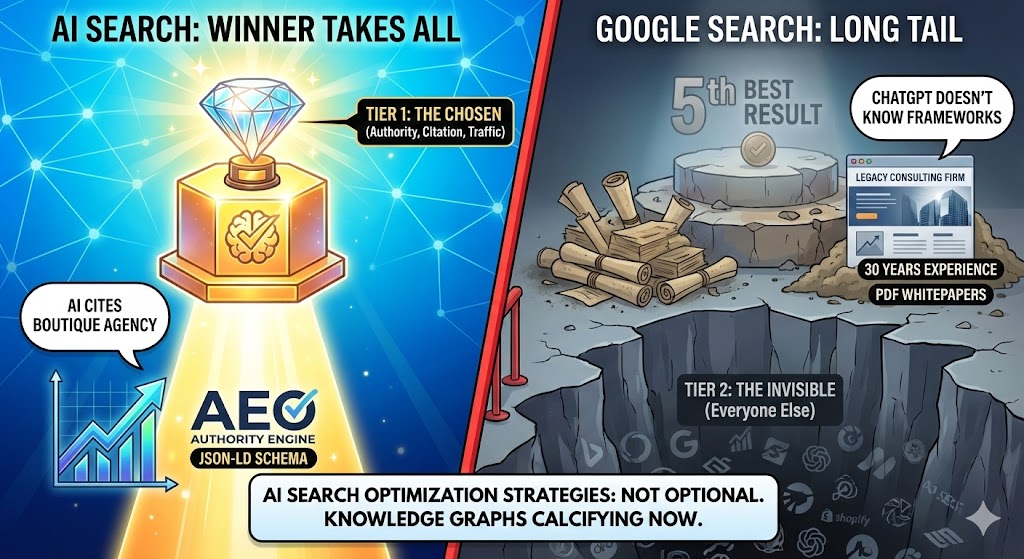
In Google Search, there was room for the “Long Tail.” You could be the 5th best result and still build a business. In AI Search, the “Winner Takes All.”
If the AI provides one answer, it usually cites one primary authority. There is no “Page 2” in a voice conversation with Siri or ChatGPT. There is no scrolling in a Gemini summary.
This creates a binary outcome for founders:
- Tier 1 (The Chosen): The brand that the AI recognizes as the authority. They get the citation, the brand awareness, and the high-intent traffic.
- Tier 2 (The Invisible): Everyone else.
This is why AI search optimization strategies are not “optional” or “something for next year.” The Knowledge Graphs are calcifying now. The AI models are deciding today who the authorities are in every niche. Once an entity is established as the “trusted source,” displacing it becomes exponentially harder.
Case Study: The Invisible Market Leader
Imagine a legacy consulting firm. They have 30 years of experience. They have served Fortune 500 clients. But their website is a static brochure from 2018. Their insights are locked in PDF whitepapers.
- Result: ChatGPT likely doesn’t know their specific frameworks.
Now imagine a new boutique agency. They have 2 years of experience. But they use the AEO Authority Engine. Their content is wrapped in JSON-LD Schema. Their articles directly answer common questions in a “Question-Answer” format.
- Result: When a user asks, “Who has the best modern framework for change management?”, the AI cites the boutique agency.
The boutique agency didn’t out-work the legacy firm. They didn’t have better expertise. They just made themselves “Choosable.” They optimized for the machine.
The Choice is Yours
The transition from “Being Found” to “Being Chosen” is the single biggest threat—and opportunity—facing startup founders today.
You can continue to play the Google Game. You can chase the long-tail keywords and fight for a 2% Click-Through Rate on a search results page that is slowly dying.
Or, you can adapt. You can recognize that the future belongs to Machine-Readable Authority.
By implementing specific AI search optimization strategies, you future-proof your visibility. You ensure that when the world asks questions about your industry, the Artificial Intelligence doesn’t just find you—it selects you, summarizes you, and recommends you.
The AEO Authority Engine was built for this exact pivot. We don’t just “do SEO.” We engineer authority. We build the bridge that allows your human expertise to walk across the digital divide and be welcomed by the machines.
Don’t settle for a rank on a list. Strive to be the answer.
Stop Being Invisible. Start Being Chosen.
Your expertise deserves to be the default answer. But it won’t happen by accident. We are currently offering a comprehensive AEO Audit Report to help you understand exactly how the major AI platforms view your brand today.
- Are you an entity or a string?
- Are you trusted or ignored?
- What is your “Trust Probability” score?
Find out now.
👉 Click here to book your Strategy Call and claim your free AEO Audit Report.