
For entrepreneurs building a startup, verifying a contractor's license in California isn't just a best practice—it's a critical risk management function. Before committing capital to an office build-out or facility upgrade, a founder must use the official Contractors State License Board (CSLB) portal to confirm their chosen contractor is active, insured, and legally cleared to perform the work. This simple act of due diligence is an essential step in protecting your startup's financial and legal health from preventable setbacks.
Why Contractor Vetting Is a Critical Founder Responsibility

As a founder, every dollar is scrutinized and every decision impacts your runway. Hiring a contractor for a physical build-out or renovation is not a mere operational task; it's a strategic decision tied directly to your startup's stability and growth trajectory. For entrepreneurs, contractor verification is an essential business practice, not a homeowner's chore. The fallout from hiring an unlicensed or improperly insured contractor can be devastating for a startup where cash flow is paramount and any operational disruption can be fatal.
The Real-World Risks for Startups
The consequences of improper vetting extend far beyond a poorly executed project. Engaging an unlicensed individual can trigger severe financial and legal liabilities that jeopardize your entire venture. This is a common pitfall that can derail even the most promising early-stage companies.
Key risks for founders include:
- Liability for On-Site Injuries: If a worker is injured on your property and the contractor lacks the legally required workers' compensation insurance, your startup could be held liable for their medical expenses and lost wages. This kind of unexpected cost can cripple a startup's finances.
- Voided Insurance Policies: Your own business liability insurance may refuse to cover claims for property damage caused by an unlicensed contractor, leaving you to pay for repairs out-of-pocket.
- Project Delays and Launch Setbacks: An unlicensed contractor who abandons a project leaves you with an unfinished build, no legal recourse through the CSLB, and a completely disrupted timeline. For a startup, this can delay product launches, impede hiring, and negatively impact revenue projections.
For a startup, unforeseen liabilities from improper vetting can cascade into larger governance issues, impacting investor confidence and operational integrity. Diligence here is a non-negotiable aspect of sound business management.
A High-ROI Business Practice
Taking a few minutes to perform a contractor license verification in California via the CSLB portal is one of the highest-ROI activities a founder can undertake. It protects capital, ensures operational continuity, and upholds your company’s professional integrity.
This simple check aligns perfectly with core principles of startup governance, where proactive risk mitigation is key to sustainable growth. Ultimately, ensuring your contractor is licensed, bonded, and insured isn't just about compliance—it’s about safeguarding your startup's future.
How to Use the CSLB Online Lookup Tool
For a founder moving at startup speed, the Contractors State License Board (CSLB) online portal is an indispensable resource. This free, public database is the single source of truth for a contractor license verification in California. Think of it as an essential, rapid background check you perform before signing any contract. The tool provides multiple search options, which is incredibly helpful when you're evaluating bids from several potential partners.
Navigating the Search Options
The most efficient way to use the portal is to search by the contractor's six-digit license number. This direct approach eliminates confusion from similarly named businesses and takes you straight to the correct record.
If the license number isn't immediately available, you can also search by:
- Business Name: Use the full, official business name as listed on their proposal.
- Personnel Name: This allows you to look up the owner or the "qualifying individual" associated with the license.
- HIS Number: This is specific to registered Home Improvement Salespersons.
Here’s a look at the straightforward search interface.
The CSLB’s "Check a License" portal is designed for quick, efficient verification.
What the License Status Really Means
Once you locate the contractor’s record, the most critical piece of information is the license status. This single data point confirms whether they are legally permitted to work in California. The CSLB Public Data Portal, a massive resource covering more than 240,000 licensed contractors statewide, is the backbone of consumer and business protection in the state's construction industry.
Here's a breakdown of what each status means for your startup:
- Active: This is the only acceptable status. It confirms the license is current and the contractor holds the required bonding and insurance. This is your green light.
- Expired or Inactive: Avoid contractors with these statuses. An expired license indicates a failure to renew, while an inactive one means it has been voluntarily put on hold. In either case, they cannot legally bid on or perform work.
- Suspended: This is a major red flag indicating a serious problem, such as a disciplinary action, a lapse in their bond, or failure to carry workers' compensation insurance.
- Revoked: This is the worst-case scenario. A revoked license has been canceled due to severe violations. This contractor is legally barred from the industry.
A contractor's license status is a real-time indicator of their professional standing and operational health. An "Active" status is non-negotiable; anything else exposes your startup to significant financial risks and legal liabilities.
Mastering this simple database navigation is a powerful tool for any founder. It streamlines the vetting process and empowers you to make sound, data-driven hiring decisions under pressure, protecting your investment from the start.
Matching License Classifications to Your Project
Confirming an active license is the first step, but ensuring the contractor holds the correct license classification for your project is equally critical. A mismatch is as risky as hiring an unlicensed individual, exposing your startup to substandard work, project delays, and legal complications.
The Contractors State License Board (CSLB) maintains a robust system with 45 different license types, overseeing roughly 285,000 contractors. This structure, in place since 1929, ensures specialists operate within their field of expertise. It guarantees the professional wiring your server room is a licensed electrician, not a plumber.
The Main License Categories Explained
Understanding the primary license classes is fundamental to protecting your project. Each class defines a distinct scope of work.
- Class A General Engineering Contractor: These contractors handle large-scale infrastructure like bridges and dams. Unless your startup is in the heavy civil engineering space, you will likely not engage a Class A contractor.
- Class B General Building Contractor: This is your primary contact for most commercial build-outs, office renovations, or complex tenant improvements. A Class B contractor is licensed to oversee projects involving multiple trades, acting as the project manager for your construction.
- Class C Specialty Contractor: These licenses are for specialists in specific trades. This includes C-10 Electrical contractors for wiring, C-36 Plumbing contractors for new facilities, and dozens more. They are the experts brought in for specific, technical jobs.
This chart provides a glimpse into the administrative side of CSLB licensing.
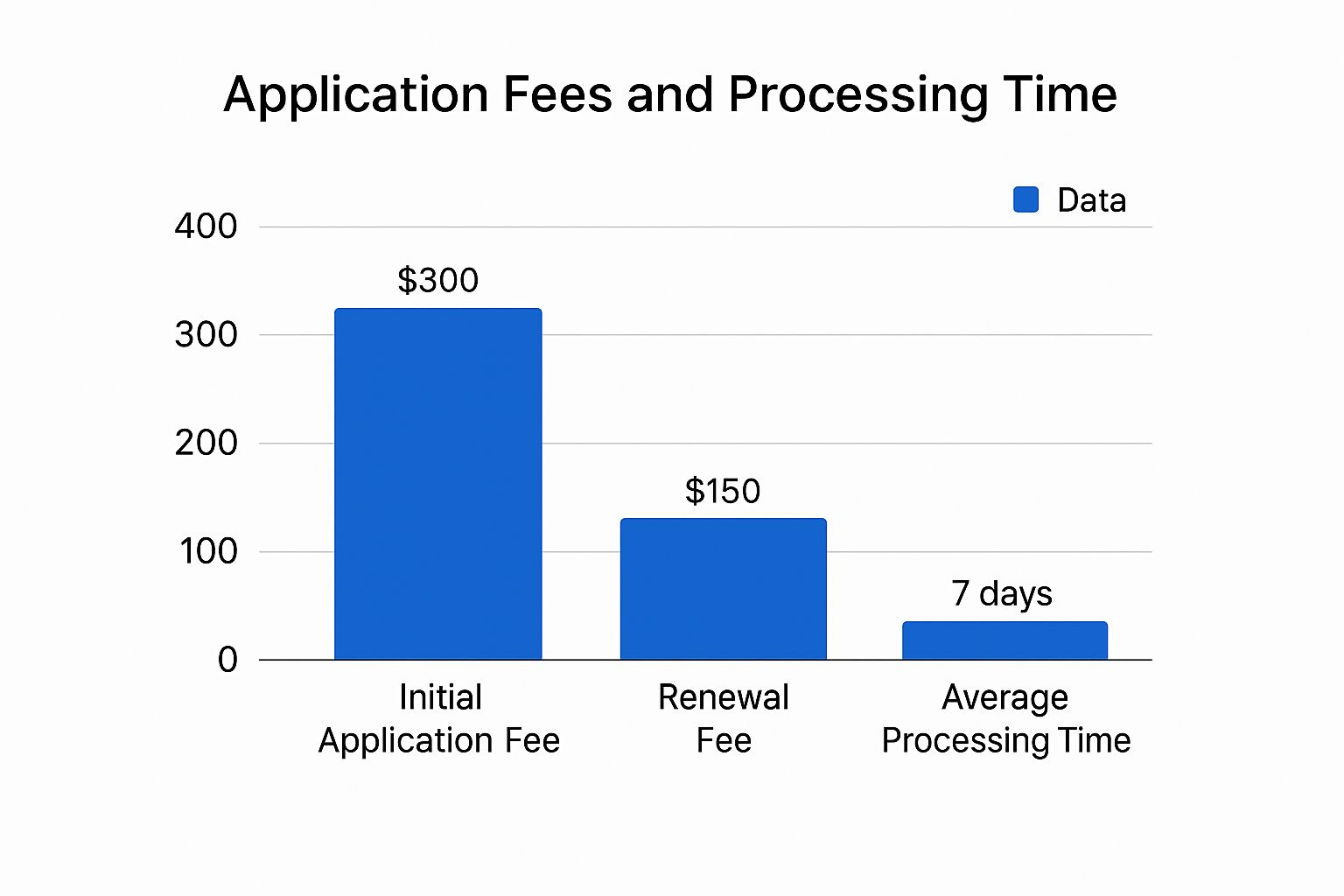
The processing times shown underscore the importance of selecting a contractor who is already licensed and ready to work. Your startup doesn't have the time to wait for a potential partner to get their affairs in order.
Matching the License to Startup Scenarios
How does this apply to a founder in a real-world scenario? Imagine your SaaS company is leasing a new office and requires a full build-out. You will need a Class B General Building Contractor to manage the entire project, coordinating everything from framing and drywall to painting and flooring. They function as the CEO of your construction project.
A general contractor is responsible for hiring correctly licensed subcontractors for all specialty work. However, the ultimate responsibility for verifying every license—both the GC's and their subs'—rests with you, the founder.
Now, consider a hardware startup building a specialized lab requiring custom electrical grids and ventilation. In this scenario, you must verify that the team includes, at a minimum, a C-10 Electrical license and a C-20 HVAC license.
The contractor you choose directly impacts the safety and operational success of your facilities. Familiarity with different construction project delivery methods can also provide a strategic advantage. Verifying these specialty licenses ensures that qualified experts are handling your critical infrastructure, protecting your startup’s assets and personnel.
Common CSLB License Classifications for Startup Projects
This reference table maps common startup construction needs to the specific CSLB license classification required.
| Project Type | Required License Class | Description |
|---|---|---|
| Full Office Build-Out | Class B – General Building | Oversees entire project, manages subcontractors. |
| Server Room Wiring | C-10 – Electrical | Handles all electrical circuits, panels, and data cabling. |
| New Office Kitchen/Restrooms | C-36 – Plumbing | Installs pipes, fixtures, and drainage systems. |
| Custom Cabinetry/Workstations | C-6 – Cabinet, Millwork & Finish Carpentry | Builds and installs custom desks, cabinets, and shelving. |
| Interior/Exterior Painting | C-33 – Painting and Decorating | Manages all painting, staining, and wall finishing. |
| Security System Installation | C-7 – Low Voltage Systems | Installs alarms, cameras, and access control systems. |
| Flooring (Carpet, Tile, Wood) | C-15 – Flooring and Floor Covering | Lays down all types of commercial flooring. |
This list covers common specialists, but always use the CSLB’s resources to double-check classifications for any trade you are unfamiliar with.
Checking for Insurance and Contractor Bonds
A valid license is the first checkpoint; insurance and bonding are the financial safeguards that protect your startup from disaster. Skipping this verification is a high-stakes gamble that successful founders are unwilling to take. The CSLB portal provides direct, reliable information on a contractor's insurance and bond status, as this data is updated by the providers themselves.
Why You Can't Skip General Liability Insurance
General liability insurance is the financial safety net that covers property damage or bodily injury resulting from the contractor’s work. Imagine a contractor's error causes a water leak that damages equipment in the office below yours. Without adequate general liability coverage, your startup could be held responsible for the damages. The CSLB record will confirm if a policy is active.
Pro Tip for Founders: Go beyond the CSLB portal. Always request a Certificate of Insurance (COI) directly from the contractor's insurance agent. For larger projects, ask to be named as an 'additional insured' on their policy. This simple step extends their coverage to your company, providing a crucial layer of protection in the event of a lawsuit.
The Make-or-Break Role of Workers' Compensation
If a contractor has any employees, California law mandates they carry Workers' Compensation insurance. This policy covers medical bills and lost wages for their crew if an injury occurs on your property. Verifying this is critical: if a worker is injured on your site and the contractor is uninsured, your startup can be sued and held financially responsible.
The CSLB portal will clearly indicate one of two things:
- Active Policy: The record shows a current, active workers' compensation policy.
- Exemption Claim: This means the contractor has sworn under penalty of perjury that they have zero employees. If they claim an exemption but arrive with a team, this is a major red flag.
What Exactly Is a Contractor's Bond?
Every licensed contractor in California is required to have a $25,000 contractor's bond. This is not an insurance policy; it's a financial guarantee from a third-party company. It protects you if the contractor abandons the job, fails to pay suppliers (who could then place a lien on your property), or violates licensing laws.
While $25,000 may not cover the full cost of a major project failure, it provides a clear path to financial recourse. The CSLB portal will confirm if the bond is active. A lapsed bond results in an automatic license suspension and is an immediate dealbreaker.
Together, general liability, workers' comp, and a contractor bond form a critical trifecta of financial protection. Verifying each is an essential component of prudent startup management.
Reading Between the Lines of a Complaint History

A contractor's public record is a powerful predictor of future performance. When conducting a contractor license verification in California, the complaint history on their CSLB profile offers a candid look into their operational reliability. For a founder managing a tight budget and an even tighter timeline, ignoring these signals is an unacceptable risk.
The goal isn't to find a contractor with a perfect record, but to understand the nature of past issues and how they were resolved. This is about making a calculated, informed decision, not disqualifying a partner over a single, minor issue from years ago.
Interpreting Disciplinary Actions
Not all complaints carry the same weight. The CSLB has a clear hierarchy for disciplinary actions, which helps you assess the severity of any past issues.
- Citations: These are akin to a minor penalty for less serious violations, often resolved with a fine. A single, old citation is likely not a concern. A recent pattern of citations for poor workmanship, however, signals a significant problem.
- Arbitration: The CSLB uses arbitration to resolve disputes. A history of resolved arbitration cases can indicate a contractor’s willingness to work toward a fair solution when problems arise.
- Suspension: This is a serious action where the CSLB legally prohibited the contractor from working for a set period due to significant violations, such as insurance lapses or project abandonment.
- Revocation: This is the ultimate penalty. A revoked license signifies that the contractor was removed from the industry for major offenses. This is an absolute dealbreaker.
Context is critical when reviewing a complaint history. A single resolved issue from five years ago is vastly different from a recent string of serious complaints, which may indicate a pattern of poor business practices or financial distress.
A Framework for Assessment
When you review a contractor’s file, analyze the complaints rather than just counting them. For example, a project delay during the global supply chain disruptions of 2021 is understandable. A complaint from last month about taking a large deposit and failing to perform work is a different matter entirely.
Always evaluate the frequency, severity, and resolution of any issues. A contractor who demonstrates accountability by quickly resolving problems is a desirable partner. Conversely, a history of unresolved complaints suggests a disregard for client satisfaction and a high potential for future conflict. This diligence protects your startup's budget, timeline, and reputation.
Spotting Red Flags Before You Sign
The official CSLB record provides hard data, but a contractor's behavior during the bidding process is equally revealing. For anyone overseeing startup project management, recognizing these behavioral cues is a vital part of final due diligence and your last line of defense against costly mistakes.
One of the most significant early red flags is a contractor who is hesitant to provide their license number. A professional will offer it proactively, knowing it's the first step in verification. Any delay or excuse is a warning that they may be unlicensed or attempting to use another's credentials.
Financial and Administrative Warning Signs
Pay close attention to how a contractor discusses financial matters. Unprofessional requests are often a sign of instability or a potential scam.
Be wary of any contractor who:
- Asks for a large upfront payment. California law limits down payments to 10% of the total contract price or $1,000, whichever is less. A demand for more is illegal and suggests they lack the operating capital to begin your project.
- Uses a different business name. The name on their proposal, vehicle, and contract must perfectly match the name registered on their CSLB license. Any discrepancy could mean you're dealing with an unlicensed operator.
- Applies high-pressure sales tactics. Reputable contractors want you to feel confident in your decision and will provide the time and information needed to perform due diligence. Pressure tactics are designed to rush you into a poor choice.
A contractor’s professionalism during the bidding process is a direct reflection of how they’ll manage your project. Trust your gut—if something feels off, it probably is.
Ultimately, performing these final checks is just smart startup project management. It ensures your partners are legitimate and protects your company’s time, capital, and reputation.
Got Questions? We’ve Got Answers on Vetting Contractors
As a founder, a construction project gone wrong is a distraction you can't afford. Proper contractor vetting is non-negotiable for any office build-out or facility upgrade. Here are answers to the most common questions we hear from entrepreneurs about contractor license verification in California.
What Is the Fastest Way to Verify a California Contractor License?
The most efficient and reliable method is the CSLB’s Online License Lookup tool. Avoid searching by business name, which can return multiple similar results. The best practice is to request the contractor's six-digit license number and search by that directly. This provides an immediate, real-time status of their license, bonding, and workers' compensation insurance—essential due diligence for protecting your startup’s physical assets.
Can I Hire a Contractor with an Expired License if They Promise to Renew?
No. It is illegal for a contractor in California to bid on or perform any work with an expired, suspended, or inactive license. Allowing them to begin work "while they get it sorted out" exposes your startup to significant liability. If an injury occurs on-site, you could be held responsible. Furthermore, you will have no recourse through the CSLB if the work is substandard. It is a fundamental principle of risk management to wait until the license is officially listed as "Active" on the CSLB website before signing a contract or allowing work to commence.
What Is the Difference Between a Contractor Being Bonded and Insured?
This is a critical distinction for protecting your company’s finances. They cover very different risks.
- Contractor's Bond: In California, this is a $25,000 financial guarantee. It protects you from financial loss if the contractor abandons the project, fails to pay suppliers (who could then place a lien on your property), or violates licensing laws.
- General Liability Insurance: This covers property damage or bodily injury caused by the contractor's work. If their negligence causes damage, this policy pays for the repairs.
- Workers' Compensation Insurance: This is legally required for any contractor with employees. It covers their crew's medical costs if they are injured on your project, protecting your business from potential lawsuits.
For your startup to be fully protected, you must verify that all three are active and in good standing.
What if a Contractor's Business Name Doesn't Match Their License?
This is a major red flag that requires an immediate halt to negotiations. The business name on the contract, proposal, and invoices must perfectly match the name registered with the CSLB. A discrepancy could indicate that you are dealing with an unlicensed operator illegally using another company's credentials. Do not proceed until you receive a clear explanation and see that all official documents align perfectly with the CSLB portal.
At Spotlight on Startups, we believe that smart operational decisions are the bedrock of successful ventures. Explore our insights on funding, technology, and best practices to build a resilient and thriving business. Visit us at https://spotlightonstartups.com/.