
Securing capital is often the most defining—and daunting—challenge an entrepreneur will face. The path you choose isn't just about the money; it's a strategic decision that shapes the company you build, the control you retain, and the vision you ultimately realize.
The most common funding options for startups include bootstrapping, friends and family rounds, angel investors, venture capital, and non-dilutive sources like government grants. Each route comes with a unique set of advantages and trade-offs, and the right choice depends on your startup's stage, ambitions, and industry. This guide provides a framework for making that critical decision.
Navigating the Startup Funding Landscape
Choosing how to finance your venture is far more than a financial transaction. It's a strategic move that will shape your company's future. The capital you raise dictates your growth trajectory, how much control you keep, and the expectations you'll be held to. The wrong choice can lead to painfully slow growth, excessive dilution, or worse, a partnership with investors who don't share your long-term vision.
To navigate this complexity, it helps to view funding not as a single event but as a lifecycle. A startup’s capital needs change dramatically from a back-of-the-napkin idea to a scalable business. Think of it like building a bridge: you need different materials for the initial pylons (your pre-seed stage) than you do for the final, traffic-bearing roadway (Series C and beyond). Each stage requires a specific kind of support.
Understanding the Funding Lifecycle
A startup's journey is typically marked by distinct funding stages, each with its own purpose and key players. Knowing where you are in this lifecycle is the first step to identifying the right funding options.
- Pre-Seed/Seed Stage: This is the earliest phase, focused on validating an idea, building a minimum viable product (MVP), and achieving initial market traction. Capital is often sourced from personal funds or from those willing to take a significant risk on your vision.
- Early Stage (Series A): At this point, you have a proven concept and early revenue. The goal is to solidify product-market fit and begin scaling operations. This is when professional investors, such as venture capitalists, typically enter the picture.
- Growth Stage (Series B, C, and beyond): With a solid user base and predictable revenue, the game shifts to aggressive market expansion, product diversification, and team scaling. Funding rounds become substantially larger to fuel this explosive growth.
The infographic below helps visualize how these different stages connect and build upon one another.
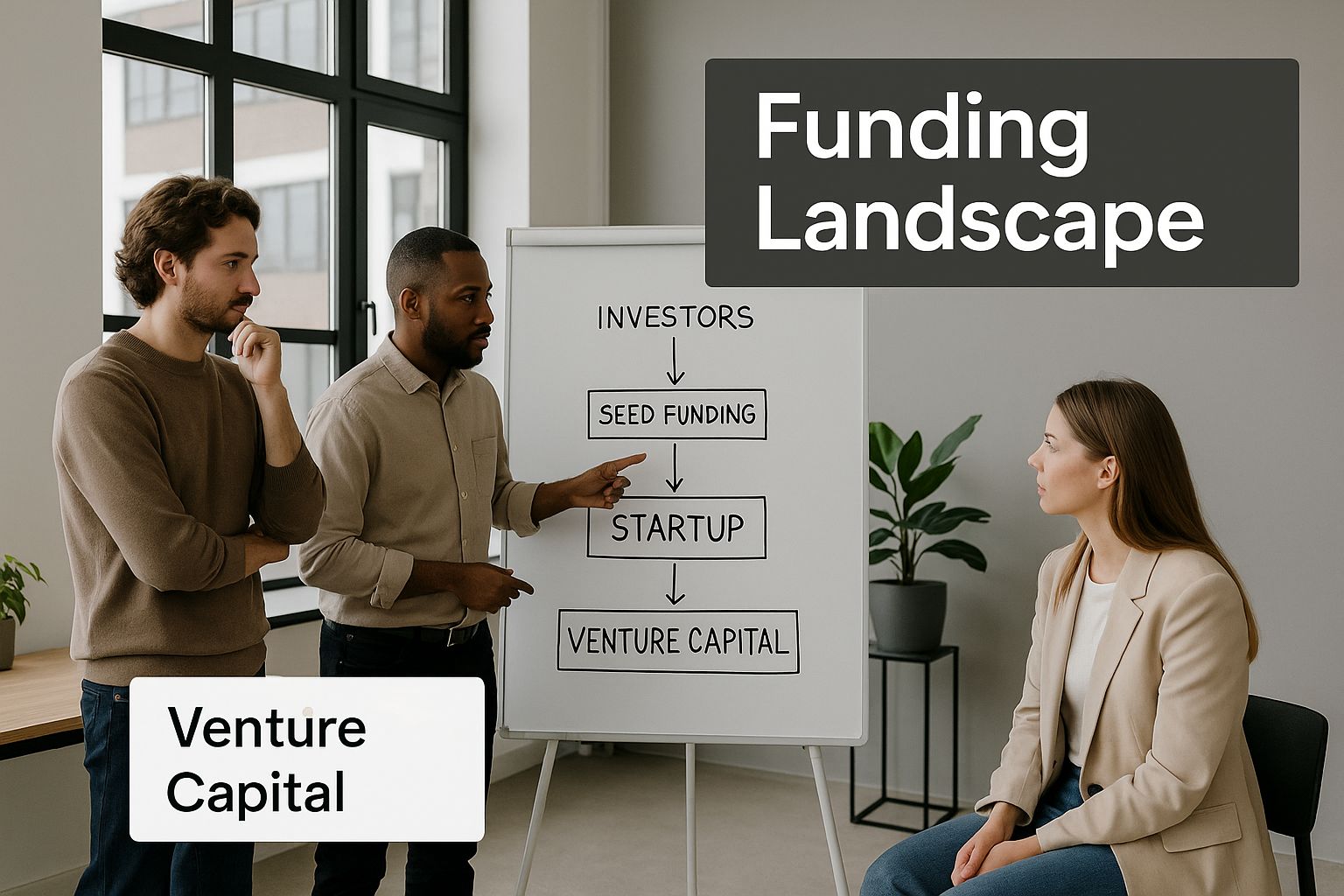
This visual shows how each stage builds on the last, demanding a strategic, forward-thinking approach to fundraising. To help you get organized, here’s a quick look at the main funding types and where they fit in.
Startup Funding Options at a Glance
This table provides a high-level overview, categorizing the primary funding types by their typical stage, source, and strategic use case.
| Funding Type | Typical Stage | Source of Capital | Best For |
|---|---|---|---|
| Bootstrapping | Pre-Seed/Seed | Personal Savings, Revenue | Maintaining full control, validating a business model with limited capital. |
| Friends & Family | Pre-Seed/Seed | Personal Network | Early validation and MVP development when you have a strong support system. |
| Angel Investors | Seed/Early Stage | High-Net-Worth Individuals | Gaining "smart money" (capital + mentorship) to achieve product-market fit. |
| Venture Capital | Early to Growth Stage | Institutional Investment Funds | Rapid scaling, market domination, and aggressive growth initiatives. |
| Government Grants | All Stages | Federal/State/Local Agencies | R&D, innovation in specific sectors without giving up equity. |
Use this table as your mental model as we dive deeper into each of these options, breaking down what they are, who they’re for, and what it takes to secure them.
Early-Stage Funding for Your Initial Growth
The first few months of a startup are a whirlwind of high risk and even higher ambition. This is where an idea needs its first cash injection to become something tangible. The funding options at this stage are usually more personal and foundational, leaning on close relationships and belief in the founder's vision rather than hard metrics.
This initial money is the lifeblood that fuels the journey from a concept scribbled on a napkin to a minimum viable product (MVP) that early adopters can use.

Let's walk through this with a composite founder we'll call Anya. She has an idea for a SaaS platform to help small businesses manage their inventory. She has the technical expertise but needs capital to launch the company.
The Bootstrapping Phase
Anya's first move is bootstrapping—the art of self-funding the business. She pulls from her personal savings to cover foundational costs like web hosting and software licenses, dedicating her nights and weekends to building the first version of the platform.
The primary benefit of bootstrapping is maintaining 100% ownership and control. Every decision is hers, with no investors to answer to. This forces a culture of resourcefulness and a laser focus on building a revenue-generating product from day one. The tradeoff, however, is nearly always speed, as personal funds are finite.
The Friends and Family Round
After six months, Anya has a working MVP. To get it in front of real users and fund a small marketing push, she pursues a friends and family round, raising $25,000 from her parents and a former colleague who believe in her vision.
The investment is structured as a convertible note—a common instrument for early-stage startups that defers the valuation discussion.
A friends and family round is built on trust. It is critical to treat these investments with professionalism—using clear, written agreements—to protect both the business and your personal relationships.
This capital allows Anya to onboard her first ten pilot customers and start gathering crucial data. While this type of funding is often more accessible than institutional capital, it carries personal risk. Clear communication and sound legal paperwork are essential to prevent future complications.
Securing an Angel Investor
With a working product and positive user feedback, Anya is ready for the next level. She needs to hire a developer and launch a formal marketing campaign. It's time to find an angel investor—a high-net-worth individual who invests their own capital in startups in exchange for equity.
Angels often provide more than just a check; their mentorship and network access can be invaluable. Finding the right one is akin to finding a business partner. After extensive networking, Anya connects with an investor who has a track record of scaling SaaS companies. He is impressed by her early traction and agrees to invest $150,000 for a 15% stake in the company.
This "smart money" is a game-changer. Here’s what it unlocks:
- Expert Guidance: The angel provides strategic advice on her product roadmap and go-to-market strategy.
- Expanded Network: She gains access to the investor's contacts, opening doors to potential partners and future investors.
- Credibility: Having an experienced angel on board signals to the market that her startup has significant potential.
This step is also crucial for building the narrative that will attract VCs later on. For founders looking to build on this kind of momentum, it's a perfect time to learn how to use media coverage to accelerate fundraising rounds, turning early wins into powerful leverage.
The main downside is dilution—Anya now owns less of her company. But the trade-off is that she has a slice of a much larger, more valuable pie. Each of these funding steps served a specific purpose on Anya's journey, setting the stage for bigger investment rounds to come.
Demystifying the Venture Capital Process
Venture capital (VC) often seems like an exclusive, high-stakes club, but it is a structured process that can be navigated with the right preparation. It's one of the most powerful funding options for startups, providing the fuel needed for ambitious, high-speed growth.
Unlike an angel investor writing a personal check, venture capital comes from large, institutional funds that manage money for limited partners. Their goal is to back startups capable of delivering exponential returns. VCs aren't looking for businesses that can simply compete; they are hunting for companies with the potential to dominate a market. Understanding this mindset is the first step to a productive conversation.
The Stages of Venture Capital Funding
The VC journey is a series of distinct funding rounds, each tied to specific milestones. Think of it like leveling up in a video game—you must clear one stage to unlock the resources for the next, and the stakes get higher each time.
- Seed Round: While angels are common here, VCs are increasingly active at this stage. Investors are betting on the founding team, the vision, and early signs of market demand. A compelling proof of concept is key.
- Series A: This is where you must prove product-market fit—that magical moment when your product resonates with a clearly defined customer base. Investors need to see a repeatable, scalable sales process and hard evidence of customer demand.
- Series B: The game shifts from proving the model to scaling it aggressively. This capital is for capturing market share, expanding the team, and investing heavily in sales and marketing. Predictable revenue is a non-negotiable requirement.
- Series C and Beyond: These later rounds are about cementing market leadership and preparing for a major exit, such as an IPO or acquisition. The investment amounts become significantly larger, and the focus is on optimizing the business for maximum growth and efficiency.
This step-by-step process aligns with the scaling financial needs of a startup. According to Investopedia, a seed round might range from $500,000 to $2 million, while a Series A can be $2 million to $15 million. By the time a company hits Series C, it could be raising $50 million or more to fuel global ambitions. You can dig into more of these startup funding trends in this comprehensive guide.
Preparing Your Pitch and Data Room
Securing a meeting with a VC is one thing; securing funding is another. To cross the finish line, you need a powerful story backed by solid evidence.
Your pitch deck is your narrative. It must be a clear, concise, and persuasive story that explains the problem you’re solving, why your solution is uniquely positioned to win, and how you will build a massive business.
The data room is your evidence. It’s a secure online folder containing all the documents a VC needs for due diligence. A clean, well-organized data room signals professionalism and preparedness for serious investment discussions.
A great pitch gets you in the door, but a disorganized data room can kill the deal. Investors look for founders who are not only visionary but also meticulous and prepared for scrutiny.
Key Elements of a Strong Data Room
- Financials: Detailed financial models, historical statements, and realistic future projections.
- Team Information: Biographies for key personnel and a clear organizational chart.
- Product Details: Demos, technical documentation, and the product roadmap.
- Legal Documents: Incorporation papers, your capitalization (cap) table, and any intellectual property (IP) filings.
- Market Analysis: Research on market size, competitors, and customer profiles.
Once you’ve made your case, the next step is the term sheet—a non-binding document outlining the proposed terms of the investment. It covers valuation, the investment amount, board seats, and various investor rights. Understanding these terms is critical, as they will define your relationship with your investors for years to come.
A great pitch deck is your entry ticket, but investors evaluate the whole picture. To better understand their mindset, explore our guide on what venture capitalists look for beyond the pitch deck. Arming yourself with that knowledge will give you the confidence to negotiate a deal that serves your long-term vision.
Alternative Funding Paths Beyond Traditional Equity
While venture capital gets the headlines, it is not the only path to building a great company. For many startups, it isn't even the right one. Numerous powerful funding options exist that don't involve selling equity. These non-dilutive paths provide necessary capital while allowing founders to retain full ownership and control.
Exploring routes beyond traditional VC can be a game-changer. It provides cash to prove your market and extend your runway without diluting your stake. For founders whose businesses don't fit the hyper-growth, "unicorn-or-bust" model, these alternatives are often a perfect strategic fit.

Leveraging Government Grants and Public Funding
Government grants are non-repayable funds awarded to support projects that serve a public good. Federal, state, and local agencies offer this capital to startups focused on innovation in fields like technology, scientific research, or clean energy. The evaluation is based less on potential valuation and more on the real-world impact of your work.
The application process can be rigorous, often demanding detailed proposals and budgets. However, the reward is capital with no strings attached. You don't give up equity, and you don't have to pay it back.
A grant is more than "free money"—it's a powerful stamp of approval on your mission or technology. Winning a competitive grant provides instant credibility that can open doors with future investors, partners, and customers.
The Strategic Use of Venture Debt
For startups that have already secured an equity round, venture debt is an excellent tool. It's a type of loan from specialized lenders designed for venture-backed, pre-profitability companies. It serves as a capital injection to extend your runway between funding rounds without further dilution.
Unlike traditional banks, venture debt lenders are comfortable with risk because they're betting on your future growth, with your VC backing acting as a form of validation. It’s an ideal way to finance specific growth milestones—like purchasing key equipment or funding a major marketing campaign—before raising your next equity round.
Harnessing the Power of the Crowd
Crowdfunding has evolved into a legitimate funding source that allows you to raise capital directly from hundreds or thousands of individuals. Beyond the money, it is a powerful way to validate your product and build a loyal community of early adopters who are invested in your success.
There are two primary models:
- Reward-Based Crowdfunding: Platforms like Kickstarter and Indiegogo facilitate this model. You offer backers a reward—such as early access to the product—in exchange for their financial support. It is ideal for consumer product companies needing capital for their first manufacturing run.
- Equity Crowdfunding: This approach allows unaccredited investors to purchase a small ownership stake in your company, democratizing startup investing and turning passionate customers into brand advocates with skin in the game.
Exploring Revenue-Based Financing
For SaaS companies or businesses with predictable, recurring revenue, revenue-based financing (RBF) is a compelling option. Instead of selling equity, you receive a lump sum of cash upfront. You then repay the financing over time by remitting a small, fixed percentage of your monthly revenue.
This model aligns the lender's success with yours. When you have a strong month, they are repaid faster; if revenue dips, your payment adjusts accordingly. This flexibility makes RBF an attractive choice for founders who want to accelerate growth without the intense pressure and loss of control associated with venture capital.
Comparing Traditional vs Alternative Funding
To fully understand the differences, it helps to see these options side-by-side. Each path comes with its own set of trade-offs, from corporate control to repayment terms. The table below breaks down the key characteristics.
| Characteristic | Venture Capital | Venture Debt | Grants | Crowdfunding |
|---|---|---|---|---|
| Source of Funds | Institutional investors (VC firms) | Specialized lenders, banks | Government agencies, foundations | General public, individuals |
| What You Give Up | Equity (ownership) and a board seat | No equity; requires interest payments | No equity, but requires strict reporting | Rewards, product pre-orders, or small equity stakes |
| Control | Significant investor influence and oversight | Founder retains full operational control | Founder retains full control | Minimal to no investor influence |
| Best For | High-growth, scalable startups with huge market potential | VC-backed companies needing bridge financing | Mission-driven or R&D-heavy projects | Consumer products and community-driven brands |
| Repayment | No direct repayment; investors exit via acquisition or IPO | Principal + interest payments over a set term | None; funds are non-repayable | Varies (rewards fulfilled or dividends from equity) |
Ultimately, the right choice depends on your business model, growth ambitions, and how much control you wish to maintain. There is no single "best" answer, only the best fit for your unique journey.
The Global Context of Startup Investment
Where you raise money can be as important as how you raise it. The global investment landscape is not a monolith but a patchwork of distinct ecosystems, each with its own culture, industry focus, and network density. A founder’s journey is often shaped by their location.
Understanding these regional dynamics is essential. Established hubs like Silicon Valley and London offer unparalleled access to capital and talent but are hyper-competitive. In contrast, emerging ecosystems often provide unique advantages, such as government support and a focus on specific high-growth sectors.
Established Hubs vs. Emerging Ecosystems
Silicon Valley has long been the epicenter of venture capital, known for its risk-tolerant culture and deep investor networks. London, a global financial center, is a powerhouse for fintech and SaaS. These mature hubs provide infrastructure that can accelerate growth, but gaining entry requires a strong network and a truly differentiated idea.
Meanwhile, emerging ecosystems are rapidly gaining ground. Cities like Paris and Bengaluru-Karnataka are becoming serious contenders, fueled by exceptional tech talent and growing pools of local and international capital. These regions often offer a lower cost of operations and access to unique market opportunities—a strategic advantage for the right startup.
The global pecking order is constantly shifting. The Global Startup Ecosystem Report 2025, which analyzed data from over 5 million startups, highlights this dynamism. London slipped to 3rd place globally, while Boston re-entered the top five. Paris climbed to 12th, driven by a surge in unicorns and early-stage funding, and Bengaluru-Karnataka jumped seven spots to 14th. You can explore more of these geographic funding dynamics in the full report.
The Rise of Remote Investment
The post-pandemic era accelerated the trend of remote investment, breaking down some traditional geographic barriers. VCs are now more willing to fund companies outside of established tech hubs, driven by new collaboration technologies and a search for untapped talent.
This presents a massive opportunity for founders everywhere. However, location has not become irrelevant. Investor networks remain heavily regional, and a local connection can still be a deciding factor.
Remote investment is democratizing access to capital, but it doesn’t erase the need for smart networking. Founders outside the major hubs must be more intentional about building relationships, whether through virtual meetings or strategic in-person travel.
The key takeaway is that your location should be a strategic decision. For some, relocating to a major hub to immerse themselves in a dense network is the right move. For others, leveraging remote investment trends from their current location is more capital-efficient. The key is to understand the trade-offs and ensure your geographic strategy aligns with your business goals and the latest investor trends driving startup valuations. Your headquarters is no longer just an address; it's a critical part of your fundraising narrative.
How to Choose the Right Funding for Your Startup
You've reviewed the menu of funding options. Now comes the most critical step: making the right choice. There is no single “best” way to fund a startup. The only thing that matters is finding the path that is right for your company and your vision. This decision requires a brutally honest assessment of your goals, risk tolerance, and the type of business you are building.
A sound funding strategy begins with asking the right questions. It is about moving beyond a simple pros-and-cons list to consider how your capital plan will either fuel or conflict with your long-term vision. Getting this right leads to partners who support your goals, not ones who impede them.
Key Questions Every Founder Must Answer
Before writing a pitch deck or taking a meeting, you must gain clarity on your startup’s position and your own ambitions. Your answers will serve as a compass, pointing you toward the right kind of capital.
- What is the end game? Are you aiming for hyper-growth and market domination, a path that almost always requires significant outside capital? Or are you building a sustainable, profitable business where you retain control? Venture capital is rocket fuel for speed; bootstrapping is the path to autonomy.
- How much control are you willing to give up? Every dollar of equity financing costs you a piece of your company and a degree of control. Be honest with yourself: are you prepared to answer to a board and incorporate investor feedback?
- Where are you in your journey? Your startup's maturity is a major factor. A pre-revenue, "idea-on-a-napkin" concept is best suited for bootstrapping or a friends and family round. A company with proven product-market fit is positioned to talk to VCs.
- What is the capital for? Do you need a massive war chest for a global launch, or just enough cash to extend your runway for six months? The amount you need to raise will immediately narrow your options.
The goal isn’t just to get funded—it’s to get the right funding. Taking VC money for a slow-and-steady lifestyle business is a classic mistake. It creates a fundamental misalignment of expectations that almost always leads to conflict.
Making the Final Decision
Remember that geography plays a role. In 2024, global tech startup investment reached a massive $337 billion. While hubs like the San Francisco Bay Area captured a large share, capital is flowing globally. Smaller, dynamic ecosystems in places like Singapore and Switzerland are punching above their weight in VC investment per capita. This demonstrates that great companies can find capital anywhere. To dive deeper, check out the latest global startup funding trends on Dealroom.co.
In the end, choosing your funding path is a deliberate process of matching your startup’s DNA with a capital source that understands your mission. Use the questions above as a framework to build a clear profile of your needs. With that clarity, you can confidently pursue the funding that aligns with your vision and find financial partners who will feel more like allies than just investors.
Frequently Asked Questions About Startup Funding
Navigating the world of startup finance can feel overwhelming, with new questions arising constantly. Understanding common terms and expectations is critical, as these early decisions will shape your company’s future for years to come.
Here are answers to some of the most common questions founders have about funding.
How Much Equity Should I Give Away in a Seed Round?
This is a critical question. A typical seed round involves selling between 15% and 25% of your company. This range represents a balance between securing enough capital to reach your next milestones and protecting your own equity for future rounds.
Factors that influence this percentage include your team's track record, early traction, and the size of your target market. Giving away too much equity early on can lead to heavy dilution, making it difficult to raise subsequent rounds. Future investors may view a diluted cap table as a sign that the founders lack sufficient motivation.
What Is the Difference Between Pre-Money and Post-Money Valuation?
These two terms are foundational to understanding how an investment impacts your ownership.
Pre-Money Valuation: This is your startup's value before an investor's capital is added. It is the agreed-upon worth of the company based on its progress to date.
Post-Money Valuation: This is the company's value after the investment is made. It is calculated by adding the investment amount to the pre-money valuation.
For example, if an investor contributes $500,000 at a $2 million pre-money valuation, the post-money valuation becomes $2.5 million. The investor’s $500,000 now represents a 20% stake in the newly valued company ($500,000 / $2.5 million).
Can I Combine Different Types of Funding?
Absolutely—and it is often a highly strategic move. A hybrid approach, where you combine different funding sources, can create a more resilient financial foundation. This allows you to leverage the strengths of each option while mitigating the weaknesses of relying on a single source.
For instance, you could secure a non-dilutive government grant for R&D while simultaneously raising an angel round to fund sales and marketing. Another common strategy is using venture debt to supplement a Series A equity round. This provides extra capital to extend your runway without further diluting your equity, giving you more time and flexibility to scale. Layering capital in this way demonstrates financial savvy to future investors.
At Spotlight on Startups, our mission is to provide the clarity and practical insights you need to navigate every stage of your entrepreneurial journey. From deep dives into funding to frameworks for founder excellence, we are your resource for building something remarkable. Explore more expert guidance at spotlightonstartups.com.