
Before you can build a product, craft a marketing message, or pitch an investor, you must answer the most fundamental question in business: *Who is this for?
How to Identify Your Target Market: An OC Founder’s Guide to Startup Growth
Before you can build a product, craft a marketing message, or pitch an investor, you must answer the most fundamental question in business: Who is this for? Identifying your target market is the strategic process of defining the specific group of consumers most likely to buy your product or service. For founders, this isn’t about guesswork; it’s a deliberate framework for research, segmentation, and validation that ensures your product, marketing, and entire growth strategy are aimed at the right target.
This guide provides a practical, step-by-step approach for startups to move from a vague idea to a crystal-clear picture of their ideal customer—a critical step for securing funding and achieving scalable growth.
Why a Niche Target Market is Mission-Critical for Startups

In the hyper-competitive Orange County startup ecosystem, one phrase signals immediate trouble: “Our product is for everyone.” That’s not just a marketing mistake; it’s a surefire way to burn through seed funding with almost nothing to show for it.
Knowing your target market isn’t just a task on a launch checklist. It’s the foundational decision that influences every other choice you’ll make, from product features and pricing strategy to your customer acquisition channels. Without that sharp focus, your efforts are diluted, your message falls flat, and your capital disappears.
The High Cost of a Blurry Target: An OC Case Study
I’ve seen this play out firsthand. Take the story of an OC-based SaaS company I advised. They had a slick new project management tool and were convinced any small or medium-sized business (SMB) would jump at it.
They poured over 60% of their seed round into broad digital ad campaigns targeting generic “business owners” across Southern California. The results were predictable: a sky-high burn rate, dismal conversion numbers, and a product that, by trying to be everything to everyone, was perfect for no one.
After a tough board meeting, they paused all marketing to re-evaluate. By interviewing their few loyal customers, they had a breakthrough. Their ideal users weren’t just any SMB. They were architecture and engineering firms with fewer than 50 employees who had a very specific, frustrating workflow problem that the software happened to solve beautifully.
By shifting from a vague “SMB” target to this tight niche, everything changed. They refined the product, rewrote their messaging to focus on industry pain points, and focused their ad spend with surgical precision. The result? Their customer acquisition cost (CAC) plummeted by over 70%, and they finally gained the traction needed to close their next funding round.
This isn’t a one-off story; it’s a classic lesson in founder excellence. A well-defined market gives you the clarity to make crucial decisions with confidence.
With it, you can:
- Build a Product People Need: You’re solving real, urgent problems for a specific audience, leading to higher product-market fit.
- Optimize Your Marketing Spend: Every dollar is spent reaching people who actually have the problem you solve, drastically improving your return on investment (ROI).
- Create a Message That Resonates: You can speak directly to the pain points, ambitions, and language of a specific group, forging a deeper connection and building brand authority.
- Carve Out a Defensible Niche: While competitors cast a wide, expensive net, you can dominate a specific segment and build an unshakeable base of loyal customers.
How to Identify Your Target Market with Segmentation

You know you need to focus. So how do you actually do it? The next step is to break the broad market into smaller, more manageable pieces. This is the work of market segmentation—sorting a large, anonymous crowd into distinct groups based on shared characteristics.
For a startup, this isn’t a fluffy marketing exercise. It’s a core component of your growth strategy. You’re trying to build something that a specific group of people will absolutely love, and you can’t do that if you don’t know who they are. The goal is to layer different data types to create a rich, multi-dimensional picture of who they are, where they are, why they buy, and how they behave.
The Four Core Layers of Segmentation
To build a robust customer profile, you need to analyze your market through four different lenses. It’s the combination of these views that provides a sharp, actionable picture.
- Demographic Segmentation (The “Who”)
This is the starting point. It groups people based on objective, statistical data. For a B2C startup, this includes age, gender, income, and education level. For a B2B SaaS company in Orange County, this means looking at firmographics: industry, company size, annual revenue, and the job titles of key decision-makers. - Geographic Segmentation (The “Where”)
This is simple but powerful: where are your customers located? For a local OC service business, you might target companies within the Irvine Spectrum or near John Wayne Airport. For a national e-commerce brand, this could mean focusing on major cities versus rural areas. - Psychographic Segmentation (The “Why”)
Now we get into what makes your customers tick. Psychographics cover their lifestyles, values, interests, and personalities. Are they early adopters who value innovation? Do they make buying decisions based on sustainability? Answering this helps you craft a brand story that connects on an emotional level. - Behavioral Segmentation (The “How”)
This is about what your customers do. It groups people based on their actions—their buying habits, product usage frequency, brand loyalty, and the specific benefits they seek. A software company, for example, could segment users into “power users” who leverage advanced features and “casual users” who stick to the basics.
Finding Data Without a Big Budget
Good news: you don’t need a massive research budget. Early-stage founders can gather significant information from accessible, often free, sources.
Here are a few ways to get started:
- Public Data: Government sites like the U.S. Census Bureau are gold mines for demographic and geographic data. Industry associations and trade publications also release reports with valuable market insights.
- Website & Social Analytics: Tools like Google Analytics reveal the demographics and interests of your site visitors. Your social media pages have similar audience insight tools that show you who’s engaging with your content.
- Customer Surveys: A simple survey on SurveyMonkey or Google Forms can provide direct psychographic and behavioral data from your first users or potential customers.
The real power comes from combining these layers. Knowing your target is a 35-year-old marketing manager is a start. But knowing she works in B2B tech in Irvine (geographic), values efficiency and career growth (psychographic), and has churned through three project management tools in the last year (behavioral)? That’s a game-changer.
From Smart Segments to Startup Growth
This detailed approach directly impacts your bottom line. According to McKinsey, companies that excel at personalization generate 40% more revenue from those activities than average players. They achieve this by using a precise targeting strategy built on a mix of demographic, psychographic, and behavioral insights.
By moving from broad guesses to data-backed segments, you’re building the foundation for a go-to-market strategy that works. Dive deeper into these tactics in our complete guide to market research for startups. Next, we’ll turn these segments into a vivid, validated profile of your ideal customer.
Building and Validating Your Ideal Customer Profile (ICP)

You’ve carved out your market segments. Now it’s time to get personal and bring your ideal customer to life. We’re moving beyond broad categories to build a crystal-clear portrait of your Ideal Customer Profile (ICP).
An ICP isn’t just a list of demographics. It’s a living document detailing the deepest frustrations, daily workflows, and core motivations of the perfect customer for your solution. Think of it this way: your market segment is the neighborhood, but your ICP is the specific house you’re knocking on. For an Orange County startup, this means you don’t just target “tech companies.” You target the VP of Engineering at a mid-stage SaaS company in Irvine who is struggling to retain top talent.
But here’s the catch: a profile built on assumptions is a house of cards. Until you validate it with real people, it’s just an educated guess. Validation is where you test your hypothesis—on a shoestring budget—to confirm you’re solving an urgent problem for a real audience.
From Hypothesis to Human Insight
The first rule of validation? Get out of the building. Your theories about customer pain points rarely survive first contact with reality. The goal is to gather qualitative data—the stories, emotions, and direct quotes that a dashboard will never show you.
And you don’t need a huge budget for this, just some hustle.
- Go Where They Are: Attend tech meetups in Irvine or Costa Mesa. Don’t pitch. Instead, ask open-ended questions about the challenges people in your target role are facing. Your only job is to listen.
- Tap Your Network: Use LinkedIn to find professionals who fit your ICP. A simple message asking for 15 minutes for “market research” goes a long way. Most people are happy to share their expertise if you approach them with genuine curiosity.
- Mine Competitor Reviews: Scour sites like G2, Capterra, and Reddit for reviews of competing products. The one-star and five-star reviews are pure gold—they expose what customers either love or desperately wish was different.
Running Lean Validation Experiments
Once you have some qualitative insights, you can start testing your assumptions more quantitatively. This is about seeing if people will take a small action that signals genuine interest.
A classic method is the landing page test. Create a simple, one-page website that spells out your value proposition for that specific ICP. Drive traffic to it with a small, hyper-targeted ad campaign on Google or LinkedIn. For an OC-based B2B startup, you could target ads to specific job titles at companies within a 10-mile radius of the Irvine Spectrum.
The key metric isn’t clicks; it’s conversions. Did they sign up for an early-access email list? That’s a powerful signal that your message is hitting home.
This level of detailed profiling isn’t just a “nice-to-have.” According to Investopedia, 81% of consumers are more likely to buy from brands that understand them. Startups that want to keep a constant pulse on their customers often form an inner circle of early adopters. Learn how to structure this by creating effective customer advisory boards in our detailed guide.
Customer Profile Validation Methods
Testing your ICP doesn’t have to be expensive. In fact, some of the most effective methods are free. Here’s a quick comparison of a few low-cost techniques you can use right away.
| Method | Primary Goal | Tools/Resources | Cost Level |
|---|---|---|---|
| Customer Interviews | Gather deep qualitative insights and “day in the life” stories. | LinkedIn, personal network, local meetups | Low |
| Online Surveys | Quantify pain points and priorities across a larger group. | SurveyMonkey, Google Forms, Typeform | Low to Medium |
| Landing Page Test | Measure intent by testing if people will “sign up” for a solution. | Carrd, Webflow, Google/LinkedIn Ads | Low to Medium |
| Competitor Analysis | Identify gaps and “must-have” features from existing solutions. | G2, Capterra, Reddit, software review sites | Free |
Each of these methods gives you another piece of the puzzle. Combining a few of them will give you a much more robust and defensible picture of who you’re building for.
Founder Takeaway: Validation isn’t a one-time event; it’s a continuous feedback loop. Your first ICP is a draft. With every interview, survey response, and landing page click, you refine it, making it sharper and more accurate. This iterative process is what separates startups that build something people might use from those that build something people can’t live without.
Using Tech and AI to Sharpen Your Market Focus
Gut instinct and manual research will only get you so far. Today, founders have an incredible advantage: a suite of tools that can put your market identification process on steroids. This isn’t just about moving faster; it’s about seeing patterns and opportunities that are otherwise invisible.
Even lean startups can access powerful technology that turns educated guesses into data-backed certainties. Platforms that once cost a fortune are now accessible, helping you make smarter decisions and stay ahead of the curve.
Uncovering Behavioral Gold in Your Data
One of the best tools you have is likely already running: your own website analytics. Platforms like Google Analytics are more than just visitor counters; they’re a direct window into the minds of your potential customers.
You can watch how people behave. What pages do they linger on? Where did they come from? What’s their journey before they click away? This is a goldmine for refining your ICP. For instance, if you notice a spike in visitors from the manufacturing industry all downloading the same case study, that’s a massive clue pointing to a niche with a burning problem you can solve.
Competitive Intelligence Through a Digital Lens
A huge part of knowing your market is knowing who your competitors are chasing. You don’t have to guess. Competitive intelligence tools like Semrush or Ahrefs are like a periscope into your rivals’ entire digital strategy.
With a few clicks, you can see which keywords they’re targeting, what content is driving their traffic, and the demographic profile of their audience. If you discover a competitor is pouring ad spend into targeting “financial planners in Newport Beach,” you’ve just found a segment they consider highly valuable. That insight is powerful—you can decide to go head-to-head or, even better, find an underserved niche they’re completely ignoring.
AI as Your Market Research Co-Pilot
Artificial intelligence isn’t a far-off concept anymore; it’s a practical, hands-on tool for founders. AI-powered platforms can sift through thousands of online conversations, customer reviews, and social media comments in minutes, pulling out recurring themes and sentiment trends you’d never spot on your own.
Imagine knowing, almost instantly, the top three things customers hate about your competitor’s product. Think about analyzing forum threads to hear the exact language your audience uses to describe their pain points. This gives you an almost unfair advantage in crafting messaging that resonates every single time.
AI and big data analytics are completely changing the game for market segmentation. Startups can now process incredibly complex data with speed and precision, turning raw information into a clear strategic path.
Leaning on these modern tools is fast becoming a matter of survival. As Gartner points out, AI could boost business productivity by as much as 40% by enabling smarter marketing decisions. For a deeper dive, check out this in-depth analysis of emerging techniques.
By building a simple tech stack to sharpen your market focus, you’re not just saving time—you’re building a more resilient, intelligent business. In a crowded market, this strategic use of AI becomes a real differentiator and a crucial part of building AI defensibility for startups.
Sizing Your Market: Speaking the Language of Investors
You’ve identified a promising market. That’s a massive win. But for a founder seeking investment—especially in a competitive hub like Orange County—you’ve only solved half the puzzle.
The next question any investor will ask is, “Okay, but how big is the opportunity?” They need to see that your idea can become a venture-scale business. This isn’t just about having a great concept; it’s about proving the financial runway is long enough to justify their risk. Market sizing takes your vision and translates it into the language investors speak: dollars and cents.
Understanding TAM, SAM, and SOM
To make a compelling case, you must show investors you understand your market from every angle. The industry-standard framework for this is TAM, SAM, and SOM. Think of it as showing the whole universe, then your galaxy, then the star system you plan to conquer first.
- Total Addressable Market (TAM): This is the total global demand for a product or service if you faced zero competition. It’s the theoretical ceiling, the absolute maximum potential for your idea.
- Serviceable Addressable Market (SAM): This is your slice of that giant pie—the portion of the TAM you can realistically serve with your product, limited by factors like geography, language, or industry focus. This is your playground.
- Serviceable Obtainable Market (SOM): This is the piece of your SAM you can realistically capture in the near future. It accounts for your team, resources, business model, and the competitors breathing down your neck.
Investors know you won’t capture 100% of the TAM. They’re looking for a logical, well-researched story that moves from a massive market (TAM) down to a believable, achievable starting point (SOM). A huge TAM shows ambition, but a credible SOM shows you have a plan.
How to Calculate Your Market Size: Top-Down vs. Bottom-Up
There are two primary ways to approach this: top-down and bottom-up. While top-down can provide broad context, it’s the bottom-up math that will earn you credibility with investors.
Top-Down Analysis
This is the quick-and-dirty method. You start with a big market report from a source like Gartner or Forrester, find a massive number, and carve it up. For example, starting with the $200 billion global market for CRM software and claiming you’re targeting a small percentage. It’s easy, but it often comes across as lazy because it’s built on broad assumptions.
Bottom-Up Analysis
This is the gold standard. You build your market size from the ground up, starting with your actual potential customers.
The formula is simple:
Market Size = (Number of Potential Customers) x (Average Annual Price of Your Product)
The power of this method is that it forces you to get specific. How many companies fit your ICP? What’s a realistic price they’d be willing to pay? It’s more work, but the number you end up with is far more defensible and believable.
A Founder’s Story from Orange County
I worked with a B2B SaaS startup out of Irvine that learned this lesson the hard way. They had built an amazing compliance management tool for small and mid-sized biotech firms.
In their first pitch deck, they used a top-down analysis, claiming a sliver of the multi-billion-dollar global compliance software market. The investors were polite, but you could see the skepticism.
They went back to the drawing board and built a bottom-up model. Using industry databases, they identified the exact number of biotech firms in the U.S. with 50-250 employees—that became their SAM. From there, they calculated a SOM based on capturing just 5% of that market within three years at their proposed subscription price.
The difference was night and day. This detailed, bottom-up calculation transformed their fundraising conversations. It proved they had done the gritty work to truly understand their niche. It gave investors confidence that the opportunity wasn’t an abstract number but a tangible, achievable goal. That precision was a key factor in them successfully closing their seed round.
Bringing It All Together: Your Go-to-Market Blueprint
You’ve done the hard work. You’ve moved from a broad concept to a sharp, actionable strategy for identifying your target market. This process—from initial segmentation and customer validation to using tech and sizing the opportunity—is the bedrock of your startup’s success. Think of it as your final pre-flight check before you start pouring serious capital into customer acquisition.
With this clarity, every decision gets easier. You can confidently build a product with features that solve real, validated problems. Your marketing will connect because it speaks the language of an audience you now understand inside and out.
Market Discovery is a Loop, Not a Line
Remember: this process isn’t a one-and-done task. Defining your TAM and validating your ICP is a continuous cycle of learning and tweaking. Markets shift, customers evolve, and your understanding must keep pace.
This framework visualizes how you narrow your focus from the entire universe of potential customers down to the ones you can win right now.
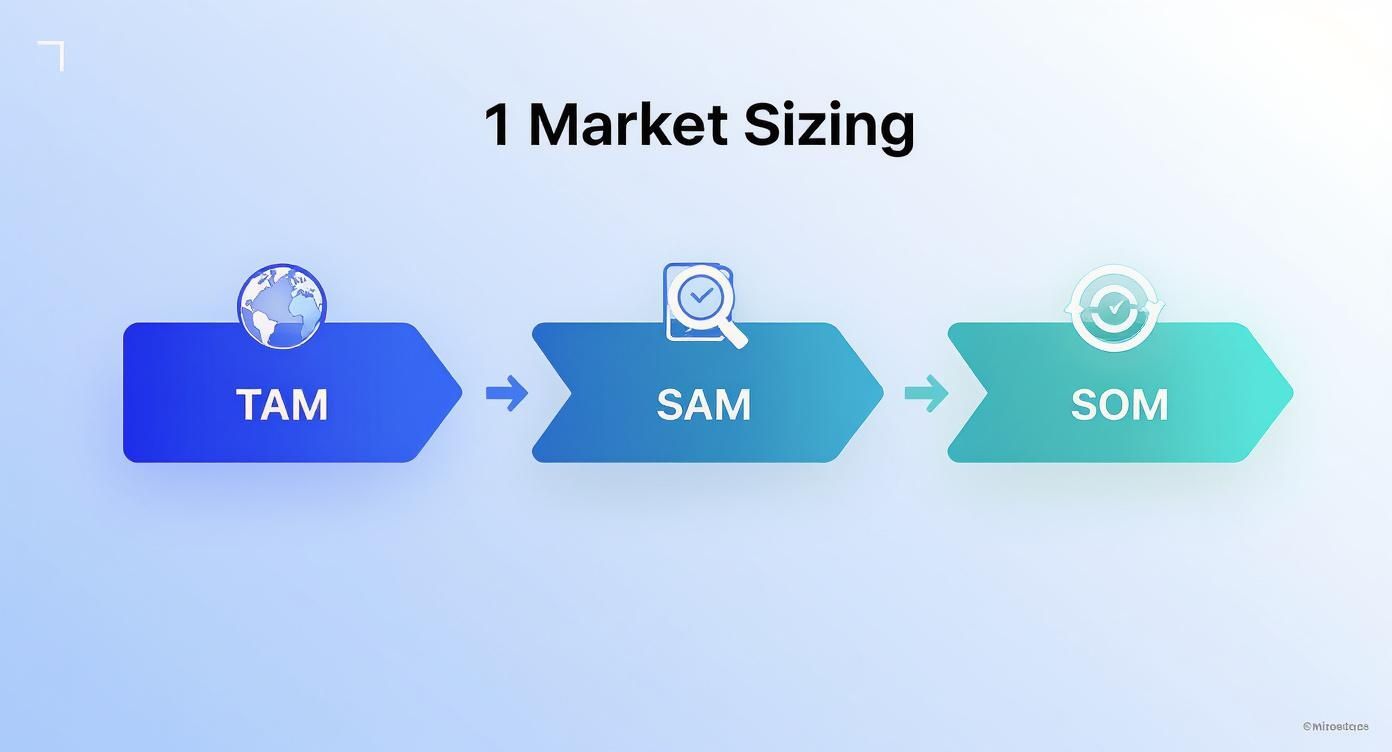
The flow is simple but powerful. You start with the giant Total Addressable Market (TAM), narrow it to the slice you can realistically serve (Serviceable Addressable Market or SAM), and then zero in on the Serviceable Obtainable Market (SOM)—the piece you can actually capture in the near term.
Founder Takeaway: The best founders treat their target market not as a static destination but as a living hypothesis. You must constantly listen, challenge your assumptions, and be ready to adapt based on real-world data.
This disciplined approach means you’re not just throwing a product into the world and hoping it sticks. You’re launching a genuine solution into a market that’s ready and waiting for it.
So, whether you’re building your MVP, scripting your first ad campaign, or walking into a pitch meeting with Orange County investors, you’ll do it with unshakeable, data-backed confidence. Your greatest asset isn’t just your idea; it’s your ability to articulate exactly who your customer is and why your startup is the one they’ve been waiting for.
Common Questions About Identifying Your Target Market
Even with a solid framework, defining your target market isn’t always a straight line. Founders often run into the same roadblocks. Here are some of the most frequent questions we hear from the Orange County startup community.
How Often Should We Re-evaluate Our Target Market?
Think of your initial target market as a living hypothesis. For early-stage startups still seeking product-market fit, you should be revisiting it constantly. A quarterly review is a good rhythm. You should also do a deep dive after any significant event, like a product launch, a major pivot, or after getting revealing customer feedback.
Once you achieve product-market fit and have a more stable customer base, you can shift to an annual strategic review. The key is to stay agile. Market feedback is your most valuable asset, so use it to keep sharpening your focus with real-world data.
What’s the Biggest Mistake Founders Make When Defining a Target Market?
Going too broad. It’s the most common and costly mistake by a long shot. Founders often have a fear of missing out (FOMO), worrying that a niche market will be too small to support their big vision. This anxiety leads them to declare their product is “for all small businesses” or “for busy professionals.” This vague approach leads to diluted messaging, wasted marketing dollars, and a product that doesn’t truly connect with anyone.
A much smarter strategy for startups is to secure a “beachhead market.” Pick a small, specific niche you can absolutely dominate. Establish a strong foothold and build intense brand loyalty there before expanding into adjacent markets.
Can My Startup Have More Than One Target Market?
Eventually, yes. But at the start? No. You must prioritize.
While your product might one day serve several customer segments, an early-stage startup lacks the resources—time, money, or focus—to chase multiple markets at once. Trying to be everything to everyone is a classic recipe for mediocrity.
The answer is disciplined prioritization. Pinpoint your primary target market—the single group with the most urgent problem that your solution is uniquely built to solve. Pour all your energy into winning them over first. Once you have a solid base of happy customers and have validated your model, then you can strategically expand into secondary markets.
At Spotlight on Startups, we provide the frameworks and insights you need to navigate these critical decisions with confidence. Explore our expert analysis to build a resilient, high-growth venture. Find out more at https://spotlightonstartups.com/.