
Think of an Orange County tech startup customer acquisition funnel as a strategic roadmap. It’s the journey someone takes from first hearing about your startup to becoming a paying customer. For a founder, this isn't just a marketing buzzword—it's a survival guide for scaling. A well-defined funnel provides a repeatable system for turning strangers into loyal customers and, just as importantly, helps you prove to investors that your business has a clear path to scalable growth.
Why Orange County Tech Startups Can't Afford to Ignore the Funnel
When you're running a startup, every dollar and every hour counts. You don't have the luxury of guessing. The customer acquisition funnel brings much-needed structure to your growth strategy, shifting you from hopeful gambles to a measured, intentional process. It’s the operational framework for building predictable revenue and a core component of your overall business model.
Instead of throwing money at ads or creating content without a clear purpose, a funnel forces you to think from your customer's perspective. What information and validation do they need at each step? This structured approach aligns your marketing and sales efforts, creating a smooth journey that builds trust and guides prospects toward making a purchase decision.
The tangible benefits for a startup are clear:
-
Smarter Spending: It shows you exactly where to allocate limited time and capital for the biggest impact at each stage of the customer journey, optimizing your Customer Acquisition Cost (CAC).
-
Predictable Growth: When you understand your conversion rates from one stage to the next, you can forecast revenue with credible accuracy. This is critical for financial planning and for building a compelling case in your investor pitches.
-
Find and Fix Leaks: The funnel acts as a diagnostic tool for your business. If you see a massive drop-off at one stage, you’ve found a leak. It could be your messaging, a clunky user experience, or a weak value proposition. This lets you patch the holes before they drain your budget.
The Reality of Tech Startup Funnel Drop-Off
Here's a hard truth every founder must accept: not everyone who enters your funnel will come out the other side as a customer. That's why it's a funnel, not a cylinder. People will naturally drop off at every step.
This visual provides a great overview of the classic stages, from a person's first glimmer of awareness to the final handshake (or checkout click).
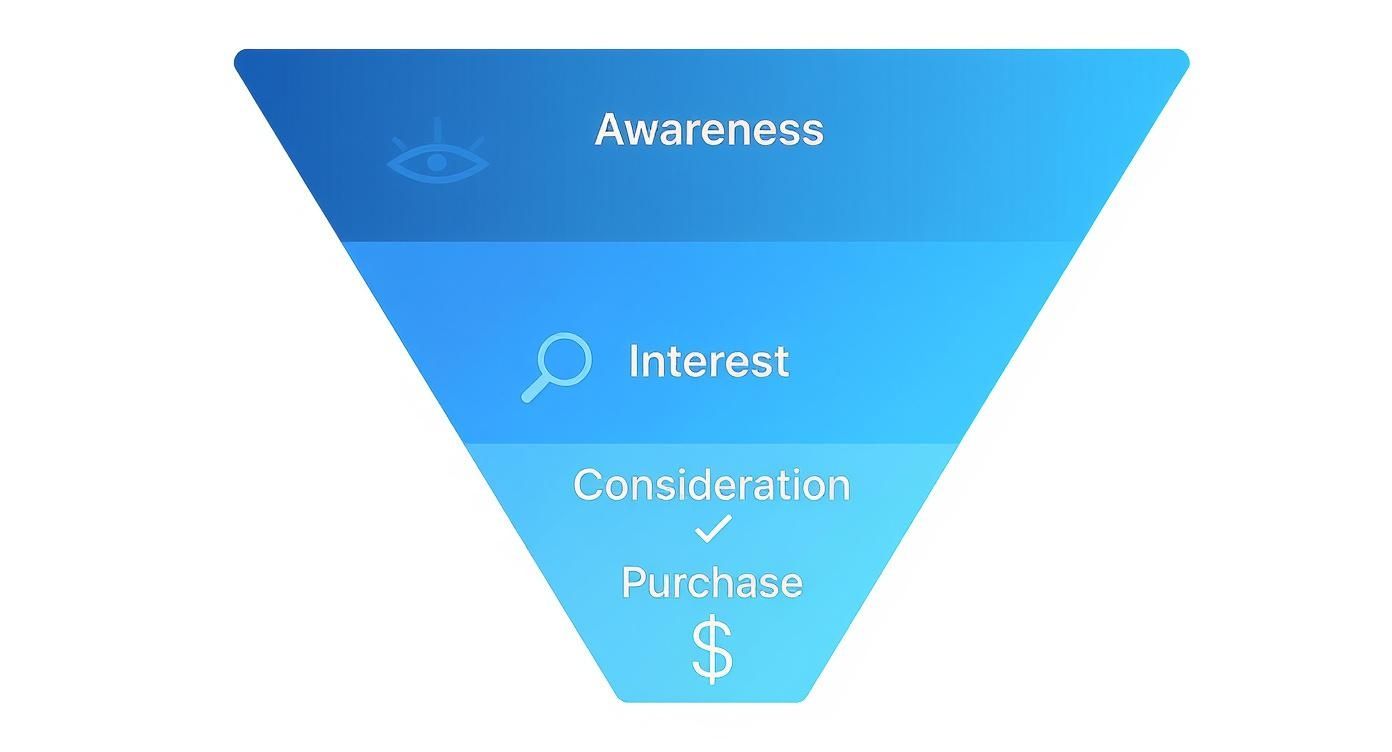
At each stage, you're filtering your audience. The top is wide to capture broad interest, but it narrows as prospects move toward a purchase decision based on intent and qualification.
The numbers really drive this point home. According to research from HubSpot, it’s not uncommon for 79% of marketing leads to never convert into sales. As you move down the funnel, you'll still see drop-offs, sometimes as high as 50% or 25% at the interest and consideration stages. In the end, you might only see 10-15% of your initial qualified leads make it all the way through. These sales funnel statistics highlight just how critical it is to optimize every single step.
To make this crystal clear, here’s a breakdown of what each stage looks like for a growing startup.
The Four Core Stages of an Orange County Tech Startup's Customer Acquisition Funnel
| Funnel Stage | Primary Goal for Startups | Example Activities |
|---|---|---|
| Awareness | Get on the radar of your ideal customer profile (ICP). | Running targeted social media campaigns, publishing SEO-optimized thought leadership content, getting featured in industry newsletters. |
| Interest | Engage them and prove you understand their core problem. | Offering a free e-book or webinar, sharing detailed case studies, creating an educational email nurture sequence. |
| Decision | Convince them that your solution is the superior choice. | Hosting a live product demo, offering a risk-free trial, providing detailed feature comparisons and customer reviews. |
| Action | Make it incredibly easy for them to convert. | Sending a clear final offer with a compelling call-to-action, creating a frictionless checkout process, providing a smooth onboarding experience. |
Understanding these stages is the first step toward building a funnel that doesn't just attract prospects, but reliably converts them into the paying customers who will fuel your growth.
Building Awareness at the Top of the Tech Startup Customer Acquisition Funnel

This is where it all begins. Think of the Awareness stage as the wide, open top of your funnel—it’s where your startup first makes contact with potential customers. The single most important goal here is simple: get on your ideal customer's radar. Before anyone can consider buying from you, they have to know you exist.
For a startup, this isn't about renting a billboard or buying a splashy TV ad. It's about being resourceful, strategic, and incredibly helpful. The objective is to draw people in by solving their problems, answering their questions, and showing up in the places they already seek information. You're earning their attention and building authority, not just paying for impressions.
This first touchpoint is your one shot at a great first impression. You're planting a seed that, with careful nurturing, will grow into brand recognition and trust.
Strategic Channels for Maximum Impact
One of the biggest mistakes early-stage companies make is trying to be everywhere at once. That's a surefire way to burn through your budget and energy with little to show for it. Instead, pick a few high-impact channels where you know your target audience spends their time.
Here are a few proven channels for startups:
-
Content Marketing: Forget the hard sell. Create genuinely useful blog posts, in-depth guides, or original reports that tackle a specific pain point your audience struggles with. This isn't just content; it's a magnet for organic traffic that positions you as an expert.
-
Foundational SEO: This is the long game that pays dividends. By optimizing your website for the keywords your customers are actually typing into Google, you build a steady, reliable stream of inbound traffic that doesn't rely on ad spend. To dig deeper, check out our guide on how to dominate your niche with hyper-local authority building.
-
Social Media Engagement: Don't just post and ghost. Jump into relevant LinkedIn groups, answer questions on forums like Reddit or Quora, and share insights that prove you understand the ecosystem. Be part of the conversation.
An Example in Action
Let’s imagine a B2B SaaS startup with a new project management tool built for remote teams. They could run ads that scream, "Buy Our Tool!" But that’s a tough sell to a cold audience.
A much smarter play? They create "The Ultimate Guide to Asynchronous Communication." It's a high-value piece of content that solves a massive headache for their exact target market.
They then share this guide in LinkedIn communities for founders, promote it in Slack channels for remote workers, and optimize it to rank on search engines. Suddenly, thousands of project managers and team leads are landing on their site.
Key Takeaway: You are not selling at this stage. You are educating, informing, and providing so much value that your audience starts to view your startup as a go-to resource in the industry.
These visitors might not be ready to sign up today. That's okay. They are now aware of the brand and have officially entered the top of the funnel. The startup has earned the right to guide them toward the next step, building a relationship founded on trust, not just a transaction.
Keeping Their Attention: From Interest to Consideration
Getting on someone's radar is the first step, but capturing their attention is a different challenge. Once a potential customer knows you exist, your customer acquisition funnel needs to shift gears. You're moving from broad, megaphone-style outreach to the nuanced work of building a relationship.
This is the middle of the funnel—the Interest and Consideration stages. Your job here is to convert casual browsers into engaged leads by providing tangible value.
You've earned a sliver of their attention. Now, you have to prove you understand their problem better than anyone else. This isn't the time for a hard sell. It's about educating, building trust, and showcasing your expertise so that when they are ready to buy, your startup is the obvious choice.
Turning a Casual Browser into an Engaged Lead
To pull prospects deeper into your ecosystem, you need to offer them something so valuable they are willing to provide their contact information in exchange—usually an email address. This is the job of a lead magnet. It's a piece of content so compelling and useful that your ideal customer is happy to make that trade.
What works well for startups?
-
Deep-dive E-books or White Papers that tackle a major pain point in their industry.
-
Exclusive Webinars where a founder or expert offers live training or unique insights.
-
Practical Checklists or Templates that give them a tool they can use immediately.
Once you have their email, the real work begins. You can implement automated email sequences to deliver a steady stream of value, share relevant case studies, or invite them to a product demo. Every email should feel helpful, not salesy. This methodical approach is a cornerstone of a solid go-to-market strategy for startups, because it focuses on building the relationship first.
How to Stay Top-of-Mind with Retargeting
Let's be realistic—the path from "I'm interested" to "I'm ready to buy" is almost never a straight line. Prospects get busy, distracted, and look at competitors. This is exactly why retargeting is a game-changer for the middle of the funnel.
With targeted ads on social media or across the web, you can gently reappear in the feeds of people who've already visited your site. It’s a subtle reminder of the value you bring to the table.
A great retargeting campaign doesn't feel creepy; it feels helpful. It keeps your startup visible and reinforces your message, ensuring you’re still in the running when they’re finally ready to make a decision.
But even with the best nurturing, moving leads forward is tough. In fact, some data shows that on average, only about 5% of leads convert into customers. This stat from Investopedia really drives home how important trust-building is.
You can learn more by checking out these marketing funnel conversion statistics to see what the benchmarks look like. Ultimately, winning in the middle of the funnel is all about proving your expertise and laying a foundation of unshakable trust.
Driving Conversions at the Bottom of the Orange County Tech Startup Customer Acquisition Funnel

This is the moment of truth. You’ve done the hard work of building awareness and nurturing interest, and now a genuinely qualified lead is on the verge of becoming a paying customer. The goal here is simple but absolutely critical: make the final decision to buy feel like an easy, obvious choice.
At this stage, your prospects have moved past casual curiosity. They're actively weighing their options, and your solution is on the shortlist. Your job is to eliminate every last bit of friction, build unshakable confidence in your offering, and give them a clear, compelling reason to act now. This is the final step that turns marketing efforts into measurable revenue.
Crafting an Irresistible Offer
A powerful offer is much more than a price tag; it's the entire package of value a customer receives when they say "yes." To nudge leads over that finish line, you need to present them with an offer that feels too good to ignore. This usually means pairing your core product with smart, strategic incentives.
Consider a few of these proven tactics that work wonders for startups:
-
Limited-Time Discounts: A classic for a reason. Offering a special price for a limited period creates a natural sense of urgency that encourages action.
-
Bonus Features or Services: Sweeten the deal by including a valuable add-on for free. Think of an exclusive training session, premium support for the first month, or temporary access to an advanced feature.
-
Risk Reversals: A strong money-back guarantee or an extended free trial completely removes the financial risk from the decision. This makes it much easier for a hesitant customer to commit.
Leveraging Social Proof and Urgency
By this point, prospects believe your product can solve their problem, but they need final confirmation that it will. This is where social proof becomes your most powerful ally. It provides unbiased validation from real people, which is often the key to overcoming last-minute hesitation.
Key Insight: At the decision stage, logic has done most of the heavy lifting. Now, emotion and trust take the driver's seat. Testimonials, detailed case studies, and glowing user reviews provide that final nudge, confirming that other smart people have made the same choice and are thrilled with the result.
To seal the deal, you also need to create a compelling reason for them to act immediately. Scarcity and urgency are subtle but incredibly effective psychological triggers. Simple phrases like "Only 3 spots left at this price" or a visible countdown timer for a special offer can cut through procrastination and inspire decisive action.
Remember, the goal is to fine-tune every element for conversion. Industry benchmarks reveal that the average sales funnel conversion rate is a slim 2.35%. But here's the encouraging part: high-performing companies more than double that, hitting over 5.31% by relentlessly using data-driven tactics. To learn more about how the best are winning, check out these insights on mastering the customer acquisition funnel.
Turning Customers into Brand Advocates
Most funnels stop at the sale, but for a startup, that's a massive missed opportunity. The purchase isn’t the finish line; it’s the starting block for what should be a long and valuable relationship. True, sustainable growth happens when you extend the funnel beyond that first transaction to include loyalty and advocacy.
For an early-stage company, retaining a customer is far more profitable than constantly acquiring a new one. Your happy, loyal customers don't just spend more over time—they become your most powerful (and cost-effective) marketing channel.
Creating an Exceptional Post-Purchase Experience
The moments right after someone buys are critical. A smooth, welcoming onboarding experience confirms they made the right choice and sets them up for success. Your job is to help them achieve their first "win" with your product as quickly as possible.
This handover from "buyer" to "user" has to be absolutely seamless. If it's clunky or confusing, you'll trigger instant buyer's remorse and increase the likelihood of churn.
Key Takeaway: Great onboarding is more than a technical setup; it's about making your new customer feel confident and supported. This first positive impression is the bedrock of long-term loyalty.
Building a Powerful Feedback and Loyalty Loop
Once people are actively using your product, the relationship evolves. This is your golden opportunity to turn them into co-creators by consistently gathering and acting on their feedback. Their real-world insights are invaluable for product iteration and innovation.
To build this two-way street and foster loyalty, focus on these areas:
-
Proactive Feedback Collection: Don't wait for them to complain. Use simple in-app surveys or follow-up emails to ask for their thoughts. Crucially, demonstrate you’re listening by acknowledging their ideas and sharing how their input is shaping your roadmap.
-
Structured Loyalty Programs: Reward repeat customers. This could be anything from exclusive access and early-bird pricing on new features to small perks that show your appreciation. It doesn't have to be complicated; it just has to make them feel valued.
-
Empowering Your Champions: Identify your happiest customers and make it incredibly simple for them to spread the word. A basic referral program or a direct request for a testimonial can turn a satisfied user into a powerful advocate for your brand.
When you nail these post-purchase stages, you create a growth loop that practically runs itself. Happy customers stick around longer, and their referrals feed the top of your customer acquisition funnel with high-trust leads.
To take this a step further, you can formalize the process by learning how to establish effective customer advisory boards.
Common Funnel Mistakes to Avoid
A well-oiled customer acquisition funnel can be a superpower for your startup, but it's surprisingly easy to get it wrong. Small friction points can lead to massive leaks, draining your budget and stalling growth before you realize what's happening.
The most successful founders I've seen are the ones who learn from others' mistakes. They're constantly looking for these common pitfalls and fixing them before they become systemic problems.
Targeting Everyone (and Reaching No One)
One of the most tempting and destructive mistakes is targeting an audience that is too broad. It's a classic startup error: in the excitement to get the word out, founders try to appeal to everyone. The result? Their message connects with no one.
Your value proposition gets diluted, your ad spend is wasted on people who will never buy, and your funnel gets clogged with low-quality leads. The fix is to get laser-focused. Define your ideal customer profile (ICP) with obsessive detail and aim every top-of-funnel activity directly at them.
Ignoring the Follow-Up
Getting a lead is not the finish line; it’s the starting gun. A huge mistake is neglecting the follow-up. You’ve done the hard work of capturing someone's interest, but then… silence.
Leaving a new lead without an immediate, automated email sequence or a retargeting campaign is like letting a promising prospect walk out of your store without saying a word. You must stay top-of-mind with timely, helpful communication while they're still considering their options.
A leaky funnel isn't just about losing sales; it's about losing the data-driven insights that prevent future losses. Each drop-off is a lesson in what isn't working, but only if you're paying attention.
Here are a few other common tripwires that can sabotage your entire funnel:
-
Chasing Vanity Metrics: It feels great to see a spike in website traffic or social media likes. But if those numbers aren't converting into qualified leads and sales, they’re just noise. Focus on metrics that directly tie to revenue and customer lifetime value.
-
A Disconnected Experience: Your ad promises one thing, but your landing page feels completely different. The tone, messaging, and value proposition must be consistent from the first touchpoint to the final thank you page. Any jarring transition is an excuse for them to leave.
-
Overly Complicated Steps: Do you really need to ask for their phone number, company size, and job title on an initial sign-up form? Every extra field you add, every unnecessary click you force, is another reason for a potential customer to abandon the process. Simplicity wins, every time.
By keeping an eye out for these issues, you can move from plugging leaks to building a funnel that reliably and efficiently drives real growth for your startup.
Frequently Asked Questions
Even with the best map in hand, actually navigating the customer acquisition funnel can bring up some tough questions. Let's tackle some of the most common hurdles founders run into when putting all this theory into practice.
How Long Should My Funnel Be?
This is one of those "it depends" questions, but the answer is actually pretty straightforward. The ideal length of your funnel comes down to your product's complexity and its price point.
-
Simple, low-cost products? Keep it short and sweet. A direct path from a social media ad to a landing page to a quick purchase is often all you need.
-
Complex, high-ticket B2B software? You're playing the long game here. Your funnel will need multiple touchpoints—think webinars, case studies, demos, and sales calls—to build the trust required for someone to make a significant investment.
The key is to ensure your funnel's length mirrors your customer's decision-making process. Don't rush a big decision, and don't overcomplicate a simple one.
What’s the Most Important Metric to Track?
While every metric tells a piece of the story, early-stage startups should be obsessed with their LTV to CAC ratio. This is the number that compares the lifetime value of a customer (LTV) to what it cost you to acquire them (CAC).
A healthy LTV to CAC ratio—ideally 3:1 or higher, according to industry benchmarks from firms like McKinsey—is the clearest sign you have a sustainable business model. It’s the ultimate proof, for you and any potential investors, that your acquisition engine isn't just spinning its wheels; it's profitable.
If you’re spending more to acquire customers than they're worth over time, your funnel has a fundamental problem that needs to be fixed, fast.
How Do I Fix a Leaky Funnel?
A leaky funnel is one where you're losing too many prospects at a particular stage. The first step is to dive into your analytics and pinpoint exactly where the biggest drop-off is happening.
Once you know where the leak is, you have to diagnose the why. Use tools like user surveys, heatmaps, or session recordings to see what's causing the friction. Is a leak in the middle of your funnel telling you that your lead magnet isn't compelling enough? Is a massive drop-off at the end pointing to a confusing checkout process or a weak final offer? Isolate the problem, test a solution, and measure the results.
At Spotlight on Startups, we’re dedicated to giving founders the clear, actionable insights they need to build and scale. We break down the frameworks that truly drive growth, from financial discipline to market validation. Discover the strategies that separate thriving startups from the rest.