
For many entrepreneurs, landing venture capital funding feels like crossing the finish line. In reality, it’s the starting gun for a much more intense race. The moment a VC firm invests, a startup isn't just getting a check; it's becoming a key asset in a meticulously constructed portfolio.
This is where venture capital portfolio management comes into play—a discipline that’s part art, part science, and completely focused on maximizing the value of a fund's collective investments. For founders, understanding this process is crucial. It demystifies your investors' motivations and empowers you to build a stronger, more collaborative partnership that accelerates your startup's growth.
Beyond the Check: The Art and Science of VC Portfolio Management
Unlike a public stock portfolio where investors passively trade shares, venture capitalists are active, hands-on partners. Think of a VC fund as a high-stakes growth accelerator for a select group of startups. The goal isn’t just to find winners but to actively coach and develop them. This hands-on approach is essential, especially given the stark reality of early-stage investing, where a significant number of companies are expected to fail.
The entire model is engineered to generate massive returns from a few outliers that more than cover the losses from the rest. This is driven by the "power law," a fundamental principle in venture capital where a tiny number of breakout companies deliver the overwhelming majority of a fund's profits. Success isn't about every company doing moderately well; it's about ensuring the winners become monumental successes.
This diagram breaks down the core pillars that enable a VC to achieve those ambitious return targets.
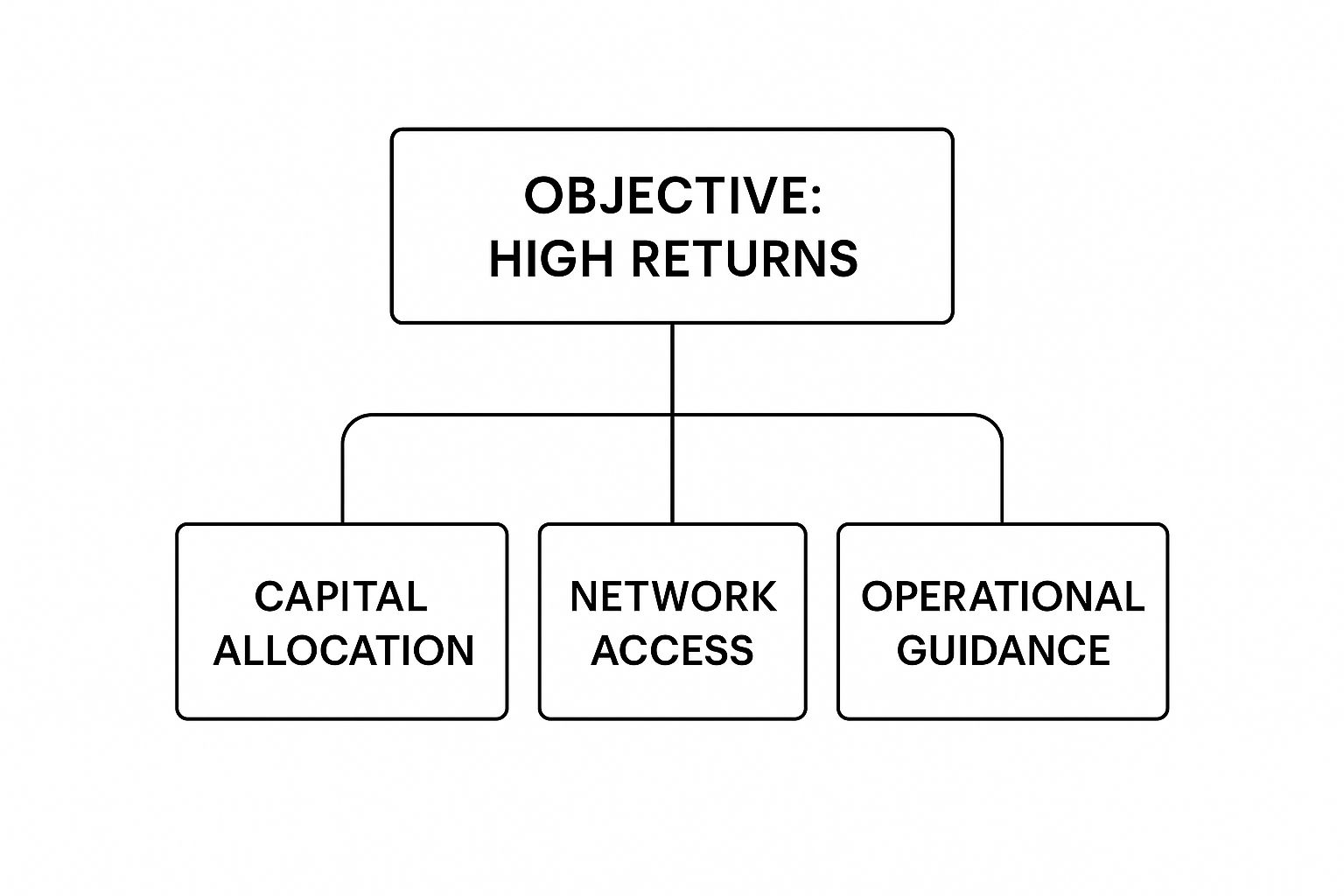
As you can see, a VC's efforts are funneled into smart capital allocation, providing invaluable network access, and offering direct guidance to steer their portfolio companies toward market leadership.
The Key Levers of Portfolio Management
To deliver top-tier performance, VCs rely on a few critical levers. Founders who understand these can align their strategy with their investors and leverage them as true growth partners. Each of these functions is designed to de-risk the investment and propel a startup toward scale.
The day-to-day work of a VC portfolio manager involves far more than reviewing pitch decks. It's an active, ongoing effort to help companies navigate complex challenges. We can break down their primary responsibilities into a few core functions.
Core Functions of VC Portfolio Management
| Component | Objective for the VC Fund | Impact on a Portfolio Startup |
|---|---|---|
| Strategic Capital Allocation | Reserve and deploy follow-on capital to back the strongest performers. | Secures crucial funding for later stages, enabling aggressive growth when it matters most. |
| Hands-On Operational Guidance | Provide expert advice on strategy, hiring, and scaling to avoid common pitfalls. | Access to seasoned operators who can help solve complex problems in product, finance, and team building. |
| Invaluable Network Access | Connect startups to customers, partners, and future investors to accelerate growth. | Opens doors to game-changing partnerships and sales opportunities that would be difficult to find otherwise. |
| Meticulous Exit Planning | Position the company for a successful acquisition or IPO from the early days. | Strategic guidance on building relationships with potential acquirers and bankers, maximizing the final outcome. |
These functions illustrate how VCs actively work to protect their investment by directly contributing to a startup's success, creating a deeply intertwined relationship.
Here's a closer look at what that means in practice:
- Strategic Capital Allocation: This is about more than just the first check. VCs must decide how much capital to reserve for follow-on funding rounds. The goal is to double down on the companies demonstrating the most promise. According to data from Crunchbase, these later-stage investments often represent a significant portion of a fund's deployed capital.
- Hands-On Operational Guidance: Many VC partners are former founders, operators, or deep industry experts. They bring real-world experience, offering priceless advice on everything from achieving product-market fit and financial modeling to hiring VPs and navigating painful scaling challenges.
- Invaluable Network Access: A VC’s network is one of its most powerful assets. This means warm introductions to potential customers, strategic partners, and investors for the next funding stage. This access can dramatically shorten sales cycles and unlock opportunities that would otherwise be out of reach.
- Meticulous Exit Planning: From day one, VCs are thinking about the endgame—typically an acquisition or an IPO. They work with founders to prepare the company for a successful exit, helping to build relationships with potential buyers and investment bankers long before a deal is on the horizon.
For a founder, the difference between a passive investor and an active portfolio manager is profound. One gives you gas money; the other provides a co-pilot, a map, and a full-service pit crew for the entire journey.
Ultimately, effective venture capital portfolio management creates a powerful win-win. As VCs help their companies succeed, they generate returns for their own investors (Limited Partners). For entrepreneurs, this active partnership is a massive catalyst, turning a simple injection of cash into a strategic accelerant for building a lasting, successful business.
Building a Winning Portfolio from Day One
A high-performing venture portfolio is the result of deliberate design, not a series of lucky guesses. For VCs, constructing this portfolio is an architectural challenge where every investment must support the fund's ultimate goal: identifying those rare, outlier successes. This strategic blueprint dictates which startups get funding, shaping the opportunities available to founders from the very first conversation.
Successful portfolio construction boils down to a few core principles that guide every check a VC writes. If you're a founder, understanding this framework provides a transparent look into the thinking that governs not just the initial investment but also the potential for future funding. It helps to remember that your startup, as critical as it is, is one piece of a much larger, interconnected puzzle.

This process isn't random; it's a disciplined approach. VCs are constantly balancing risk, expertise, and capital to build a portfolio that can weather market shocks and, with a bit of luck, capture extraordinary growth.
The Pillar of Strategic Diversification
In venture capital, diversification isn't just about spreading bets around—it's about smart risk mitigation. A fund might invest in 15 to 25 companies over its lifecycle, knowing that most won't become unicorns. The goal is to ensure that a downturn in one specific market doesn't torpedo the entire fund.
This strategy involves balancing several key variables:
- Industry and Sector: Investing across different verticals like FinTech, HealthTech, and enterprise SaaS insulates the portfolio from sector-specific headwinds. A sudden regulatory change hitting FinTech, for example, won’t sink a fund that also has strong performers in other areas.
- Business Model: A healthy portfolio often includes a mix of B2B SaaS, D2C, and marketplace models. Each has its own scaling challenges and revenue cycles, which creates a more balanced risk profile for the fund.
- Geographic Focus: While many funds concentrate on a specific region like Silicon Valley, others diversify geographically. This lets them tap into emerging innovation hubs and sidestep regional economic risks.
Getting this balancing act right is fundamental to a fund's long-term survival and performance.
The Guiding Star of Thesis Alignment
Every VC fund operates with an investment thesis—a core philosophy that defines its focus. This thesis is the fund's North Star, dictating which opportunities get a serious look and which are passed on, no matter how compelling they might seem.
A fund's thesis is its commitment to a specific vision of the future. It's the promise made to its own investors (LPs) that it will apply specialized expertise to a domain it understands better than anyone else. Straying from this path dilutes its core advantage.
For instance, a fund specializing in AI-driven B2B SaaS for regulated industries has spent years building a deep network and an evaluation framework for that exact space. If a promising D2C CPG startup pitches them, investing would be a poor fit. The fund's partners wouldn't have the right experience to add value beyond the check, making it a riskier bet for them and a disservice to the founders. Thesis alignment ensures that a VC's expertise is a genuine asset for every company in its portfolio.
The Science of Capital Allocation
Capital allocation is arguably the most critical piece of the puzzle. It’s a two-part discipline: first, determining the size of the initial investment, and second—just as important—reserving enough capital for follow-on rounds.
Most early-stage funds reserve 50% or more of their total capital specifically for follow-on investments. This "dry powder" is absolutely essential for doubling down on the portfolio's emerging winners.
This strategy plays out in a clear sequence:
- Initial Investment: The first check is a calculated entry point, buying the fund a stake in a company that fits its thesis.
- Performance Monitoring: The VC actively tracks the startup's progress against key milestones—hitting product targets, acquiring customers, and growing revenue.
- Follow-On Decision: When a company shows strong traction and is raising its next round, the VC must decide whether to invest again. This decision is a powerful signal of confidence to the market.
For founders, this means the first investment is just the beginning of the relationship. Proving you can execute is the key to unlocking the additional capital needed to scale and become one of the portfolio's breakout successes.
How VCs Measure Portfolio Success
In the startup world, it’s easy to get caught up in flashy funding announcements and soaring valuations. But for a venture capital firm and its investors (known as Limited Partners or LPs), success isn’t measured in headlines. It all comes down to a specific set of financial metrics that tell the real story of a fund's performance.
Understanding these key performance indicators (KPIs) is essential for any founder. Why? Because your startup's ability to generate returns directly fuels the numbers that define your investors' success. This isn't just financial jargon—it's the language of value creation in venture capital.
Decoding the Alphabet Soup of VC Metrics
The performance of a VC fund usually boils down to three core metrics. Each one offers a different, yet equally critical, lens on how well the fund has turned invested capital into actual value. Think of them as the vital signs that show the health and strength of a fund's portfolio management strategy.
These aren't typical profit-and-loss numbers; they're designed to account for the unique, long-term nature of venture investing.
- Internal Rate of Return (IRR): This is the fund's annualized profitability. In simple terms, IRR tells you the rate of growth the fund is generating year after year. A high IRR means the fund isn’t just picking good companies—it’s picking companies that are growing in value, fast.
- Total Value to Paid-In (TVPI): Think of this as a value multiplier. It measures the fund's total value (including both cashed-out wins and on-paper gains) against the capital the LPs have put in. A TVPI of 3.0x means that for every dollar invested, the fund has created three dollars in total value.
- Distributions to Paid-In (DPI): This is the "cash-on-cash" return, and it's the one that really counts. DPI shows how much actual cash the fund has returned to its investors. While TVPI includes future potential, DPI is the hard proof of success—money that’s back in the LPs' bank accounts.
Why DPI Is the Metric That Matters Most
A high TVPI looks fantastic on paper, but seasoned LPs know to keep their eyes on DPI. An unrealized "paper" gain is just a number on a spreadsheet until an exit—like an acquisition or an IPO—turns it into cash. DPI is the ultimate report card for a VC's ability to not only pick winners but to shepherd them toward a real liquidity event.
A fund can boast a high TVPI for years, but without strong DPI, it hasn't truly delivered. DPI is what separates the theoretical performers from the funds that generate real, tangible returns for their investors.
This intense focus on cash returns is becoming even more pronounced in today's market. An encouraging trend shows that funds are generating these returns faster than in the past. For instance, recent data on 2023 vintage funds reveals that about 15% started generating DPI after only six quarters. This quicker path to liquidity is a huge plus for LPs who are prioritizing actual cash flow from their venture investments.
Connecting Your Startup's Success to VC Metrics
As a founder, these metrics might feel distant, but they're directly connected to your company's journey. Every milestone you hit—from smashing revenue targets to landing a game-changing partnership—contributes to your valuation. That, in turn, boosts your VC's TVPI.
But the real magic happens at the exit. When your company achieves a successful acquisition or IPO, that cash flows back to the fund and drives up its DPI. This is precisely why VCs are so focused on helping you build a business with a clear path to liquidity. Your success is their success, creating the powerful alignment that sits at the heart of the founder-VC partnership.
You can learn more about the critical venture capital metrics that define this relationship right here on our platform.
Adding Value Beyond the Check

In a world where capital can often feel like a commodity, the best venture capitalists know the real work begins long after the investment wire clears. Elite VCs separate themselves from the pack by providing active, hands-on support, shifting from a simple financial backer into a genuine strategic partner.
This commitment to adding value defines top-tier firms and forges the most successful founder-VC relationships. It's not about micromanagement—it’s about providing leverage. VCs have a unique vantage point, having seen dozens of startups navigate remarkably similar challenges. They offer pattern recognition that a first-time founder simply can't have, helping them sidestep common pitfalls and hit the accelerator on growth.
The Spectrum of Strategic Support
The support a proactive VC offers is dynamic, extending far beyond the boardroom. It's a partnership built to tackle the most pressing needs of a scaling startup, providing resources and expertise a young company couldn't otherwise access.
This support generally falls into several key areas:
- Strategic Governance: Taking a board seat is the most formal way VCs provide guidance. In this capacity, they help steer major decisions, improve corporate governance, and keep the company focused on its long-term vision.
- Talent Acquisition: A VC's network is one of their most powerful assets. They can make game-changing introductions to help recruit senior executives—from a VP of Engineering to a Chief Financial Officer—who have experience managing hyper-growth.
- Customer and Partner Introductions: The right introduction can change everything. A warm intro to a potential flagship customer or strategic partner can dramatically shorten sales cycles and land a crucial early deal.
- Fundraising Strategy: When it's time for the next round, an engaged VC becomes an indispensable ally. They help sharpen the pitch, connect the founder with other friendly investors, and offer priceless advice on navigating the fundraising gauntlet.
This level of deep collaboration is a core part of what venture capitalists look for beyond the pitch deck. They aren't just betting on an idea; they're investing in a partnership where they can actively shape the outcome.
Value-Add in Action: A Composite Case Study
To see what this looks like in the real world, let's look at a composite example of "ConnectSphere," a B2B SaaS startup. After raising their Seed round, they struggled to gain traction with enterprise clients. Their lead investor didn't just wait for the next board meeting.
The investor tapped into their network to set up meetings with three Fortune 500 CIOs. The raw, direct feedback from those conversations was pure gold. It revealed a critical flaw in ConnectSphere's security features that was an absolute deal-breaker for large organizations.
Armed with this insight, the team executed a three-month product pivot. The VC partner then made a second round of introductions to the same CIOs. Impressed by the team's agility and the vastly improved product, one of them signed on as a pilot customer. This first major logo was the breakthrough ConnectSphere needed to unlock more enterprise sales, fundamentally altering its growth trajectory.
This story gets to the heart of modern venture capital portfolio management. The relationship is not transactional; it's a deep collaboration built on shared incentives. The biggest wins happen when founders treat their investors as an extension of their own team, tapping into their experience, network, and strategic guidance to navigate the turbulent waters of startup growth.
Navigating Inevitable Risks and Volatility
Venture capital is a high-stakes game defined by the pursuit of massive, fund-making returns. The path to those returns is anything but a straight line. The reality is, for every rocket ship, there are plenty of startups that fizzle out. Effective venture capital portfolio management isn't about sidestepping risk—that's impossible. It's about understanding, managing, and navigating the volatility that comes with backing early-stage companies.
For founders, understanding how VCs approach risk is a strategic advantage. It helps you see your business through their eyes, anticipate their concerns, and demonstrate that you have a solid plan for the inevitable bumps in the road. VCs don't expect a risk-free plan; they want to back a resilient team that can execute when things get messy.
The Primary Categories of Startup Risk
During due diligence, a VC categorizes risks into a few key buckets. This analysis continues long after the check is wired, as managing these risks is a core part of portfolio management. You can get a deeper look at how VCs vet companies in our articles on venture capital due diligence.
Here are the big three:
- Market Risk: Is the market actually as large or as ready as the pitch deck claims? A sudden shift in customer demand, a new well-funded competitor, or a recession can shrink a startup's potential market almost overnight.
- Execution Risk: This is all about the team's ability to deliver. Can they build the product as promised, on time, and within budget? Can they hire great people and build a culture that thrives under pressure? A brilliant idea is worthless without a team that can execute.
- Technology Risk: This risk cuts to the core of the product itself. Does the technology actually work? Is it truly defensible, or could a competitor replicate it easily? For deep-tech startups solving massive scientific or engineering problems, this is often the single biggest hurdle.
Proactive Risk Mitigation Strategies
The best VCs act as strategic partners, using their experience to help founders identify and mitigate threats before they escalate. It’s about being proactive, not just reacting to crises.
Instead of only showing up for quarterly board meetings, a hands-on investor is in the trenches with the startup. This could mean stress-testing the financial model against a potential economic downturn or introducing the founders to a legal expert who specializes in a tricky regulatory landscape. The goal is to build a more resilient, adaptable company from the ground up.
A VC’s true value in risk management lies in pattern recognition. Having seen dozens of companies face similar challenges, they can offer frameworks and solutions that a founder, facing a problem for the first time, might not see.
Navigating External Economic Headwinds
Beyond internal risks, external forces play an increasingly significant role. Geopolitical instability, new regulations, and broad economic shifts can create serious headwinds for any young company.
For instance, as of 2025, something as seemingly distant as tariff reform has become a major factor in venture investing. Changes in tariffs can spike operational costs and make investors nervous, especially for startups that rely on international supply chains. This isn't just a problem for hardware companies; it hits sectors like AI, where the cost of computing infrastructure can be highly sensitive to trade policy. To learn more about how economic trends are shaping venture capital, check out this piece on Deloitte.com.
Ultimately, managing risk is a team sport. Founders who are transparent about the challenges they're facing—and who proactively leverage their investors' expertise—are the ones most likely to navigate the inevitable storms of the startup world.
The Modern VC Toolkit and Evolving Strategies
The days of venture capital running on gut feelings and a good Rolodex are over. Today's most effective VCs blend their hard-won experience with a powerful arsenal of technology and sophisticated financial strategies to gain an edge. For founders, this shift offers a critical look at how investors will track, support, and ultimately evaluate their companies.
The biggest game-changer is the adoption of advanced data platforms. These systems go far beyond a simple spreadsheet, giving VCs a live dashboard of their entire portfolio's health. By tracking everything from cash burn and customer acquisition costs to hiring velocity, investors can spot trouble early and, just as importantly, identify their breakout stars much faster. Many are leveraging AI to parse market trends, benchmark a startup's performance against its peers, and even source new deals that perfectly fit their investment thesis.

New Strategies for Liquidity and Growth
It’s not just the tech that’s changing; the financial playbooks are adapting, too. Corporate Venture Capital (CVC) arms, for instance, are actively rewriting their portfolio management rules to tackle old problems. A recent report found that 51% of CVCs see the speed and efficiency of their deal-making process as a major drag on their portfolio’s performance.
To overcome these bottlenecks and unlock value sooner, many are getting creative with liquidity. That same report revealed that 22% of CVCs have tapped into secondary markets to generate cash—a significant 7 percentage point increase from the year before. You can dive deeper into the CVC report for more on how corporate investors are adapting their strategies at SVB.com.
This shift is huge. VCs are no longer content to just wait around for a traditional IPO or acquisition. They're now actively hunting for ways to generate returns and optimize their funds throughout a company's entire journey.
So, what does this mean for you as a founder? It’s a mix of new opportunities and higher expectations. An investor armed with sophisticated data tools will expect a new level of transparency and data-backed reporting from you. But the upside is that these same tools help them provide much more specific, data-driven advice. Understanding this modern toolkit is key to building a strong, collaborative partnership with today's investors.
Key Questions from Founders
When you're deep in the world of venture capital, certain questions come up again and again. Here are straight answers to a few of the most common ones from entrepreneurs.
How Does a VC Decide to Make a Follow-On Investment?
Deciding whether to "double down" on a portfolio company is one of the most critical decisions a VC firm makes. It’s why most funds set aside a significant portion of their capital—often 50% or more—for follow-on rounds.
Putting more money into an existing investment is the ultimate vote of confidence. Before writing that next check, a VC is looking for clear signals that the company is breaking away from the pack.
We’re generally looking at three things:
- Did you hit your marks? We need to see tangible progress against the milestones agreed upon in the last round. This could be anything from product development goals to critical hires or revenue targets.
- Is the market pulling you forward? VCs want proof of product-market fit. This means undeniable traction—strong revenue growth, an expanding customer base, and healthy unit economics.
- Can the team handle the next level? The founding team needs to demonstrate they have the leadership and resilience to navigate the next, more complex stage of growth.
Ultimately, a VC reinvests when the company’s performance indicates "outlier potential" and the terms of the new round are favorable.
What Is the Power Law in Venture Capital?
The power law is the fundamental principle of the venture capital universe. It’s the simple truth that a tiny number of investments will drive the vast majority of a fund's returns. Everything a VC does is built around this reality.
In a typical fund of 20-25 companies, just one or two massive "home runs" are expected to pay for all the others that fail or merely break even. We're talking about exits that return 50x to 100x the initial investment—enough to return the entire fund, and then some.
This is why VCs aren't just looking for good businesses; they are hunting for world-changing outliers. The math of the power law demands it. It’s not about avoiding failures; it’s about ensuring your winners are big enough to cover them.
How Much Control Does a VC Have After Investing?
The level of VC influence is determined by the details of the investment agreement. The key levers are the size of their check, whether they take a board seat, and the specific "protective provisions" baked into the term sheet.
A lead investor who takes a board seat will have a formal say in major strategic decisions, such as approving the annual budget, hiring or firing a C-level executive, or signing off on an acquisition.
However, VCs do not run the company day-to-day. That is the founder's job. The best VCs act as partners and strategic advisors. They use their influence to open doors, challenge assumptions, and help the company avoid common pitfalls—not to micromanage the business.
At Spotlight on Startups, we cut through the noise to give founders, investors, and ecosystem partners the clarity they need to succeed. Dive into our insights to sharpen your strategy, prepare for your next funding round, and understand what it takes to build an iconic company. Learn more at https://spotlightonstartups.com/.