
For an early-stage company, digital marketing is the engine for survival and growth—not just a promotional add-on. It provides a fast, measurable, and cost-effective framework to validate your business model, acquire foundational customers, and build the momentum needed to scale.
Traditional marketing, with its high costs and slow feedback loops, can be a death sentence for a new venture struggling to find its footing. Founders need agility and data, not guesswork.
Why Digital Marketing Is a Startup's Lifeblood
As a founder, you operate under intense resource constraints where every dollar and every minute must be justified. Unlike established corporations with extensive budgets, startups navigate a high-stakes environment where data-driven decision-making is paramount.
This is where old-school marketing—print ads, billboards, or TV spots—falls short. It demands significant upfront investment while offering slow, often ambiguous, feedback. A startup could invest thousands in a campaign and wait weeks, only to guess at its true impact. This is a luxury no emerging business can afford.
Digital marketing fundamentally changes this dynamic. It creates an immediate, transparent, and actionable feedback loop, transforming marketing from a cost center into a core validation tool.
For a startup, digital marketing is less about shouting a message and more about listening to the market's response. Every click, sign-up, and bounce provides critical data, guiding you toward product-market fit.
This direct line to your audience allows you to stop guessing what customers want and start testing your assumptions in real-time.
The World Has Gone Digital-First
Recent market shifts have solidified a new reality: if you're not online, you're invisible. According to research cited by Investopedia, digital channels captured a staggering 72.7% of all ad spending worldwide in 2024. This market has more than doubled since 2019 to over $790 billion and continues to show double-digit annual growth. The key takeaway for founders is clear: the digital arena is where your customers—and your competitors—operate. To better understand this evolution, see DataReportal's global overview.
A Simple Framework for Getting Started
Viewing digital marketing as a mere expense is a critical startup error. It is an indispensable tool for growth, validation, and building investor confidence. Your initial marketing efforts should be designed to achieve specific strategic objectives:
- Validating Your Business Model: Digital channels allow you to test pricing, messaging, and target audiences with minimal financial risk.
- Attracting Early Adopters: You can efficiently find and connect with the first wave of customers who will provide priceless feedback and become your brand's early champions.
- Building Investor Confidence: Nothing demonstrates viability to investors like tangible traction. A low customer acquisition cost (CAC) and high user engagement are powerful signals of a scalable business.
By aligning marketing efforts with your startup's specific stage—from pre-launch validation to scaling—you ensure every action is strategic and impactful from day one.
Building Your Lean Startup Marketing Stack

Before spending a single dollar on ads, you must establish a solid digital foundation. This is your lean startup marketing stack: a curated set of essential, low-cost tools designed to find, understand, and engage your first customers.
Attempting to scale without this core infrastructure is like flying a plane without an instrument panel. You might be moving, but you lack the data to understand your speed, direction, or fuel level. A well-chosen stack provides the insights needed to make every marketing decision measurable and defensible—a key attribute investors look for.
Core Components of Your First Marketing Stack
In the early stages, complexity is the enemy. The mission is to assemble a functional, cost-effective toolkit that solves immediate challenges. Most of these platforms offer generous free tiers or specialized startup programs, minimizing upfront costs.
Here are the non-negotiables every founder should have in place:
- A Simple Website or Landing Page Builder: You need a digital presence to test ideas quickly. Tools like Carrd, Webflow, or a basic WordPress site allow you to launch and iterate on landing pages without requiring a developer. This is critical for A/B testing your value proposition and capturing early leads.
- A Reliable Analytics Platform: You must understand user behavior on your site. Google Analytics 4 (GA4) is the industry standard and is completely free. Installing it from the outset ensures you are immediately collecting invaluable data on visitor demographics, acquisition channels, and on-site engagement.
- A Free CRM (Customer Relationship Management): As leads emerge, a spreadsheet quickly becomes inefficient. A CRM serves as a central hub to manage relationships. Platforms like HubSpot for Startups offer powerful free tools to track interactions and organize your sales pipeline.
- An Email Marketing Tool: Email remains one of the most effective channels for nurturing leads. Services like Mailchimp or Brevo provide free plans sufficient for building your initial list and sending newsletters or automated follow-up sequences.
A lean marketing stack isn’t about having the most advanced tools; it's about having the right tools. The goal is to create a seamless data flow: from a visitor landing on your page, to their actions being tracked in analytics, to their information being stored in your CRM for ongoing communication.
Setting Up for Measurable Success
With your tools in place, the final step is defining and tracking what matters. This means establishing your Key Performance Indicators (KPIs) and setting up conversion tracking before launching any campaigns.
A "conversion" is any valuable user action, such as signing up for a newsletter, requesting a demo, or making a purchase. In GA4, you can configure specific "goals" to track each time one of these actions occurs.
This simple act transforms marketing from a guessing game into a data-driven operation. Now, when you run a small ad campaign or publish a new blog post, you can directly measure its impact on the metrics that truly drive your business forward. This isn't just good practice—it's the level of accountability investors expect. To dig deeper, explore these best practices for startups to continue building a strong operational foundation.
Choosing Where to Place Your First Bets
For a startup, focus is a strategic advantage. The temptation to be everywhere at once—TikTok, LinkedIn, Google Ads—is a common pitfall. Spreading limited resources too thin guarantees mediocre results across all channels.
The objective isn't universal presence; it's strategic dominance where it matters most.
Effective digital marketing for startups requires making a few smart, calculated bets. Your channel selection should not be based on trends but on a rigorous analysis of your business model and ideal customer profile.
The Channel Selection Framework
Choosing the right channels comes down to three foundational questions. Answering them honestly will form the bedrock of your customer acquisition strategy.
- Where does your target audience live online? If you are building a B2B SaaS tool for sales leaders, they are active on LinkedIn, not Pinterest. Conversely, a D2C fashion brand targeting Gen Z must prioritize TikTok and Instagram.
- What is your business model (B2B vs. B2C)? This distinction shapes both the platform and the message. B2B sales cycles are typically longer and rely on building authority and trust, making SEO, content marketing, and LinkedIn natural fits. B2C often leverages visual appeal and community, making social platforms and influencer marketing highly effective.
- What is your primary resource (time or money)? If you have more time than capital, focus on organic strategies. Search Engine Optimization (SEO) and Content Marketing are long-term investments that build a sustainable growth engine. If you have funding and require immediate results, Paid Advertising can deliver instant traffic and invaluable market data.
The infographic below illustrates how a strong brand identity underpins these strategic choices.
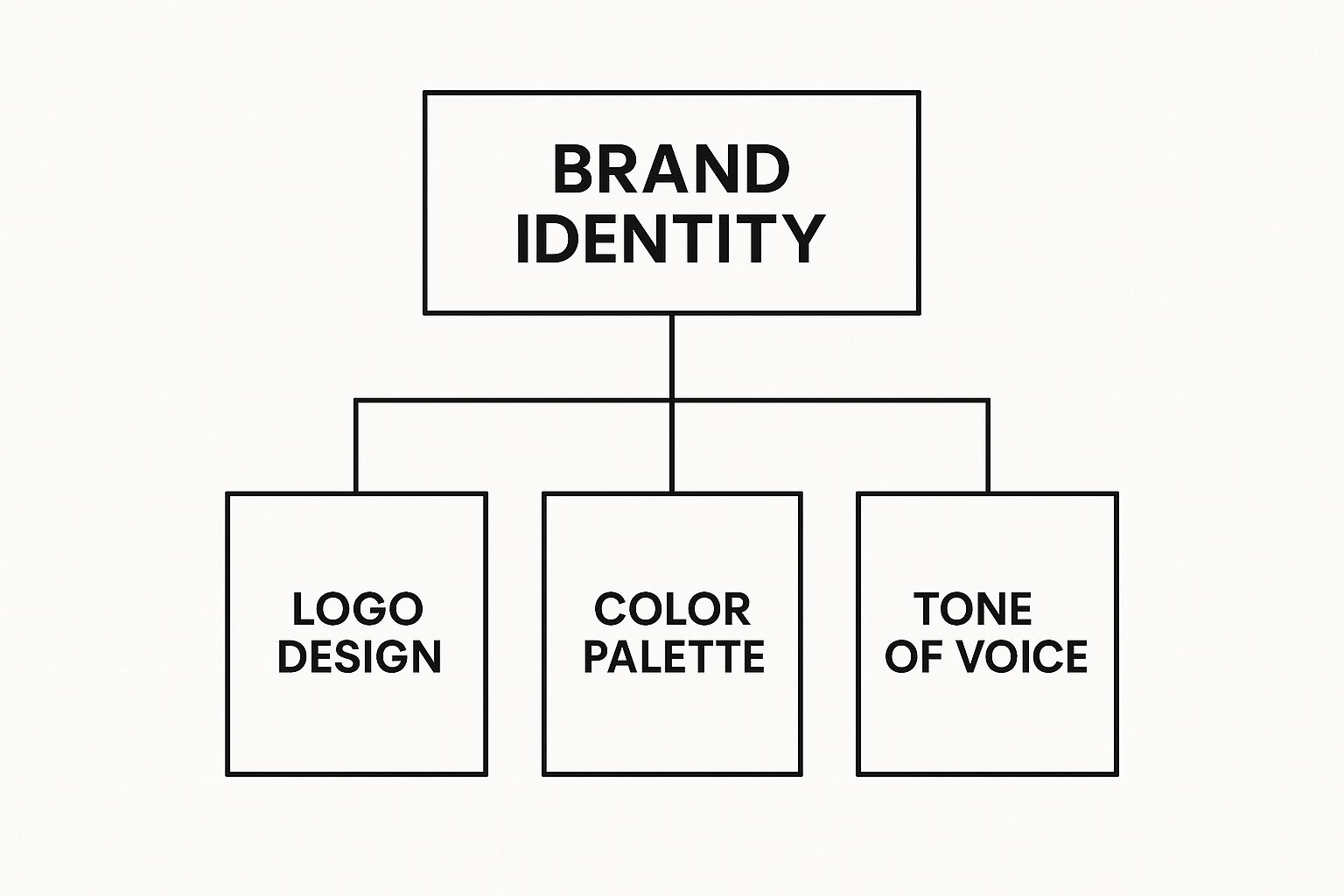
As shown, a cohesive brand—your logo, colors, and tone of voice—must be applied consistently across the channels you choose to master.
Now, let's examine the primary contenders. This table breaks down the most common channels to help you weigh your options.
Digital Marketing Channel Selection Framework for Startups
This framework is designed to help you evaluate and select the optimal digital marketing channels based on your startup's business model and available resources.
| Channel | Primary Goal | Ideal for B2B/B2C | Time Investment | Monetary Investment | Key Platforms |
|---|---|---|---|---|---|
| SEO | Long-term organic traffic, Authority | Both (esp. B2B) | High | Low to Medium | Google, Bing |
| Content Marketing | Lead nurturing, Trust building | Both (esp. B2B) | High | Low to Medium | Blog, YouTube, Podcasts |
| Social Media Marketing | Brand awareness, Community | Both (esp. B2C) | Medium to High | Low to High | Instagram, TikTok, LinkedIn |
| Paid Advertising (PPC) | Immediate traffic, Lead gen | Both | Low | Medium to High | Google Ads, Meta Ads |
| Email Marketing | Nurturing, Retention | Both | Medium | Low | Mailchimp, ConvertKit |
Think of this as a compass, not a rigid map. The goal is to match the right tool to the specific job at hand.
Your Core Channel Options
With this framework in mind, let's look closer at the primary channels. Remember, the initial goal is to master one or two.
- Search Engine Optimization (SEO) This is the practice of optimizing your website to rank on search engines for terms your customers are actively searching. While a long-term strategy, it delivers a steady stream of highly qualified, organic traffic. For startups serving a specific geography, mastering local SEO can be a game-changer. Learn more in our guide on how to dominate a niche with hyper-local authority.
- Content Marketing This involves creating valuable content—guides, articles, videos—that solves your audience's problems and positions your startup as a credible expert. High-quality content fuels SEO, provides material for social media, and is essential for nurturing leads.
- Social Media Marketing With over 5.24 billion global users, social media is a powerhouse for building brand awareness and community. According to industry data, LinkedIn’s 1.1 billion members make it the undisputed platform for B2B, with 40% of B2B marketers citing it as their most effective lead generation channel. Meanwhile, platforms like Facebook, with 3 billion monthly users, offer unparalleled scale for B2C engagement. Explore more of these digital marketing statistics to understand the landscape.
- Paid Advertising (PPC) Platforms like Google Ads and Meta Ads allow you to purchase immediate visibility. This is ideal for testing messaging, driving targeted traffic to a landing page, and generating leads while your organic efforts gain traction.
- Email Marketing Often underestimated, email remains one of the most powerful channels for building direct relationships. An email list is a valuable asset you own, free from algorithmic control.
By ruthlessly prioritizing, a B2B SaaS startup can focus its energy on LinkedIn and ranking for high-intent keywords, while a D2C brand can build an engaged community on TikTok and Instagram. This focused approach is how you win your first customers and build a repeatable engine for growth.
Putting High-Impact Marketing Tactics Into Action

With your lean stack and focused channels established, it’s time for execution.
Effective digital marketing for startups is not about launching complex, large-scale campaigns. It’s about mastering a few core tactics that drive measurable results and building a repeatable process for growth.
This section is your tactical playbook. We will break down four high-impact strategies into actionable steps that founders and small teams can implement immediately to turn strategy into customer acquisition.
Master the Fundamentals of Startup SEO
SEO is a startup’s most valuable long-term asset, allowing you to earn visibility rather than just buying it. For a new company, this means surgically targeting low-competition keywords with high purchase intent.
Avoid trying to rank for broad, competitive terms like "SaaS software." Instead, focus on long-tail keywords—longer, more specific phrases your ideal customers use. Think "project management software for small creative agencies" or "eco-friendly packaging for e-commerce startups."
Here are your first moves in SEO:
- Find Your Niche Keywords: Use free tools like Google Keyword Planner or paid platforms like Ahrefs to identify keywords with reasonable search volume and low difficulty scores. Look for questions, comparisons, and problem-based queries.
- Optimize Your Core Pages: Ensure your homepage and key service pages are structured around these target keywords. This includes optimizing page titles, meta descriptions, and on-page headings—simple fixes with significant impact.
- Dominate Local Search: If your startup has a physical location or serves a specific geographic area, setting up your free Google Business Profile is non-negotiable. It is the single most powerful action you can take to appear in local search results and on Google Maps.
Implement Smart Content Marketing
Content marketing for a startup is not about volume; it's about value. The goal is to create one incredibly useful "pillar" asset and then strategically repurpose it across all your channels. This approach maximizes effort and establishes expertise.
A pillar asset is a substantial piece of content—a definitive guide, an original research report, or a comprehensive webinar—that thoroughly addresses a topic your customers care about.
The core principle of smart content marketing is to create once, distribute forever. A single, well-researched pillar asset can fuel your marketing for months, saving you from the relentless content creation treadmill.
Once you have your pillar piece, repurposing is straightforward:
- Blog Posts: Break down chapters or sections into standalone, SEO-optimized blog posts.
- Social Media: Convert key statistics into graphics for LinkedIn, create a short video summary for TikTok, and run a poll on X (formerly Twitter) based on a key finding.
- Email Newsletter: Use snippets from the content to create a value-driven email series for your subscribers, driving them back to the full asset.
This is how you build thought leadership without needing a large content team.
Build an Authentic Social Media Community
Resist the temptation to use social media as a promotional billboard. Its true power lies in building a genuine community. Select one or two channels where your audience is most active and commit to authentic engagement.
Adopt a conversational approach. Share behind-the-scenes insights into your startup journey, solicit follower opinions, and celebrate their successes. The objective is to build relationships, not just accumulate followers.
Authentic engagement also means listening. Monitor industry conversations, identify customer pain points, and offer helpful advice—even when it doesn't directly promote your product. This builds trust and positions you as a credible resource.
Looking for more inspiration? Explore our collection of startup sales and marketing tips.
Launch Your First Paid Ad Campaign
While organic strategies build long-term value, a small, targeted paid ad campaign can provide immediate data and leads. Your first campaign should have a single, clear objective, such as generating demo requests or securing webinar sign-ups.
Platforms like Google Ads and Meta Ads (Facebook/Instagram) are ideal for this. Here’s what a founder-led, small-budget Google Search campaign looks like:
- Define Your Goal: Identify the specific action you want a user to take. This is your conversion.
- Select Keywords: Bid on the same high-intent, long-tail keywords identified in your SEO strategy.
- Craft Compelling Ad Copy: Write clear, concise ad copy that speaks directly to a user's pain point and offers a clear solution.
- Create a Dedicated Landing Page: This is critical. Do not send ad traffic to your homepage. Build a simple landing page with a single call-to-action that aligns with your ad's promise.
- Set a Small Daily Budget: Start with a budget you are comfortable losing, such as $20-$50 per day, and monitor performance closely.
This disciplined approach transforms paid advertising into a powerful learning tool, allowing you to quickly test your value proposition and determine your customer acquisition cost.
Budgeting and Measuring What Matters
How much should a startup spend on marketing? And how do you prove it's working? For founders, these questions are a constant source of anxiety. Generic advice like "spend 10% of revenue" is useless when revenue is minimal or nonexistent.
Successful digital marketing for startups demands a smarter, more accountable approach to budgeting and measurement.
Instead of arbitrary figures, tie every dollar to your business goals. This is the essence of goal-based budgeting. Your mission is not just to "do marketing" but to hit a specific, measurable target.
Forget abstract percentages and start with a concrete milestone, such as "acquire our first 100 paying customers." Your budget is now a calculation, not a guess. You can work backward to determine what it will cost to achieve that goal based on your chosen channels and their expected conversion rates.
The Metrics Investors Actually Care About
When presenting to investors, vanity metrics like social media followers or website traffic are irrelevant. They want to see the unit economics of your business—proof that for every dollar invested in marketing, more than a dollar is returned.
This is where a few critical Key Performance Indicators (KPIs) become your most important narrative tool. Mastering them is non-negotiable, as they tell the true story of your startup’s financial health and scalability.
Understanding your core marketing metrics is like having a real-time diagnostic dashboard for your business. It tells you where to accelerate and when to apply the brakes, empowering you to make data-driven decisions that lead to sustainable growth.
Here are the four essential KPIs every founder must know:
- Customer Acquisition Cost (CAC): The total sales and marketing cost required to acquire a single new customer. It answers the fundamental question: "How much does it cost to get one person to buy?"
- Lifetime Value (LTV): The total revenue you can reasonably expect from a customer over their entire relationship with your company. It demonstrates the long-term value of each acquisition.
- Conversion Rate: The percentage of users who complete a desired action, such as signing up for a trial or making a purchase. This metric reflects the efficiency of your marketing funnel.
- Monthly Recurring Revenue (MRR): For any SaaS or subscription-based startup, MRR is the lifeblood. It is a predictable measure of your revenue stream and a primary indicator of growth and stability.
Measuring these KPIs is the first step toward building a predictable growth engine. The table below details what to track and why it is crucial for demonstrating progress to investors and your team.
Essential Marketing KPIs for Early-Stage Startups
| Metric (KPI) | What It Measures | Why It Matters | How to Calculate It | Tool for Tracking |
|---|---|---|---|---|
| Customer Acquisition Cost (CAC) | The total cost to acquire one new paying customer. | Shows the efficiency of your marketing spend. A low CAC is key to profitability. | (Total Sales & Marketing Spend) / (Number of New Customers Acquired) | Your CRM or a simple spreadsheet |
| Lifetime Value (LTV) | The total revenue a customer will generate over their lifetime. | Proves your business model is sustainable. You need LTV to be significantly higher than CAC. | (Average Revenue Per User) x (Customer Lifetime) | Stripe or your payment processor |
| Conversion Rate | The percentage of visitors who complete a desired action (e.g., sign-up, purchase). | Measures the effectiveness of your website, landing pages, and marketing funnels. | (Number of Conversions / Total Visitors) x 100 | Google Analytics 4 |
| Monthly Recurring Revenue (MRR) | The predictable revenue your business generates each month from subscriptions. | The ultimate indicator of growth and stability for SaaS/subscription businesses. | Sum of all recurring charges in a month | Stripe or Chargebee |
By focusing on these core metrics, you shift from "doing marketing" to strategically building a scalable business.
Building a Defensible Marketing Dashboard
The final piece is tracking these KPIs effectively. You do not need a complex, expensive system initially. All the necessary data resides in your existing tools: Google Analytics 4, your CRM, and your payment processor.
The key is to consolidate this data into a simple dashboard. A well-organized spreadsheet is often sufficient at the start. This dashboard becomes your single source of truth, enabling you to communicate your performance with confidence and show investors a clear, quantifiable path to profitability.
Scaling Marketing as Your Startup Grows
The founder-led marketing hustle that lands your first 100 customers is essential, but it is not scalable. The tactics that get you to 100 customers will not get you to 1,000, let alone 10,000.
To scale effectively, you must transition from reactive, one-off tactics to building a predictable growth engine. This pivotal moment marks the shift from doing marketing to building a marketing function. It requires creating systems, hiring specialized talent, and implementing sophisticated tools to propel your startup from seed stage to Series A and beyond.
Your First Marketing Hire
Knowing when to hire your first dedicated marketer is a critical leadership decision. It’s not just about offloading tasks but about injecting specialized expertise to accelerate growth.
Watch for these clear signals:
- Founder Overload: You are spending more time on marketing than on core business leadership, and both are suffering.
- Plateaued Growth: Your initial channels have reached their limit, and you lack the bandwidth or expertise to explore new ones.
- Clear Product-Market Fit: You have a product customers love and a well-defined customer profile. It's time for a marketer to build on this solid foundation.
Once you decide to hire, the question becomes who. Your first hire must be a “T-shaped” marketer—an individual with broad knowledge across many channels (the top of the 'T') but deep, hands-on expertise in one or two that are critical for your current stage, such as SEO or paid social. Avoid a high-level strategist who cannot execute or a hyper-specialist with a narrow skill set. Your first hire must be a strategic doer.
Building Repeatable Growth Systems
As your startup matures, marketing must evolve from individual campaigns to sustainable systems. This involves adopting more sophisticated strategies and tools to create a well-oiled machine that drives predictable growth.
Scaling marketing isn't just about a bigger budget. It’s about building a robust operational framework that turns your initial traction into predictable revenue, reinforcing long-term company value for investors and stakeholders.
Key components of a scalable marketing system include:
- Marketing Automation: Tools like HubSpot or Marketo automate lead nurturing, email campaigns, and customer segmentation, freeing your team to focus on high-level strategy.
- Rigorous A/B Testing: Move from assumption to certainty. Systematically test everything—landing page headlines, ad copy, email subject lines—to drive incremental improvements that compound over time.
- Advanced Analytics: Go beyond vanity metrics. Build dashboards that tie marketing activities directly to revenue, allowing you to calculate metrics like LTV:CAC by channel and prove ROI.
This disciplined, data-driven approach is essential for growth and serves as a powerful signal to investors that you are ready for the next round of funding. A strong growth narrative backed by data is incredibly compelling, especially when amplified by strategic media coverage. For more on this, read our guide on how to use media coverage to accelerate fundraising.
Frequently Asked Questions
Navigating the world of digital marketing can be overwhelming. Here are direct answers to the most common questions from founders.
How Much Should a Startup Spend on Digital Marketing?
Forget generic percentages. Early-stage startups should use goal-based budgeting.
Start with a clear, measurable objective, such as "acquire our first 100 paying customers." Work backward from there. Calculate the estimated customer acquisition cost (CAC) for your chosen channels and build your budget accordingly. Start small, track everything meticulously, and reallocate funds to what proves effective. Prioritize channels with long-term leverage, like SEO and content, before scaling paid advertising.
Should I Hire a Marketing Agency or an In-House Marketer?
In the earliest stages, founders must lead marketing. This hands-on involvement is crucial for achieving product-market fit. Outsourcing this process too early is a common mistake that burns capital while an agency attempts to validate a message you haven't yet confirmed.
Your first hire should be a versatile "T-shaped" marketer—someone with a broad skill set and deep expertise in one or two critical channels. Specialized freelancers can be engaged for specific projects like design or copywriting long before committing to a costly agency retainer.
What Is the Biggest Marketing Mistake Startups Make?
The most common and damaging mistake is trying to do everything at once. Founders feel pressured to be active on every platform, which spreads limited resources too thin and leads to mediocre results everywhere.
The solution is ruthless focus. Identify the one or two channels where your ideal customers are most concentrated and dedicate your resources to mastering them.
Once you have transformed a channel into a predictable growth engine, you have earned the right to expand. This disciplined approach is what separates startups that succeed at marketing from those that simply generate noise.
At Spotlight on Startups, we provide the clarity, practical insights, and authority-building strategies founders need to build enduring ventures. Explore our expert guides and case studies to move your business forward with confidence. Learn more at https://spotlightonstartups.com/.