
Securing funding for your startup is one of the most defining challenges a founder will face. Before you even think about writing your first investor email, you need to lay the groundwork. Finding Orange County tech startup investors, especially within the dynamic Orange County ecosystem, isn't just about having a great idea; it's about proving you're building a real business that can deliver a significant return. This means getting your house in order—sharpening your story, mastering your numbers, and building a strategic roadmap to the right partners.
Think of it as building a bulletproof case for your company. This foundational work is what separates the founders who get funded from those who get frustrated. It's the first and most critical step in your fundraising journey.
Building Your Orange County Tech Startup Fundraising Blueprint
Raising capital in a competitive hub like Orange County is a full-blown campaign, not a lottery. Forget blasting a hundred cold emails and hoping something sticks. Real success comes from a strategic, methodical approach that starts long before you ever step into a pitch meeting.
Investors don’t back ideas; they back credible opportunities built by exceptional founders. And credibility is built on preparation. This process will force you to pressure-test every one of your assumptions, grounding your big vision in hard data. A solid blueprint shows investors you're not just a dreamer—you're a disciplined leader who respects their time and their capital.
Refine Your Business and Financial Models
Your business model is the engine of your startup. Investors need to see precisely how it runs and, crucially, how you plan to scale it. Vague statements about "capturing the market" won't cut it. You must articulate exactly how you create value for customers and how you capture that value for the business.
For early-stage companies, this needs to go beyond theory. If you're struggling to translate your vision into a concrete plan, a great starting point is our detailed guide on how to write a winning startup business plan investors actually read.
Once your business model is locked in, your financial model must tell the same story with numbers. This isn't just a spreadsheet exercise; it’s the financial narrative of your company's growth. It must clearly answer:
-
How do you make money? Detail your key revenue drivers and customer acquisition channels.
-
Are your unit economics sound? You have to prove that your Customer Lifetime Value (LTV) is greater than your Customer Acquisition Cost (CAC). No exceptions.
-
What's your burn rate and runway? Be crystal clear about how much you're spending, how much you need, and how long the requested funding will last.
An investor’s confidence is directly proportional to a founder’s command of their numbers. A detailed, assumption-driven financial model is non-negotiable—it’s the ultimate proof of your strategic thinking and founder excellence.
Create an Investor-Centric Pitch Deck
Many founders get this wrong. They build a pitch deck that talks at investors, not to them. Your deck must anticipate their questions and answer them proactively. Every slide should serve a purpose, logically building a compelling argument for why they should write you a check.
The funding world has become incredibly discerning. It's no longer enough to have a clever idea; you need traction and proof of a scalable solution. According to recent data, AI startups pulled in nearly $90 billion in global VC funding. This signals a massive investor appetite for businesses with validated models and obvious paths to explosive growth. Your deck must prove you fit that mold.
Define Your Ideal Investor Profile
Not all money is smart money. The right investor brings far more than cash to the table—they bring industry connections, deep expertise, and strategic guidance that can be game-changing.
Before you start your search, create a detailed profile of your dream investor.
-
Industry Focus: Do they actually understand your space and have a track record of success in it?
-
Investment Stage: Are they focused on pre-seed, seed, or Series A? Pitching an investor who doesn't play at your stage is a waste of everyone's time.
-
Geography: Are they active in Orange County or Southern California? Many funds have a geographic focus.
-
Value-Add: What can they offer besides a check? Think introductions to key customers, help with hiring senior talent, or guidance on product strategy.
Creating this profile turns your fundraising from a chaotic hunt into a targeted mission, ensuring every ounce of your limited energy is spent on the people who are the absolute best fit to help you build your company.
Your Pre-Outreach Checklist
Before you begin outreach, you need to have your core assets dialed in. Investors expect a high level of preparation, and showing up without these fundamentals is a quick way to get a "no." This checklist covers the essentials you'll need ready.
Investor Readiness Checklist
| Asset / Metric | Why It Matters to Investors | Key Elements to Include |
|---|---|---|
| Pitch Deck | This is your first impression and core storytelling tool. | Problem, Solution, Market Size, Product, Business Model, Team, Financials, The Ask. |
| Financial Model | It demonstrates your grasp of the business and its potential. | 3-5 year projections, key assumptions, unit economics (LTV/CAC), burn rate, runway. |
| One-Pager | A concise, shareable summary of your business. | A condensed version of your pitch deck; perfect for initial outreach and follow-ups. |
| Key Metrics / KPIs | Data-driven proof of traction and product-market fit. | Monthly Recurring Revenue (MRR), user growth, engagement rates, churn. |
| Founder Bios | Investors bet on people first and foremost. | Highlight relevant experience, past successes, and why you are the team to solve this problem. |
Having these documents polished and ready signals that you're a serious founder who has done the hard work. It builds instant credibility and sets the stage for a much more productive conversation.
Mapping the Orange County Investor Landscape
Here’s a hard truth about fundraising: not all money is good money. The person writing the check is often more important than the check itself. This is especially true in a tight-knit ecosystem like Orange County.
Your first job isn't to blast your pitch deck to every investor you can find. It's to strategically map the local landscape and find a genuine partner, not just a source of capital.
Every investor type plays by a different set of rules. Angels, VCs, and family offices all have unique motivations, check sizes, and appetites for risk. Aligning your startup's stage and needs with the right investor profile dramatically increases your odds of finding someone who brings more than just capital to the table.
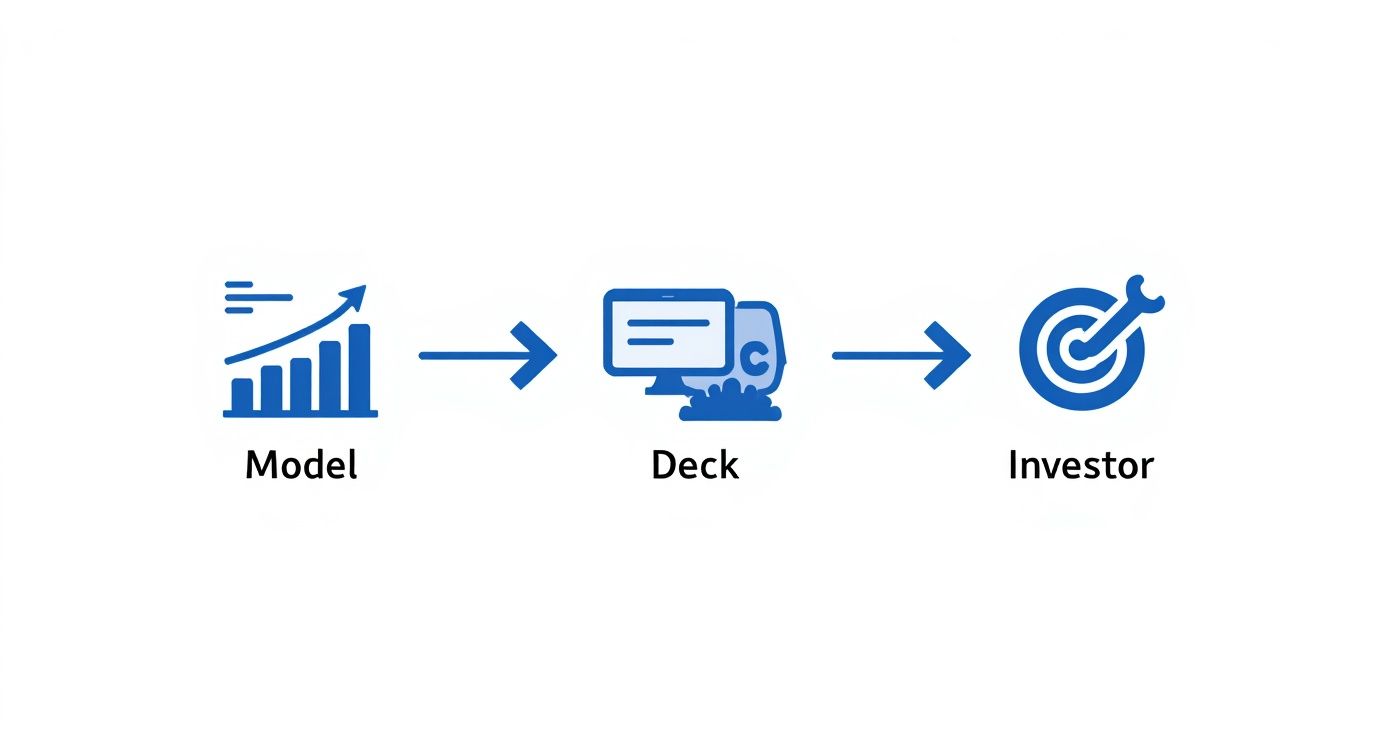
Think of it this way: your financial model is the foundation, your deck is the blueprint, and those two things together tell you exactly what kind of builder—or investor—you need to bring your vision to life.
The Key Players in Orange County
The Orange County startup scene has its own unique flavor, supported by a diverse mix of capital. Getting to know the main players is step one.
-
Angel Investors: These are successful individuals, often former founders themselves, who invest their own money. They're typically writing checks for $25k – $100k at the pre-seed or seed stage. The best angels in OC are deeply connected in the local tech and life sciences scenes and can offer invaluable mentorship.
-
Angel Groups: Think of these as angel syndicates. Groups like Tech Coast Angels are a cornerstone of the OC ecosystem, pooling money from many members to make larger investments ($250k – $1M+) and spread the risk. The big advantage here is that one pitch gets you in front of dozens of potential investors.
-
Venture Capital (VC) Firms: VCs are professional fund managers investing other people's money. They write much bigger checks (usually $1M+) and hunt for startups with clear traction and the potential for explosive, venture-scale growth. OC and LA-based VCs need to see a path to a 10x or greater return on their investment.
-
Corporate Venture Capital (CVC): These are the investment divisions of large corporations. Their motives are often more strategic than purely financial; they're looking for startups whose tech or market access aligns with the parent company's goals. A CVC investment can open doors to game-changing partnerships.
-
Family Offices: These private wealth management firms for ultra-high-net-worth families are becoming a major force in early-stage investing. They often have more patience and flexibility than traditional VCs, with longer investment horizons.
To help you visualize the differences, here's a quick breakdown of how these investor types stack up.
Investor Type Comparison
| Investor Type | Typical Check Size | Investment Stage | Key Characteristics |
|---|---|---|---|
| Angel Investor | $25k – $100k | Pre-Seed, Seed | Individual capital, hands-on mentorship, strong local networks. |
| Angel Group | $250k – $1M+ | Seed, Early Series A | Pooled capital, structured diligence, broad expertise from members. |
| Venture Capital | $1M – $20M+ | Seed to Growth | Institutional funds, demand high growth, offer operational support. |
| Corporate VC | Varies widely | All Stages | Strategic alignment is key, can provide powerful partnerships. |
| Family Office | $100k – $5M+ | All Stages | Patient capital, flexible terms, relationship-driven. |
Choosing the right type of investor is the first filter in your search. A pre-seed company chasing a late-stage VC is a non-starter. Focus your energy where it counts.
How to Actually Find Your Target Investors
Once you know the type of investor you need, it's time to build your target list. This is a game of quality, not quantity. Forget about massive spreadsheets with hundreds of random names.
Your goal is a curated, well-researched list of 50-100 investors who are a phenomenal fit. This takes real detective work.
Start With Digital Reconnaissance
Tools like Crunchbase and PitchBook are your best friends here. Use their filters to zero in on prospects by:
-
Stage: Look for investors who consistently fund companies at your stage (e.g., "Seed," "Series A").
-
Sector: Find people who have a track record in your industry (e.g., "SaaS," "MedTech," "FinTech").
-
Geography: Prioritize firms and individuals known for backing startups in Southern California, and specifically Orange County.
Investors are placing bigger bets on early-stage companies that show real promise. For context, the average Series A round for a U.S. startup has climbed significantly, and you can explore more about corporate investment trends to see where the market is headed. This tells you the capital is out there, but only for founders who can prove they're building something massive.
Founder Excellence Tip: Don't stop at the firm's website. Dig into the individual partners on LinkedIn. Find the one person whose personal investment history and stated interests perfectly match what you're building. A warm, targeted email to the right partner is a hundred times more effective than a cold blast to a generic "info@" address.
Get on the Ground in Orange County
Digital tools are great, but the best introductions happen in person. You have to immerse yourself in the local ecosystem.
Show up at events hosted by hubs like UCI Beall Applied Innovation and the various local accelerators. Talk to other founders. Get to know the startup-focused lawyers and accountants. These people are the gatekeepers and connectors. Building genuine relationships is the single most effective way how to find startup investors, because a warm introduction is your ticket to the front of the line.
Securing the Warm Introduction

You've built your target list of investors. Now comes the real challenge: getting on their radar. Let’s be blunt—blasting a cold email into the void is a rookie mistake and the lowest-probability path to funding you can take. Investors get buried in unsolicited pitches, and most get deleted without a second thought.
The single most effective way to cut through that noise is a warm introduction from a trusted mutual connection. This isn't just a nice-to-have; for many top-tier investors, it's a non-negotiable filter. A warm intro acts as a powerful signal, showing that someone they already know and respect has vetted you. It immediately separates you from the cold-email crowd and builds a foundation of credibility before you even say hello.
Mapping Your Path to a Connection
Your first job is to become a network detective. Go through your target investor list one by one and map out every possible connection. This is where a tool like LinkedIn is your best friend.
For each investor, you need to dig for shared connections. Look for first- and second-degree links among:
-
Current and former colleagues: People who can vouch for your skills and work ethic.
-
Advisors and mentors: They are already invested in your success and are often happy to help.
-
Other founders: Entrepreneurs in your circle, especially those who have already raised capital in Orange County, are an invaluable resource.
-
Service providers: Don't forget your startup-focused lawyers, accountants, or bankers. Their networks are often surprisingly deep.
Systematically searching for these links is how you turn a long shot into a legitimate opportunity. It’s tedious work, but it pays off tremendously.
Crafting the "Forwardable Email"
Once you've found a mutual connection, your next move is to make it incredibly easy for them to help you. Don't just ask, "Hey, can you introduce me to Investor X?" That puts all the work on them. Instead, you need to write a "forwardable email"—a short, punchy blurb they can literally copy and paste or forward directly to the investor.
Think of this as your mini-pitch. It has to be concise, compelling, and respectful of everyone's time.
A Great Blurb Contains:
The Opener: One crystal-clear sentence explaining what your company does. No jargon.
The Hook: Your most impressive data point or bit of traction. Something like, "We've grown our user base 30% month-over-month for the past six months" is hard to ignore.
The 'Why Them': A specific, well-researched reason you're targeting this specific investor. For example, "I saw their investment in Company Y, and our B2B SaaS strategy is right in their sweet spot."
The Ask: A simple, low-pressure request for a brief introduction.
This approach transforms your request from a vague favor into a simple, two-minute task for your contact. It dramatically increases the odds of getting that intro.
The Art of the Cold Outreach
So what happens if you've exhausted every option and have zero mutual connections? While a warm intro is always the goal, a well-executed cold email can still break through—if it’s deeply personalized and adds value. A generic, copy-paste email will fail 100% of the time.
Your cold email must prove you've done your homework. Reference a recent article they wrote, a podcast they were on, or a specific portfolio investment that aligns with what you're building. Show them you understand their investment thesis and aren't just spamming every VC on a list.
A strong public profile can also do a lot of the heavy lifting for you; founders who know how to use media coverage to accelerate fundraising rounds often find their "cold" emails feel a lot warmer.
Ultimately, the goal of any outreach—warm or cold—is simple: to earn a meeting. When you show respect, preparation, and an undeniable opportunity, you stop being just another name on a spreadsheet and become a founder worth talking to.
Nailing the Pitch and Surviving Due Diligence

You landed the meeting. This is a huge step, but it's just the first checkpoint in a marathon. Now you have to walk into that room and own it. Remember, investors hear hundreds of pitches. Yours has to be the one they're still talking about at the end of the day.
Your deck provides the structure, but your delivery is what sells it. They're not just investing in your product or your market size; they're investing in you. They need to feel your conviction and see that you're the only person on the planet who can make this happen.
It's Not a Presentation, It's a Story
The best pitches aren't a dry recitation of data. They're compelling stories. A great story has a clear beginning (the problem), an engaging middle (your brilliant solution), and an exciting future (the massive opportunity you're going to capture).
Frame the problem in a way that feels real and urgent. Make them feel the pain your customers experience. When you do that, your solution doesn't just sound clever—it feels essential. It feels inevitable.
When the hard questions come, welcome them. This is your chance to show you've thought about every angle. Investors bet on founders, not just ideas. They're looking for grit, coachability, and an unshakable command of your market. A founder who can thoughtfully handle tough objections is infinitely more impressive than one with a slick but hollow answer for everything.
Getting Ready for the Due Diligence Gauntlet
If the investors are engaged, get ready for the next phase: due diligence. This is where they pop the hood and inspect the engine. It's a meticulous audit of every claim you've made and every detail of your business. Being unprepared here can sink a deal in a heartbeat.
Think of it as an open-book exam where you should already have all the answers neatly organized. Setting up a secure data room before you even start pitching is a professional move that signals operational excellence.
Your preparedness for due diligence is a direct reflection of your operational discipline. A clean, well-organized data room can get you to a term sheet faster than almost anything else.
Here’s a look at the core documents every investor is going to request. Have them ready.
-
Corporate Docs: Your articles of incorporation, bylaws, and shareholder agreements.
-
Cap Table: A crystal-clear capitalization table showing exactly who owns what. No fuzzy math.
-
The Numbers: Historical financials, detailed projections for the next 3-5 years, and a clear breakdown of your burn rate and runway.
-
Team Info: Resumes for your key players, employment agreements, and a list of your advisors.
-
Market & Customer Proof: Key customer contracts, a snapshot of your sales pipeline, and the market analysis that backs up your TAM.
-
Intellectual Property: A tidy list of any patents, trademarks, or proprietary tech you own.
This isn't just a box-ticking exercise. It's a deep dive into risk assessment. For founders in competitive markets like Orange County, this step is non-negotiable. Investors are actively looking for reasons to believe in you, but a messy due diligence process gives them an easy reason to pass.
What Investors Really See in a Founder
While the pitch deck and financials are critical, the final decision often comes down to the founding team. They want to know if you have the obsession and resilience to drag this company across the finish line, no matter what. For a closer look at what VCs are sizing up, check out our guide on what venture capitalists look for beyond the pitch deck.
They're trying to get a read on a few core traits you can't put on a slide:
-
Problem Obsession: Are you genuinely, deeply committed to solving this problem, or are you just chasing an opportunity? They can tell the difference.
-
Coachability: Can you listen to feedback and adapt, or do you think you have all the answers?
-
Grit: How do you react when you get knocked down? They’re looking for a history of bouncing back from adversity.
How you demonstrate these qualities throughout your interactions is just as vital as the numbers in your spreadsheet. Nail both the art of the story and the science of due diligence, and you won’t just be another pitch—you’ll be a founder they can’t afford to pass on.
From Term Sheet to Signed Deal
Getting that first term sheet is a landmark achievement. It's the moment your hard work turns into a real, tangible commitment from an investor who believes in your vision. But pop the champagne later—this isn't the finish line. It's the start of the final, and most critical, part of the fundraising process.
A term sheet is a non-binding agreement. It's a roadmap for the final deal, and every single clause will shape your company's future. How you navigate this next phase—the negotiations, the legal back-and-forth, the final closing—sets the stage for your relationship with this investor for years to come. Your goal is to strike a balance: secure terms that protect you and your team while keeping the investor’s excitement and goodwill intact.
Understand What You're Looking At
A term sheet can look like it was written in a different language, filled with jargon that can be intimidating. While you absolutely need a great startup lawyer in your corner, you, the founder, have to understand the core components. These are the levers that will impact your ownership, your control, and your future flexibility.
Here's a look at a term sheet summary from Investopedia to give you a feel for the structure.
The purpose of a term sheet is to get everyone on the same page about the big-ticket items before you both spend significant money on lawyers drafting the final, binding legal documents.
Let's break down the terms you absolutely must understand:
-
Valuation (Pre-Money and Post-Money): This is the headline number. The pre-money valuation is what your company is valued at before the new cash comes in. The post-money is simply the pre-money plus the investment amount. This directly sets how much of the company your new investors will own.
-
Liquidation Preference: This is a crucial term. It determines who gets their money back first if the company is sold or winds down. The founder-friendly standard is a 1x non-participating preference. Anything more complex, like participating preferred stock, can seriously reduce the payout for you and your team (the common shareholders).
-
Anti-Dilution Provisions: These clauses protect investors if you have to raise your next round at a lower valuation (a "down round"). You'll likely see "broad-based weighted average" protection, which is standard. If you see "full ratchet," however, that’s a red flag that needs a serious conversation with your lawyer.
-
Board Seats: The term sheet will lay out what the board of directors will look like after the investment. Don't gloss over this—this is about control. Think carefully about who is on your board and how much say you're giving away.
From Negotiation to Closing the Deal
Remember, negotiation isn't a battle to be won. It's a collaborative effort to find a fair deal that aligns everyone's incentives. Focus your negotiation capital on the things that truly matter for the long run: valuation, control rights, and liquidation preferences. Be ready to back up your asks with solid data, market comps, and a compelling story about your future growth.
A term sheet isn't just a financial contract; it's the blueprint for a long-term business marriage. Negotiate for a partnership that sets everyone up for a win, not just a transaction that gets you the highest paper valuation today.
Once you’ve agreed on the terms, the lawyers take over. They'll start drafting the definitive agreements—the Stock Purchase Agreement, Voting Agreement, and so on. This part of the process is all about the details, so you and your counsel need to review everything with a fine-tooth comb.
The final step is the signing and wiring of funds. Seeing that money hit your company’s bank account is an incredible feeling—it’s the culmination of months, or even years, of relentless effort. But this cash isn’t just a reward; it’s the fuel for your vision and the start of a whole new chapter of growth and accountability.
Startup Investor FAQ
Fundraising is a minefield of tough questions. For founders, especially those navigating the Orange County scene, getting straight answers can mean the difference between a successful round and hitting a wall. Here are the most common questions we see, with actionable advice to help you get your deal closed.
When Is the Right Time to Look for Investors?
The right time to raise money isn't when you're about to run out of it. It’s when you have a story to tell, backed by real data, that proves more capital will pour gasoline on the fire.
Investors want to see that you've already taken on some of the risk yourself. This means you need traction. For an early-stage startup, that could be a launched MVP with strong user engagement, your first few paying customers, or even a signed pilot with a well-known company in your industry. You need to be able to show, with confidence, that every dollar they give you will generate a predictable and significant return.
How Do I Set a Realistic Valuation?
For an early-stage company with little to no revenue, valuation is more art than science. There’s no magic formula; it's a number you and your investors agree on based on a few key factors.
Here’s how to build your case for a solid valuation:
-
Market Comps: See what similar companies in your space and at your stage have raised. Crunchbase is a good starting point, but local intel from other OC founders is invaluable.
-
Team: A killer founding team with a track record of success or deep industry expertise can command a premium. Investors bet on people first.
-
Market Size (TAM): A massive, well-defined Total Addressable Market makes it much easier to justify a higher valuation.
-
Investor Demand: The best way to increase your valuation? Get multiple investors competing for a spot in your round. Scarcity and demand create leverage.
In the Orange County startup scene, the best reality check comes from talking to other founders who’ve recently raised. Be ready to defend your number with a solid financial model, but don't be stubborn. A slightly lower valuation from a strategic investor who can open doors is almost always better than a higher one from a passive check-writer.
What Are the Biggest Red Flags for Investors?
Investors are pattern-matchers, trained to spot trouble from a mile away. Knowing what they're looking for can keep you from accidentally torpedoing your pitch.
Here are the most common deal-killers:
-
Not knowing your numbers cold. If you fumble when asked about your CAC, LTV, burn rate, or market size, it shows a lack of discipline. You must own your metrics.
-
Being uncoachable. Investors are looking for partners. If you get defensive or shut down feedback, they'll assume you’ll be impossible to work with when things get tough.
-
Saying you have "no competitors." This is a classic rookie mistake. It either means you haven't done your homework or you don't understand your market.
-
Unrealistic projections. Hockey-stick growth charts that aren't grounded in a believable, step-by-step plan will kill your credibility instantly.
-
An incomplete team. If your founding team has obvious skill gaps—like no technical co-founder for a software company—it's a huge red flag.
The antidote is simple: be prepared, be transparent, and demonstrate founder excellence through your command of the details.
How Should I Handle Rejection from an Investor?
Get used to hearing "no." Rejection is a fundamental part of fundraising. The founders who succeed aren't the ones who never get rejected; they're the ones who demonstrate resilience and learn from every interaction. A "no" is rarely personal—it's usually about timing, fit, or their specific investment thesis.
Treat every rejection as a chance to get smarter. Always follow up with a polite email asking for the main reason they passed. Was it the team? Traction? Market? That feedback is gold for your next pitch.
And never burn a bridge. A "no" today doesn't mean a "no" forever. Ask if you can add them to a quarterly update list to share your progress. Some of the biggest companies in the world were turned down dozens of times before finding the right investor who finally understood the vision.
At Spotlight on Startups, we give founders the playbooks and insights to navigate every stage of their journey, from nailing the business model to finding the right funding partners.
Explore our platform to learn more about what it really takes to build a great company: https://spotlightonstartups.com/