
Raising capital for your Newport Beach Tech Startup isn't a one-time event; it’s a strategic journey. Think of it less like a single leap and more like climbing a mountain, with each funding round acting as a base camp. Each stop requires different gear, a new strategy, and proves you’re ready for the next leg of the ascent.
This structured process of raising capital in rounds of funding for Newport Beach tech startups is designed to fuel specific milestones—from sketching an idea on a napkin to ringing the bell at an IPO. For founders in competitive ecosystems like Newport Beach in Orange County CA, mastering this process is a critical skill for sustainable growth.
Your Guide to the Newport Beach Tech Startup Funding Ladder
So, why not just raise all the money you'll ever need in one go? It all comes down to risk and valuation.
Early on, your company is mostly just an idea, which is a big risk for investors. They write smaller checks to help you prove your concept. As you hit key milestones—building a product, getting your first customers, generating revenue—you remove risk and create tangible value. This allows you to raise more money later at a much higher valuation, a huge win for you as a founder because it means you give up less of your company.
This step-by-step approach aligns everyone’s goals. Investors see progress before committing more capital, and founders build their company’s worth before selling more equity.
Each stage of the Newport Beach Tech Startup funding journey has a clear purpose:
-
Early Stages (Pre-Seed/Seed): This is all about turning a concept into a reality. The goal is to build a minimum viable product (MVP) and find the first believers who prove you've got product-market fit.
-
Growth Stages (Series A/B/C): Now it’s time to step on the gas. Funding here is used to scale your team, marketing, and operations to capture a significant chunk of the market.
-
Late Stages (Growth Equity/Exit): At this point, you're a major player. The focus shifts to cementing market leadership, achieving profitability, and setting the stage for a major liquidity event, like an acquisition or going public.
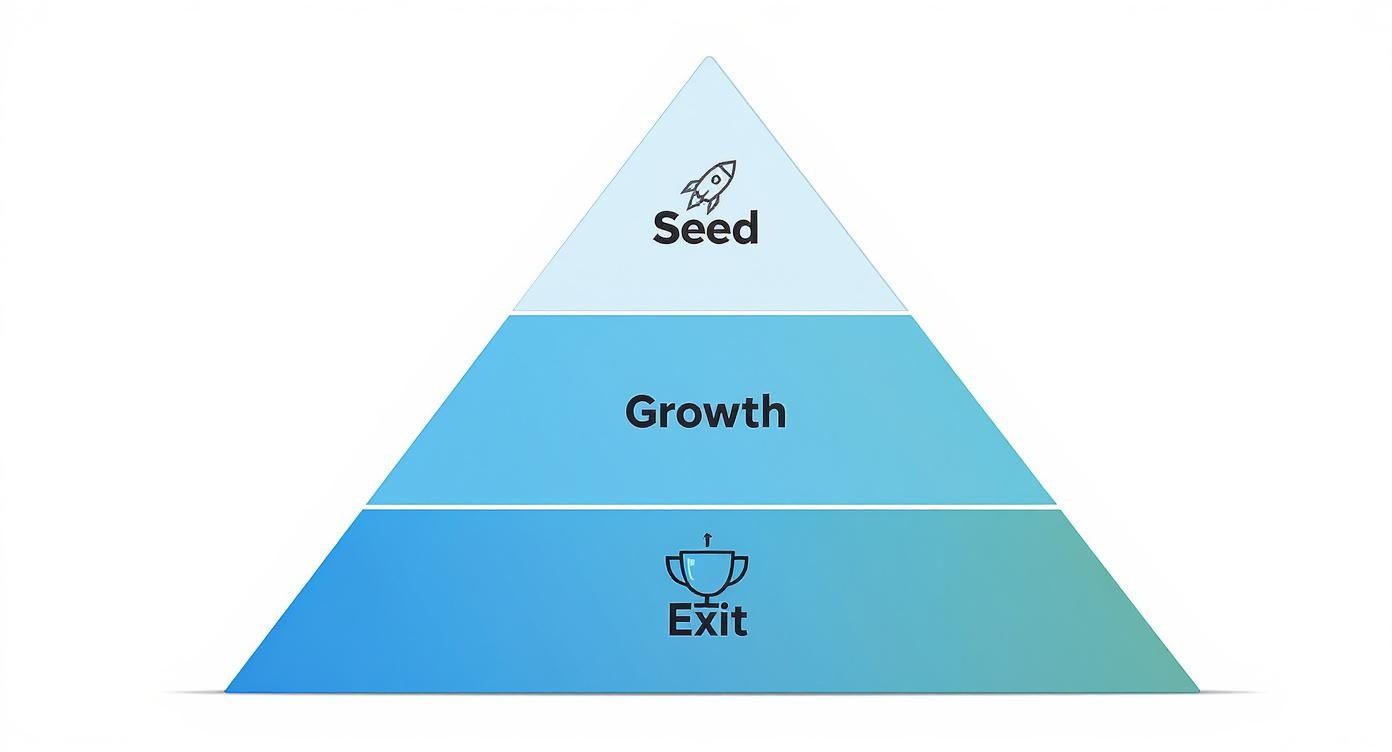
This climb gets steeper as you go, with fewer companies making it to the top. The pyramid below gives you a visual sense of this progression—starting from a broad base of early-stage ideas and narrowing toward a handful of major exits.
To give you a clearer map for this journey, here’s a breakdown of what each round typically looks like.
Newport Beach Tech Startup Funding Rounds at a Glance
This table provides a high-level overview of the most common funding rounds, helping you understand the typical check sizes, objectives, and the types of investors you'll be talking to at each stage.
| Funding Round | Typical Check Size | Primary Goal | Common Investors |
|---|---|---|---|
| Pre-Seed & Seed | $50K – $3M | Develop MVP & find product-market fit | Angel Investors, Friends & Family, Micro-VCs |
| Series A | $3M – $20M | Optimize business model & scale growth | Venture Capital Firms |
| Series B | $20M – $80M | Aggressively expand & capture market share | Venture Capital, Growth Equity |
| Series C & Beyond | $50M+ | Achieve market leadership & prepare for exit | Growth Equity, Private Equity, Hedge Funds |
Think of this table as your compass. It helps you anticipate what investors will expect and what you need to accomplish before you even start thinking about that next fundraise.
Securing Your First Capital: The Pre-Seed and Seed Rounds
This is where it all begins—the moment your vision gets its first real shot of capital. For founders, especially those navigating competitive hubs like Newport Beach, the Pre-Seed and Seed rounds aren't just about money. They’re about turning an idea into something tangible.
Frankly, these early fundraising stages are less about financial models and more about belief. Belief in you, your team, and your hunch that you can solve a problem people actually care about.
The Pre-Seed Round: A Bet on the Newport Beach Tech Startup Founder
The Pre-Seed round is often the very first money you'll take from someone outside your own bank account. At this point, your startup is probably little more than a powerful idea, a rough prototype, or maybe a super-basic Minimum Viable Product (MVP).
Investors here aren't poring over spreadsheets filled with metrics; they don't exist yet. They are betting on your vision, your resilience, and your sheer ability to make things happen.
The checks are usually modest, typically somewhere between $50,000 and $500,000. The mission is simple but absolutely critical:
-
Validate the Idea: Get out and talk to real potential customers to prove the problem exists.
-
Build a Working MVP: Show, in the simplest way, what your product does.
-
Establish the Business: Incorporate the company and handle initial legal requirements.
-
Assemble a Core Team: Rally the troops who can actually build this thing.
Your investors will likely be angel investors, specialized micro-VCs, or just people in your network who believe in you. They know it's a long shot, but they're drawn to the chance of getting in on the ground floor. Their decision is almost entirely a gut call based on how well you tell your story and the conviction you and your team radiate.
The Seed Round: A Bet on the Business Concept
Once you’ve made it through the Pre-Seed gauntlet, you’re ready for the Seed round. This is your first "official" fundraise, and the conversation shifts. It's no longer just about you and your vision; it's about proving that your vision can actually become a business.
Seed rounds are a big step up, with funding typically ranging from $500,000 to $3 million. The investor pool gets more formal, often including institutional venture capital firms that focus on early-stage companies. They’re going to want to see the first glimmers of product-market fit.
Before you start taking meetings for a Seed round, you should have solid answers to these questions:
-
Is anyone using it? You need initial traction, whether that's a small group of active users, a few paying customers, or impressive engagement numbers.
-
Does the product actually work? You should be well beyond a clunky MVP and have a more polished product that solves a real problem.
-
Will people pay for it? Even a little revenue is powerful proof that you're creating value.
-
How will you grow? You need a clear, believable plan for how you're going to find and win over more customers.
This is also the stage where a polished business plan goes from "nice-to-have" to "must-have." For a deep dive, check out our guide on how to write a winning startup business plan investors actually read.
SAFEs and Convertible Notes: The Founder's Fundraising Toolkit
In both Pre-Seed and Seed rounds, you’ll hear a lot about SAFEs (Simple Agreement for Future Equity) and Convertible Notes. These have become popular because they let you raise money without having to agree on a specific valuation for your company—a notoriously tricky negotiation for a brand-new startup.
Key Insight: A SAFE or Convertible Note isn’t a traditional loan. It's an agreement giving an investor the right to buy equity in your company during a future funding round, usually with a perk like a valuation cap or a discount.
This approach is a win-win for a couple of big reasons:
-
It’s Fast and Efficient: They cut down on the legal back-and-forth and associated fees that come with a priced equity round.
-
It Defers the Valuation Conversation: You postpone the "what are we worth?" conversation until you have more data and traction to back it up (usually at your Series A).
By understanding what each of these early rounds is for, you can be much more strategic about raising the capital you need to bring your idea to life and get it ready for the next stage of growth.
Scaling Up: Navigating Series A, B, and C
So, you’ve made it through the early-stage gauntlet. You survived the pre-seed and seed rounds, found your footing, and proved your startup isn’t just a good idea—it’s a real business with a pulse. You have a product people want, a small but mighty customer base, and the first taste of real traction.
Now what? It’s time to shift gears from survival to scale. This is where you enter the big leagues of venture capital: Series A, B, and C. Forget the informal handshake deals of the early days. This is a whole different ballgame.
The conversation is no longer about potential; it’s about performance. Your story has to be backed by hard data, and investors expect to see a clear, repeatable engine for growth.

Series A: The Turning Point for Scalability
Think of your Series A as graduation day. You’re moving from a promising project to a legitimate, high-growth company. It’s arguably the most critical fundraising moment you’ll face, because this is where you prove your business model isn't just viable—it’s scalable.
Investors in a Series A, almost always institutional venture capital firms, are looking for one thing above all else: a repeatable go-to-market strategy. They need to see that for every dollar you put into your growth machine, a predictable, larger number of dollars comes out.
Before you even think about raising a Series A, you need to have your ducks in a row:
-
Rock-Solid Product-Market Fit: You’re not guessing anymore. You have a passionate user base and cold, hard data showing you solve a major pain point.
-
Consistent Revenue Growth: You need a track record of meaningful, month-over-month revenue growth.
-
A Believable Path to Profitability: You don't need to be profitable yet, but you absolutely need a financial model that shows how you’ll get there. No more back-of-the-napkin math.
A typical Series A round brings in $3 million to $20 million. This isn't money for throwing ideas at the wall. It’s precision fuel for building out your sales team, perfecting your marketing engine, and turning customer acquisition into a science.
Series B: Gearing Up for Aggressive Expansion
If Series A was about building the engine, Series B is about hitting the nitrous button. You’ve proven the model works, and now the race is on to grab as much market share as you can before competitors even know what hit them.
The entire conversation with investors changes. It shifts from "Can this actually work?" to "Just how big can this thing get?" They’ll expect to see staggering growth metrics, a team that executes flawlessly, and leadership ready to manage an organization that’s doubling in size.
Investor Insight: At the Series B stage, VCs are betting on your ability to out-execute everyone. They want to see a company that isn't just growing but is on a clear trajectory to become a dominant force in its category.
The due diligence gets intense. Investors will pore over your unit economics, your customer lifetime value (LTV), and your customer acquisition cost (CAC). Be prepared for a financial deep dive like you’ve never experienced.
The capital raised here, usually between $20 million and $80 million, is pure acceleration capital used to:
-
Scale the Team: Go on a massive hiring spree across every department.
-
Enter New Markets: Expand geographically or attack new customer segments.
-
Make Strategic Acquisitions: Start looking at smaller companies you could acquire for their tech or talent.
Series C: Cementing Market Leadership and Preparing for an Exit
By the time you’re raising a Series C, you're no longer the scrappy underdog. You’re a major player, a well-known name in your industry. This round is all about cementing that leadership position, pushing hard toward profitability, and setting the stage for a major exit, like an IPO or a blockbuster acquisition.
Series C investors are a different breed—late-stage VCs, private equity firms, and sometimes even hedge funds. They aren't looking for unproven moonshots; they’re backing established winners. They write massive checks, often $50 million or more, to help you build an unbreachable moat around your business.
Recent trends show just how much capital is flowing into this stage. According to Investopedia, these rounds are for ventures that have already proven their business model and are ready to scale globally.
The focus here is on achieving massive operational efficiency and preparing the company for the intense scrutiny of the public markets or a major buyer. You’re not just running a startup anymore; you’re building an institution. It’s critical to understand just how deep investors will dig, which is why you need to know what venture capitalists look for beyond the pitch deck.
Sector-Specific Funding and the Rise of the Megaround
The traditional funding ladder—Seed, Series A, B, C—is a great mental model, but it’s not a universal truth. The reality is that your industry can completely change the fundraising game. The sector you’re building in has a massive impact on your valuation, the size of your rounds, and what investors expect from you.
Nowhere is this more obvious than in the world of Artificial Intelligence. If you’re a founder in a truly groundbreaking field like AI, biotech, or climate tech, you’re often playing with a different set of rules. Investors are willing to write much bigger checks at higher valuations because they aren’t just betting on you to disrupt a market; they’re betting on you to create an entirely new one.
Of course, this creates a different kind of pressure. While capital might seem easier to come by in these hot sectors, the expectations are through the roof from day one.
The AI Effect: How One Sector Is Rewriting the Rules
The explosion in AI hasn't just been a technological shift; it's fundamentally warped how venture capital gets deployed. VCs are making bigger, more concentrated bets on the companies they believe will own the next decade. This intense focus means a huge portion of all available capital is now flowing into just a handful of sectors.
And the numbers are staggering. In 2025 alone, AI-focused startups pulled in $89.4 billion in global VC funding. Think about that—it’s 34% of all venture capital invested, even though AI companies only made up 18% of the startups that got funded. That’s a massive concentration of capital, and it screams investor confidence.
The valuations reflect this feeding frenzy, with the average AI startup being valued 3.2 times higher than a traditional tech company. We're also seeing the money skew heavily toward later stages. While Series A rounds for AI companies brought in $18.7 billion, Series B hit $21.3 billion, and the money really started flowing at Series C and beyond, which vacuumed up $28.9 billion with an average round size of a whopping $158 million. You can dig deeper into the latest AI startup funding and investment trends to see the full picture.
This data tells a crucial story for every founder, whether you're in Orange County or Silicon Valley: you have to understand the unique capital dynamics of your own industry to build a smart fundraising strategy.
What Exactly Is a Megaround?
This flood of capital into high-growth sectors has given rise to the megaround—a single funding round that tops $100 million. These deals used to be rare, almost mythical. Now, they’re becoming a key strategic weapon for investors looking to cement a company’s market dominance.
A megaround isn't just a bigger check. It’s a strategic move to flood a breakout company with so much capital that it creates an almost insurmountable lead. It’s a bet on forging a new category king.
These nine-figure rounds are almost exclusively for late-stage companies, typically at the Series C stage or later. By this point, a startup has already proven its model at scale and has a very clear runway to an IPO or a massive acquisition.
Why Megarounds Matter, Even If You’re Not Raising One
So, you're not building a foundational AI model. Why should you care about these massive deals? Because the trend toward megarounds sends ripples across the entire startup ecosystem.
Here’s how it affects you:
-
It Raises the Bar for Everyone: Megarounds are a loud market signal. They crown perceived "winners" in a space, which can make it tougher for smaller competitors to hire top talent or win over new customers.
-
It Skews Valuation Expectations: When a competitor in your industry raises a giant round, it can warp valuation benchmarks for everyone else. Suddenly, investors might have unrealistic expectations for earlier-stage companies in the same field.
-
It Reinforces the Power of Scale: The core takeaway here is that VCs are increasingly obsessed with scale and market leadership. It’s a powerful reminder that you need a compelling story for how you’ll become the dominant player in your niche, no matter how big or small it is.
For any founder, paying attention to these broader market dynamics is non-negotiable. Whether you’re building the next great AI platform or a targeted SaaS tool for a small industry, understanding how capital is moving helps you set realistic goals, frame your story, and build a winning long-term strategy.
Mastering Late-Stage Funding and Your Ultimate Exit
As your Newport Beach Tech startup matures, the fundraising game changes entirely. You're no longer a scrappy underdog trying to survive; you're becoming an established market leader. This final stretch of private funding isn't about fueling experiments—it's about preparing for the finish line. We're now in the world of late-stage funding and meticulously planned exits, where the stakes are astronomical.
If you’ve successfully navigated the earlier rounds, this is the payoff for years of relentless work. It’s about securing the capital you need for massive scale while strategically setting the stage for that final, big liquidity event.

Growth Equity: The Pre-IPO Power-Up
Growth equity rounds—often called Series D, E, and beyond—are a different breed of investment. Traditional VC money often funds high-burn, unprofitable growth in the hope of finding product-market fit. Growth equity is different. These investors back mature companies that are already profitable or just a stone's throw away from it.
The investors here, typically private equity firms or the growth-stage arms of massive VC funds, aren't betting on a dream. They're investing in a proven, well-oiled machine, giving you the fuel to make it even bigger.
The goals for a growth equity round are sharp and focused:
-
Global Expansion: Planting your flag in new international markets.
-
Strategic Acquisitions: Buying up smaller competitors to consolidate your hold on the market.
-
Fortifying the Balance Sheet: Cleaning up and strengthening the company’s financials before a potential IPO.
This is the stage of massive capital. Mega-rounds of $100 million or more have become a hallmark of the modern startup landscape. According to Crunchbase, in Q3 2025, these giant rounds accounted for a staggering 70% of all U.S. venture capital deployed. It’s a clear signal that investors prefer making huge bets on a few companies poised for total market dominance. You can see the full analysis on how megarounds are shaping the state of startups in 2025.
The Ultimate Goal: Choosing Your Newport Beach Tech Startup Founder Exit Path
Every dollar you raise is a step towards an eventual exit. This is the moment when you, your team, and your investors finally realize the value of your equity. The two main paths to this destination are an Initial Public Offering (IPO) or a Merger or Acquisition (M&A).
The choice between them is one of the most critical decisions a founder will ever make. It has profound implications for your company's future, its culture, and your own legacy.
The Initial Public Offering (IPO): Ringing the Bell
An IPO is the process of taking your private company public by selling shares on a major stock exchange like the NASDAQ or NYSE. It's often hailed as the pinnacle of startup success—a public announcement that you’ve built something durable and industry-defining.
Going public brings a huge influx of cash and brand prestige, but it’s not a free lunch.
-
The Upside of an IPO:
-
Massive Capital: Accessing public markets can fund growth on an unprecedented scale.
-
Enhanced Credibility: Being a public company instantly boosts your reputation and visibility.
-
Liquidity for Everyone: It creates a clear path for early investors and employees to sell their shares.
-
-
The Downside of an IPO:
-
Intense Scrutiny: Public companies live under a microscope, with strict SEC reporting requirements.
-
Loss of Control: You answer to a board and public shareholders.
-
Short-Term Pressure: The relentless demand for quarterly earnings can stifle long-term, innovative thinking.
-
Getting ready for an IPO is a grueling, multi-year marathon that requires a world-class finance team and bulletproof internal processes. As you consider it, be sure to explore the new landscape of going public to understand what it takes today.
Mergers and Acquisitions (M&A): Joining Forces
An M&A happens when a larger company buys your startup. For venture-backed companies, this is by far the more common exit. An acquisition can be a strategic play for the buyer to get their hands on your technology, your talented team, or your loyal customer base.
Key Consideration: A good M&A isn't just about the sale price. It’s about finding a partner whose vision aligns with yours, ensuring your product and people can thrive inside a larger organization.
An M&A offers a faster and more certain route to liquidity than a long, risky IPO process.
-
The Upside of an M&A:
-
Strategic Synergy: Combining forces can give you access to immense resources and market reach overnight.
-
Faster Payout: The sale provides a direct cash or stock payment to shareholders.
-
Less Bureaucracy: You skip the intense regulatory and reporting headaches of being public.
-
-
The Downside of an M&A:
-
Potential Culture Clash: Merging two distinct company cultures is notoriously difficult.
-
Loss of Autonomy: You're no longer the captain of your own ship; you'll lose independence in decision-making.
-
Legacy Concerns: The founder's original vision can easily get diluted or completely changed.
-
In the end, whether you're aiming for that bell-ringing IPO or a strategic acquisition, planning for your exit should start years in advance. It’s what will shape your late-stage funding strategy and ensure you’re building a company that isn't just successful, but truly valuable.
Your Top Fundraising Questions, Answered
The world of startup funding is a maze of strange terms, critical decisions, and high-stakes negotiations. To help clear things up, here are straightforward answers to the questions we hear most often from founders.
This is your go-to FAQ for the fundraising trail. Our goal is to break these concepts down so you can get back to what you do best: building an incredible company.
What’s the Real Difference Between a SAFE and a Priced Round?
A SAFE (Simple Agreement for Future Equity) is an instrument designed for speed and simplicity, which is why it's common in Pre-Seed and Seed rounds. It’s not debt, and its biggest advantage is that it lets you bring in capital without having to agree on a specific company valuation when your startup is still mostly an idea.
An investor gives you money now, and that investment converts into equity later when you raise a "priced round." As a thank-you for taking an early risk, they'll typically get a better deal through a valuation cap or a discount. It’s a much faster and cheaper way to get a deal done.
A priced round, the standard for Series A and beyond, is exactly what it sounds like. You and your investors negotiate and agree on a price-per-share, officially setting your company's valuation. It’s a much heavier lift, involving deep due diligence and significant legal paperwork, but it creates absolute clarity for everyone on who owns what.
How Should I Really Be Thinking About Dilution?
Dilution is a part of the fundraising game. It's the simple math of your ownership percentage going down every time you issue new shares to investors. It’s easy to get hung up on this, seeing your personal stake shrink, but that’s the wrong perspective.
The Founder's Mindset on Dilution: You're not losing a piece of your company. You're trading a bigger slice of a small pie for a smaller, but much more valuable, slice of a giant one. The cash you raise should create far more value than the equity you give up.
For a typical funding round, founders should expect to sell between 15% and 25% of the company. The smartest founders don't just look at the round in front of them; they model out their cap table for the next few rounds. This gives them a clear picture of what their ownership and control will look like down the road, which is absolutely critical for making good decisions today.
What Does a Realistic Fundraising Timeline Actually Look Like?
Raising money is a marathon, not a sprint. One of the biggest mistakes founders make is underestimating the time commitment. From the day you start preparing your materials to the moment the money is in your bank account, you should budget for three to six months.
The process usually unfolds in three stages:
-
Preparation (1-2 months): This is all on you. You'll be building your pitch deck, creating a financial model that holds up to scrutiny, researching a target list of investors, and practicing your story until it’s second nature.
-
Outreach & Pitching (2-3 months): Now you're in the trenches. This phase is about getting warm intros, taking meeting after meeting, following up professionally, and trying to build momentum.
-
Due Diligence & Closing (1-2 months): Once an investor provides a term sheet, they'll start digging into everything—your numbers, legal docs, tech, and team. After that, it’s a final round of legal negotiations to get the deal signed.
The main lesson here? Start raising money long before you need it. Walking into investor meetings with a healthy runway gives you leverage and massively boosts your odds of closing a great round.
At Spotlight on Startups, we provide the clarity and insights you need to navigate every stage of the entrepreneurial journey. Our platform delivers actionable knowledge on everything from funding pathways to the core attributes of successful founders. Explore our resources to build your company with confidence. Find out more at https://spotlightonstartups.com/.