
You have a compelling business idea—a concept that keeps you up at night, sketching on napkins and mapping out features. But passion, while essential for any founder, isn't enough to build a scalable company.
What's the first step? It's not drafting a business plan or coding a prototype. It's executing a rigorous business idea test. This is your reality check—a structured process to validate if your concept has a real, paying audience before you invest significant time and capital. It's about gathering hard evidence to confirm a genuine market need exists, a core principle of successful entrepreneurship.
Why Most Startups Fail and How to De-Risk Yours

The startup ecosystem is filled with innovative ideas that never achieved commercial success. Founders burn through funding, energy, and countless late nights, only to launch to a market that isn't listening. This isn't just bad luck; it’s often a direct result of failing to validate the core business idea.
The tough lesson for many founders is that building an interesting product isn't the goal. Building something customers desperately need—and will pay for—is. A rigorous business idea test is a startup’s best insurance policy against wasted effort and a critical step in building a resilient company.
The Real Reason Ventures Falter
The data is clear. Up to 90% of startups fail, and it's not for a lack of passion or vision. A staggering 34% of these failures are attributed to a lack of product-market fit. Another 22% stems from ineffective marketing that fails to connect with the target audience. You can dig deeper into the data behind these startup failure rates.
These statistics point to a single, critical mistake: founders fall in love with their solution before they truly understand the problem. They build on gut feelings and unverified assumptions—a high-stakes gamble that rarely pays off for early-stage companies.
A business idea test isn't about proving yourself right. It's about trying to prove your assumptions wrong as quickly and cheaply as possible. The market, not your ego, is the ultimate judge.
Shifting from "Build It" to "Prove It"
A solid validation process flips the old "build it and they will come" model on its head. Instead, you adopt a "prove they will come before you build it" mindset. It’s a methodical framework to de-risk your venture, turning assumptions into validated facts, one small experiment at a time.
This proactive approach is a game-changer for startup growth. It helps you:
- Confirm a Real-World Problem: Are you solving a "hair-on-fire" problem or just a minor inconvenience?
- Identify Your Ideal Customer: Move beyond basic demographics to understand the psychographics and motivations of your target buyer.
- Make Data-Informed Decisions: Swap guesswork for evidence. Know when to pivot, persevere, or shelve an idea with confidence.
- Build a Foundation for Growth: Companies built on a validated need have a much stronger foundation for sustainable growth and attracting investor interest.
When you embrace this evidence-based path, you evolve from a dreamer into a strategic founder. You build businesses designed for success.
To give you a roadmap, our entire validation framework rests on four key pillars. Each one builds on the last, systematically turning your idea into a tested concept ready for fundraising and scaling.
The Four Pillars of an Effective Business Idea Test
| Validation Pillar | Core Objective | Key Activities to Perform |
|---|---|---|
| Market Research | Uncover the problem and identify your ideal customer. | Analyze market trends, scout competitors, create detailed customer personas. |
| MVP Creation | Build the simplest version of your solution to test the core value proposition. | Define core features, develop a "no-code" or low-code MVP. |
| Customer Interviews | Get direct qualitative feedback from your target audience. | Conduct problem/solution interviews, analyze qualitative data for insights. |
| Landing Page Testing | Measure actual purchase intent and gather leads. | Craft a clear value proposition, run A/B tests, and track conversion metrics. |
Each pillar represents a critical stage in the journey from a raw idea to a market-validated business. In the sections ahead, we’ll dive into the practical steps for executing each one.
Uncover Market Gaps with Smart Research
Every legendary business begins by fixing something that's broken. But before you can think about building a solution, you must become an expert on the problem itself. A solid business idea test isn't about guesswork; it’s a deliberate process of swapping your assumptions for credible market evidence.
Your first move is to map the competitive landscape. Who is already solving this problem? Go beyond a simple list and dig into their approach. What are their core strengths? More importantly, where are their blind spots? Underserved niches are often hidden in plain sight, waiting for a founder who is paying close attention to customer pain points.
Gauge Real-Time Market Interest
To find those gaps, you need to listen to what potential customers are saying. Social listening tools are excellent for tapping into unfiltered conversations on forums, social media, and review sites. Pay close attention to the specific frustrations people mention repeatedly. The exact words they use are invaluable for crafting your future marketing copy and brand positioning.
Google Trends is another essential tool for a high-level view of market demand. It shows you the public's interest in a specific problem or solution over time. A rising trend could signal a growing market and a significant opportunity for innovation, while a steady decline might be a major red flag for investors.
For instance, here’s a peek at the search interest for "AI productivity tools" over the last year.
This isn't a temporary blip; the chart shows sustained, high-level interest. It's clear confirmation that people are actively seeking solutions in this space right now. This kind of data helps validate that you're operating in a field with an engaged audience.
Craft Your Ideal Customer Profile
Once you have a feel for the market, it's time to get specific and build out your Ideal Customer Profile (ICP). This isn't just a generic demographic sketch. It's a detailed, living portrait of the single person who feels this problem most acutely and has the authority to make a purchasing decision.
A truly useful ICP goes deep. It should include:
- Job Role and Responsibilities: What does their day-to-day work actually look like?
- Primary Goals: What are they trying to accomplish professionally? What does success mean to them?
- Biggest Frustrations: Where do they get stuck? What inefficient, manual workarounds are they using right now?
- Decision-Making Power: Are they the end-user, the budget holder, or both?
This profile becomes your North Star for product development, customer acquisition, and overall business strategy.
Get Out of the Building
Now for the part you absolutely cannot skip: talking to actual humans. These initial conversations have one simple goal, and it's not to pitch your idea. It's to listen.
Your only objective is to understand their world. Ask open-ended questions like, "Tell me about the last time you dealt with [the problem]." Then, be quiet and take detailed notes.
These informal chats will give you the nuance that spreadsheets and market reports can never provide. You'll hear about their pain points in their own words, learn about the ad-hoc solutions they've created, and gather the raw insights you need to build something they'll actually value.
For founders looking to systematize this process, exploring frameworks for setting up customer advisory boards can add incredible structure for long-term feedback. This early qualitative data is the bedrock of a successful, customer-centric startup.
Building Your First Validation Engine with a Lean MVP
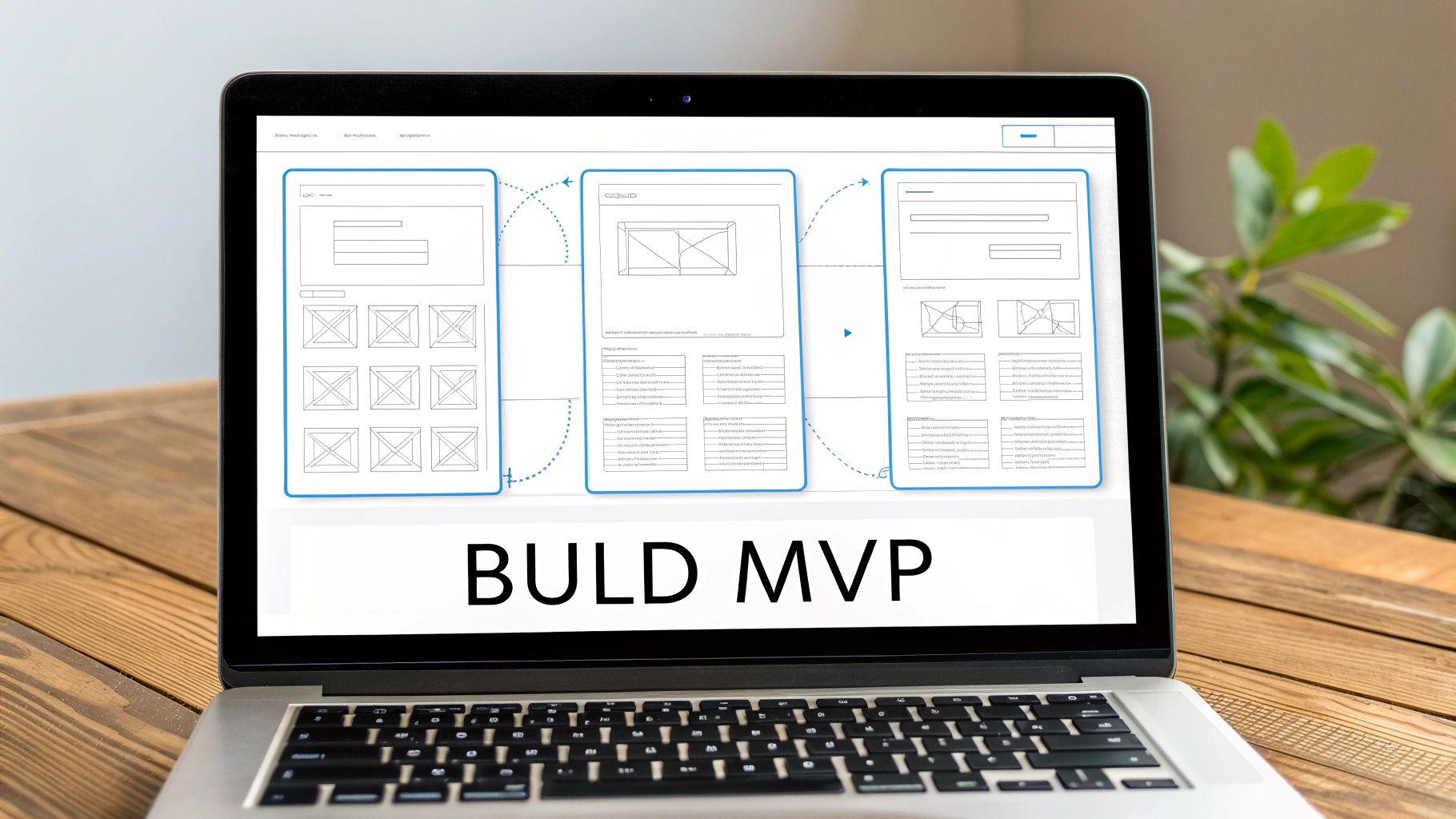
A Minimum Viable Product (MVP) is not a buggy, half-baked version of your final product. That's a common misconception that leads founders to build a disappointing V1 that fails to gain traction.
Think of an MVP as a focused experiment. It's the simplest possible thing you can build to test your most critical assumption with real people. The goal isn't to generate revenue or attract thousands of users. The goal is to learn—as much as possible, as quickly as possible, with the least amount of effort. Your whole purpose during this business idea test is to find evidence, not just build software.
Choosing the Right Kind of MVP to Maximize Learning
The best MVPs often don't involve a single line of code. The fastest, most capital-efficient way to validate an idea is to skip initial development altogether. These low-effort, high-learning approaches let you prove your concept before you've spent a dime on developers.
Here are a couple of my favorite non-technical MVP models:
-
The Concierge MVP: This is a hands-on approach where you personally deliver the service to your first handful of customers. For an idea for a curated meal-planning app, you'd start by manually creating custom meal plans and shopping lists for your first users over email. The direct contact gives you incredible insight into their real problems and desires.
-
The Wizard of Oz MVP: This model presents a polished front-end that appears to be fully automated, but your team manually handles all the processes behind the curtain. Users think they're interacting with a complex algorithm, but it's all manual work. This is perfect for testing demand for a complicated service before committing to the massive task of building the backend.
The smartest founders know an MVP is a question, not a statement. The question is simply: "Do people actually want this?" Everything else is just noise.
A Real-World Example of Scrappy Validation
Consider a founder who wanted to launch a SaaS tool to automate social media scheduling for small businesses. Instead of sinking six months and $50,000 into development, she got scrappy.
- The "Product": She used a simple tool like Carrd to build a professional-looking landing page in an afternoon. It clearly explained the value proposition and included mockups of the future software.
- The "Backend": The call-to-action wasn't "Buy Now." It was "Request Early Access." Every time someone signed up, their email was simply added to a Google Sheet.
- The "Service": For the first 10 sign-ups, she performed the entire service manually. She collected their content ideas via email and used basic, free scheduling tools to post on their behalf.
Within two weeks, she had her answer. Small business owners were willing to pay for this. She got priceless feedback on the features they actually cared about and used testimonials from her first manual "customers" to secure pre-seed funding.
This entire validation loop cost her less than $100 and saved months of wasted time and capital. It's a textbook example of the lean methodology we break down in our complete guide to startup founder best practices.
Running Customer Interviews That Reveal the Truth

Your research and MVP have given you a solid hypothesis. Now it's time to get out of the building and pressure-test it with real conversations. Getting honest, unfiltered feedback is one of the hardest parts of a business idea test, but it's also the most critical. You have to learn the difference between genuine interest and polite encouragement to build a resilient founder mindset.
The fear of failure is a real obstacle for many entrepreneurs. A 2024 survey showed 49% of people admitted they wouldn't start a business because of it, up from 44% in 2019. Customer interviews are the perfect antidote—they provide concrete evidence to move forward with confidence. If you want to dive deeper, this research on entrepreneurial mindsets shows how validation builds incredible resilience.
Finding the Right People to Interview
First, you need to talk to people who perfectly match the Ideal Customer Profile (ICP) you built earlier. Quality over quantity is the name of the game here. Five deep, insightful conversations with your exact target user will tell you infinitely more than fifty surface-level chats with a random audience.
So, where do you find these people?
- Lean on Your Network: Start with your professional connections on platforms like LinkedIn. Ask for introductions to people who fit your ICP, but make it crystal clear you're doing research, not selling.
- Go to Their Hangouts: Find the niche forums, Slack channels, or industry groups where your ideal customers spend their time. Participate authentically before asking if anyone is willing to chat about a specific problem they're facing.
- Offer a Small Incentive: People's time is valuable. A simple gesture, like a $25 gift card for a 30-minute call, shows you respect their contribution and can significantly boost your response rates.
The Art of the Problem-Focused Question
This is the most important part: the goal of these interviews is not to pitch your solution. It's to validate the problem. The second you mention your brilliant idea, the dynamic shifts. People will start being nice and giving you polite feedback instead of the raw, honest truth you need. This is where most founders get it wrong.
"The moment you start talking about your solution, you've stopped learning about their problem."
Instead of asking, "Would you use an app that does X?" your entire line of questioning needs to revolve around their past experiences and current behaviors. Keep your questions open-ended and focused on uncovering real-world struggles.
Powerful questions you should be asking:
- "Tell me about the last time you dealt with [the problem you're solving]."
- "What was the hardest part about that experience?"
- "What, if anything, have you done to try and solve this problem yourself?"
- "How much did that workaround cost you, either in time or money?"
Listen for emotion—frustration, annoyance, excitement. These are signals of a problem worth solving. When someone describes a clunky, expensive workaround they've already cobbled together, you've struck gold. That’s a genuine buying signal, and this is the qualitative data that will inform your next move.
Measuring Real Intent with Landing Page Tests
Customer interviews provide the "why" behind a problem, but they don't prove someone will actually pull out their wallet. That's a different kind of validation, and it’s where a simple landing page test becomes your best friend. You must see if people will take a concrete step when you ask them to, a key part of customer acquisition strategy.
The goal here isn't to build a whole website. We're building a single, focused page designed to do one thing: measure genuine intent. Think of it as your final reality check before writing a line of code. With modern AI tools for startups, you can get this entire experiment running in a single afternoon.
The Anatomy of a Killer Validation Page
A great validation page is brutally simple. It has no distractions, no extra links, and no fluff. It's all about getting a visitor to make a decision, and it boils down to just three core parts.
- A Punchy Value Proposition: This is your headline, and it has to be killer. It needs to immediately answer the visitor's silent question: "What's in it for me?" Pull directly from the biggest pain point you heard in your interviews.
- A Can't-Miss Call-to-Action (CTA): This is where the rubber meets the road. A vague "Learn More" button is a waste of space. You need a specific, low-friction ask that signals real interest. Think "Join the Waitlist," "Request an Early-Bird Discount," or "Get Notified at Launch."
- Just Enough 'Why': Give them a few bullet points or a quick sentence or two about the key benefits. You're selling the destination, not the plane. Resist the temptation to list every feature you've dreamed up.
You don't need to be a developer to make this happen. Platforms like Unbounce have drag-and-drop builders that make creating these pages a breeze.
As you can see, modern tools take the technical headache out of it. They give you templates and even AI-powered copy suggestions to help you nail your value proposition. This lets you, the founder, stay focused on the message, not the mechanics.
From Clicks to Conversions: Reading the Tea Leaves
Once your page is live, the real work starts. The idea is to drive a small but highly targeted stream of traffic and watch what happens. We're not trying to go viral; we're trying to see if our Ideal Customer Profile actually cares.
Fire up a small, laser-focused ad campaign on a platform like LinkedIn or Facebook. Target the exact job titles, industries, or interests that define your ICP. A budget of a few hundred dollars is usually more than enough to get the data you need.
A conversion rate isn't just a metric; it's the market casting a vote on your idea. A low rate isn't a failure—it's critical feedback telling you to tweak your message or value prop before you sink a fortune into building the wrong thing.
Keep a close eye on these numbers:
- Conversion Rate: This is your north star. Of all the people who landed on your page, what percentage provided their email? For a targeted audience that supposedly has this pain point, anything in the 5-15% range is a fantastic signal that you're onto something.
- Cost-Per-Acquisition (CPA): How much did you spend on ads to get one person to sign up? This early CPA gives you a rough benchmark for what it might cost to acquire customers down the road, which is critical for figuring out if your business model is viable.
- Quality of Sign-Ups: Don't just count the emails; analyze them. Are you getting sign-ups from corporate domains that match your ICP? Or is it a list full of generic Gmail accounts? A handful of high-quality leads from perfect-fit companies is a much stronger signal than a hundred sign-ups from random people.
Making the Critical Go/No-Go or Pivot Decision
You’ve done the work. The customer interview notes are synthesized, the landing page analytics are in, and a waitlist of potential users is in a spreadsheet. Now comes the moment of truth, a time that demands clear-eyed leadership and decision-making, not wishful thinking.
This is where you weave together every thread of data—the qualitative stories and the quantitative numbers—to determine the smartest path forward. The goal isn't just to find a simple "yes" or "no." More often than not, it means adjusting your course. A successful test doesn’t always end with a green light; sometimes, its greatest value is showing you exactly what needs to change.
From Data to Decision
Start by looking for patterns. Do the same specific pain points keep popping up in your interview notes? Does the language people used to describe their problems match the value proposition that drove the highest conversions on your landing page?
An idea doesn't fail; an assumption is proven false. Discovering that your initial concept won't work is a successful outcome—it's validated learning that saves you years of wasted effort and capital.
Genuine product-market fit has clear signals, and they're rarely subtle. It’s not polite curiosity; it’s a palpable sense of urgency from potential customers. They’ll ask when they can pay for it, offer detailed feedback without you even asking, and won't be easily put off by a clunky MVP. If you're getting more vague encouragement than eager commitment, that’s your cue to pause and dig deeper.
This decision tree gives you a simple framework for thinking through your test results, weighing market viability against your feedback and resource readiness.
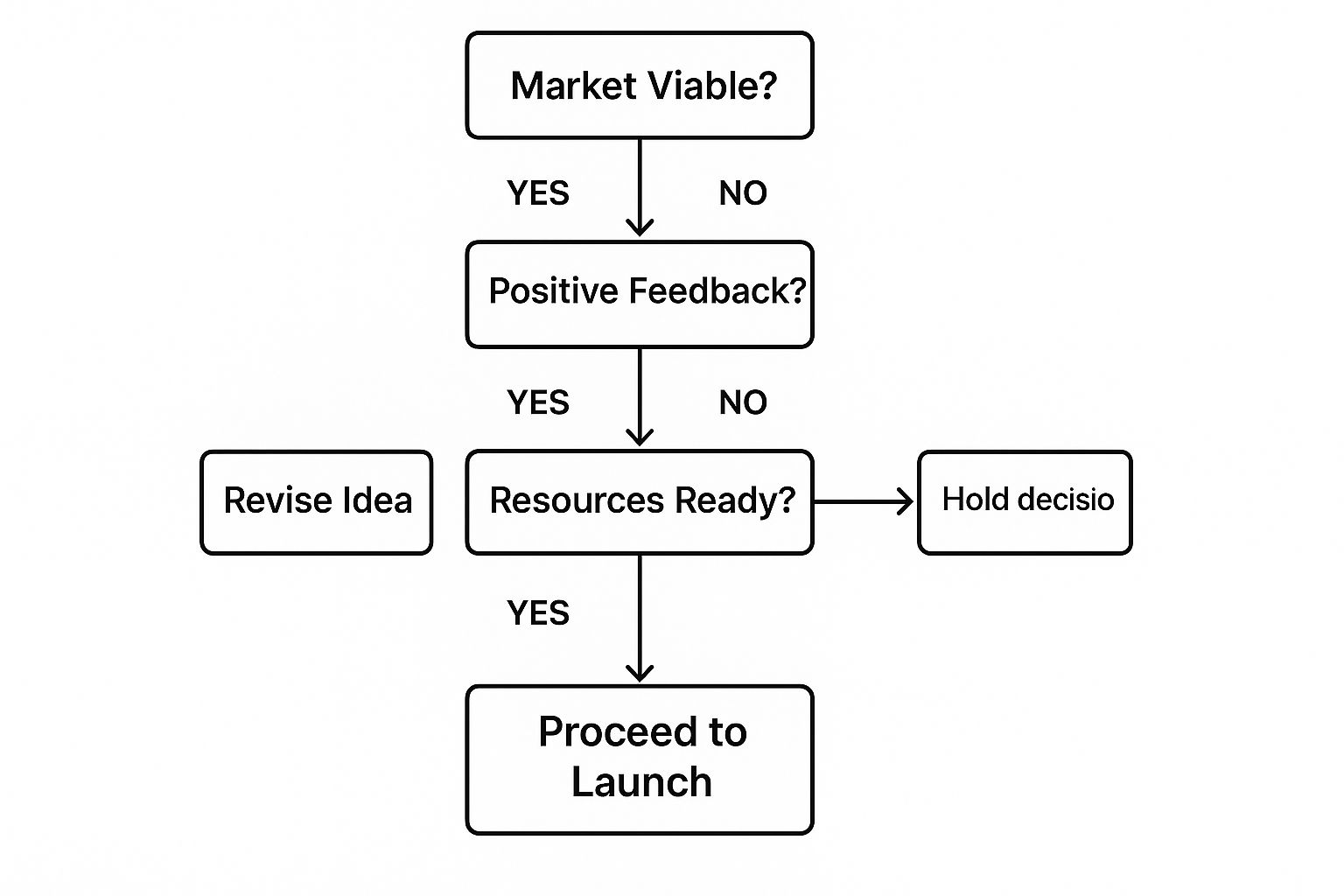
As the visual shows, even with positive signals from the market, the decision to push forward still hinges on whether you have the resources to execute effectively.
Embrace the Pivot
Most of the time, the answer isn’t a straightforward "go" or "no-go." It’s a pivot. Think of a pivot as a structured course correction, one designed to test a new, fundamental hypothesis about your product, strategy, or growth engine. It’s not a frantic scramble in the dark; it’s an informed change based on what you’ve learned from the market.
Your industry can also provide crucial context. For instance, ventures in finance, insurance, and real estate historically have higher survival rates, with 58% still running after four years. Knowing benchmarks like these can help you interpret your own results with a dose of reality. You can find more details about these industry dynamics and entrepreneur statistics.
Ultimately, a well-run business idea test provides the hard evidence you need to move forward with conviction—whether that means launching, pivoting, or shelving the idea for now. It transforms you from a founder running on hope to one armed with market-validated insights, a core attribute of founder excellence.
Spotlight on Startups delivers the clarity and authority you need to navigate every stage of your entrepreneurial journey. From validating your first idea to preparing for a critical funding round, we provide the actionable knowledge to help you build a company that lasts. Find out more at https://spotlightonstartups.com/.