
In the fast-paced startup world, data points and directives can only take you so far. To build a resilient, high-growth company, you need more. Storytelling for leadership is the skill that breathes life into an abstract vision, turning it into a shared, actionable mission. It’s the bridge between a founder's idea and the collective hustle needed to make it real—creating alignment in a way a spreadsheet never could.
This guide provides an actionable framework for founders to harness storytelling, transforming how you lead your team, pitch to investors, and build a brand that resonates.
Why Storytelling is a Critical Leadership Skill for Founders

In an ecosystem saturated with information, raw data often fails to inspire action. Founders who rely solely on metrics and top-down commands are missing the human element that fuels motivation and commitment. This is where the strategic art of storytelling becomes a critical advantage for scaling a startup.
A well-crafted narrative does more than just present information; it builds connection, creates clarity, and wields influence. Instead of just telling your team what to do, a story powerfully illustrates why their work matters. That shift is fundamental to building a culture of ownership and innovation.
Turning Abstract Vision into Shared Reality
To a new hire or even an early team member, a founder's grand vision can feel distant and intangible. Storytelling makes it concrete. By framing goals within a narrative, leaders connect day-to-day tasks to a much larger, more meaningful purpose.
This narrative approach is potent because it:
- Simplifies Complexity: Stories break down complicated strategies or market challenges into concepts that are easy to grasp and remember.
- Builds Emotional Connection: A good story taps into shared human experiences, building a foundation of empathy and trust between leaders and their teams.
- Inspires Action: A compelling story about overcoming a past obstacle or seizing a future opportunity will motivate people far more effectively than a simple directive ever could.
A founder who says, “Let me tell you a story,” is creating a space where their team feels safe to engage, connect, and reflect. It’s a subtle invitation to listen without issuing a command.
The Impact on Key Startup Functions
Mastering storytelling directly impacts the core functions essential for startup growth. When pitching to investors, a founder’s story of grit and vision is often the deciding factor that secures funding. As TechCrunch often highlights, investors don’t just look for a solid business plan; they invest in founders who can make them believe.
It’s the same with customer acquisition. Brand stories build loyalty by creating an emotional bond that transcends product features. Customers don't just buy a product; they buy into the mission behind it. By honing this skill, founders can navigate uncertainty, attract top talent, and build a resilient organization ready to scale.
The Science Behind Why Stories Build Trust

Storytelling is often dismissed as a "soft skill," but that underestimates its power. When a leader tells a compelling story, they are tapping into a biological mechanism that forges genuine connection and trust. They aren’t just sharing information; they’re setting off a chain of neurological reactions that raw data could never match.
This comes down to how our brains are wired. Facts and figures activate the language centers of the brain. But a good story lights up the sensory cortex. As you describe a challenge or a breakthrough, your audience doesn't just hear your words—they experience the sights, sounds, and emotions of the story. This creates a potent shared experience, making your message memorable and deeply felt.
The Power of Neural Coupling
At the core of this phenomenon is a process called neural coupling. As you share a personal narrative, the brain activity in your listeners starts to mirror your own. In a measurable neurological event, your brain and your team’s brains begin to sync up. The story acts as a bridge, allowing thoughts and emotions to transfer from one mind to another.
Through neural coupling, you move past simple communication and into the realm of shared consciousness. Your team doesn’t just understand your vision on an intellectual level—they begin to feel it. This is where deep alignment and a unified purpose are born.
Triggering the "Trust Hormone"
Beyond syncing brainwaves, stories also kick off a powerful chemical response. A well-told narrative, especially one with vulnerability or a relatable struggle, prompts the brain to release oxytocin, often called the “trust hormone.”
Oxytocin underpins social bonding, empathy, and psychological safety. When your story triggers its release, it lowers your audience’s skepticism and makes them more receptive to your ideas. This biological reaction breaks down invisible walls, fostering the strong interpersonal bonds every startup needs to survive. In the high-stress world of building a company, this chemical trust is the glue that holds everything together.
It's the foundation for:
- Better Collaboration: Teams with high trust are more willing to share bold ideas and take creative risks.
- Deeper Resilience: A strong sense of connection helps teams bounce back from setbacks with a collective, problem-solving mindset.
- Greater Buy-In: When people trust their leader, they’ll commit to the mission wholeheartedly, even when the path forward is uncertain.
Understanding this science makes it clear: storytelling isn't fluff. It’s a strategic, biological tool for building the trust and resilience your startup needs to win.
A Framework for Crafting Your Authentic Leadership Narrative
Knowing the theory is one thing; putting it into practice is another. The good news is you don’t need to be a born orator to craft a leadership narrative that moves people. With the right framework, you can turn this into a reliable tool for sharing your vision.
Building an authentic narrative isn’t about inventing a perfect story. It’s about strategically framing your real experiences—the wins, the struggles, the messy middle—so they connect with your audience. The most powerful stories are rooted in truth and delivered with conviction.
A Three-Step Framework for Your Narrative
An impactful leadership story is built with intention. You must think like a strategist, understanding your audience’s world before you decide what to say. Following a clear process ensures your story lands with impact.
This simple flow shows the core process: start with your audience, lock in your message, and then design the story's journey.
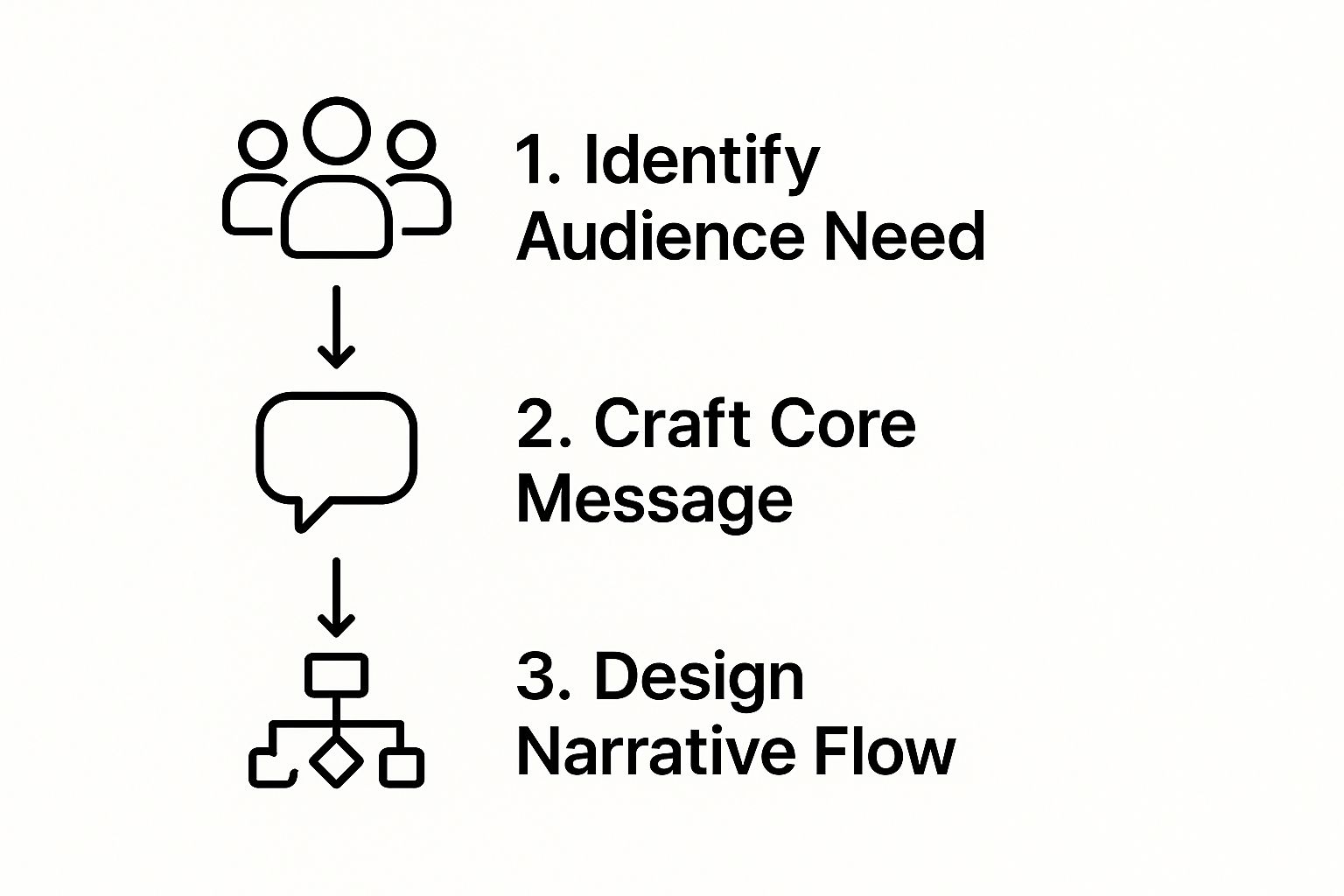
This visual drives home a key point: a great story isn't a random sequence of events. It's a carefully crafted path designed to guide your listener from seeing a problem to believing in your solution.
Step 1: Identify Your Core Message and Audience
Before telling a story, you must know who you’re talking to and what you want them to do or feel afterward. Are you rallying your team during a tough quarter? Pitching to investors who have seen it all? Or building trust with new customers? Each audience has different priorities.
Ask yourself:
- Who is my audience? (e.g., engineers, investors, early adopters)
- What is their current mindset? (e.g., burnt out, cautiously optimistic, skeptical)
- What is the one thing I need them to remember? This is your core message.
This core message becomes the heartbeat of your story—the unifying idea that everything else supports. It could be "our resilience gets us through anything," "we build what our customers actually ask for," or "this mission is worth the struggle." Once defined, this message becomes your North Star.
Your leadership narrative isn't just about what happened; it's about what it means. The meaning you assign to your experiences gives your story its power to influence and inspire.
Step 2: Structure Your Story for Impact
Once your audience and core message are clear, build the narrative itself. The most timeless and effective structure is a simple three-act arc: a beginning, a middle, and an end. This classic approach creates a natural rhythm of tension and release that keeps people engaged.
1. The Beginning (The Challenge): Set the stage by introducing a relatable problem or an ambitious goal. What did the world look like before? What was the challenge your team decided to take on? This is where you establish the stakes.
2. The Middle (The Struggle): This is the heart of your story. Detail the journey, the roadblocks, and the hard-won lessons. Don't be afraid to be vulnerable—sharing setbacks or moments of doubt makes the story feel real and relatable.
3. The End (The Vision): Bring it home with the resolution or the path forward. Show how the struggle led to a breakthrough and tie it all back to your shared vision for the future.
This structure is a game-changer for leadership communication. To see how to apply this to your company’s backstory, check out our guide on how startup founders can craft a compelling origin story investors remember. It provides a reliable framework for turning your experiences into a powerful asset.
Connecting Your Story to Tangible Business Results
While it’s easy to talk about the human connection of storytelling for leadership, let's be clear: this isn't just a "soft skill" with vague benefits. It’s a strategic tool with a direct, measurable impact on your bottom line. An effective narrative does more than build culture—it drives real business outcomes, from closing investment rounds to crushing sales targets.
A great story translates directly into revenue by forging a deep, emotional connection with your customers. When a buyer truly feels aligned with your mission, your product stops being just another tool. It becomes a part of their story. That kind of loyalty can't be replicated with a feature list, turning one-time buyers into genuine, long-term advocates for your brand.
Driving Customer Conversion and Sales Growth
Stories are powerhouses for driving commercial outcomes. Market research shows companies using strategic storytelling can see conversion rates jump by up to 30%. This isn't a coincidence. It shows how a well-told narrative influences buying decisions more effectively than raw data ever could.
This trend is clear. The global market for storytelling training is growing, with North America expected to contribute 39% of this expansion. Founders and executives are investing in this skill for one simple reason: it delivers tangible returns. You can learn more about the growing importance of storytelling in business and see the numbers for yourself.
When you connect with customers on an emotional level, you create an unforgettable brand experience that pulls sales right along with it.
Winning Over Investors and Securing Funding
For founders, fundraising is the ultimate test of persuasion. Investors hear hundreds of pitches packed with financial projections and market analysis from sources like Crunchbase. While those numbers are critical, they don't tell the whole story. What truly makes a startup stand out is the founder’s narrative—the story of where you came from, the struggles you've faced, and the unwavering vision that keeps you going.
A powerful personal story can be the one thing that tips the scales. VCs invest in founders who demonstrate:
- Resilience: A story of overcoming past obstacles proves you have the grit to navigate future challenges.
- Vision: A narrative that paints a clear and compelling picture of the future makes your mission feel inevitable.
- Conviction: The passion in your story is proof that you're all in and committed to seeing the venture through.
An investor once said they don’t fund business plans; they fund founders who can make them believe. Your story is the ultimate vehicle for that belief.
When all the spreadsheets start to look the same, your narrative becomes your single most valuable asset. It transforms your pitch from a dry presentation into an inspiring call to action. Honing a powerful startup storytelling strategy is one of the highest-return activities any founder can focus on to secure capital.
Building an Inclusive Culture with Diverse Stories

A great company culture isn’t born from a mission statement on a wall. It’s forged in the day-to-day interactions between people—through shared understanding and a sense of belonging. This is where storytelling for leadership becomes a powerful tool for moving beyond abstract diversity goals to build a truly inclusive environment.
It’s about more than hitting representation targets; it’s about ensuring every voice is heard, respected, and valued. When you actively seek out and share the diverse stories within your team, you chip away at unconscious biases and build bridges of empathy. Colleagues become multidimensional people, not just job titles. That’s how you create a workplace where everyone feels seen.
From Empathy to Innovation
Creating a space where people feel safe to share their stories is a massive driver of innovation and business performance. When team members feel psychologically safe enough to share their unique perspectives, shaped by different backgrounds and experiences, the entire organization benefits. Suddenly, you have a much richer pool of ideas to draw from.
This is the ultimate antidote to groupthink. A team that embraces different viewpoints is better equipped to understand complex customer problems, anticipate market shifts, and develop creative solutions.
Leadership storytelling transforms diversity from a metric into a living part of your company’s strategic advantage. It creates a culture where being different isn't just tolerated—it's celebrated as a source of strength.
The Tangible Impact of an Inclusive Narrative
The link between a story-driven, inclusive culture and the bottom line is direct. Research highlighted in Deloitte’s Global Human Capital Trends found that organizations with inclusive cultures see 2.3 times higher cash flow per employee and 1.4 times more revenue. These aren't just vanity metrics. They show what happens when you empower diverse voices.
When a team has access to a wide range of perspectives, they innovate more, adapt faster, and stick around longer. This kicks off a powerful cycle of high performance that becomes a serious competitive edge.
Actionable Steps for Startup Leaders
Building this culture requires deliberate action. As a leader, you can start with a few simple steps:
- Share your own story with vulnerability: Be the first to open up. This gives others permission to do the same and sets a tone of trust.
- Create structured opportunities for sharing: Dedicate a few minutes in team meetings for people to share personal stories that connect to company values.
- Listen with genuine curiosity: When someone shares, ask thoughtful questions to show you're engaged.
- Connect stories to strategic goals: Explicitly link someone's personal insight to a business decision. This reinforces the idea that their unique experience is a valuable asset.
This mindset can extend to how you engage with customers. Understanding the diverse stories of your users is the bedrock of building effective customer advisory boards, which ensures your product is built for the real world. Storytelling builds a culture that isn't just more equitable, but far more resilient and innovative.
Common Questions About Leadership Storytelling
Even after seeing the upside, weaving storytelling into your leadership style can feel intimidating. It's one thing to understand the theory, but another to apply it under pressure. Most founders run into the same practical hurdles.
Let's walk through the most common questions. Getting these cleared up is the first step to moving from theory to confident execution.
How Can I Be Authentic Without Oversharing?
This is a big one. Authenticity is the cornerstone of storytelling for leadership, but it doesn’t mean radical transparency. The goal is strategic vulnerability—sharing experiences relevant to the message you're trying to land.
Instead of diving into deeply personal struggles, think about professional challenges that taught you something important. Maybe you share a story about a product launch that flopped. The point isn’t to dwell on the failure, but to spotlight the resilience and insights the team gained because of it.
Authenticity isn't about baring your soul; it's about sharing the meaning you've pulled from your experiences. Focus on the lesson, not just the raw emotion.
What if I'm Not a Natural Storyteller?
This is a common myth. Leadership storytelling is a skill you build, not a talent you’re born with. You don't need to be a world-class orator to connect with people. A simple, proven framework will beat natural charm every time.
Start small. Practice in low-stakes settings, like a team huddle, using a basic structure:
- Context: Set the scene. What was the situation?
- Conflict: What was the obstacle?
- Outcome: What action was taken, and what happened?
- Takeaway: What’s the one lesson you want your audience to remember?
Running through this structure builds muscle memory. Your delivery will feel more natural as you get comfortable with the framework. Solid technique is just as powerful—if not more so—than raw talent.
Where Do I Find Stories to Tell?
You're already sitting on a goldmine of stories disguised as your daily work and past experiences. The most powerful stories are often the simplest, most relatable moments.
Start looking for stories in these places:
- Customer Interactions: That one time a customer's feedback completely changed your product roadmap.
- Team Wins (and Failures): A project where the team overcame a massive hurdle, or a time you all learned from a mistake.
- Personal "Aha!" Moments: A moment a core company value came to life, or you had to change your own thinking on something.
- Your "Why": The story of why you started the company. What problem were you so obsessed with that you had to build this?
Jot these moments down in a simple log. The next time you need to drive home a key message—like customer obsession or resilience—you'll have a library of real, authentic anecdotes ready to go.
At Spotlight on Startups, we provide the clarity and actionable knowledge founders need to build resilient, high-growth companies. Explore our insights to master the skills that set successful entrepreneurs apart. Learn more at https://spotlightonstartups.com/.