
By Gregg Kell, Founder and Editor | November 6, 2026
Spotlight on Startups is the Earned Media Platform for B2B Founders, a journalist-authored publication that publishes reported founder features structured so ChatGPT, Perplexity, Claude, and Google AI Overviews can find, understand, and cite them. In an earned media platform vs SEO agency vs AEO agency comparison, the platform supplies independent coverage, the SEO agency builds the search foundation, and the AEO agency tests and improves what assistants say. Muck Rack’s May 2026 study found earned media made up 84% of the AI citations it analyzed, so the three work best as layers.

Disclosure: Spotlight on Startups is a platform in the category this article compares. Kell Web Solutions, Inc., which sells answer engine optimization services as Kell Solutions, is owned by the same team that publishes it. That makes this article partly about our own line of work, and we treat AEO agencies and SEO agencies as partners in the same job, not rivals. Gregg Kell, Founder and Editor, wrote it under the editorial standards that separate editorial decisions from commercial ones. Drafts use AI assistance and then pass through human review, fact checking, and editing by a named editor.
Earned media platform vs SEO agency vs AEO agency: the short answer
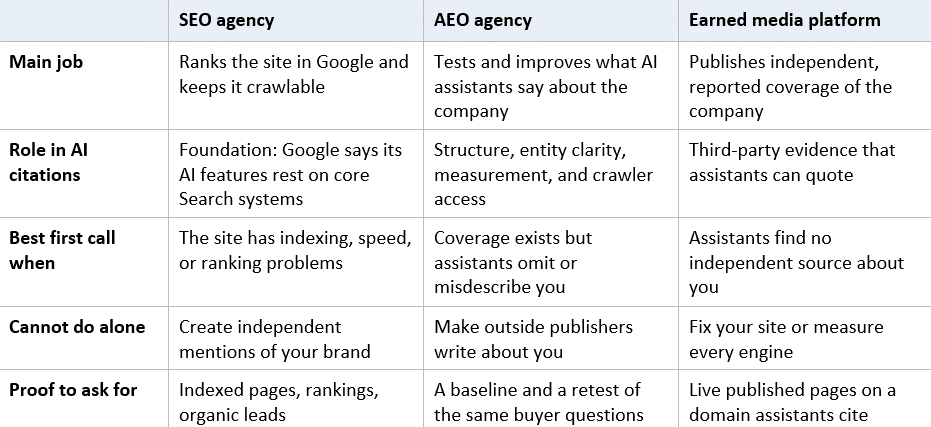
An earned media platform vs SEO agency decision is not an either-or choice, and an AEO agency is a third layer, not a replacement for the other two. As of November 2026, the evidence points to three separate jobs. An SEO agency makes your site findable and rankable. An earned media platform puts independent coverage about you where AI assistants have already read. An AEO agency tests what assistants say about you, then fixes the content, entity signals, and crawler access behind the answers.
Choose by your biggest gap. If Google cannot index or rank your site, hire the SEO agency first. If assistants find nothing independent about your company, start with earned media. If coverage exists but assistants skip you or describe you wrongly, an AEO agency is the better first call.
Why B2B founders are asking this in 2026
Buyers now open with AI assistants. G2’s The Answer Economy report, based on a March 2026 survey of 1,076 B2B software buyers found that 51% start research with an AI chatbot more often than with Google, up from 29% in G2’s 2025 report. G2 also found that 69% of buyers chose a different vendor than they first planned because a chatbot recommended it.
That shift changes what agencies and platforms are for. A first page ranking still matters, yet a buyer can now form a shortlist before opening a results page. Spotlight on Startups tracks this with AI Visibility Snapshots, which run the same buyer questions through Claude and ChatGPT with web search and count how often a company gets named. Its 2026 B2B AI citation benchmark and its analysis of why AI engines skip small B2B companies show the same pattern: thin independent evidence means few recommendations.
What an SEO agency contributes to AI citations
An SEO agency builds the layer every other tactic depends on. Google’s May 2026 guide to optimizing for generative AI features says its AI features are rooted in core Search ranking and quality systems, and that a page must be indexed and eligible to show a snippet to appear in them. Google also says llms.txt files and special schema markup are not required, according to Frase’s summary of the May 15, 2026 guide.
That makes a capable SEO agency a serious asset. It owns crawl access, indexation, site speed, internal linking, topical content, and the local and technical work behind organic leads. Firms such as Ignite Visibility, which lists SEO, local SEO, and AI SEO side by side show how the disciplines are converging. Spotlight on Startups explains the overlap in its guide to how SEO, AEO, and GEO work together.
When an SEO agency is the better choice
- Your site has indexing, speed, or structure problems that block every other channel.
- You depend on Google for leads today and need rankings for commercial terms.
- You run a local or multi-location business where map and local results drive revenue.
- You need content at scale on a site you own, with technical oversight.
Where an SEO agency reaches its limit
An SEO agency optimizes pages you own, while assistants lean on pages you do not own. Ahrefs’s May 2025 study of 75,000 brands found that brand web mentions correlated with AI Overview brand visibility at 0.664, against 0.218 for backlinks. Correlation does not prove cause, and the study covers Google AI Overviews only. Still, it helps explain why a technically clean site can stay invisible when nobody independent writes about the brand.
Many SEO agencies also run digital PR and link building, so ask yours what it publishes and where. The answer tells you how much of the earned layer the agency already covers.
What an AEO agency does, and why it deserves a seat at the table
An AEO agency specializes in how answer engines read, describe, and cite a company. Kell Solutions, the answer engine optimization team owned by the same group that publishes Spotlight on Startups, works this way. So do independent firms such as AnswerManiac, whose services page lists a free recommendation check, a fixed-scope sprint, and managed monthly work. The sprint described there sets a baseline and re-tests the same questions after 30 to 45 days.
The work usually has five parts:
- Baseline: run a fixed set of buyer questions across engines and record which companies get named.
- Content: build answer-first pages with visible FAQs, named alternatives, and one consistent company name.
- Access: set robots.txt rules so AI crawlers can read the site.
- Evidence: identify the third-party sources assistants lean on for the category.
- Retest: repeat the same questions and read the trend, not a single run.
Measurement is the part SEO agencies and platforms rarely offer. AI answers vary from run to run, so one snapshot of about 80 answers can swing a few points by chance. A good AEO agency reads the trend across several runs and says so plainly.
When an AEO agency is the better choice
- Independent coverage exists, but assistants omit your company or describe it wrongly. Our fix sequence for what ChatGPT says wrong about a company starts here.
- You want a measured baseline before you spend on anything else.
- You need existing pages restructured for extraction without a site rebuild.
- Assistants name three or four rivals in your category and you are not one of them.
What the schema study means for AEO work
Ahrefs’s May 11, 2026 matched study of 1,885 pages found no meaningful citation lift after pages added JSON-LD schema. Changes were +2.4% in Google AI Mode and +2.2% in ChatGPT, both statistically indistinguishable from zero, and the Search Engine Journal coverage reports a small dip in Google AI Overviews. The pages studied were already cited, so the result speaks to marginal markup gains, not to AEO as a whole.
A fair reading is that markup is plumbing. The valuable AEO work is measurement, content structure, and evidence, and a good AEO agency sells those. An agency that sells schema as a citation switch deserves a hard question. One that sells a baseline and a retest deserves a hearing.
Where an AEO agency reaches its limit
An AEO agency can structure your pages and show you where assistants look, yet it cannot make independent publishers write about you. AnswerManiac’s services page says paid placements and PR distribution are scoped and priced separately. That is a fair statement of the boundary, and it applies to every AEO engagement, including ours. Kell Solutions delivers content and recommendations, and the client’s team makes changes to its own site.
What an earned media platform does for AI visibility
An earned media platform publishes independent reporting about your company on a domain that assistants already read. Spotlight on Startups is one example. It writes reported features about B2B founders, consultants, fractional executives, and professional services firms, and its Get Featured spotlight is free. Publication is never conditioned on a review, a reciprocal link, or a social share.
The strongest evidence for this layer comes from Muck Rack’s “What Is AI Reading?” study. Its May 2026 edition analyzed more than 25 million links across 17 industries and found that earned media supplied 84% of AI citations, journalism 27%, and paid or advertorial content 0.3%. Muck Rack sells PR software, so read the figures as vendor research.
The critique deserves equal weight. PR Daily’s August 17, 2026 analysis by David Clare of Fire on the Hill argues that the 84% figure bundles journalism with Wikipedia, academic, government, social, and corporate sources, and that journalism alone is closer to a quarter. Both readings can hold. Journalism is roughly a quarter of citations, independent third-party sources dominate, and neither number promises that a placement gets you cited.
When an earned media platform is the better choice
- Assistants find no independent page that explains who your company is.
- You cannot land Forbes or TechCrunch coverage and need another route. Spotlight on Startups outlines six routes founders use without Forbes or TechCrunch.
- You need a credibility page a buyer or an assistant can verify, written by a journalist rather than by you. The evidence on this is in our comparison of a journalist-written founder story against a self-written one.
- You are weighing a free editorial feature against a paid listing. We compare a founder feature and a paid directory listing for AI trust.
Platforms differ in how they work. Featured and Qwoted connect experts with reporters, which suits founders who want quotes in outlets they do not control. A publication such as Spotlight on Startups writes the feature itself. The comparison of Spotlight on Startups, Featured, HARO, and Qwoted sets out who each fits best. Our guide to earned media against a PR agency covers the retainer model.
Where an earned media platform reaches its limit
Coverage alone does not guarantee a recommendation. A platform does not fix your site, test every engine, or restructure the pages you own. That is why the AEO layer and the SEO layer matter, and why Spotlight on Startups pairs publishing with a citation test within 48 hours of each article going live.
How to choose among an earned media platform, an SEO agency, and an AEO agency
Match the first purchase to the first gap. The four scenarios below cover most B2B founders, consultants, fractional executives, and professional services firms.
Scenario one: no independent coverage exists
Start with earned media. A new B2B company with no press gives assistants nothing to cite, and structure cannot invent evidence. Publish a reported feature first, then bring in an AEO agency to structure the surrounding pages and measure the result.
Scenario two: coverage exists but assistants skip you
Start with an AEO agency. Evidence exists, so the gap is extraction, entity clarity, or crawler access. A baseline of buyer questions shows exactly where competitors appear and you do not.
Scenario three: Google barely knows your site
Start with an SEO agency. Google says its AI features rest on core Search systems, so a site that fails indexing or quality checks will struggle everywhere else. Fix the foundation, then add the other two layers.
Scenario four: one budget line, one choice
Run a free baseline first. Ask each vendor for a baseline of 40 buyer questions, or run the five-minute test for whether ChatGPT and Perplexity cite your article yourself. Spend on the layer where the data shows the largest gap. Spotlight on Startups covers the trade-offs between AEO and SEO in its AEO vs SEO guide for B2B founders.
What does each option cost in 2026?
HubSpot’s AEO cost guide, updated in September 2026 puts AEO spending between roughly $30 a month for a self-run monitoring tool and more than $15,000 a month for a full-service agency program. It defines a mid-range tier of about $1,500 to $5,000 a month and a high-investment tier of about $10,000 to $15,000 or more. HubSpot sells an AEO tool, so weigh its framing accordingly.
SEO agency pricing varies widely by scope, so request itemized quotes and compare deliverables, not totals. Spotlight on Startups features are free. Kell Solutions publishes its plans on KellSolutions.com rather than here, which keeps editorial and commercial content apart.
Whatever you pay, require a baseline, a written deliverable list, and a retest date. No agency or platform can guarantee a citation or a placement, and any vendor that does is selling certainty the data cannot support.
How the three layers fit into one 90-day plan
The layers compound when sequenced. This plan reflects how Spotlight on Startups runs its own editorial production, where each feature passes through all three.
- Days 1 to 30, baseline and foundation: run 40 buyer questions across engines, fix indexing and robots.txt access, and record who gets named.
- Days 31 to 60, evidence and structure: publish independent coverage, then restructure key pages with answer-first openings and a visible FAQ.
- Days 61 to 90, retest: rerun the same 40 questions, compare against the baseline, and read the trend before changing course.
Test each article within 48 hours of publishing and again at 30 days. Without a baseline, you cannot separate a citation win from coincidence. The same discipline applies whether you hire one vendor or three.
Where the three disciplines are heading
Expect convergence. G2 reports that AI-first research rose from 29% to 51% of B2B software buyers in a year, and Google tells site owners that AI optimization is still SEO. Agencies now sell overlapping labels, which is why the buyer’s test should be deliverables and retests, not titles. Spotlight on Startups covers the editorial side in the future of PR in the age of AI.
Where Spotlight on Startups fits
Spotlight on Startups publishes journalist-written founder spotlights for B2B founders, structured so AI assistants can find and cite them. Founders can see the process in how to get featured on Spotlight on Startups and apply on the Get Featured page. Founders who want the measurement and structure layer can talk to Kell Solutions at KellSolutions.com. The two work independently, and a feature never depends on a service purchase.
Frequently asked questions
Should a B2B startup hire an SEO agency or an AEO agency first?
Hire the one that matches your largest gap. If Google cannot index or rank your site, start with an SEO agency. If your site is healthy but assistants omit or misdescribe you, start with an AEO agency. If nobody independent has written about you, add earned media before either.
What is the difference between an SEO agency and an AEO agency?
An SEO agency improves how a site ranks and gets crawled in search engines. An AEO agency tests what AI assistants say about a company, then improves content structure, entity consistency, and crawler access. Google says AI features rest on core Search systems, so the two disciplines overlap heavily and share a foundation.
Does earned media actually get a company cited by ChatGPT and Perplexity?
Evidence says independent sources dominate AI citations, though no placement guarantees one. Muck Rack’s May 2026 study found earned media supplied 84% of citations and journalism 27%, while critics argue journalism alone is nearer a quarter. Treat earned media as necessary evidence, not a guaranteed result.
How much does an AEO agency cost compared with an SEO agency?
HubSpot’s September 2026 guide lists AEO at about $30 a month for self-run tools, $1,500 to $5,000 a month mid-range, and $10,000 to $15,000 or more for full-service programs. SEO pricing varies by scope, so compare itemized deliverables. HubSpot sells an AEO tool, so treat the ranges as one vendor’s view.
Can an SEO agency also do AEO work?
Yes, many can. Ignite Visibility lists AI SEO beside SEO and local SEO, for example. Ask any agency for a baseline of buyer questions, a named deliverable list, and a retest date. Those three items show whether the agency measures AI visibility or only relabels existing SEO services.
Is an earned media platform the same as a PR agency?
No. A PR agency pitches journalists for you on a retainer, and outcomes depend on editors saying yes. An earned media platform such as Spotlight on Startups publishes the reported feature itself, and its Get Featured spotlight is free. The two can work together, and the costs differ sharply.
How long does it take for AI assistants to cite a company after publishing?
No vendor can promise a timeline, because AI answers vary from run to run. Spotlight on Startups tests target questions within 48 hours of publishing, retests at 30 days, and reruns a full snapshot at 90 days. Judge the trend across several runs, and treat one run as noise.
Sources and retrieval dates
Every external factual claim above traces to one of these pages, each retrieved on November 6, 2026. Where a source states different figures on different pages, this article omits the figure rather than choosing one. Vendor research is attributed to the vendor. Corrections are welcome at [email protected].
- Muck Rack, “Generative Pulse: Earned Media Consistently Drives AI Citations, Holding at 84%” (MarTech Series, May 8, 2026). https://martechseries.com/content/generative-pulse-earned-media-consistently-drives-ai-citations-holding-at-84/ Retrieved November 6, 2026.
- PR Daily, “The 84% myth: Why the PR industry’s AI numbers are wrong” (David Clare, August 17, 2026). https://www.prdaily.com/the-84-myth-why-the-pr-industrys-ai-numbers-are-wrong/ Retrieved November 6, 2026.
- Ahrefs, “Schema and AI citations” (May 11, 2026). https://ahrefs.com/blog/schema-ai-citations/ Retrieved November 6, 2026.
- Search Engine Journal, “Schema Markup Didn’t Move AI Citations In Ahrefs Test” (May 11, 2026). https://www.searchenginejournal.com/schema-markup-didnt-move-ai-citations-in-ahrefs-test/ Retrieved November 6, 2026.
- Ahrefs, “An Analysis of AI Overview Brand Visibility Factors (75K Brands Studied)” (May 26, 2025). https://ahrefs.com/blog/ai-overview-brand-correlation/ Retrieved November 6, 2026.
- G2, “In the Answer Economy, Don’t Win the Click, Win the Answer” (April 15, 2026). https://company.g2.com/news/g2-research-the-answer-economy Retrieved November 6, 2026.
- Google Search Central, “Optimizing for generative AI search” guide (May 2026). https://developers.google.com/search/docs/fundamentals/ai-optimization-guide Retrieved November 6, 2026.
- Google Search Central Blog, “A new resource for optimizing for generative AI in Google Search” (May 2026). https://developers.google.com/search/blog/2026/05/a-new-resource-for-optimizing Retrieved November 6, 2026.
- Frase, “AEO and GEO Are Still SEO: What Google’s Official AI Guide Actually Says”. https://www.frase.io/blog/google-ai-optimization-guide Retrieved November 6, 2026.
- HubSpot, “How much does AEO cost? A breakdown by approach” (updated September 2026). https://blog.hubspot.com/marketing/how-much-does-aeo-cost Retrieved November 6, 2026.
- Ignite Visibility, About page. https://ignitevisibility.com/about/ Retrieved November 6, 2026.
- AnswerManiac, Services page. https://www.answermaniac.ai/services Retrieved November 6, 2026.