
Launching a startup is a monumental achievement, but it's only the first step. The real challenge is navigating the path to sustainable, scalable growth. In an ecosystem where a high percentage of startups ultimately fail, according to data from Startup Genome, a powerful idea alone is not enough. Success hinges on deploying the right startup growth strategies at the right time.
This guide moves beyond generic advice to dissect 10 battle-tested models that have powered today's most successful companies. We will explore the frameworks, metrics, and actionable steps behind each approach, from the viral loops of Product-Led Growth to the high-touch precision of enterprise sales. This isn't just theory; it’s a practical playbook designed for founders to apply immediately.
For founders, investors, and startup professionals, understanding these distinct strategies is critical for allocating limited resources, building a resilient business, and achieving market leadership. This article, curated by Spotlight on Startups, provides the authoritative insights you need to choose and implement the strategies that will define your growth trajectory. You will learn not just what to do, but how and when to execute these plans for maximum impact.
1. Product-Led Growth (PLG)
Product-Led Growth (PLG) is a go-to-market strategy where the product itself acts as the primary driver for customer acquisition, conversion, and expansion. Instead of relying solely on sales and marketing funnels, PLG empowers users to experience the product’s value firsthand, often through freemium tiers or free trials. This approach turns the product into the main vehicle for growth, making it one of the most effective startup growth strategies for modern SaaS companies.

The core principle is to let the product sell itself. Companies like Slack, Calendly, and Dropbox have mastered this by embedding collaborative features directly into their user experience. Slack’s freemium model allows teams to adopt the tool organically, with usage spreading from one department to another until the entire organization sees the value, prompting an upgrade to a paid plan. According to a 2022 report from OpenView Venture Partners, PLG companies are valued over 30% higher than their public SaaS peers, highlighting the market’s confidence in this model.
How to Implement Product-Led Growth
To successfully execute a PLG strategy, focus on creating a seamless user journey from discovery to advocacy. The goal is to minimize friction and deliver value as quickly as possible.
- Identify the 'Aha Moment': Pinpoint the exact moment a user understands your product's core value. Optimize your onboarding process to guide new users to this critical milestone as fast as possible.
- Frictionless Onboarding: Use progressive disclosure to introduce features gradually. Avoid overwhelming users with complex setups or too much information upfront. The goal is to shorten the "time to value."
- Build Virality In: Incorporate features that encourage sharing and collaboration. Calendly, for instance, grows every time a user sends their scheduling link to a new contact, exposing the product to a potential new user.
- Use Data Triggers: Implement usage-based triggers to prompt upgrades. When a user hits a feature limit or tries to access a premium capability, present a clear and contextual upgrade path.
PLG is not just a tactic; it’s a company-wide philosophy popularized by thought leaders like Wes Bush. It aligns product, engineering, sales, and marketing teams around a single goal: creating a product so valuable that users can't help but adopt, pay for, and share it.
2. Viral Growth/Referral Loops
Viral Growth, often powered by referral loops, is a strategy where your existing users become the primary engine for acquiring new users. This creates a self-perpetuating cycle, where each new user is incentivized or naturally inclined to bring in more users. It’s one of the most cost-effective startup growth strategies because it leverages network effects to achieve exponential scale, turning customers into your most effective marketing channel.

The goal is to achieve a viral coefficient (K-factor) greater than one, meaning each user, on average, successfully refers more than one new user. A famous case study is Dropbox, which executed this by offering extra storage space for both the referrer and the new user, leading to a staggering 3900% growth in 15 months, as documented by TechCrunch. Similarly, PayPal’s early strategy of giving new users $10 for signing up and another $10 for referrals fueled its initial user explosion.
How to Implement Viral Growth/Referral Loops
A successful viral loop makes sharing feel like a natural and rewarding part of the user experience. The key is to remove friction from the sharing process while providing a compelling reason for users to participate.
- Offer Two-Sided Incentives: Reward both the person referring and the person being referred. Airbnb’s travel credit system is a classic example, as it gives value to both parties and encourages immediate product usage.
- Make Sharing Inherent: Build sharing directly into the product’s core functionality. Zoom's growth is inherently viral; every time a user creates a meeting and shares the link, they are introducing new potential users to the platform.
- Minimize Referral Friction: Design a one-click sharing process. The fewer steps a user has to take to send an invite, the higher the participation rate will be.
- Track Your Viral Coefficient: Continuously measure your K-factor (K = number of invites sent per user × conversion rate of invites). This metric is crucial for understanding and optimizing your loop’s effectiveness.
Popularized by growth experts like Andrew Chen, viral loops are a cornerstone of modern growth. By aligning user incentives with business growth, this strategy creates a powerful, scalable acquisition model. However, it’s critical that the core product delivers significant value first; a referral program can only amplify a product that users already love.
3. Content Marketing & SEO
Content Marketing is a strategic approach focused on creating and distributing valuable, relevant content to attract and retain a specific audience, ultimately driving profitable customer action. When combined with Search Engine Optimization (SEO), it becomes one of the most powerful and sustainable startup growth strategies, creating a low-cost acquisition channel that builds compound value over time. Instead of "renting" attention through ads, you "own" it by becoming a trusted authority.
This strategy centers on ranking for keywords that potential customers are searching for. By answering their questions and solving their problems with high-quality content, you build trust and guide them naturally toward your product. HubSpot, for example, built its empire on this model, creating an extensive blog and resource hub that attracts millions of visitors from organic search. This inbound methodology, as they term it, demonstrates how educational content can be a primary driver of B2B lead generation.
How to Implement Content Marketing & SEO
A successful content and SEO strategy requires a long-term commitment to quality and a deep understanding of your customer's journey. The goal is to create a library of assets that work for you 24/7.
- Focus on High-Intent Keywords: Start by targeting keywords with high purchase intent (e.g., "best CRM for small business"). These users are closer to converting, delivering faster ROI and early momentum.
- Build Topical Authority: Dominate a single, specific niche before expanding. Create comprehensive "pillar pages" on core topics and support them with detailed "cluster" articles to establish your expertise in Google's eyes.
- Apply the Skyscraper Technique: Find the top-ranking content for your target keyword and create something significantly better. Add more depth, fresh data, better visuals, or more actionable insights to outperform competitors.
- Optimize for Search Intent: Go beyond keywords to understand what users are really looking for. Optimize for featured snippets and "People Also Ask" boxes by directly answering common questions within your content.
This approach, popularized by thought leaders like Brian Dean, transforms your website into a lead-generation machine. It not only drives traffic but also provides the perfect foundation to amplify your message through other channels, helping you understand how to use media coverage to accelerate fundraising rounds.
4. Partnership & Integration Strategy
A Partnership and Integration Strategy involves forming strategic alliances with complementary companies to access new customer bases, co-market products, or create integrated solutions. Instead of building every function from scratch, startups leverage the audience, technology, and credibility of established partners. This is one of the most capital-efficient startup growth strategies for unlocking new distribution channels and creating compounded value.
The core principle is to create a "better together" story. Stripe achieved massive scale by partnering with platforms like Shopify and Amazon, embedding its payment processing directly where transactions happen. This integration-led growth made Stripe the default choice for millions of businesses without requiring a massive direct sales force from day one. This ecosystem play is crucial for scaling a startup in today's interconnected technology landscape.
How to Implement a Partnership & Integration Strategy
To execute this strategy successfully, focus on creating mutual value and a seamless experience for joint customers. The goal is to build an ecosystem where your product becomes more valuable when connected to others. As you prepare to validate, fund, and scale the right company, a solid partnership plan can be a significant accelerator.
- Identify Ideal Partners: Prioritize partnerships with companies that target your ideal customer profile (ICP) but solve a different, non-competitive problem. Tools like Crossbeam can help identify customer overlaps without sharing sensitive data.
- Start with Technical Integrations: Before launching a full co-marketing campaign, build a valuable technical integration. An app that works well with another platform provides immediate, tangible value and makes co-marketing efforts far more effective.
- Provide Partner Enablement: Equip your partners with the materials they need to succeed. This includes co-branded marketing assets, sales training, case studies of joint customer success, and dedicated support contacts.
- Track Partnership KPIs: Measure the impact of your efforts with specific metrics. Track lead referrals, integration adoption rates, and revenue influenced by each partnership to understand what is working and double down on successful alliances.
This ecosystem-based approach has been championed by experts like Jay McBain of Canalys. It transforms growth from a solo effort into a collaborative one, aligning your startup with other key players in your industry to create a powerful network that drives acquisition and retention.
5. Community Building
Community building is a growth strategy centered on creating an engaged ecosystem of users, advocates, and enthusiasts around your product or mission. Instead of solely focusing on one-way marketing, this approach nurtures a self-sustaining network where members provide peer support and drive word-of-mouth growth. This creates a powerful competitive moat, making it one of the most durable startup growth strategies.

The underlying principle is to transform customers from passive consumers into active participants. Notion excels at this through its ambassador program, which empowers community leaders globally to host events and create resources. Similarly, Figma's community thrives because users can create and share design templates and best practices, adding value to the entire ecosystem and reducing the company's burden to create all support materials internally. This user-generated content acts as a powerful acquisition and retention tool.
How to Implement Community Building
A successful community strategy requires fostering genuine connection and delivering value beyond the product itself. The goal is to create a space where members feel a sense of belonging and are motivated to contribute.
- Start Small and Focused: Begin with a small, highly engaged core group. Nurture these early members, as they will set the tone and culture for future growth.
- Hire a Dedicated Community Manager: A dedicated manager is crucial for moderating discussions, organizing events, and advocating for the community's needs within the company. This is a leadership role, not just a support function.
- Empower Member Contributions: Create opportunities for members to help each other. Feature user-generated templates, host member-led webinars, and establish forums for peer-to-peer support.
- Recognize and Reward Advocates: Publicly acknowledge and reward top contributors. This can be through special titles, exclusive access, or company swag, which encourages continued participation and reinforces positive behavior.
Community building is a long-term investment popularized by experts like David Spinks, founder of CMX. It aligns your brand with a shared purpose, turning your user base into a powerful asset that improves retention and becomes a primary engine for acquisition and innovation.
6. Performance Marketing & Paid Acquisition
Performance marketing is a growth methodology where you invest in paid advertising channels and pay only for specific, measurable actions such as clicks, leads, or sales. Unlike traditional brand advertising, this approach provides immediate, scalable results by leveraging platforms like Google Ads, Meta (Facebook/Instagram), and LinkedIn Ads. This makes it one of the most direct and quantifiable startup growth strategies for acquiring customers quickly.
The core principle is data-driven accountability: every dollar spent is tied to a specific outcome. The ultimate goal is to achieve positive unit economics, where the customer's lifetime value (LTV) significantly outweighs the customer acquisition cost (CAC). A commonly cited benchmark from venture capitalists like David Skok is to aim for an LTV:CAC ratio of at least 3:1 for a sustainable business model.
How to Implement Performance Marketing & Paid Acquisition
To execute a successful paid acquisition strategy, you must focus on ruthless optimization and maintaining a positive return on ad spend (ROAS). It requires a continuous cycle of testing, measuring, and refining.
- Master Your Unit Economics: Before scaling your budget, ensure you have a firm grasp of your LTV to CAC ratio. A ratio of at least 3:1 ensures profitability and sustainable growth.
- Focus on One Channel First: Instead of spreading your budget thinly across multiple platforms, master one channel first. Understand its nuances, audience, and best practices before diversifying your efforts.
- Create Dedicated Landing Pages: Drive campaign traffic to custom landing pages that match the ad's message and offer. A consistent user experience from ad click to conversion is critical for maximizing results.
- Leverage Retargeting and Lookalikes: Implement retargeting campaigns to re-engage users who visited your site but didn't convert. Use lookalike audiences to find new customers who share characteristics with your best existing ones.
Performance marketing is a powerful engine for predictable growth. It empowers startups to control their growth trajectory by turning advertising spend into a reliable source of new customers. When executed with analytical rigor, it provides a direct path to scaling revenue and market share.
7. Customer Success & Expansion Revenue
Customer Success is a strategy centered on maximizing value from your existing customer base. Instead of focusing solely on acquiring new logos, this approach prioritizes customer retention, upsells, and cross-sells by ensuring they achieve their desired outcomes with your product. This method turns happy customers into the primary engine for sustainable, long-term growth.
The core principle is that it's more cost-effective to grow existing accounts than to acquire new ones. As research from Bain & Company shows, a 5% increase in customer retention can increase profitability by 25% to 95%. Companies like Salesforce and Datadog exemplify this, with Net Revenue Retention (NRR) rates well over 100%, meaning they grow even if they don't sign a single new customer. This is one of the most powerful startup growth strategies for B2B SaaS businesses, as it builds a resilient, compounding revenue stream.
How to Implement Customer Success & Expansion Revenue
A successful expansion revenue strategy requires a proactive, data-driven approach to the entire post-sale customer lifecycle. The goal is to move from a reactive support model to a proactive success partnership.
- Establish a Structured Onboarding Process: Guide new customers through a defined journey with clear milestones. A seamless onboarding experience is critical for long-term retention and sets the stage for future expansion.
- Implement Customer Health Scoring: Use product usage data, support tickets, and survey feedback to create a health score for each account. This allows you to identify at-risk customers early and pinpoint opportunities for growth.
- Identify 'Expansion Qualified Accounts': Proactively look for accounts showing high engagement, achieving key outcomes, or approaching usage limits. These are prime candidates for upsells or cross-sells.
- Build a Customer Education Program: Create resources like a knowledge base, webinars, or an academy to help users master your product. Empowered customers find more value and are more likely to expand their usage. For deeper engagement, consider creating customer advisory boards to gather strategic feedback.
Pioneered by thought leaders like Lincoln Murphy, this philosophy aligns your entire organization around delivering value. When customers win, they stay longer, spend more, and become advocates, creating a powerful, capital-efficient growth loop.
8. Sales-Led Growth (SLG)
Sales-Led Growth (SLG) is a go-to-market strategy centered on a proactive sales team that identifies, nurtures, and closes high-value customers. Unlike product-led models, SLG relies on human interaction and consultative selling to navigate complex buying processes. This approach is one of the most essential startup growth strategies for companies with high-priced, sophisticated products targeting enterprise B2B markets.
The core principle of SLG is that high-value deals require a high-touch approach. Enterprise software companies like Snowflake and Oracle built their empires on this model. Their sales teams engage multiple stakeholders, conduct tailored demos, and negotiate custom contracts—a necessary process when a single deal can be worth six or seven figures and requires significant organizational buy-in.
How to Implement Sales-Led Growth
A successful SLG strategy requires a well-defined process, a structured team, and a deep understanding of your ideal customer. The goal is to build a predictable revenue engine that can scale effectively.
- Define Your Ideal Customer Profile (ICP): Be hyper-specific about the companies you target based on industry, size, revenue, and technological maturity. A clear ICP prevents the sales team from wasting resources on poor-fit leads.
- Implement a Lead Qualification Framework: Use proven systems like MEDDIC (Metrics, Economic Buyer, Decision Criteria, Decision Process, Identify Pain, Champion) or BANT to qualify opportunities rigorously and focus on deals that are most likely to close.
- Build a Scalable Sales Process: Create specialized roles such as Sales Development Representatives (SDRs) for prospecting and Account Executives (AEs) for closing deals. Document every stage of your sales cycle and create a repeatable hiring and training playbook.
- Equip Your Team with Enablement Materials: Develop battle cards, competitor analyses, case studies, and ROI calculators to help your sales reps effectively communicate value and handle objections.
SLG is a methodology championed by sales leaders like Aaron Ross, author of Predictable Revenue, who emphasize creating a data-driven sales machine. It aligns marketing and sales to create a seamless journey from initial outreach to long-term partnership, making it a powerful engine for enterprise-focused startups.
9. Marketplace & Platform Strategy
A Marketplace & Platform Strategy involves creating a two-sided platform that connects distinct user groups, such as buyers and sellers. The platform's primary function is to facilitate transactions and interactions between these groups, creating value that wouldn't exist otherwise. This approach is one of the most powerful startup growth strategies because it builds powerful network effects, where the platform becomes exponentially more valuable as more participants join.
The core principle is to solve the classic "chicken and egg" problem: you need sellers to attract buyers, and buyers to attract sellers. Companies like Airbnb and Uber mastered this by intensely focusing on one side of the market first. Airbnb famously jumpstarted its supply by offering professional photography for listings in New York City, while Uber subsidized drivers to build a reliable fleet, creating critical mass city by city.
How to Implement a Marketplace & Platform Strategy
Successfully launching a marketplace requires a deliberate, focused approach to generating liquidity—the reasonable expectation of a transaction occurring. You must solve the cold start problem and build defensible moats through network effects.
- Solve the Hard Side First: Identify which side of your marketplace (supply or demand) is harder to acquire and focus your initial efforts there. For most platforms, like Etsy, a high-quality, diverse supply is the key differentiator.
- Start in a Niche: Don't try to be everything to everyone at once. Focus on a specific geography (like DoorDash's city-by-city model) or a narrow vertical (like Etsy's initial focus on handmade crafts) to achieve critical density faster.
- Subsidize to Kickstart Growth: To overcome initial inertia, you may need to subsidize one side of the market. This could mean offering bonuses to drivers, discounting initial transactions for buyers, or waiving fees for early sellers.
- Build Trust Mechanisms: Since you are facilitating transactions between strangers, trust is paramount. Implement features like verified profiles, transparent reviews, secure payment systems, and user insurance from day one.
The marketplace model has been extensively analyzed by thought leaders like Andrew Chen, author of The Cold Start Problem. His work emphasizes that while difficult to build, successful marketplaces create incredibly durable businesses by locking in users and establishing high barriers to entry for competitors.
10. Account-Based Marketing (ABM)
Account-Based Marketing (ABM) is a strategic approach that flips the traditional marketing funnel. Instead of casting a wide net, ABM concentrates marketing and sales resources on a predefined set of high-value target accounts, treating each one as a market of one. This hyper-focused methodology is one of the most powerful startup growth strategies for B2B companies with high-value deals and complex sales cycles.
To visualize how ABM shifts focus from lead volume to account-level success, consider the core metrics that define an effective ABM program.
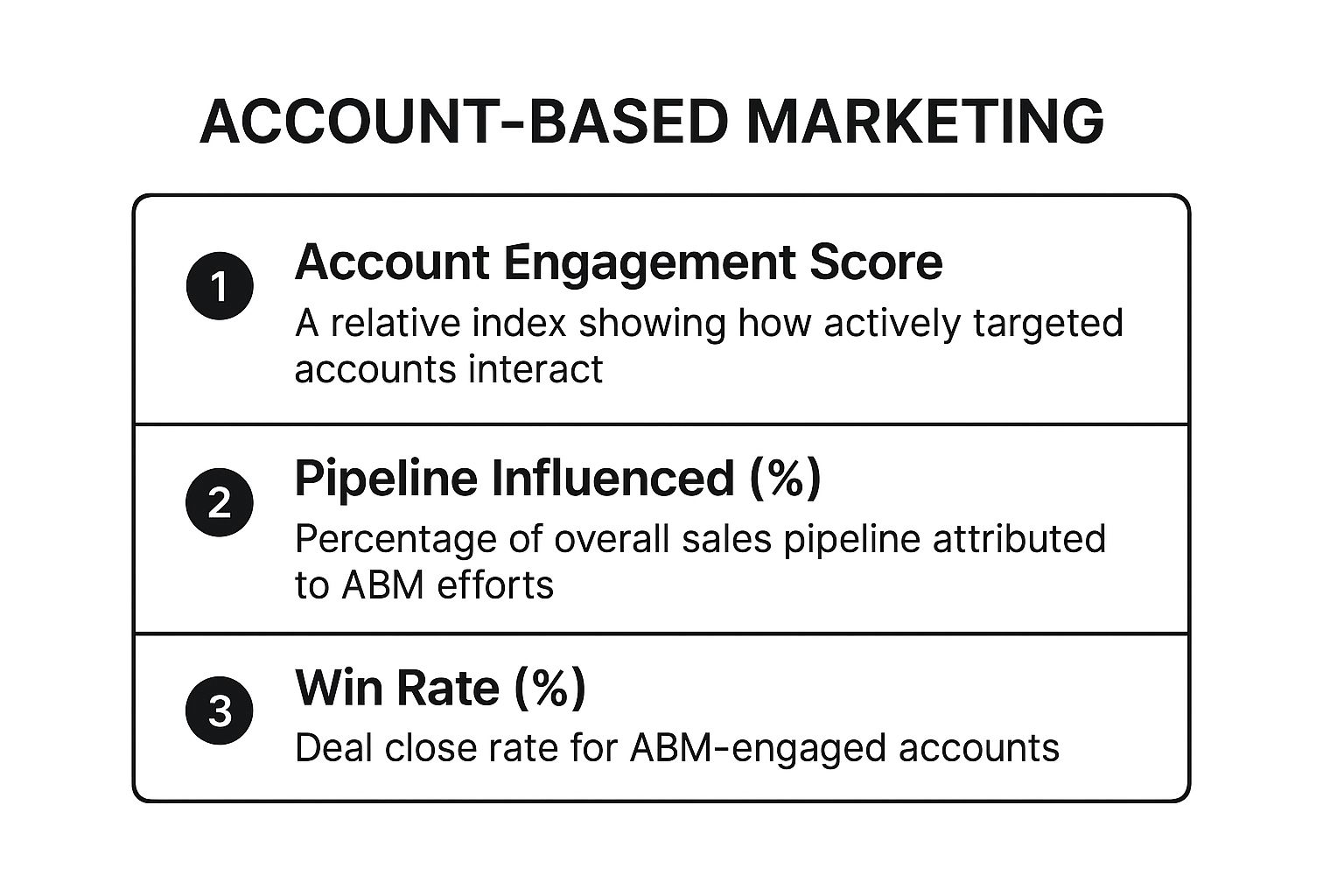
This data highlights a crucial shift: success is measured by deep engagement and influence within target accounts, leading to higher win rates, not just a high quantity of leads. According to research from ITSMA, 87% of marketers who measure ROI say that ABM outperforms every other marketing investment. Companies like DocuSign used this focus to land massive enterprise clients by tailoring their outreach and demonstrating a deep understanding of each account's specific needs.
How to Implement Account-Based Marketing
Executing a successful ABM strategy requires tight alignment between marketing and sales, built on a foundation of shared goals and deep customer insight. The objective is to surround key decision-makers at target accounts with coordinated, personalized messaging.
- Identify and Tier Your Target Accounts: Work with sales to select a small, manageable list of "Tier 1" accounts (typically 50-100) that represent the best fit for your solution based on firmographic and technographic data.
- Develop Detailed Account Plans: Map out the key stakeholders, their pain points, and the organizational structure for each account. Use intent data from platforms like 6sense or Bombora to identify which accounts are actively researching solutions like yours.
- Create Personalized Content: Move beyond generic ebooks. Develop bespoke content like personalized landing pages, industry-specific case studies, or even direct mail campaigns tailored to each account.
- Coordinate Multi-Channel Outreach: Execute a "surround sound" strategy using a mix of channels. This includes targeted ads on LinkedIn, personalized emails, executive-level outreach, and exclusive virtual or in-person events.
ABM is a strategic go-to-market motion championed by B2B leaders like Sangram Vajre of Terminus. It transforms sales and marketing from separate functions into a unified revenue team focused on landing and expanding the accounts that matter most.
Startup Growth Strategies Comparison Overview
| Growth Strategy | Implementation Complexity 🔄 | Resource Requirements ⚡ | Expected Outcomes ⭐📊 | Ideal Use Cases 💡 | Key Advantages ⭐ |
|---|---|---|---|---|---|
| Product-Led Growth (PLG) | High – requires strong engineering and UX focus | High – product development and analytics | Sustainable, scalable growth; lower CAC; high user satisfaction | SaaS, self-service products, bottom-up adoption | Viral loops; data-driven optimization; scalable sales |
| Viral Growth / Referral Loops | Medium-High – engineering viral mechanics needed | Medium – incentives and tracking systems | Exponential user growth via network effects | Consumer apps, SaaS with network effects | Strong organic growth; low CAC; high-quality leads |
| Content Marketing & SEO | Medium – content creation and SEO expertise | Medium – ongoing investment in content | Long-term, compounding organic traffic and authority | B2B, inbound marketing, education-based products | Sustainable organic growth; brand authority build-up |
| Partnership & Integration Strategy | Medium-High – technical integrations + negotiation | Medium-High – partner enablement and marketing | Access to new customer bases; faster market penetration | B2B SaaS, platform ecosystems | Reduced CAC; credibility boost; product stickiness |
| Community Building | High – requires ongoing management and moderation | Medium-High – community managers and events | Increased brand loyalty and engaged user base | Products with passionate users, long-term engagement | Customer advocacy; peer support; authentic content |
| Performance Marketing & Paid Acquisition | Medium – campaign setup and continuous optimization | High – ad spend and tech stack | Immediate and scalable traffic acquisition | Consumer products, high-velocity sales | Fast results; precise targeting; measurable ROI |
| Customer Success & Expansion Revenue | Medium – dedicated team and structured processes | Medium-High – success team and programs | Increased retention, upsells, predictable recurring revenue | SaaS, subscription-based, B2B | Lower churn; higher LTV; predictable revenue growth |
| Sales-Led Growth (Enterprise) | High – large sales org and complex processes | High – sales hiring, training, and enablement | High-value enterprise deals; longer sales cycles | Complex products, enterprise B2B | Builds relationships; handles complex deals; control |
| Marketplace & Platform Strategy | Very High – complex supply-demand balancing | Very High – tech, trust systems, liquidity | Network effects; scalable multi-sided platform growth | Marketplaces, multi-sided platforms | Strong defensibility; multiple monetization streams |
| Account-Based Marketing (ABM) | High – highly personalized, coordinated campaigns | High – dedicated team and tech stack | Higher conversion rates; targeted revenue growth | B2B with large deal sizes | Efficient resource use; sales-marketing alignment |
Choosing Your Growth Engine: From Strategy to Execution
The journey from a promising idea to a category-defining company is rarely linear. The landscape of startup growth strategies is diverse, offering a powerful toolkit for founders ready to scale. From the frictionless momentum of Product-Led Growth (PLG) to the targeted precision of Account-Based Marketing (ABM), there is no single "correct" path. The art lies in understanding which engine, or combination of engines, is right for your startup at its current stage.
A common pitfall for early-stage founders is viewing these strategies as mutually exclusive. The most successful scale-ups master the art of layering. A B2B SaaS company might secure its first dozen enterprise clients with a classic Sales-Led Growth motion to prove market need. Concurrently, it could be building a Content Marketing and SEO foundation to capture long-term organic demand, while also designing a PLG motion to attract smaller, self-serve customers. This strategic sequencing is the hallmark of a mature growth mindset.
Synthesizing Your Growth Blueprint
Reflecting on the ten models detailed, several core principles emerge as universal truths for any founder crafting their growth plan. These are the actionable takeaways that transcend specific tactics and form the foundation of sustainable scaling.
- Product-Market Fit is the Prerequisite: No growth strategy, whether a brilliant Viral Loop or a massive paid ad budget, can compensate for a product that people don't want. Before pouring resources into any acquisition channel, relentlessly validate that you are solving a painful problem for a well-defined audience.
- Know Your Customer and Their Journey: The ideal growth model is dictated by your customer. An enterprise CIO making a seven-figure decision requires a different approach (like ABM) than a developer adopting a new API tool (PLG). Map your customer’s buying process to determine the most effective way to engage them.
- Measurement is Non-Negotiable: Growth is a science. Every strategy, from Performance Marketing to Partnership & Integration efforts, must be tied to clear, quantifiable metrics. Define your Key Performance Indicators (KPIs) upfront, whether it's Customer Acquisition Cost (CAC), Lifetime Value (LTV), viral coefficient (K-factor), or expansion revenue. Data, not gut feeling, should guide your decisions.
From Knowledge to Action: Your Next Steps
Reading about startup growth strategies is the first step; implementing them is where the work begins. To translate this knowledge into tangible progress, consider this actionable framework:
- Diagnose Your Stage: Are you pre-product-market fit, seeking your first 10 customers, or ready to scale from 100 to 1,000? Your current position dictates your priorities. An early-stage startup should focus on strategies that maximize learning, like direct sales, while a later-stage company can invest in scalable engines like SEO.
- Formulate a Hypothesis: Based on your product, market, and stage, select one or two primary growth strategies to test. For example: "We believe a PLG model will be effective because our product has a short time-to-value and our target users are developers who prefer self-service."
- Execute and Measure: Run a small, focused experiment. Launch a limited freemium version, run a small paid ad campaign, or reach out to ten potential integration partners. Track the results rigorously against your predefined KPIs for a set period (e.g., 90 days).
- Iterate or Pivot: Analyze the data. Did the experiment validate your hypothesis? If yes, double down and invest more resources. If not, analyze why it failed and use those learnings to formulate a new hypothesis. This continuous loop of experimentation is the engine of all successful growth teams.
Mastering these concepts is the fundamental skill that separates startups that stagnate from those that achieve exponential growth. The ability to strategically select, test, and combine these growth models is what builds resilient, market-leading companies. It is the path to securing funding, attracting top talent, and ultimately, delivering on your founding vision.
Ready to take the next step in your founder journey? At Spotlight on Startups, we provide the frameworks, insights, and expert guidance you need to navigate the complexities of building a successful company. Explore our resources to move from strategy to execution with confidence. Visit Spotlight on Startups to accelerate your growth.