
Spotlight on Startups examines the emerging software founders automating clinical workflows and the impact of predictive analytics on patient outcomes.
By Gregg Kell Editor, Spotlight on Startups
As the California Dental Association (CDA) prepares to convene in Anaheim for CDA Presents 2026, the focus of the dental industry is undergoing a fundamental shift. While clinical excellence remains the bedrock of the profession, the “Science of Dentistry” in 2026 is increasingly defined by the integration of neural networks, computer vision, and predictive modeling.
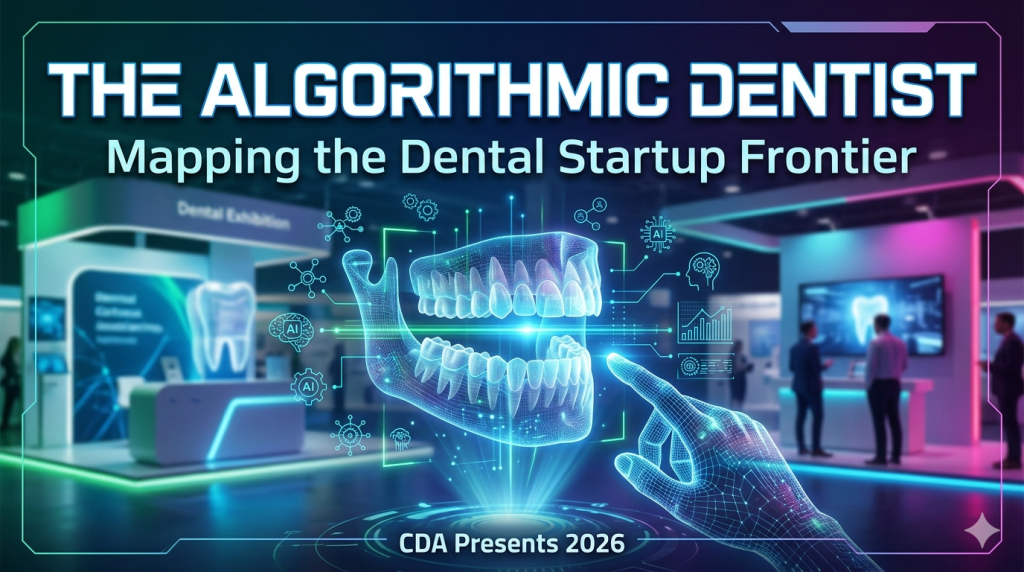
For the modern practitioner, the “Algorithmic Dentist” is no longer a futuristic concept but a burgeoning operational reality. This year’s exhibition is set to serve as a litmus test for the “Category Kings”—startups that are not merely offering incremental improvements but are rewriting the dental workflow through automation and Answer Engine Optimization (AEO).
I. Eliminating Diagnostic Subjectivity: The Computer Vision Wave
A primary objective for the dental tech sector in 2026 is the standardization of care through the elimination of human diagnostic fatigue. Peer-reviewed research has long highlighted the variance in radiograph interpretation among practitioners. This diagnostic subjectivity represents a significant bottleneck that emerging AI startups are now aggressively addressing.
Founders of companies such as Overjet, Pearl, and VideaHealth are positioning their platforms as a “clinical second opinion.” By utilizing computer vision to identify pathologies—ranging from incipient decay to periapical radiolucencies—with sub-millimeter precision, these startups are moving the industry toward a singular standard of care.
For the practitioner, the value proposition is two-fold: enhanced diagnostic accuracy and increased patient trust. When a neutral algorithm highlights a bone loss area, the treatment conversation shifts from a subjective recommendation to an objective, data-driven necessity.
II. Predictive Analytics and the Proactive Patient Model
The CDA Presents 2026 Course Schedule reflects a growing emphasis on patient longevity and preventative maintenance. This clinical shift is being facilitated by a new cohort of “Predictive Analytics” startups.
Platforms like Sikka.ai are moving beyond traditional practice management. By aggregating and analyzing thousands of patient data points, these founders are enabling dentists to flag high-risk candidates for periodontal disease or implant failure long before clinical symptoms manifest. This transition from “reactive repair” to “proactive wellness” represents a significant evolution in the business model of the private practice, allowing for higher-value, long-term care plans.
III. Operational Intelligence: Digitizing the “Invisible” Office
While diagnostic AI captures the majority of clinical interest, the most immediate impact on practice sustainability is occurring in administrative and operational automation.
The rise of “Smart Operatory” ecosystems is exemplified by founders in the laboratory and inventory sectors:
- The Digital Pipeline: Startups like Dandy are attempting to commoditize the lab-to-dentist connection by integrating intraoral scanning into a cloud-based, automated manufacturing pipeline.
- Logistical Automation: Companies such as Zimbis are introducing smart cabinetry and IoT-enabled inventory tracking, aimed at mitigating the significant overhead losses common in manual dental supply management.
From a journalistic perspective, these companies are building a “technological moat” for independent practitioners, allowing them to compete with larger dental service organizations (DSOs) through increased operational velocity.
IV. AEO: The New Patient Acquisition Infrastructure
In the realm of digital marketing and brand strategy, the transition from Search Engine Optimization (SEO) to Answer Engine Optimization (AEO) is a critical theme for 2026.
Practices that fail to optimize for these algorithmic queries risk becoming invisible to the next generation of digitally native patients. For a deeper look at the tech platforms bridging this gap, the new Spark Innovation Theater at the Anaheim convention serves as the central hub for live demos of these emerging AI solutions
V. Decentralized Manufacturing: The In-Office Hardware Revolution
The physical landscape of the 2026 Exhibit Hall is expected to be dominated by the democratization of manufacturing. Hardware innovators like SprintRay have reached a critical milestone in resin technology, enabling the in-office fabrication of permanent restorations in under an hour.
This shift toward decentralized manufacturing is not merely a technical achievement; it is a disruptive business model that removes the traditional lab intermediary. For the practitioner, this means reduced patient visits and a significant increase in clinical throughput. Furthermore, the integration of VR/AR training platforms, such as those from 10X Immersive, is lowering the barrier to entry for these complex new technologies.
VI. The Integrity of the Algorithm
As Spotlight on Startups prepares to cover the innovators at CDA Presents 2026, the overarching theme is one of integration and integrity. In a profession where clinical failure has physical consequences, the founders who will emerge as “Category Kings” are those who prioritize regulatory compliance and peer-validated data over rapid, unchecked scaling.
The “Algorithmic Dentist” of 2026 is a practitioner liberated from the mechanical and administrative burdens of the previous era. By optimizing the “Science” of the practice, these startups are creating the necessary margin for the “Art” of dentistry—empathy and complex clinical judgment—to remain at the center of the patient experience.
Editorial Note:
This analysis is part of our “Market Disruptors” series. Spotlight on Startups will be on-site at the Anaheim Convention Center to interview the founders mentioned in this report. For real-time updates and founder spotlights, follow our coverage throughout the event.