
Table of contents
- 1. The Paradigm Shift: SEO vs. GEO vs. AEO
- 2. Under the Hood: How ChatGPT and Perplexity Retrieve Your Startup
- 3. The 7-Prompt AI PR Audit Framework
- Prompt 1: The Unbranded Category Discovery Test
- Prompt 2: The Explicit Entity Definition & Fact-Checking Test
- Prompt 3: The Head-to-Head Competitive Matrix Test
- Prompt 4: The Use Case & ICP Boundary Validation Test
- Prompt 5: The Reputation, Vulnerability & Negative Sentiment Test
- Prompt 6: The Digital Citation & Earned Media Traceability Test
- Prompt 7: The Investor & Due Diligence Stress Test
- 4. Scoring Your AI PR Audit:
- 5. Reverse-Engineering Citations: Identifying AI Trust Sources
- 6. How to Fix Your Brand’s AI Hallucinations and Knowledge Gaps
- 7. The Ongoing AI PR Workflow: A Founder’s Operating Rhythm
When a target buyer asks an AI engine, “What is the most reliable tool for mid-market parcel shipping audits?” or “Compare early-stage CRM tools for technical founders,” your startup is either in the synthesized answer, or your startup does not exist.
Organic search was built on indexed blue links and search result pages (SERPs). If you ranked on page one, a user scrolled, scanned your metadata, and clicked through to your conversion funnel.
Generative engines do not operate as catalogs; they operate as autonomous synthesizers. When an entrepreneur, procurement executive, or venture capitalist enters a naturallanguage prompt into ChatGPT, Perplexity, Claude, or Google Gemini, the model does not present ten options—it produces a unified, coherent, narrative consensus. It names three contenders, explains their pros and cons, cites specific third-party reviews, and discards everything else.

Traditional SEO tools like Semrush, Ahrefs, and Google Search Console cannot tell you whether an LLM understands your core product category, hallucinates out-of-date pricing, or systematically recommends your closest competitor while erasing your presence.
Conducting a comprehensive AI search brand audit is the baseline requirement of modern earned media. To stay ahead of algorithmic changes, founders must master the future of PR in the age of AI to ensure their core value propositions are correctly indexed.
This guide delivers a definitive, production-ready framework to run an end-to-end audit of your company across generative search engines, complete with a battle-tested 7-prompt audit suite, diagnostic scoring rubrics, and the structural roadmap to repair your brand’s AI citation graph.
1. The Paradigm Shift: SEO vs. GEO vs. AEO
Understanding how to audit your brand requires diagnosing why generative engines output recommendations in the first place.
Three distinct optimization practices govern discoverability:
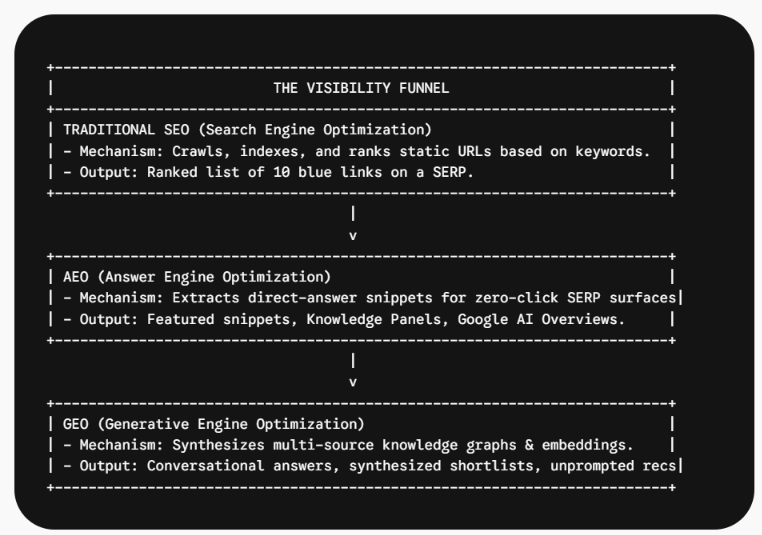
Traditional SEO (Search Engine Optimization)
Core Objective: Secure page-one placement for discrete keywords.
Retrieval Mode: Keyword frequency, semantic search vectors, anchor text distribution, and PageRank link equity.
Failure State: Ranking on Page 2 or lower, resulting in near-zero organic traffic.
AEO (Answer Engine Optimization)
Core Objective: Become the verbatim excerpted source for a direct user question.
Retrieval Mode: Semantic schema parsing, FAQPage microdata extraction, and immediate concise definition blocks (40–60 words).
Failure State: A competitor’s table or bulleted list occupies the Google Featured Snippet or AI Overview block.
GEO (Generative Engine Optimization)
Core Objective: Influence the synthesized consensus of large language models so your startup is cited, recommended, and accurately contextualized in generative conversations.
Retrieval Mode: Multi-document retrieval-augmented generation (RAG), vector similarity matching, token co-occurrence across high-authority training corpuses, and citation graph weighting. Deploying dedicated AI visibility tools for B2B companies has become essential for tracking these multi-document signals in real time.
Failure State: Total conversational erasure. The user asks for solutions in your exact niche, and the LLM explicitly confirms only your direct rivals as viable options.
| Metric / Dimension | Traditional SEO | Answer Engine Optimization (AEO) | Generative Engine Optimization (GEO) |
| Primary Platforms | Google, Bing, DuckDuckGo | Google AI Overviews, Siri, Featured Snippets | ChatGPT, Perplexity, Claude, Gemini |
| Search Intent Unit | Exact keywords & search queries | Conversational question strings | Complex, multi-constraint conversational prompts |
| Target Output | URL click-throughs (Blue Links) | Zero-click snippet extraction | Brand recommendations, comparative consensus positioning |
| Algorithmic Trigger | Web crawler indexing & link equity | Natural Language Processing (NLP) snippet extraction | Retrieval-Augmented Generation (RAG) & LLM parametric memory |
| Key Attribution | Impressions, Clicks, SERP Rank | Snippet share, Voice share | Citation Rate, Share of Model (SoM), Recommendation Sentiment |
2. Under the Hood: How ChatGPT and Perplexity Retrieve Your Startup
To conduct an effective AI search brand audit, you must appreciate the architectural differences between how ChatGPT and Perplexity assemble information. Optimizing for one is not identical to optimizing for the other.
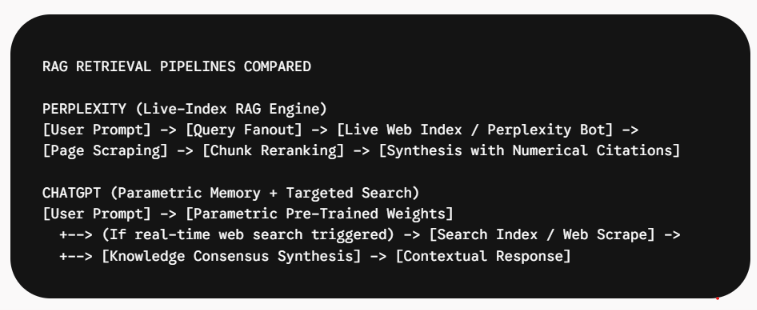
How Perplexity Evaluates Your Startup
1. Perplexity acts as a real-time indexing and synthesis engine. When a user executes a prompt: Query Fanout: Perplexity deconstructs the user’s conversational prompt into 3 to 6 parallel algorithmic search sub-queries.
2. Multi-Source Fetching: It queries real-time search APIs (including Bing, Google indexes, and its proprietary PerplexityBot web index) to retrieve the top 15–30 document snippets.
3. Chunking & Vector Reranking: It scores the retrieved chunks against user intent using dense vector retrieval.
4.Attributed Generation: It synthesizes an answer, appending explicit hyperlinked footnotes to every assertion.
Key Audit Implication: If your startup has broken technical indexation, blocks AI crawlers in robots.txt , or lacks fresh coverage on third-party domains within the last 90 days, Perplexity will fail to fetch your brand in real-time runs.
How ChatGPT Evaluates Your Startup
1. ChatGPT relies on a hybrid blend of parametric weights (frozen pre-trained memory) and dynamic SearchGPT/Browsing capabilities: Entity Associations: When asked about your brand in an offline context (or without explicit real-time search triggering), ChatGPT relies purely on vector clusters established during training. If your startup was discussed extensively across industry forums, editorial profiles, and community discussions prior to training cutoff, it will construct an answer from historical consensus.
2. SearchGPT Retrieval: When the system determines live web access is necessary (or when prompted explicitly), it runs targeted search queries, evaluating high-domainauthority hubs, consensus review platforms, and digital earned media.
3. Consensus Bias: ChatGPT prefers consensus over novelty. If three independent publications state that your startup specializes in a specific category, but your own homepage claims an alternate marketing pivot, ChatGPT will default to the thirdparty consensus.
3. The 7-Prompt AI PR Audit Framework
To execute a comprehensive audit, open clean, incognito/unauthenticated sessions across ChatGPT (GPT-4o/SearchGPT) and Perplexity (Pro Search enabled). Do not use an existing chat history where previous context could pollute the retrieval mechanism.
Run each of the following 7 diagnostic prompts sequentially. Document the exact responses in an AI Audit Ledger.
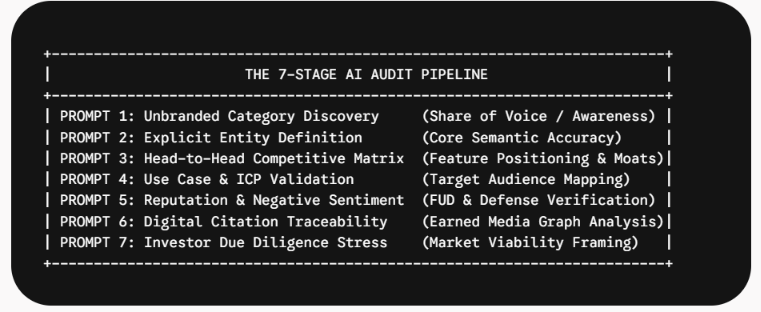
Prompt 1: The Unbranded Category Discovery Test
Audit Objective: Determine whether the engine considers your startup a categorydefining solution when no brand name is supplied.
Funnel Stage: Top of Funnel (Awareness / Initial Consideration).
Copy-Paste Prompt Template:
Act as an enterprise software procurement consultant. A [Insert Company Size/Stage, e.g., Series A B2B SaaS] is looking for the best solution for [Insert Specific Problem / Use Case].
List the top 5 platforms currently leading this category in 2026. For each platform, provide:
- Core Value Proposition
- Primary Target Audience
- Typical Price Point or Pricing Model
- Key Strengths & Differentiators
Include citations and sources for where your data originates.
Evaluation Checklist:
[ ] Is your startup included in the top 5 list?
[ ] What position did you rank (e.g., #1, #4, or completely omitted)?
[ ] Does the AI engine frame your solution accurately, or does it assign you capabilities you do not provide?
[ ] Which competitors appear ahead of you?
[ ] What third-party domains did the engine cite to validate the list (e.g., review networks, boutique blogs, industry analyses)?
Prompt 2: The Explicit Entity Definition & Fact-Checking Test
Audit Objective: Evaluate the accuracy of your brand’s underlying knowledge entity, checking for hallucinations, dead features, or out-of-date pricing.
Funnel Stage: Middle of Funnel (Discovery & Verification).
Copy-Paste Prompt Template:
Provide a comprehensive corporate and product profile for [Insert Exact Startup Name].
Detail the following with high precision:
- What does the company do, and what is its flagship product?
- Who founded the company, in what year was it launched, and what is its current funding status?
- What are its exact product tiers and current pricing structure?
- What are the key technical integrations supported?
- What do user reviews identify as its single biggest limitation or drawback?
If you lack high-confidence data for any point, explicitly state: “Data not verified.”
Evaluation Checklist:
[ ] Did the engine correctly identify your founders and launch year?
[ ] Is your current positioning reflected, or is it referencing a discontinued pivot?
[ ] Are the pricing models and subscription tiers factually correct, or has it fabricated legacy numbers?
[ ] Did the engine flag legitimate product limitations, or did it hallucinate nonexistent bugs?
Prompt 3: The Head-to-Head Competitive Matrix Test
Audit Objective: Uncover how AI models navigate vendor selection when a buyer directly compares you to your primary rivals.
Funnel Stage: Bottom of Funnel (Consideration & Vendor Selection).
Copy-Paste Prompt Template:
I am evaluating a software purchase between [Insert Your Startup Name] and [Insert 1-2 Direct Competitors].
Create an unbiased, detailed comparative analysis table comparing them across:
- Ideal Customer Profile (who should buy which)
- Core Feature Differentiation & Proprietary Tech
- Implementation Time and Complexity
- Pricing Transparency & Value for Money
- Customer Support & Onboarding Quality
Conclude with a clear verdict: Under what exact business conditions should a buyer choose [Your Startup] over [Competitor]?
Evaluation Checklist:
] In what scenarios does the AI advise the user to pick your competitor over you?
[ ] Does the AI engine identify your true proprietary moat (e.g., proprietary algorithms, unique API access, faster deployment)?
[ ] Is the comparison objective, or does one vendor possess clear semantic bias due to high-volume SEO content?
[ ] Are the comparative citations pulling from unbiased reviews or competitorpublished comparison pages?
Prompt 4: The Use Case & ICP Boundary Validation Test
Audit Objective: Test whether the AI engine routes the right customers to your startup or misidentifies your target market.
Funnel Stage: Mid-to-Bottom of Funnel (Qualification).
Copy-Paste Prompt Template:
Review the operational capabilities of [Insert Your Startup Name].
Define:
- The ideal company size, vertical, and technical maturity of a company that gets 10x ROI from this tool.
- Three specific use cases where this platform completely outperforms legacy or alternative tools.
- Three scenarios or company profiles where this platform is a POOR fit, and a different vendor should be chosen.
Evaluation Checklist:
[ ] Does the AI match your actual Ideal Customer Profile (e.g., enterprise vs. solopreneur, dev-first vs. no-code)?
[ ] Are the “poor fit” disqualifiers legitimate product boundaries, or are they rooted in misconceptions?
[ ] Does the model direct users to your direct competitors for adjacent workflows where you actually have a strong product offering?
Prompt 5: The Reputation, Vulnerability & Negative Sentiment Test
Audit Objective: Detect brand hallucination risks, critical public complaints, and sentiment contamination across the web.
Funnel Stage: Risk Mitigation / PR Defense.
Copy-Paste Prompt Template:
Act as an investigative technology reporter preparing a risk analysis on [Insert Your Startup Name].
Identify:
- What are the most common technical complaints, outage reports, or performance issues cited by users?
- What controversies, executive turnover, or customer service complaints have been documented online?
- What security, compliance, or data-handling concerns exist regarding their platform?
- How has the company responded to public criticisms?
Provide direct links/citations to the public threads or review pages where these concerns are raised.
Evaluation Checklist:
[ ] Are the negative citations sourced from unmoderated forum rants, verified software reviews, or competitor blog posts?
[ ] Has the engine hallucinated a security breach, downtime event, or legal issue that never occurred?
[ ] Does the model distinguish between historical, resolved bugs from early MVP days and your current production software?
Prompt 6: The Digital Citation & Earned Media Traceability Test
Audit Objective: Identify which media publications, industry databases, and digital assets inform the LLM’s perception of your brand.
Funnel Stage: PR & Media Strategy Planning.
Copy-Paste Prompt Template:
Conduct a comprehensive source audit on the digital footprint of [Insert Your Startup Name].
Analyze where the most authoritative information about this company resides across the web:
- Which 5 specific websites, publications, or review platforms provide the most authoritative data about this company?
- Does this startup possess verified structured data on knowledge hubs like Wikidata, Crunchbase, or official registries?
- What influential earned media articles, podcast appearances, or industry studies have shaped public consensus around them?
- What significant source gaps exist (e.g., lack of verified customer reviews, missing technical documentation)?
Evaluation Checklist:
[ ] Which earned media pieces are repeatedly indexed by Perplexity and ChatGPT?
[ ] Does your startup have structured entities on major knowledge graphs?
[ ] Are boutique industry profile sites providing the foundational citation context for your company?
[ ] Where are the obvious citation voids where competitors dominate the narrative?
Prompt 7: The Investor & Due Diligence Stress Test
Audit Objective: Audit how VC analysts, angel investors, and market researchers encounter your company when conducting preliminary market mapping via AI.
Funnel Stage: Capital Raising / Strategic M&A.
Copy-Paste Prompt Template:
Act as a Principal at a top-tier venture capital firm conducting preliminary investment due diligence on [Insert Your Startup Name].
Provide an investment memo summary assessing:
- Market Opportunity: Addressable market sizing and macro tailwinds for their specific niche.
- Defensibility & Moat: Does this startup have proprietary technology, network effects, or switching costs, or is it a wrapper?
- Competitive Threat Vector: Which funded venture-backed startups and incumbents represent existential threats to their growth?
- Verdict: Would you recommend issuing a Term Sheet, monitoring for future progress, or passing entirely? Justify your thesis.
Evaluation Checklist:
[ ] Does the AI dismiss your tech stack as a “thin wrapper,” or does it credit you with genuine defensibility?
[ ] How accurately does it assess your market traction and customer adoption?
[ ] Are the existential threats listed current venture-backed players, or defunct startups that shut down two years ago?
[ ] What missing information forced the AI to deliver a conservative or “pass” verdict?
4. Scoring Your AI PR Audit:
The 5 Core Metrics To move beyond qualitative impressions, quantify your brand’s AI search health using a standardized scoring rubric. Track these 5 core GEO Key Performance Indicators (KPIs) on a monthly basis:
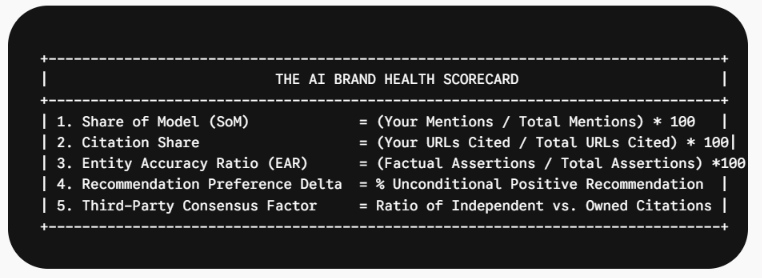
1. Share of Model (SoM)
Definition: The percentage of category-level, unbranded discovery prompts where your startup is mentioned among the top suggested solutions.
Calculation: Run 20 variations of unbranded prompts in your niche.

Benchmark:
- Under 15%: Invisible. You are losing the discovery phase to incumbents.
- 15%–40%: Emerging Challenger. You are present in high-specificity prompts but absent from general queries.
- 40%+: Category Leader. You are established in the core parametric knowledge graph.
2. Citation Share & Placement
Definition: The frequency with which an AI search engine (specifically Perplexity or SearchGPT) provides an explicit, clickable reference link directly pointing to your domain versus third-party aggregators.
Calculation:

Actionable Goal: Achieve at least 1 primary citation per relevant prompt, while ensuring the remaining citations come from positive earned-media coverage rather than competitor landing pages.
3. Entity Accuracy Ratio (EAR)
Definition: The mathematical ratio of factually true claims versus hallucinated or outdated claims generated by the LLM regarding your pricing, features, and team.
Calculation: Extract every discrete factual assertion from Prompt 2.

Benchmark: Target an EAR of ≥ 95% × . Anything below 80% indicates dangerous knowledge decay that directly converts pipeline into churn.
4. Recommendation Preference Delta (RPD)
Definition: In head-to-head competitive prompts (Prompt 3), how frequently does the model deliver an explicit, unconditional recommendation for your startup over competitors for standard use cases?
Scoring:
- +1: Explicit recommendation (“Choose [Your Brand] for best performance”).
- 0: Neutral/Equivocal (“Choose [Your Brand] if you want X; choose [Competitor] if you want Y”).
- -1: Negative recommendation (“Choose [Competitor] because [Your Brand] lacks mature support”).
5. Third-Party Consensus Factor (TPCF)
Definition: The balance of sources the AI model trusts to validate your existence. Models heavily discount self-promotional claims on your homepage unless validated by independent platforms.
Target: Minimum of 4 distinct third-party domains citing your product for every 1 owned domain citation.
5. Reverse-Engineering Citations: Identifying AI Trust Sources
When Perplexity or SearchGPT answers an inquiry about your software category, where does it find the source material? It does not scrape the entire web uniformly. Generative engines operate on an authority hierarchy skewed toward domains that exhibit high information gain, structured table formatting, and clear editorial consensus.
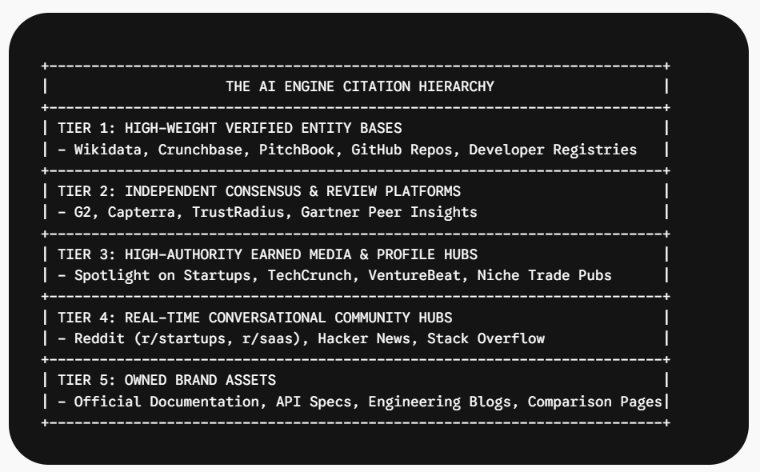
The Role of Tier 3 Profile Platforms
Startups frequently make the mistake of relying solely on Tier 5 (their own website). When an early-stage company lacks a massive digital footprint, the AI engine relies on Tier 3 media hubs—specifically editorial startup review platforms and niche profile coverage. You can examine how deep editorial features ground product capabilities by reading the ShipPlug news and profile analysis or the breakdown of Experts in value News & Market analysis.
These platforms carry disproportionate citation weight in answer engines because:
- Third-Party Validation: The LLM treats an editorial review on a dedicated startup media platform as an independent evaluation, eliminating the self-serving bias of your own marketing landing pages.
- Entity Consistency: Dedicated startup profiles systematically list the company name, founder names, core value proposition, tech stack, and primary customer demographic in a clean, easily extractable format that RAG crawlers ingest smoothly. For an example of how services and organizational frameworks are indexed cleanly, see our coverage on H2R-Solutions news and HR tech reviews.
- Freshness Ingestion: RAG engines prioritize recent publications when fulfilling time-sensitive prompts. A syndicated review published within the last 180 days frequently supersedes legacy forum threads dating back three years.
6. How to Fix Your Brand’s AI Hallucinations and Knowledge Gaps
If your 7-Prompt AI PR Audit exposed inaccuracies—such as hallucinated limitations, missing use cases, or complete omission from category prompts—follow this sequential engineering and PR playbook to fix your standing:
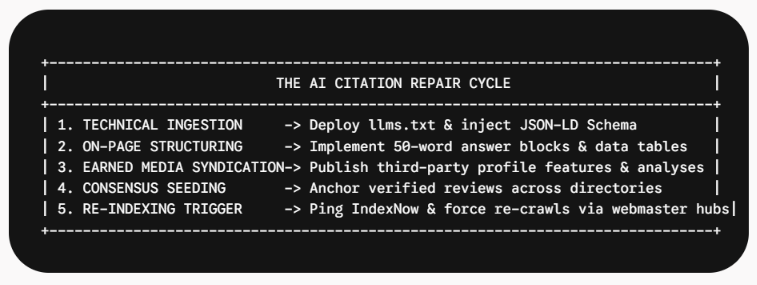
1. Deploy the llms.txt Standard on Your Root Domain
Just as robots.txt dictates web scraping permissions, the emerging llms.txt standard provides LLM user-agents with clean, markdown-formatted summaries of your platform without code bloat, navigation scripts, or CSS styling.
- Action: Host a file at [https://yourstartup.com/llms.txt] (https://yourstartup.com/llms.txt) .
- Content: Include a 200-word markdown summary explaining what your product does, who it is for, its primary capabilities, exact pricing tiers, and direct markdown links to your high-value API docs and case studies.
2. Implement Deep Entity Schema (JSON-LD)
Generative models ingest structured semantic markup to confirm organizational entities. Ensure your homepage and primary about pages deploy comprehensive and Software Application JSON-LD schemas:
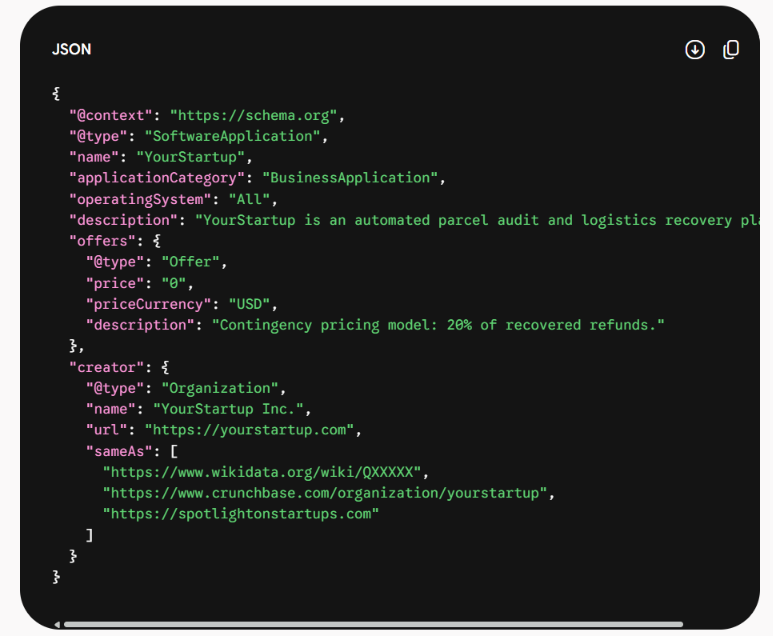
Note the sameAs array: linking your site to authoritative third-party entities explicitly anchors your startup’s identity within external knowledge graphs.
3. Build Direct, Quotable “Answer Blocks”
LLM retrieval models look for semantic chunks that directly resolve user intent without requiring complex parsing.
- Structure your product pages with Question-Led H2s (e.g., calculate parcel carrier refund claims? ). ## How does [Product]
- Immediately follow the header with a 40-to-60-word bolded, factual definition block answering the question directly before moving into details.
- Embed explicit numerical proof points and statistics directly into the copy. Instead of saying “Our software saves users a significant amount of money,” write: “Our platform recovers an average of 4.8% of total shipping spend within 14 days of integration.“
4. Seed Verified External Profiles
Because LLMs seek third-party consensus, you cannot correct a hallucination simply by editing your own landing page. If ChatGPT believes your software lacks a critical integration, updating your website alone will often fail to shift the model’s parametric weights.
- Secure an editorial profile or company feature on an established platform like Spotlight on Startups to provide a clean, unconflicted source of truth for search engines. Ensure the article contains clear factual statements, integration tables, and verified quotes.
- Update and verify your software categorization across neutral review directories.
- Answer technical questions on public developer forums (Reddit, GitHub Discussions, Stack Overflow) using verified corporate handles.
7. The Ongoing AI PR Workflow: A Founder’s Operating Rhythm
Monitoring your brand’s AI search visibility is not a one-time project; it is an ongoing operating rhythm. Generative models retrain, knowledge weights shift, and competitors routinely deploy targeted comparison content.
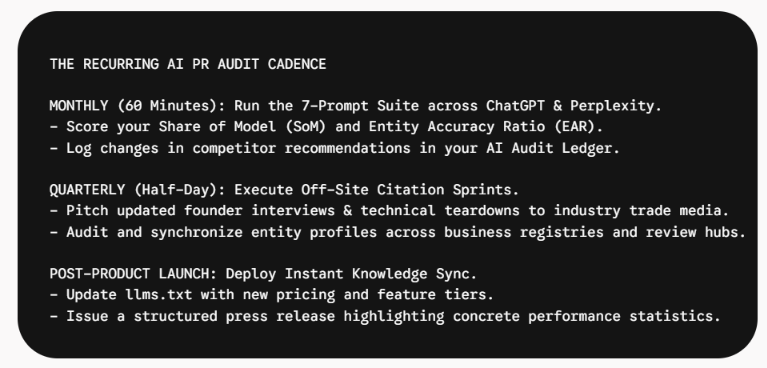
By executing this AI search brand audit, you protect your startup from algorithmic erasure. You guarantee that when prospects turn to conversational AI to decide where to invest, what tools to integrate, and which partners to trust, your startup is presented accurately, authoritatively, and persuasively.