
By Gregg Kell, Founder and Editor
Future of B2B Startup Search Marketing in 2027 – The Short Version
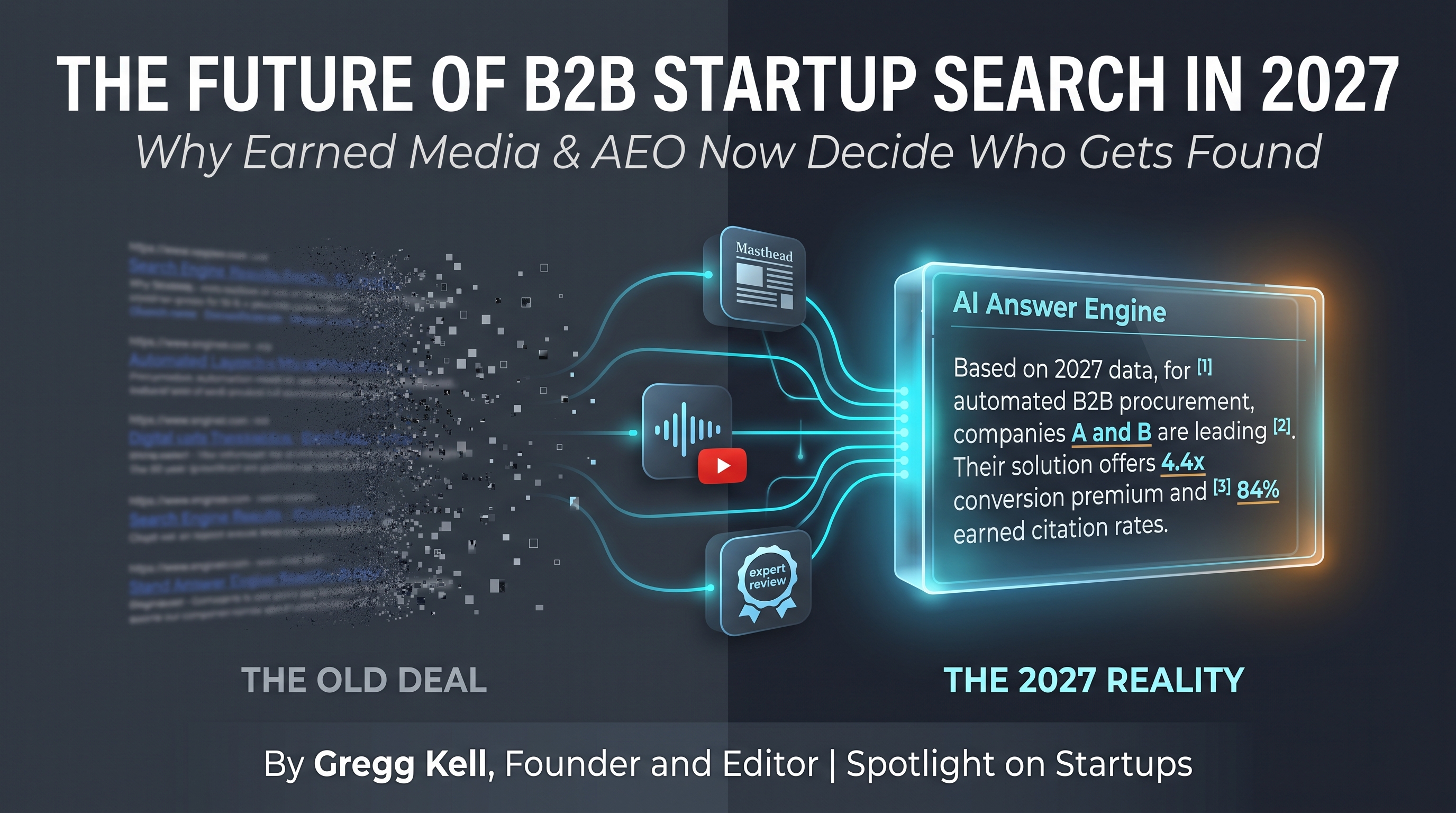
The future of B2B startup search marketing in 2027 is not a better version of SEO. It is a different transaction entirely. For roughly twenty five years, the deal between a company and a search engine was simple: publish something useful, rank for a query, earn a click, and control the next impression. That deal is being dismantled. In its place is a system where a machine reads the web on the buyer’s behalf, decides which three or four companies deserve mention, and delivers a synthesized answer that the buyer often never leaves.
For a startup, this is the whole ballgame. A Fortune 500 brand can survive a bad year in AI answers because buyers already know the name. A two year old B2B company cannot. If the answer engine does not say your name, you were never in the room.
The evidence that has accumulated through 2025 and 2026 points to two disciplines that determine whether a startup gets named: earned media, meaning independent third party coverage that machines treat as credible, and answer engine optimization (AEO), meaning the technical and editorial work that makes your own material parseable, extractable, and safe for a model to quote. The research does agree on this. It also contains enough noise, vendor incentive, and measurement instability that any founder reading a single statistic and reorganizing a budget around it is making a mistake. Both halves of that sentence matter, and this article covers both.
“Now more than ever, businesses – especially B2B startups — need to invest in a marketing mix that focuses on answer engine optimization (AEO) and earning a variety of media placements, which ultimately increases their chances of appearing in AI platform searches,” said Matt Wolf, Owner of Matt Wolf Marketing. “You build credibility by being seen and heard in the right places, coupled with creating specific messaging that separates you from competitors that are investing in similar tactics.“
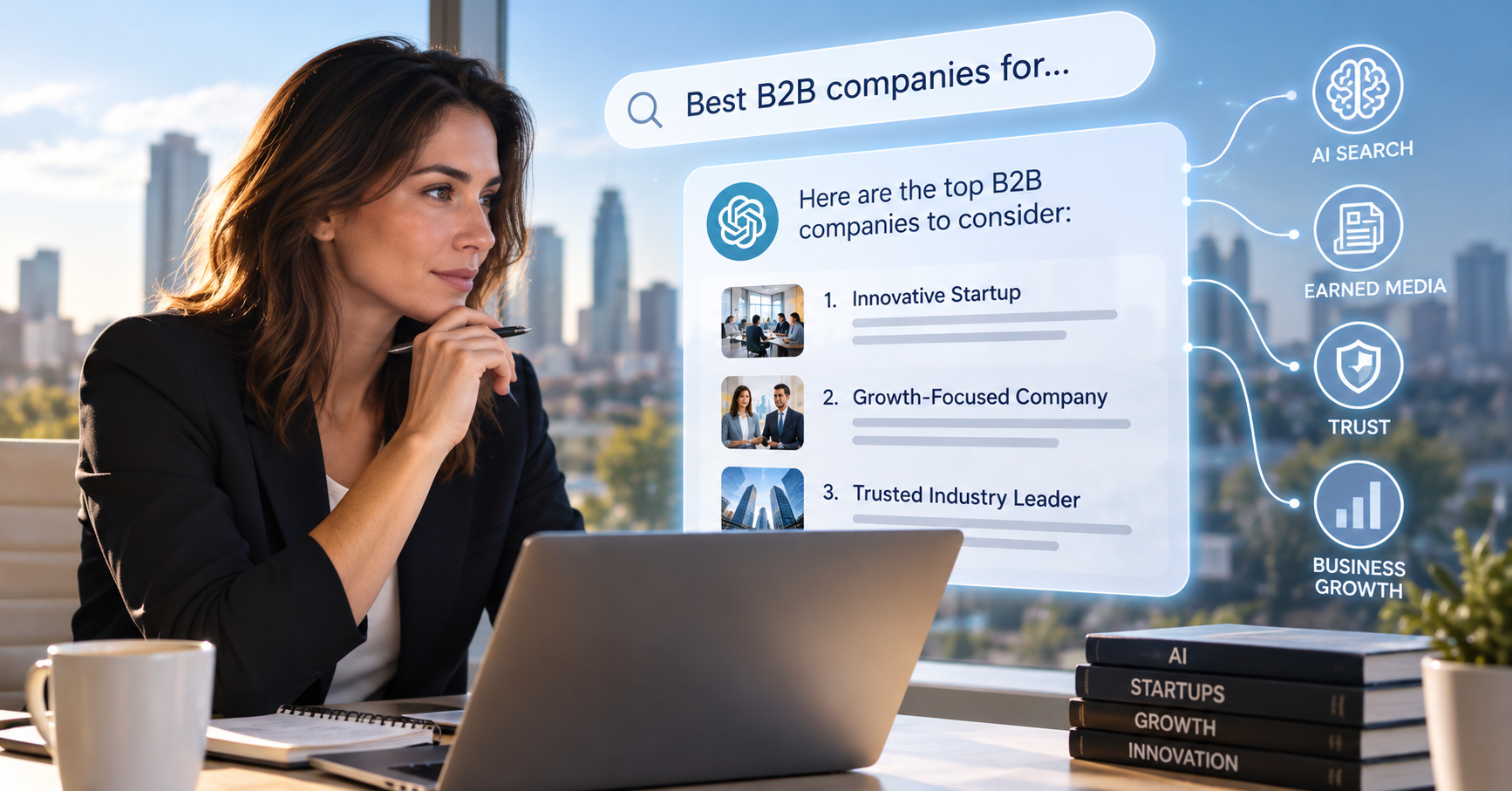
What Actually Changed in the 2027 B2B Buyer Journey
Buyers moved first, and they moved fast
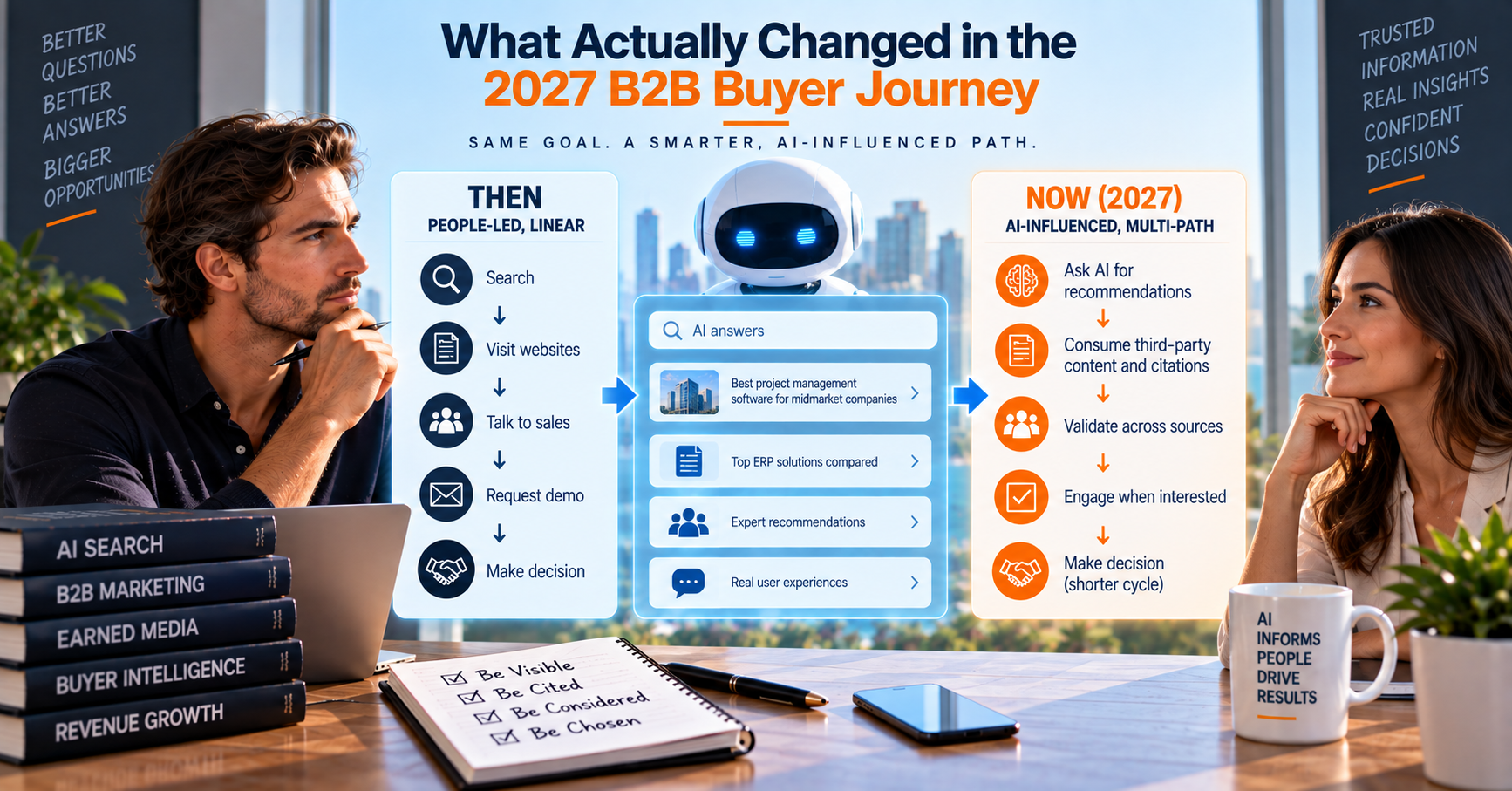
The behavioral shift is no longer speculative. Forrester’s 2026 Buyers’ Journey Survey of nearly 18,000 global business buyers found AI answer engine usage grew from 89% in 2025 to 94% in 2026, and AI answer engines now rank as the number one vendor research source, outranking websites, sales representatives, and product experts.
That is usage. Dependence is the more important number. G2’s March 2026 survey of 1,076 B2B software buyers and decision makers found that 71% rely on AI chatbots for software research, up from 60% previously, and that 53% consider AI assisted research more productive than traditional search, up from 36%. In the same research, 51% of buyers now begin research with AI before Google, up from 29% roughly seven months earlier, and only 3% said AI had not meaningfully changed their research habits. This is the behavior documented in detail in how B2B founders use AI search to vet vendors before they ever request a quote.
Two findings from that G2 data set should stop any founder cold:
33% of B2B buyers purchased from a vendor they had never previously heard of, discovered entirely through an AI search answer. 69% chose a different vendor than they initially planned, based on AI guidance.
That is not synthesis of an existing shortlist. That is discovery, and it is discovery happening inside a system that most founders have never actually audited.
Being named by a machine changes how buyers feel about you
Eighty five percent of buyers think more highly of a software vendor when an AI chatbot mentions them in a recommendation, and four out of five say AI chatbots accelerated their purchasing decision. A related finding from the Edelman 2026 Trust Barometer reported that buyers are 3.4 times more likely to trust an AI cited vendor than one they encounter through paid advertising.
The practical translation: a citation is not a link. It is an implicit endorsement delivered by a system the buyer already trusts, arriving before any sales conversation, at a moment when the buyer has no defensive posture. That is the closest thing to a warm referral that scales, and it is the same dynamic at work when investors search a startup in ChatGPT before a pitch meeting.
The shortlist shrank
The average B2B shortlist has contracted to roughly 2.5 vendors, down from 3.2 a few years earlier, and buyers place four of the five vendors they evaluate on the shortlist on day one. Bain’s September 2025 research found that 85% of B2B buyers purchase from their day one vendor list, formed before any formal search begins.
Fewer slots, decided earlier, increasingly assigned by a machine. That is the competitive geometry of 2027.
The Traffic Math B2B Startups Can’t Ignore
Clicks are leaving, and they are not coming back
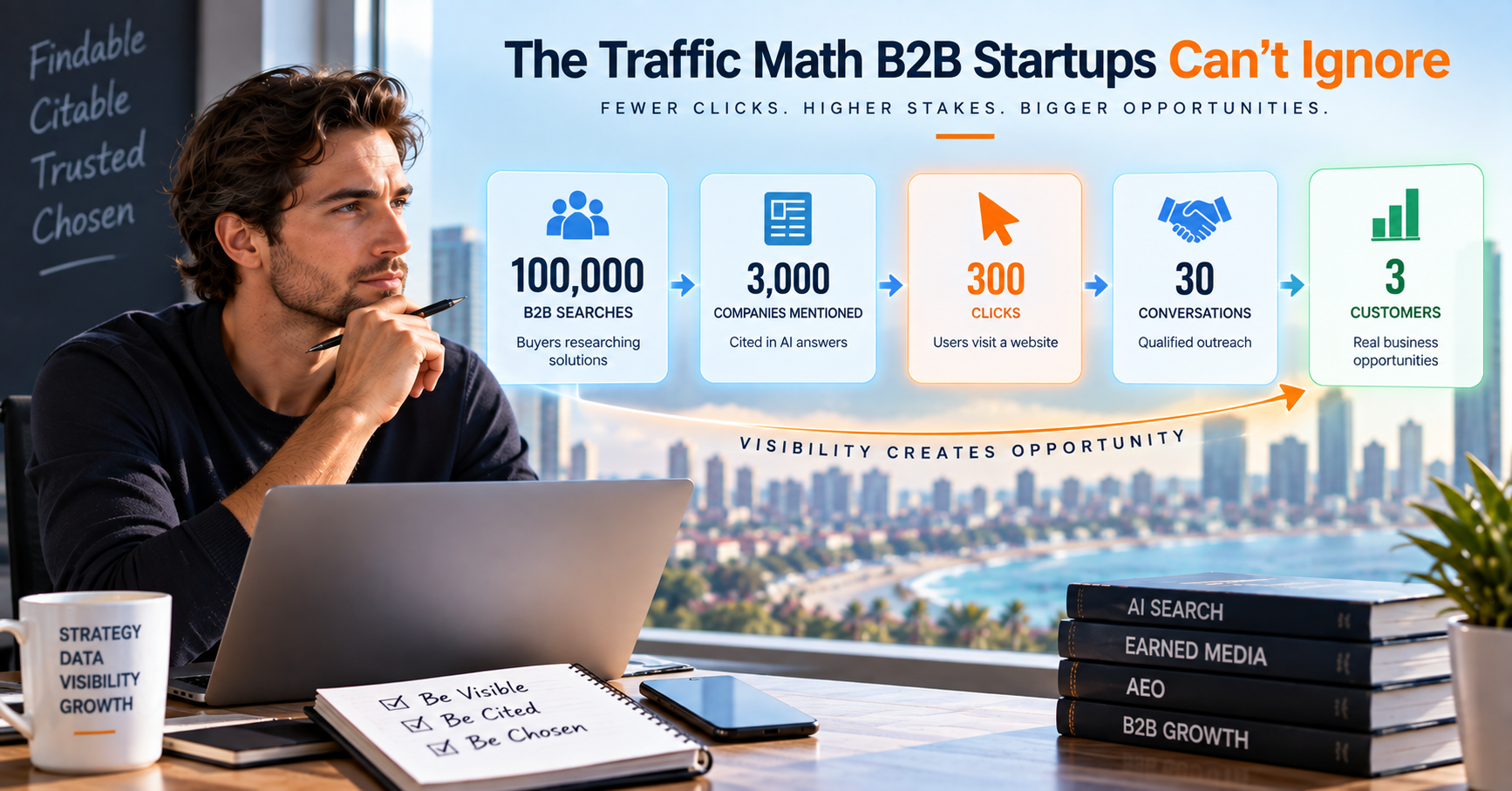
Ahrefs compared aggregated Google Search Console data across 300,000 keywords and found that Google’s AI Overviews reduced clicks to top ranking content by 58%, up from 34.5% just eight months earlier. That is a measured outcome, not a projection, and it is why showing up inside Google AI Overviews has become its own discipline.
The projections are worse. Gartner forecast in February 2024 that traditional search engine volume would drop 25% by 2026, with search marketing losing market share to AI chatbots and other virtual agents. The firm’s longer range forecast put organic search traffic down 50% or more by 2028. That longer forecast now looks conservative as AI Mode, which shows a 93% zero click rate compared with AI Overviews at 43%, expands to more markets and becomes the default experience.
For B2B specifically, Forrester reported in February 2026 that B2B companies are already seeing traffic declines of 10 to 40% as buyers migrate research activity into AI answer engines.
The visitors who remain are worth more
This is the part that reframes the budget conversation. Semrush research established the baseline: AI referred visitors convert at 4.4 times the rate of traditional organic visitors. Siege Media’s B2B data shows ChatGPT visitors with roughly double the session duration and 33% higher conversion than average, and one mid market cybersecurity client reported AI at 4% of sessions but 19% of qualified pipeline in January 2026.
The mechanism is not mysterious. Profound’s study of 50 million ChatGPT prompts found transactional intent at 6.1% on ChatGPT versus 0.6% on Google, roughly a nine times jump, while informational intent collapsed the other way. The model absorbs the browsing, the comparing, and the filtering. What arrives at your door has already decided it likes you.
The forward looking implication matters most for 2027 planning. Semrush projects that AI channels will drive economic value equal to traditional search by late 2027, not through equal traffic volume but because the conversion premium of AI referred visitors compensates for lower volume.
Read that again as a planning statement. Equal economic value, from a fraction of the sessions, within the fiscal year most founders are budgeting for right now.
Why B2B Startups Are Structurally Disadvantaged in AI Search
Citation supply is concentrated
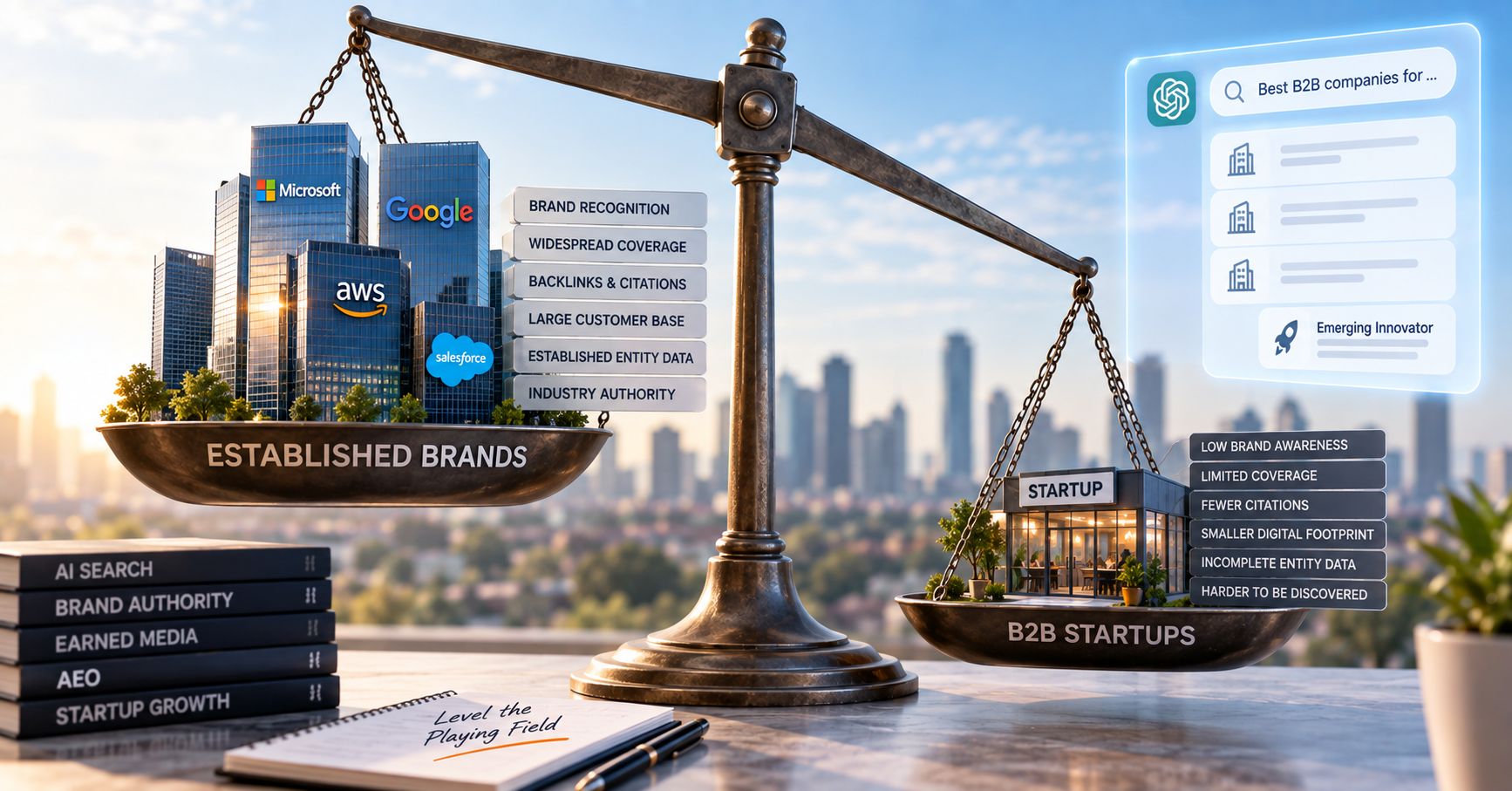
Answer engines do not distribute attention evenly. Research analyzing 1.2 million ChatGPT responses found that 67% of citations within a topic go to just 30 domains. Ahrefs analysis of ChatGPT citation behavior found that 65.3% of top cited pages come from domains with a Domain Rating of 80 or higher. Which domains make that cut is the subject of what sources ChatGPT trusts and cites the most.
If the citation pool for your category is thirty domains and none of them have written about you, your product quality is not the binding constraint. Your presence in the corpus is.
Incumbents win the comparison queries
A 2026 study of 25 B2B SaaS brands found the average startup was mentioned 2.4 times less often than the average enterprise brand, while “alternative to” queries favored incumbents 87% of the time.
The “alternative to” query is exactly where a challenger should win. It is the query a dissatisfied buyer types when they are ready to switch. Losing it 87% of the time is a structural problem, not a content gap, and it is the core of why AI engines do not recommend small B2B companies.
Most companies are invisible at the category level
This is where our own research landed. The 2026 B2B AI Citation Benchmark, published by Spotlight on Startups in August 2026, tested thirty companies across repeated AI discovery runs and found zero citations in generic category prompts. Not low citation rates. Zero.
Independent figures point the same direction. A 2X survey in 2026 found 96% of B2B companies invisible in early stage AI discovery queries, with only 4.3% appearing in AI responses to broad category level questions. Crackle PR’s Q2 2026 AI Citation Benchmark found 51% of B2B tech brands have zero citations across ChatGPT, Perplexity, and Gemini. If you have ever wondered why your company does not show up in ChatGPT, that is the population you are in.
The gap between “we rank well on Google” and “we exist in AI answers” is the defining strategic surprise of this period. Moz ran 40,000 queries through Google AI Mode and found 88% of citations came from pages outside the organic top 10. Ranking and citation are different achievements produced by different mechanisms.
Does the Research Support Earned Media as a B2B Growth Strategy in 2027? Yes, and Strongly
This is the question I was asked to test rather than assume. The research supports it, with caveats I will lay out in the next section.
The headline finding
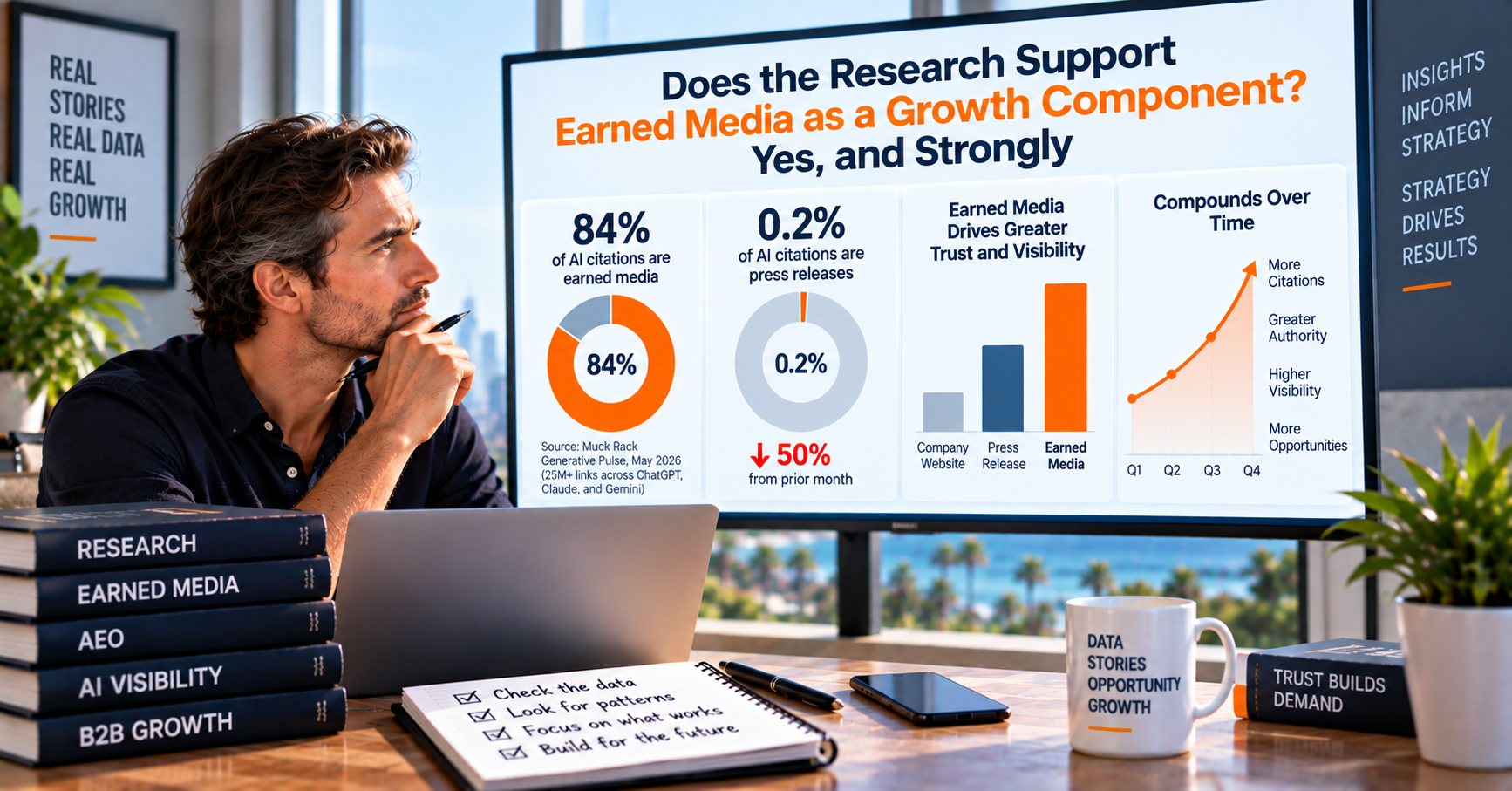
Muck Rack’s Generative Pulse study, May 2026 edition, analyzed more than 25 million links from ChatGPT, Claude, and Gemini responses across 17 industries. Earned media accounts for 84% of all AI citations. Paid and advertorial content accounts for 0.3%. Journalism alone makes up 27% of cited sources. Across all three editions of the study going back to July 2025, earned media has ranged from 82% to 89%, and journalism citations have stayed between 25% and 27%.
The near zero figure for paid and advertorial content is the reason press releases and earned media are not interchangeable strategies. The study also found that question type significantly influences what gets cited: industry trend queries drive journalism citations at more than double the rate of how-to questions. For a founder, that is a targeting instruction. Trend framing pulls journalism. Tutorial framing pulls documentation.
The stability across three editions is the part that matters more than the specific number. A finding that holds through multiple model updates over ten months is describing architecture, not a moment. It also settles a question founders ask constantly, which is whether press coverage actually helps with AI and ChatGPT visibility.
The controlled experiment
Correlation studies are common. A controlled test is rarer and more persuasive. Stacker and Scrunch ran one. The study tested 8 articles across 944 prompt and platform combinations on five leading LLMs. The baseline citation rate for content on a brand’s own site was 8%. When the same content was distributed through third party news outlets, the citation rate reached 34%, a 325% lift. A follow up report in March 2026 found a 239% median lift across a broader sample. The key variable was not content quality but distribution context.
Same words. Same claims. Same author. Four times the citation rate, purely because of where the words lived. That finding does most of the argumentative work in this article, and it explains why where founder coverage gets published matters more than how much of it there is.
The correlation data
Ahrefs studied 75,000 brands to identify which signals predict AI visibility. Brand web mentions showed the strongest correlation with AI Overview brand visibility at 0.664, compared with backlinks at 0.218. The top three correlations were all off site factors: brand web mentions (0.664), brand anchors (0.527), and branded search volume (0.392).
A December 2025 follow up extended the analysis. YouTube mentions, defined as any time a brand name appears in a video title, transcript, or description, showed a correlation of approximately 0.737 with AI visibility, consistent across ChatGPT, Google AI Mode, and AI Overviews. YouTube mention impressions, weighted by views, came in slightly lower at roughly 0.717.
That gap between frequency and reach is instructive: it means how often you are mentioned matters more than how large the audience of each mention is. Brands are not at a significant disadvantage if they are mentioned in low view videos, as long as they are mentioned widely.
For a startup with no budget for tier one placements, that is the single most encouraging data point in this entire body of research. Breadth of mention beats prestige of mention, which reframes what it actually costs to get featured in Forbes or TechCrunch as a question of whether that spend is the best available use of citation budget.
Independent replication
University of Toronto research (Chen, Wang, et al., 2025) described a systematic and overwhelming bias toward earned media, meaning third party authoritative sources, over brand owned and social content. ZipTie.dev found brands in the top 25% for web mentions earn over 10 times more AI citations than brands in the bottom 25%. The AirOps 2026 State of AI Search report found approximately 85% of brand mentions in AI answers originate from external domains, making brands 6.5 times more likely to earn citations through third party coverage than owned properties. A Fullintel academic study found more than 89% of cited links came from earned media and 95% from unpaid sources. Taken together, these findings map closely to the seven AI citation signals a B2B founder can actually control.
The dissenting measurement, which deserves airtime
Not every study lands at 84%. Meltwater’s April 2026 analysis covered 5.35 million citations across eight LLMs and found earned and news media captured 39.5% of all citations, up from 38.3% in March, while owned and other content took 50.3%. ChatGPT specifically gave 51.1% of its citations to earned media, while Claude allocated 53% to owned content.
That is a wide spread from the Muck Rack figure, and it is not a contradiction so much as a definitional difference. Muck Rack’s “earned media” category includes journalism, academic research, government sources, encyclopedic sites, and third party corporate content. Meltwater separates news and editorial from that broader bucket. Any founder quoting either number in a board meeting should know which definition they are using.
What survives both methodologies: paid content is functionally irrelevant to AI citation, third party sources carry disproportionate weight, and the engine your buyer uses most (ChatGPT) leans hardest toward earned coverage.
Why the engines behave this way
The mechanism is not editorial preference. It is training and retrieval architecture. Language models learned credibility from corpora that weighted editorially independent, high authority sources. Retrieval systems then layer on domain level trust scoring. AirOps analysis found ChatGPT retrieves many pages but cites only about 15% of them, a severe selection filter favoring high authority sources with independent validation.
A company describing itself is, to a retrieval system, a low confidence source about itself. A journalist describing that company is a higher confidence source about the same facts. That asymmetry is baked in, and it is unlikely to reverse, because reversing it would make these systems trivially easy to manipulate. It is also the reason a dedicated AEO earned media platform behaves differently from a self published blog.
What Answer Engine Optimization Actually Does in 2027
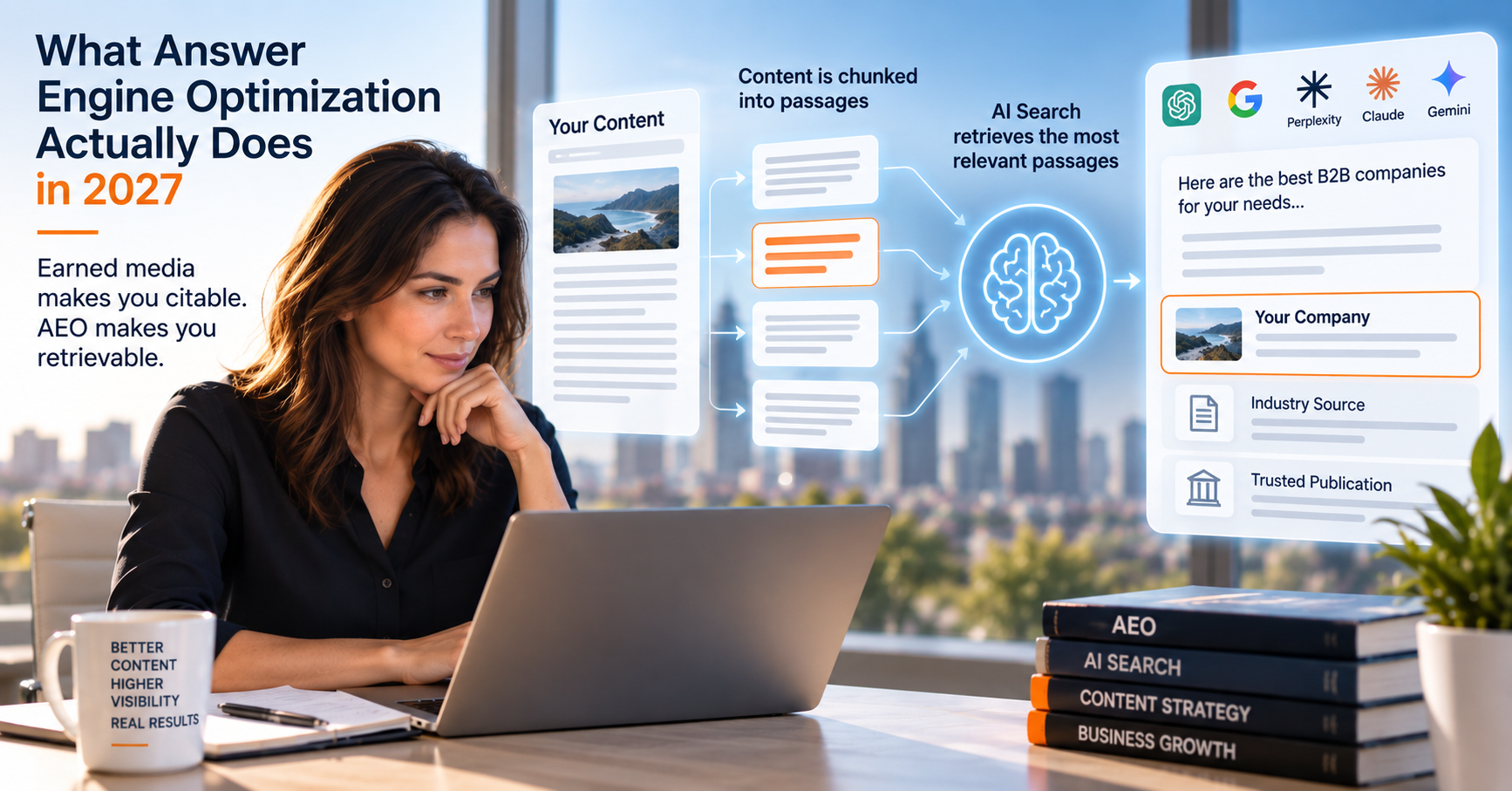
Earned media makes you citable. AEO makes you retrievable. They solve different problems and neither substitutes for the other.
The unit of optimization changed from the page to the passage
Generative search systems index, embed, and retrieve semantically relevant text passages from external documents, then synthesize an answer and cite the passages they leaned on. That changes the unit of optimization from the page to the passage. Content is chunked, embedded as vectors, and pulled in when it is the most semantically relevant match for a query, so clarity, structure, and self contained claims matter more than keyword density. The retrieval step that decides which passages get considered at all is query fan-out.
This single architectural fact invalidates a large amount of standard content practice. A 3,000 word pillar page that builds an argument across ten paragraphs is a poor retrieval target, because no individual chunk answers anything completely. A page that opens each section with a direct, self contained, attributable statement is an excellent one. The practical version of that discipline is covered in how to get cited by Perplexity and ChatGPT search.
The academic baseline
The Princeton and Georgia Tech GEO research (Aggarwal et al., SIGKDD 2024) is the most cited work in this field, and its findings are unglamorous and durable: adding statistics to content improves AI citation rates by 30 to 40%, and citing credible sources within your content improves citation probability further.
Cite others, and you become more citable. That is a genuinely counterintuitive result for anyone trained in link hoarding SEO, and it aligns with how these systems evaluate epistemic reliability.
Format matters more than volume
Original research and proprietary data achieve a 38 to 65% citation rate, compared with 6 to 15% for standard blog posts and 3 to 8% for product or marketing pages. Data rich benchmark reports score 28 to 55%, making them the second highest owned content category.
The spread between original research and a product page is roughly ten to one. That is the most actionable ratio in this article. A startup that publishes one genuine data set a year, even a small one built from its own customer base, creates an asset that outperforms a year of blog posts for citation purposes.
Ahrefs also found that the number of pages on a site had almost no bearing on AI visibility. Publishing volume, the core tactic of the 2015 to 2022 content era, has stopped working as a visibility lever.
The infrastructure half
Retrieval requires access, and access is where a surprising number of startups fail silently. The technical layer includes crawler permissions for AI user agents, clean and current structured data, consistent entity naming across every property where the company appears, and resolvable canonical information. On the markup question specifically, the evidence on whether schema markup actually influences AI citations is more nuanced than most vendors admit.
Microsoft Bing published a framework in February 2026 explaining that its search index now does two structurally different jobs: ranking pages for a human to click, and grounding facts for an AI system to cite. A startup can pass the first test and fail the second.
Retrieval systems also do not only read your site. They read software and service directories, review platforms, and industry listings, and they will recite what those third parties say about you, accurately or not, instead of what your own homepage says. Directory hygiene, G2 and Capterra profiles, LinkedIn company data, and Crunchbase entries are not administrative chores in 2027. They are source documents. A structured way to assess that surface is the AI Confidence Score.
The good news for founders under time pressure: crawler and technical fixes can show up in AI visibility relatively quickly, sometimes within weeks, since they remove an active blocker rather than requiring new content to be built and indexed, while building genuine third party authority typically takes months of sustained effort. Realistic expectations are set out in how long it takes to show up in AI search results.
Fix access first. Build authority in parallel. The sequencing matters when runway is finite.
How Earned Media and AEO Compound in 2027
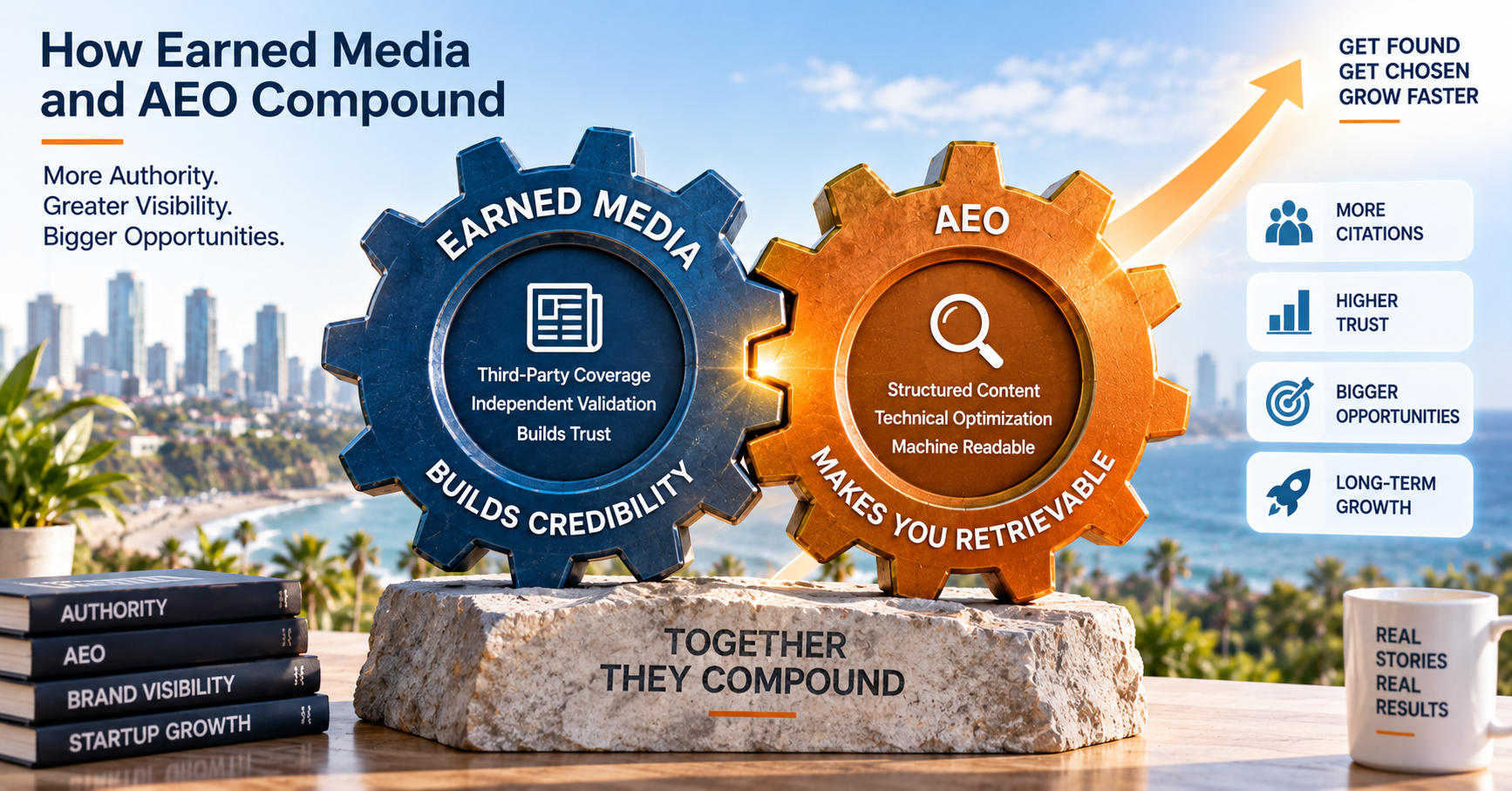
The two disciplines are usually sold separately and fail separately. Run together, they form a loop:
- An independent publication reports on the company, producing a third party document that retrieval systems weight heavily.
- That coverage increases branded web mentions, the strongest measured correlate of AI visibility.
- Increased mentions raise branded search volume, itself a correlate at 0.392.
- AEO work on the company’s own properties ensures that when a model follows a citation back to the source, it finds structured, extractable, consistent information that confirms rather than contradicts the coverage.
- Confirmed entity data increases the model’s confidence in naming the company in future answers.
- Being named produces the conversion premium documented above, which funds more of steps one through four.
Break any link and the loop stalls. Coverage without AEO produces mentions the model cannot verify against a legible source. AEO without coverage produces a beautifully structured site that no engine has a reason to trust. This is the specific reason a startup can rank on page one of Google and still never be recommended, and it is the same shift that turned public relations into a citation business rather than a clippings business.
The 2027 Variable: When Your Buyer Is Not a Person

The most consequential shift in the future of B2B startup search marketing in 2027 is that a growing share of first pass evaluation will be performed by software acting for a buyer, not by the buyer.
Gartner predicts that by 2028, 90% of B2B buying will be AI agent intermediated, pushing over $15 trillion of B2B spend through AI agent exchanges, and that traditional SEO and PPC will give way to agent engine optimization, with products needing to be machine readable and procurement shifting to autonomous machine to machine transactions.
Cloudflare, which handles traffic for roughly 20% of all websites globally, reported AI bot crawling growth of 24% year over year, with agent driven requests the fastest growing category, and its CEO expects automated software traffic to surpass human generated traffic by 2027.
The readiness gap is the opportunity. Deloitte research found only 24% of B2B suppliers use agentic AI, against 38% of buyers. Buyers’ agents are already evaluating sellers who have not structured their product data to be read. A separate Deloitte Digital figure puts B2B buyers using AI in purchasing decisions at 61%, against 24% of suppliers using agentic AI in sales.
The core problem for most B2B brands is that their digital presence was built for human navigation. Visual hierarchy, benefit focused copy, and gated technical specifications were designed to move a human buyer through a funnel. AI agents do not read funnels. They parse schemas, follow semantic markup, and weight recommendations based on how frequently and authoritatively a brand is cited by independent third party publishers.
Gated content deserves specific attention here. A PDF behind a form is invisible to every retrieval system on earth. The 2015 playbook of trading a whitepaper for an email address now removes your best material from the corpus that decides whether you get named at all. For most B2B startups, the arithmetic has inverted: the lead value of a gated asset is now smaller than the citation value of an ungated one.
A necessary counterweight before anyone overcorrects: Gartner expects over 40% of agentic AI projects to be cancelled by the end of 2027 on cost, unclear value, or weak risk controls. Consumer agentic commerce runs on price, description, rating, and a buy button. B2B procurement runs on negotiated contracts with custom pricing tiers, volume commitments, payment terms, and redlined clauses that differ per customer. Complex B2B purchasing will not be fully automated by 2027. Discovery and shortlisting already are, and that is the stage where startups live or die.
The Skeptic’s Case, Taken Seriously
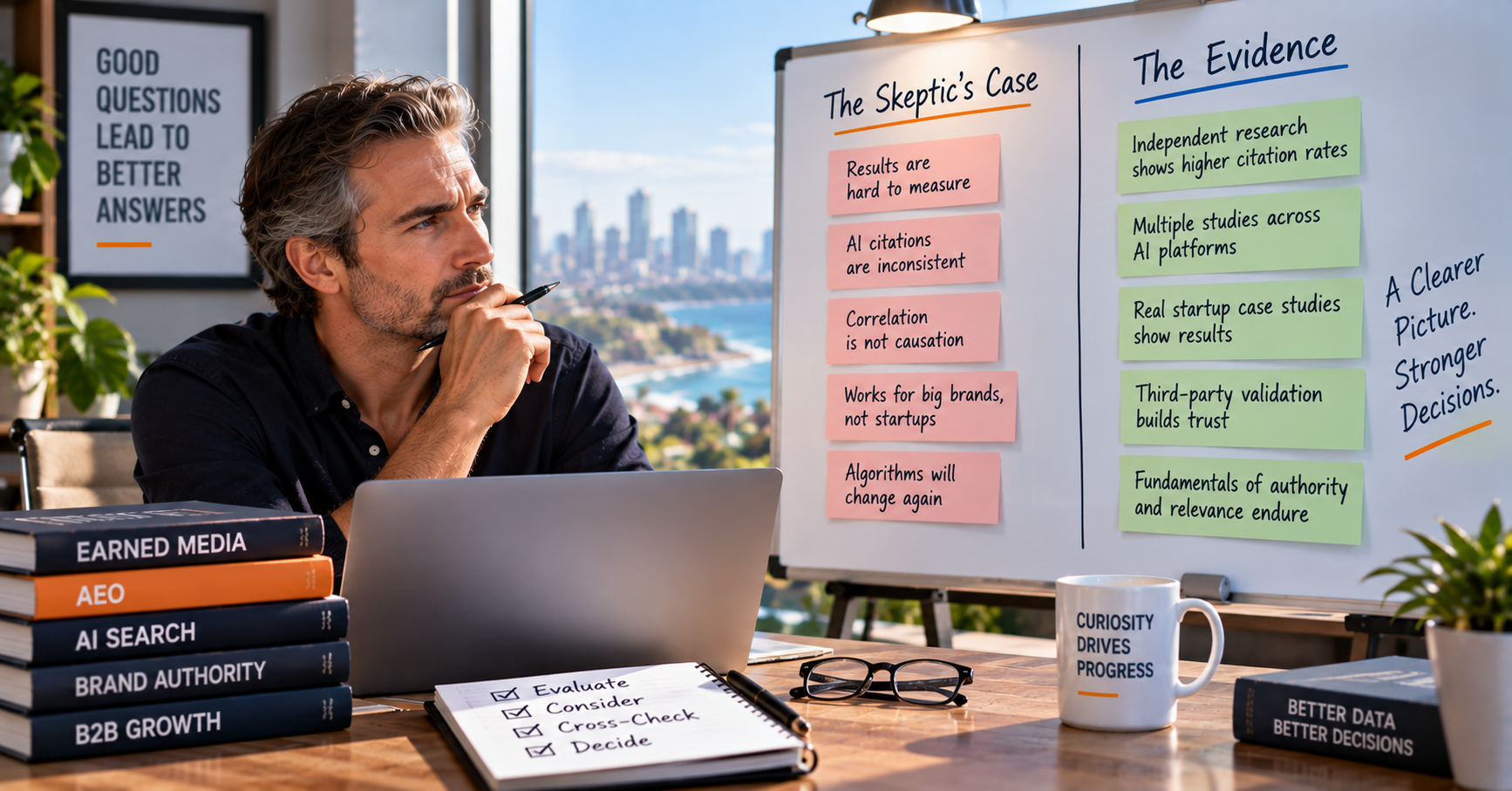
Anyone selling AEO has an incentive to overstate it. Here is the honest counter argument, which a founder should weigh before signing anything, and it is worth reading alongside an evidence based comparison of AEO services and agencies for B2B companies.
The measurement is genuinely unreliable. Writing in Forbes in August 2026, Jason Goldberg noted that repeated runs of the same prompt return different brands and different sources, purchase intent questions are the least stable query type, and published research shows an apparent move from 8% to 11% citation share cannot be distinguished from random noise, while most AI visibility dashboards report a single number to one decimal place anyway. His conclusion is worth adopting: build the practice regardless, not because the number is accurate, but because a shared methodology and a team that can reason about probabilistic measurement are worth more right now than the metric itself. That is also the honest framing behind what AI visibility monitoring actually shows.
Correlation is not causation. Ahrefs said so plainly about its own study. Brands that get mentioned in editorial media also tend to be brands that have invested in PR, product quality, and earned coverage. The mentions are a proxy for “this is a real brand,” not necessarily the lever itself. The study also measures presence in the cited set, not citation depth, and it is one study, with replication still pending.
The absolute volume is still small. Conductor’s industry benchmark puts AI referral traffic at about 1.08% of website traffic across the industries studied. Current estimates put AI powered search at roughly 12 to 18% of total referral traffic across web sources, up from 5 to 8% in late 2024, with some B2B SaaS sites still under 2% and others already north of 20%. Wide variance, small base.
Attribution is broken. Not all AI referral traffic is identifiable in analytics platforms, some AI sourced visits appear as direct traffic, and approximately 40 to 60% of AI generated responses lack visible source attribution. As of October 2025, only 16% of brands systematically tracked AI search performance.
The conversion multiples are shaky. One analyst reviewing the claims concluded: “directionally correct, the specific multiplier is unreliable. Plan on AI referred traffic converting meaningfully better than cold organic, probably 25% to 80% better for most B2B SaaS sites. Stop citing the 5x number unless you want to be the person fact checked in a board meeting.”
None of this overturns the strategic conclusion. It disciplines it. The right posture for 2027 is to treat AI visibility as a real and growing channel with genuinely poor instrumentation, to build the underlying assets (coverage, structure, original data) that would be valuable under any measurement regime, and to refuse to pay for dashboards that report noise to one decimal place.
A Practical 2027 Plan for B2B Startup Search Marketing Success
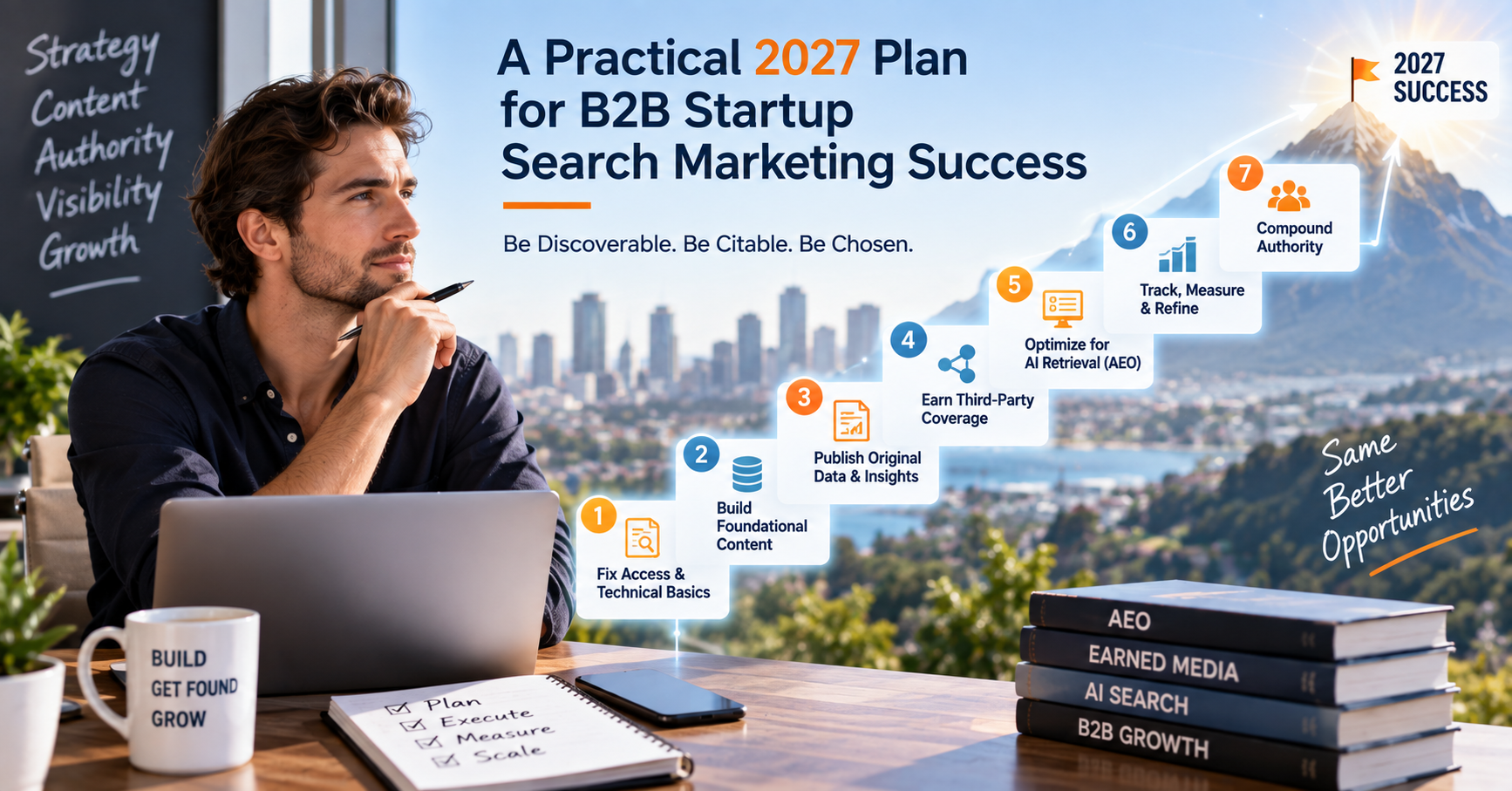
What follows is an operating sequence, ordered by ratio of impact to cost.
1. Establish a baseline before you spend anything. Write down the fifteen to twenty questions a real buyer would ask an AI engine in your category, including category queries, “best X for Y” queries, and “alternative to [incumbent]” queries. Run each across ChatGPT, Claude, Gemini, and Perplexity. Run each three times, because the answers vary. Record who gets named and what sources get cited. That list of cited sources is your earned media target list, derived from evidence rather than a media database. Eight founders who ran exactly this exercise found results they did not expect.
2. Remove the blockers. Verify AI crawler access. Audit structured data. Make entity naming identical across your site, LinkedIn, Crunchbase, G2, Capterra, and every directory where you appear. Ungate anything whose citation value exceeds its lead capture value, which for most startups is most of it. This is weeks of work, not months, and it is the fastest path to any movement at all.
3. Restructure existing content at the passage level. Every section opens with a direct, self contained, quotable answer. Add statistics with named sources and dates. Cite credible third parties inside your own material. Build honest comparison pages, including ones where you lose on some dimension, because models reward specificity over advocacy and buyers reward candor.
4. Publish one piece of original research. A small brand that surveys 400 of its own customers and publishes the result becomes a source. You do not need a market research budget. You need a question only you can answer from data only you have. At a 38 to 65% citation rate against 3 to 8% for a product page, this is the highest return content decision available to a startup.
5. Pursue earned coverage in the publications the engines already cite. Not the ones with the best readership numbers. The ones that appeared in your step one audit. Independent, journalist authored coverage is the format the research consistently identifies as the strongest citation input, and it is structurally unavailable through paid channels, which sit at 0.3% of citations. A comparison of eight platforms where startups can actually get featured is a reasonable starting point for building that target list.
6. Get into video. Given YouTube’s 0.737 correlation and the finding that mention frequency outweighs mention reach, a founder who appears on ten small industry podcasts that publish to YouTube is building a stronger signal than one who lands a single prestige placement. Transcripts and descriptions count.
7. Instrument what you can, and be honest about what you cannot. Track named prompts on a fixed cadence with a fixed methodology. Treat single point movements as noise. Look for trend over quarters, not weeks. A survey of what AI visibility tools for B2B companies actually do is useful before committing budget to any of them.
What to Measure in 2027
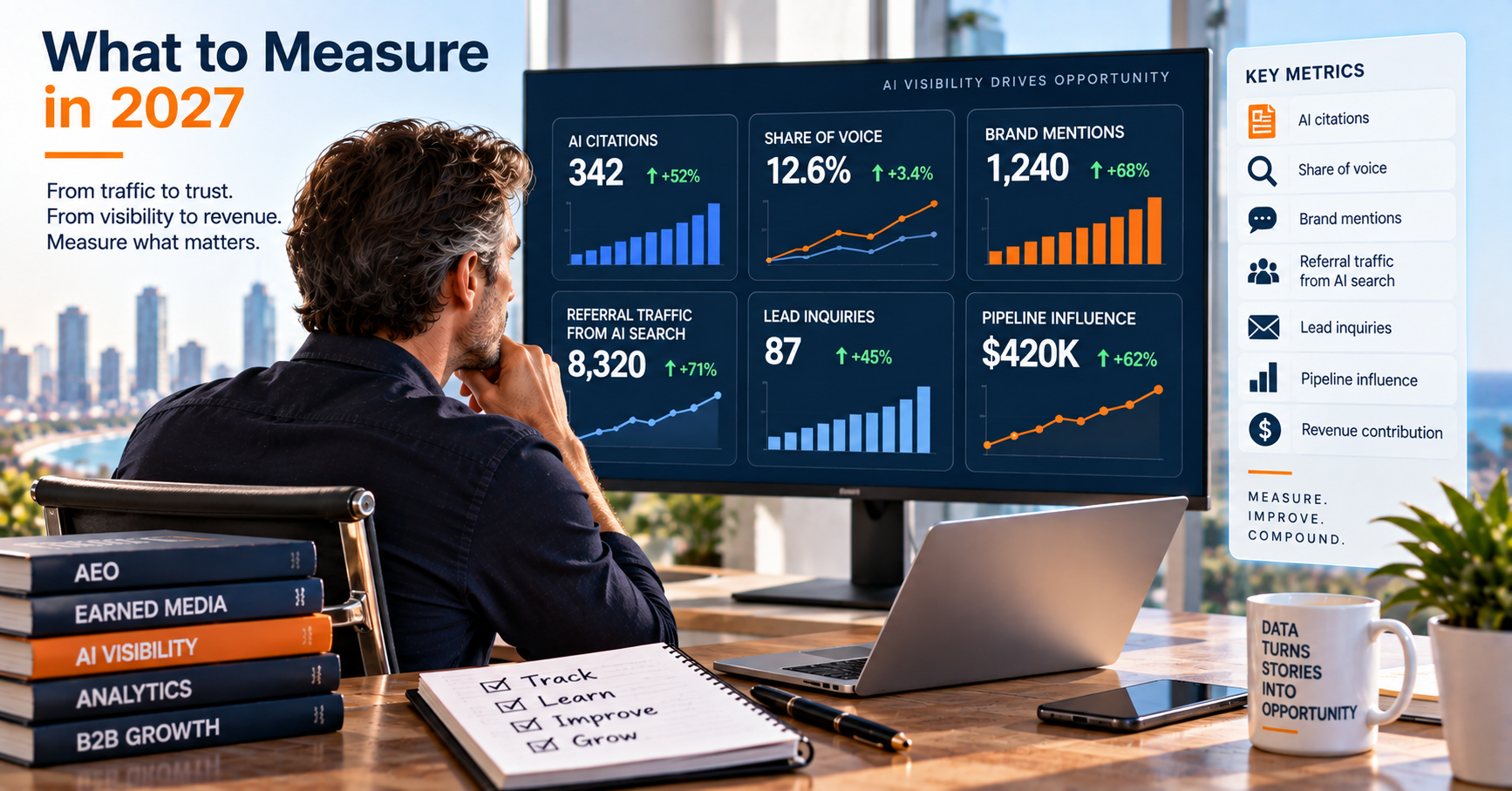
The metrics that mattered under the old deal are becoming actively misleading. Ranking position now says little about whether you are named. Organic sessions are falling for reasons unrelated to your performance. Impressions count appearances that never produced awareness.
The replacements:
- Citation presence. For a fixed prompt set, in what percentage of runs does your company get named at all? This is binary and comparatively stable.
- Share of answer. Among the companies named for your core category prompts, what share is yours, and how does that move against named competitors?
- Source accuracy. When an engine describes you, is the description correct? An inaccurate citation is a liability, and it usually traces to stale directory data.
- Branded web mentions. The strongest measured correlate of visibility, trackable through standard tools, and a reasonable leading indicator for citation.
- AI sourced pipeline, not AI sourced traffic. Given that AI referral often misattributes as direct, the more reliable signal is asking inbound leads how they found you, and capturing the answer in your CRM as a structured field.
Communications teams should add AI citation share to their standard measurement framework alongside coverage volume and reach, and track whether placements are being absorbed into the answer text or merely listed in citation footnotes.
The Conclusion a Founder Should Take Away
The future of B2B startup search marketing in 2027 rewards a specific and slightly old fashioned combination:
- Be worth writing about
- Get written about
- Make sure the machines can read both the coverage and you.
That is not a new idea. It is public relations plus technical rigor, which is roughly what marketing looked like before the click economy convinced everyone that traffic was the product. What changed is the enforcement mechanism. For twenty years, a startup could substitute budget for credibility by buying clicks. The current architecture removes that option at the decisive moment. Paid and advertorial content accounts for 0.3% of AI citations. You cannot buy your way into the answer. You can only be the sort of company that independent sources have reason to name, and then make sure nothing technical prevents a machine from finding, parsing, and trusting the record.
The window is the interesting part. This opening for challengers rarely exists in traditional SEO. It will close as large players invest in distribution, but it remains exploitable. Right now, roughly half of B2B technology brands have zero citations. The incumbents in most categories have not systematically addressed this. A startup that begins in Q4 2026 is not behind. A startup that begins in Q4 2027 probably is.
Frequently Asked Questions
What is answer engine optimization?
Answer engine optimization, or AEO, is the practice of making a company’s information discoverable, parseable, and citable by AI answer engines such as ChatGPT, Google AI Overviews, Google AI Mode, Perplexity, Claude, and Gemini. It covers technical access for AI crawlers, structured data, consistent entity information across the web, and content written so that individual passages answer specific questions completely on their own. See what an AEO earned media platform is and why it changes everything for B2B founders.
How is AEO different from SEO?
Traditional SEO optimizes a page to rank in a list of links so a human clicks it. AEO optimizes a passage to be retrieved and quoted inside a generated answer, often with no click at all. The two overlap in technical fundamentals but diverge in content structure and in what counts as success. Moz found 88% of Google AI Mode citations came from pages outside the organic top 10, which means ranking and citation are separate achievements.
Why does earned media matter more than owned content for AI visibility?
Multiple independent studies through 2025 and 2026 found AI engines cite third party editorial sources at far higher rates than brand owned pages. Muck Rack’s analysis of more than 25 million links found earned media at 84% of citations, with paid content at 0.3%. A controlled Stacker and Scrunch study found identical content moved from a brand site to third party news outlets went from an 8% to a 34% citation rate. Retrieval systems weight the credibility of the domain making a claim, and a company is a low confidence source about itself. More detail in earned media versus press releases.
Can a startup with no brand recognition get cited by AI engines?
Yes, but not through publishing volume. The measured levers are breadth of third party mentions rather than prestige of placement, original research and proprietary data (38 to 65% citation rates versus 3 to 8% for product pages), correct and consistent listings on the directories engines already read, video presence including podcasts published to YouTube, and content structured so individual passages answer specific buyer questions completely. Professional services firms face a slightly different version of the problem, covered in AI visibility for consultants.
How long does AEO take to show results?
Technical fixes that remove crawler blockers can show movement within weeks because they unblock access rather than build new signal. Third party authority typically takes months of sustained effort. Plan on a quarter before any reliable read and a year before a defensible position. Full timeline in how long it takes to show up in AI search results.
Is AI search traffic worth pursuing if it is only about 1% of visits?
The volume is small and the conversion premium is large. Semrush measured AI referred visitors converting at 4.4 times the rate of traditional organic, and Semrush projects AI channels reaching economic value parity with traditional search by late 2027. More important, most AI influence never appears as traffic: the buyer reads your name in a synthesized answer and forms an impression without visiting your site at all.
Spotlight on Startups is an Answer Engine Optimization Earned Media Platform publishing journalist-authored founder spotlights structured so AI engines can find, understand, and cite them.