
Market qualitative research is the art of understanding the why behind your customer's actions. While quantitative data gives you numbers, qualitative insights give you the story—the motivations, frustrations, and unmet needs that drive your target market. For a startup founder, this isn't just "nice-to-have" information; it's a critical tool for de-risking your business model and building a product customers will champion.
It provides the rich, human context that a spreadsheet of metrics simply can't. This guide is a practical playbook for founders who need to make smart, customer-centric decisions to achieve sustainable startup growth.
Why Market Qualitative Research Is a Startup Superpower

As a founder, you're inundated with data: user metrics, conversion rates, market size projections. But these numbers only tell you part of the story. They can show you what is happening—for example, that 70% of users abandon your onboarding process—but they can’t tell you why.
That's where market qualitative research comes in. It’s your strategic advantage for getting beyond the numbers and into the minds of the people you’re building for.
Think of it this way:
- Quantitative data is the map showing you where your customers are going.
- Qualitative research is the conversation with a local guide who explains why they take a certain shortcut, what potholes to avoid, and what they secretly wish the journey was like.
Before we dive deeper, let’s clarify the fundamental differences between qualitative and quantitative research. A successful founder knows which tool to pull from their research toolkit and when.
Qualitative vs. Quantitative Research: A Founder's Cheat Sheet
| Aspect | Qualitative Research (The 'Why') | Quantitative Research (The 'What') |
|---|---|---|
| Goal | To explore ideas, understand user experiences, and uncover deep-seated motivations. | To measure trends, test hypotheses, and identify statistical patterns. |
| Data Type | Non-numerical: interview transcripts, user observations, open-ended survey responses. | Numerical: stats, metrics, survey ratings (NPS, CSAT), analytics data. |
| Sample Size | Small and focused (e.g., 5-15 in-depth interviews) to achieve depth. | Large and statistically significant (e.g., hundreds or thousands of respondents) for validation. |
| Questions Asked | Open-ended: "Walk me through your process for…" or "How does that make you feel?" | Closed-ended: "How many times…?" or "On a scale of 1-10…" |
| Best For Startups | Early-stage idea validation, feature discovery, understanding user behavior, and refining value propositions. | A/B testing, market sizing, measuring user satisfaction, and tracking growth metrics. |
The most powerful insights emerge when you combine both approaches. Let the "why" from your qualitative findings explain the "what" you see in your quantitative data.
De-Risk Your Business Model Before You Scale
Every startup is built on a series of assumptions about a customer problem. Qualitative research is the fastest way to validate those assumptions before you invest significant capital and engineering hours.
By speaking directly with potential users, you can confirm whether the problem you think they have is a real, burning pain point they are willing to pay to solve. This process de-risks your venture by ensuring you’re building something people genuinely need. For example, a startup founder might learn through interviews that a "nice-to-have" feature is actually a "must-have" for their core audience, instantly clarifying their product roadmap and accelerating the path to revenue.
Qualitative insights are the antidote to building a brilliant solution for a problem that doesn’t exist. They ground your vision in the reality of your customer’s world, paving the way for true product-market fit.
Build a Product People Champion
The insights you gather directly inform product development, marketing strategy, and brand positioning. You'll learn the emotional triggers behind a purchase and hear the exact language customers use to describe their challenges—gold for writing marketing copy that resonates.
Establishing this research rhythm early creates a powerful feedback loop. For startups looking to formalize this process, creating structured channels for feedback is a smart next step. Learn how to set up customer advisory boards in our detailed guide, a framework for turning customer conversations into a strategic asset.
Choosing the Right Qualitative Research Method
Selecting the right qualitative research method is about aligning your tool with your objective. The method you choose depends entirely on what you need to learn. For founders, making the right choice is critical—it conserves precious time and capital while delivering the precise insights needed for strategic decisions.
We'll focus on three of the most effective and accessible methods for startups: In-Depth Interviews, Focus Groups, and Observational Research.
The diagram below illustrates where these methods fit within the broader market research landscape, highlighting their exploratory nature.
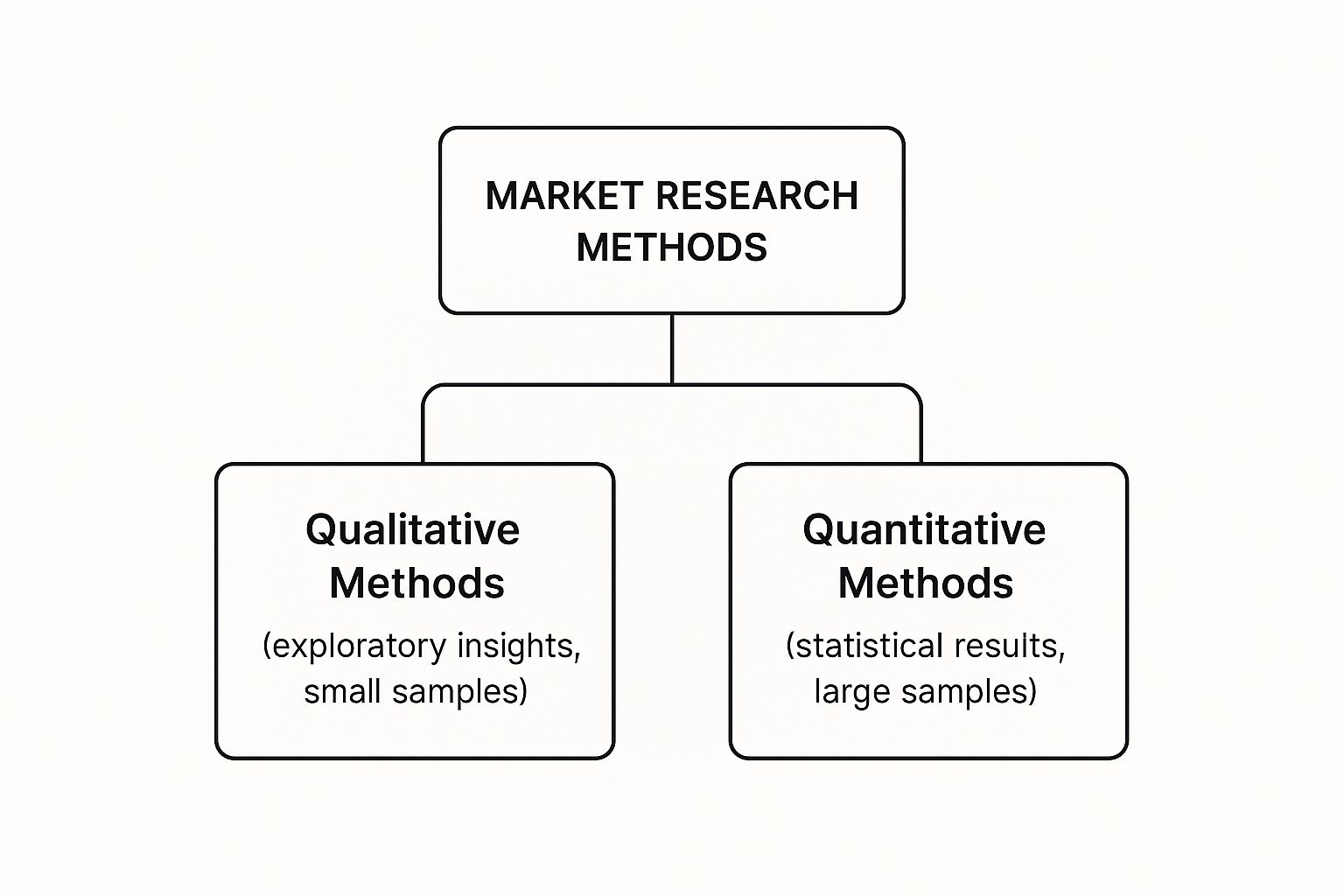
As you can see, qualitative research is designed to generate deep, exploratory insights from smaller, focused samples—exactly what an early-stage startup needs to validate ideas and understand the user mindset.
In-Depth Interviews (IDIs): The Deep Dive
In-depth interviews are one-on-one conversations designed to explore a person's thoughts, feelings, and experiences in detail. Think of it less as a rigid Q&A and more as a focused dialogue where you can follow interesting tangents and dig deeper into unexpected comments.
This method is your go-to for understanding personal, complex, or sensitive topics, as the private setting encourages honest, unfiltered feedback.
When Founders Should Use In-Depth Interviews:
- Validating a Core Problem: Before writing a line of code, confirm that the problem you're solving is a significant pain point for a specific audience.
- Developing User Personas: Move beyond demographics to truly understand the goals, motivations, and frustrations of your ideal customer.
- Mapping Complex User Journeys: Understand the step-by-step process a customer follows, whether it's a purchase decision or a daily workflow.
For startups, this method is invaluable for gathering the foundational insights that shape your entire business. Our library on market research for startups offers more frameworks to help apply these findings.
Focus Groups: The Social Dynamic
Focus groups convene a small, curated group of participants (usually 6-10 people) for a moderated discussion. The power of this method lies in the group dynamic; participants build on each other's ideas, debate concepts, and reveal shared attitudes you wouldn't capture one-on-one.
A skilled moderator guides the conversation, ensuring it stays on track while allowing for organic discussion. This method is excellent for gauging initial reactions to a new concept, brand message, or user interface.
Focus groups are less about individual depth and more about collective resonance. They reveal not just what individuals think, but how those thoughts are shaped and expressed within a social context. This is crucial for understanding how your product might be discussed in the real world.
When Founders Should Use Focus Groups:
- Testing New Concepts: Pitch a new product idea and observe the group's spontaneous reactions and brainstorming.
- Exploring Brand Perceptions: Understand how your target audience perceives your brand in relation to competitors.
- Gauging Reactions to Marketing Messages: See if your value proposition and ad copy resonate with your target demographic.
Logistical barriers for focus groups have fallen. By 2025, nearly 87% of market researchers expect at least half of their qualitative work to happen remotely. This shift is enabled by virtual focus group platforms, with 28% of researchers already using online formats for fast, flexible feedback. You can read more about the future of qualitative research on Focusinsite.com.
Observational Research: The Unspoken Truth
Observational research involves watching users interact with a product or perform a task in their natural environment. This method is incredibly powerful because it reveals what people do, not just what they say they do—and there is often a significant gap between the two.
This could be a "contextual inquiry," where you watch someone use your prototype, or an "ethnographic study," where you observe how people currently complete a task you aim to simplify.
When Founders Should Use Observational Research:
- Improving Usability (UX): Pinpoint exactly where users get stuck, confused, or frustrated while using your app or website.
- Discovering Unmet Needs: Identify the clever workarounds people create to solve problems—these can inspire new features or entire products.
- Validating Workflow Integration: See if your solution integrates smoothly into a user's existing habits and daily tasks.
By observing behavior directly, you bypass social desirability bias and uncover the raw, unfiltered truth of the user experience. This is how you identify the small friction points that, once solved, can lead to a massive boost in customer satisfaction and retention.
Executing Your First Research Project: A Founder's Framework

Turning an idea into a workable strategy depends on executing a solid qualitative research project. For founders, this means channeling curiosity into a disciplined process. Breaking it down into clear stages makes it manageable and ensures your insights are impactful.
Think of this as a journey from a broad question to a specific, actionable insight that can inform your next strategic move.
Step 1: Define Your Research Objectives
Before you schedule a single interview, you must be ruthlessly clear about what you need to learn. A vague goal like "get feedback on our app" will yield vague, unusable answers. Your objectives must be sharp, focused, and tied to a specific business decision you need to make.
Is your objective to determine if a problem is painful enough for customers to pay for a solution? Or is it to understand why users are abandoning your checkout process?
A razor-sharp objective acts as your North Star throughout the research process. It dictates who you talk to, what you ask, and how you interpret the answers. Without it, you're just having interesting conversations with no clear purpose.
Examples of strong, actionable objectives for startups:
- For a new B2B SaaS tool: "Understand the current workflow small marketing agencies use for client reporting to identify their top three biggest frustrations and unmet needs."
- For a direct-to-consumer app: "Discover the primary motivations and barriers for first-time users completing our onboarding process."
- For a pre-launch hardware product: "Identify the key factors that influence the purchasing decision for smart home devices among tech-savvy parents."
Step 2: Craft an Effective Discussion Guide
Your discussion guide is a roadmap, not a rigid script. Its purpose is to ensure you cover key topics while leaving space for the conversation to flow into unexpected—and often valuable—territory. The most common mistake founders make is asking leading questions that merely confirm their existing beliefs.
Instead of asking, "Wouldn't this feature make your life easier?" (which pressures a "yes"), use an open-ended prompt like, "Walk me through how you currently handle this task." This encourages storytelling, which is where you'll uncover true pain points. A good guide flows naturally from broad, rapport-building questions to the more specific topics related to your solution.
Step 3: Recruit the Right Participants
The quality of your insights is directly tied to the quality of your participants. Avoid the trap of recruiting friends, family, or team members; their feedback will be polite and biased, not the unfiltered truth your startup needs. Your mission is to find people who perfectly match your ideal customer profile (ICP).
Finding the right participants on a startup budget:
- Leverage your network thoughtfully: Use platforms like LinkedIn to seek introductions to professionals in specific roles or industries.
- Engage with targeted communities: Participate in relevant subreddits, Facebook Groups, or industry forums where your ideal customers gather. Be transparent about your research and offer a small incentive for their time.
- Tap into your waitlist: If you have an email list from a landing page, these individuals have already expressed interest and are prime candidates for feedback.
Use a brief screener survey to filter out anyone who doesn't fit your ICP, saving both your time and theirs.
Step 4: Conduct the Research with Empathy
During the interview or focus group, your primary role is to listen. Make the participant feel comfortable, valued, and heard. Building this rapport is what unlocks honest, gut-level feedback. Start by explaining your purpose, reassuring them that there are no wrong answers, and positioning them as the expert.
Pay attention to non-verbal cues and emotional undertones. If a participant says a task is "fine" but hesitates or sighs, that's your cue to dig deeper. Use gentle probes like, "Tell me more about that," or "What makes that part challenging?"
Always respect their time and privacy. Be clear about how their feedback will be used, and always obtain permission before recording a session. This isn't just good ethics; it builds a foundation of trust for your brand from the very beginning.
Turning Raw Data Into Actionable Insights
Collecting hours of interview transcripts and notes is just the first step. Raw data is potential; its true value is unlocked through analysis. This is where many founders get overwhelmed. The goal isn't just to report what people said, but to uncover the deeper story behind their words.
This process transforms messy, human feedback into a clear narrative that can guide your startup’s strategy. It's less about spreadsheets and more about being a detective—looking for clues, connections, and patterns that reveal what truly matters to your customers.
From Notes to Narratives with Thematic Analysis
One of the most effective methods for analyzing qualitative data is thematic analysis. Think of it as organizing a cluttered room: you group similar items until you have neat, labeled boxes. In research, these "boxes" are your themes—the recurring ideas, frustrations, or desires that appear across multiple interviews.
The process starts with coding, which simply means applying short, descriptive labels to specific quotes and observations.
- Initial Review: First, read through your transcripts and notes to get a feel for the data. Highlight anything that seems interesting or relevant.
- Coding: Go back through and apply your codes. If a customer describes frustration with a complicated setup, you might code that section "onboarding friction" or "setup pain point."
- Grouping: Once everything is coded, start grouping similar codes. "Confusing UI," "too many steps," and "unclear instructions" could all be clustered under the broader theme of "Complex User Onboarding."
This structured approach helps you move from hundreds of individual comments to a handful of powerful, evidence-backed themes.
Synthesizing Findings into Actionable Recommendations
Identifying themes is important, but the real value lies in translating them into actionable recommendations. Each theme should lead to a clear "so what?" for your business. This is how research directly influences your product roadmap, marketing messages, and overall strategy.
Your role is to connect customer feedback to concrete business decisions, creating a clear justification for your next steps. This is invaluable for aligning your team or pitching your vision to investors.
An insight is a discovery about customer motivation that can unlock growth. An observation tells you what is happening; a true insight tells you why it's happening and reveals an opportunity to act.
For example, a theme of "distrust in automatic billing" suggests more than just customer wariness. The actionable recommendation could be to redesign the pricing page for transparency, add a payment confirmation email, and test a "pay-as-you-go" option. These are tangible actions that address the underlying user anxiety. This process is critical to achieving product-market fit, which often hinges on these customer-driven pivots.
Case Study: From Feedback to a Founder's Pivot
Consider a composite example: a startup called "TaskFlow" launched a project management tool for freelancers, assuming their biggest need was advanced features like Gantt charts.
- Qualitative Data: After a dozen in-depth interviews, the founders noticed a recurring theme. Freelancers weren't talking about features; they were expressing anxiety about "scope creep" and getting client sign-off on deliverables.
- The Insight: The core problem wasn’t project management; it was client management. Freelancers needed a tool that simplified communication and approvals, not one that just organized tasks.
- The Actionable Pivot: TaskFlow shifted its focus. They deprioritized complex features and fast-tracked a simple, shareable client portal for approvals. Their marketing message changed from "The Most Powerful PM Tool" to "Effortless Client Approvals for Freelancers."
This pivot, driven entirely by qualitative insights, addressed a more painful and valuable problem, transforming their business and positioning them for leadership in a new niche.
Can AI Help With Qualitative Research? Absolutely.

Technology is not here to replace the human element of qualitative research; it’s here to supercharge it. For a founder juggling multiple roles, AI tools for startups offer a massive competitive advantage.
Think of AI and automation as the ultimate research assistant. They handle the most tedious parts of the process, freeing you to focus on strategic thinking. This allows you to move from a mountain of raw data to clear, actionable insights much faster. This trend is already reshaping the industry, with around 47% of researchers now using AI to improve efficiency. You can explore the trends shaping market research over at Greenbook.org.
Supercharge Your Analysis with AI Tools
AI's most immediate benefit is saving you from hours of manual labor. Sifting through pages of interview transcripts to identify key themes is a grind. AI tools can dramatically accelerate this process and even spot connections you might have missed.
How startups can leverage these tools:
- Automated Transcription: Services like Otter.ai or Descript can convert hours of audio into text in minutes with surprising accuracy, saving you dozens of hours.
- Sentiment Analysis: These tools scan transcripts to identify emotional tone—happy, frustrated, or neutral—giving you a quick pulse check on how customers feel.
- Thematic Analysis Software: Platforms like Dovetail or Condensr are designed to organize qualitative data. You can tag feedback, and their AI can suggest potential themes, making it easier to see patterns emerge.
Streamline Recruitment and Logistics
Finding the right participants for your study can be a full-time job. Technology can streamline this as well.
Platforms now use algorithms to match your specific criteria—for example, "moms of toddlers in the Midwest who use subscription box services"—with a pool of pre-vetted participants. This not only speeds up recruitment but also improves data quality by ensuring a better fit.
Technology handles the 'what'—the patterns, the transcription, the sentiment scores. The founder’s job is to interpret the 'why.' AI can highlight a recurring frustration, but only your intuition and market knowledge can translate that into a strategic pivot.
The key is balance. Use technology for heavy lifting and workflow efficiency, but never outsource your strategic thinking. The real competitive edge comes when a founder's unique insight meets the power of smart tools.
Common Qualitative Research Pitfalls to Avoid
Even well-planned qualitative research can be derailed by common mistakes. For a startup, these aren't minor slip-ups; they can lead you to build a strategy on flawed assumptions, resulting in wasted capital and missed opportunities.
Recognizing these pitfalls is the first step to ensuring your insights are solid enough to guide your team and impress investors.
The Blinding Danger of Confirmation Bias
Confirmation bias is the human tendency to seek and favor information that confirms our existing beliefs. As a founder passionate about your vision, you are particularly susceptible. This bias can cause you to subconsciously focus on positive feedback while dismissing valid, tough-to-hear criticism.
Imagine a founder whose app gets feedback from ten users. Eight find the interface confusing, but two call it "brilliant." Confirmation bias is the internal voice that latches onto the "brilliant" comments, ignoring the evidence of a significant usability problem. To combat this, actively seek out dissenting opinions. Ask questions like, "What's the single biggest drawback of this feature?" or "What would prevent you from using this?"
Accidentally Asking Leading Questions
A leading question subtly guides a participant toward the answer you want to hear, poisoning the data. It's one of the fastest ways to get biased, useless feedback, as you never learn what people actually think.
Instead of asking, "Don't you agree our new dashboard is much cleaner?"—which pressures a "yes"—use a neutral prompt: "Walk me through your thoughts as you look at this new dashboard." The goal is to capture their raw, unfiltered reaction, not to seek validation.
The quality of your insights is a direct reflection of the quality of your questions. Unbiased, open-ended questions are the keys that unlock honest, valuable feedback.
Recruiting the Wrong Crowd
Your insights are only as good as your participants. A classic startup mistake is to solicit feedback from friends, family, or colleagues. They are inherently biased; they either want to be supportive or are too close to the project to offer a fresh perspective.
Your participants must reflect your ideal customer profile. If you’re building a tool for enterprise sales teams, the opinions of freelance graphic designers are not just irrelevant—they're misleading. Invest your effort in finding people who live with the exact problem you're trying to solve. For credible qualitative research, this precision is non-negotiable.
Frequently Asked Questions
For founders balancing tight budgets and tighter timelines, qualitative research can seem daunting. Let's address some of the most common questions about implementing it in a fast-paced startup environment.
How Many Participants Do I Need for Qualitative Research?
The answer is simpler than you think: it’s about insights, not numbers. Unlike quantitative research, which requires large sample sizes for statistical significance, the goal here is thematic saturation—the point at which new interviews no longer reveal new core themes.
- For in-depth interviews: Patterns often emerge quickly. You may start hearing the same themes repeatedly after just 5-8 conversations with a well-defined customer segment.
- A solid target: Most teams aim for 10-15 interviews per segment to feel confident they have uncovered the core issues without spending excessive time.
- For focus groups: One or two sessions with 6-8 participants each is often sufficient to understand group dynamics and reactions to a concept.
Remember, quality trumps quantity. A few deep conversations with your ideal customers are infinitely more valuable than dozens of superficial chats with the wrong audience.
Can I Conduct Qualitative Research on a Tight Startup Budget?
Absolutely. In fact, some of the most powerful qualitative methods are ideal for bootstrapped startups. The key is to be resourceful and trade your time for expensive tools.
Don’t let a shoestring budget become an excuse for not talking to customers. The cost of building a product nobody wants is always, always higher than the cost of a few well-planned interviews.
How to conduct research without breaking the bank:
- Use free tools: Conduct interviews using video platforms you already have, like Google Meet or Zoom, eliminating travel costs.
- Recruit organically: Tap into your existing email list, social media followers, or relevant online communities on Reddit or LinkedIn.
- Get creative with incentives: Cash isn't always necessary. Offering a free subscription, a significant discount, or a small digital gift card can be highly effective. Your most critical investment is a thoughtful research plan, not a large budget.
How Do I Present Qualitative Findings to Investors?
Investors respond to data, but they are moved by compelling stories. Your job is to weave your qualitative findings into a narrative that demonstrates a deep, validated understanding of your market. This isn't about feelings; it's about de-risking their investment.
Don't just list your findings. Tell a story that starts with the core problem you explored. Use powerful, anonymous quotes to let the customer's voice shine through in your pitch—it’s far more impactful than your own summary. Develop two or three detailed user personas based on your research to make your target audience tangible.
Frame your insights as hard evidence. Show how this feedback validates your product roadmap, justifies a strategic pivot, or confirms a massive, untapped market need. When you do this, you transform subjective feedback into strategic intelligence and prove you know your customer better than anyone else.
At Spotlight on Startups, we believe deep customer understanding is the bedrock of every great company. Our platform provides founders with the frameworks, expert insights, and real-world case studies needed to turn customer research into decisive action. Explore our resources and build your startup on a foundation of proven strategies.
Learn more at https://spotlightonstartups.com/