
SEO for Generative AI Features
For a quarter of a century, the fundamental growth engine for early-stage startups remained unchanged: you compressed your brand’s core value proposition into hyper-targeted keywords, optimized your internal blog posts, and waited for Google to index your links.
At the annual Google I/O keynote, that playbook was officially retired.
Google announced a sweeping, structural transition away from link-retrieval and toward continuous, intent-driven actions. Backed by the massive speed and context windows of Gemini 3.5 Flash, the traditional list of “10 blue links” has been replaced by a default “AI Mode.” Instead of searching for information and clicking away to a startup’s website, users are now asking complex, multi-layered questions, while Google’s engine synthesizes answers and builds interactive UI widgets entirely on-screen.
As Mashable points out in its deep-dive analysis on the evolution of the search bar, the internet is moving rapidly away from keyword matching. For startup founders looking to scale, this structural shift introduces a massive hurdle: if the search engine handles the research on-page, how does an emerging brand earn digital visibility?
The answer lies in understanding the core architecture driving Answer Engine Optimization (AEO).
Under the Hood: The 3 Core Pillars of Google’s “Ask” Architecture
To optimize content for this new frontier, founders must first understand the mechanical infrastructure Google just deployed to its 2.5 billion monthly AI Overview users. The update is built on three pillars:
1. The Gemini 3.5 Flash Engine
Google has migrated its global search “AI Mode” to Gemini 3.5 Flash. According to tech breakdowns from the Financial Express, this specific model infrastructure gives Search the capacity for lightning-fast, multi-step reasoning. Instead of pulling matching text strings from an index, the engine dynamically reads, digests, and synthesizes cross-web data points in real time, serving fluid, conversational answers without latency.
2. Generative UI via Google Antigravity
The search results page is no longer static. Through a real-time rendering platform code-named Antigravity, Google Search now builds custom layouts, interactive charts, and mini-dashboards on the fly to fulfill a user’s prompt. If a user asks the engine to compare five different startup accounting platforms based on specific compliance needs, Google doesn’t link to a blog post; it writes the code to render an interactive, customizable comparison matrix directly inside the search window.
3. Persistent 24/7 “Search Agents”
The most disruptive shift for B2B and consumer startups alike is the launch of autonomous Information Agents. As reported by The Next Web, these agents run continuously in the background on behalf of users. A user can task an agent to watch a specific market sector, monitor product releases, track startup funding patterns, or find real-time software deals. The agent autonomously parses blogs, forums, and directories 24 hours a day, sending synthesized push notifications only when actionable conditions are met.
The Mechanics of Machine Trust: How AI Builds Its Knowledge Graphs
To understand why publicity has eclipsed legacy SEO, you have to look at the math behind how modern Large Language Models (LLMs) verify facts.
When an engine like Gemini 3.5 Flash processes a user’s prompt, it doesn’t just guess the answer based on raw text strings. Instead, it relies on advanced architecture patterns known as GraphRAG (Graph Retrieval-Augmented Generation).
Unlike traditional search infrastructure that views the internet as a collection of isolated web pages, GraphRAG tools map the digital world as a massive, interconnected Knowledge Graph. In this graph, your startup is a “Node” (an entity), and every factual claim about your startup—your pricing, your target industry, your software integrations—is an “Edge” (a relationship link).
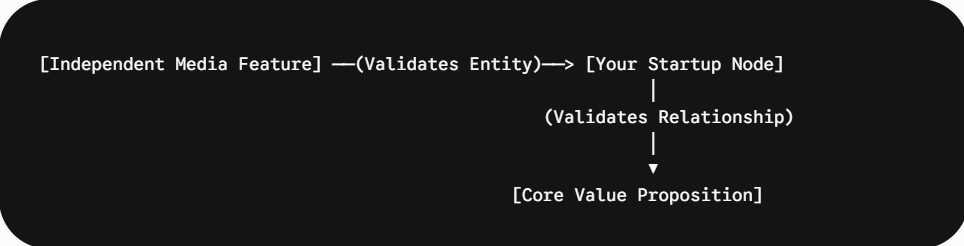
When a 24/7 background Search Agent is tasked with evaluating vendors or solutions, it uses a multi-step data verification pipeline to construct this graph from raw text:
- Entity and Relationship Extraction: As the agent crawls news websites, blogs, and public forums, it actively strips away marketing fluff to isolate nouns and verbs. It records statements like: [Your Startup] provides [Compliance Automation] for [FinTechs].
- Cross-Web Reconciliation: A single self-reported claim on your own website is considered a “weak edge.” The AI’s reconciliation pipeline will explicitly search for independent, secondary sources to verify that node.
- Consensus Anchoring: If the machine finds your exact value proposition corroborated across high-authority third-party media platforms, the connection is locked in. The graph matures, the “trust weight” increases, and your brand is cleared to be served up in a real-time Generative UI summary.
For founders looking to see this technical evolution in practice, watching engineering breakdowns can demystify how these systems think. This expert discussion on Practical GraphRAG engineering by Neo4j explores the precise mechanics of combining knowledge graphs with vector databases to create trustworthy, agentic AI solutions—the exact architecture Google is scaling across global search.
Why Media Coverage Is Your New AI Training Data
This is the exact point where traditional keyword-stuffed blogging fails. If you write an internal blog post targeting a specific keyword, you are only feeding data to your own domain. The AI treats it as an unverified claim.
However, when you secure a dedicated editorial feature or an in-depth founder interview on an authoritative media site like Spotlight on Startups, you are injecting a high-weight, independent validation node directly into the public data stream.
You are giving the machine the exact cross-web corroboration it requires to resolve entity sprawl and clear your business for active recommendation. Landing high-quality press is no longer just about human eyeballs; it is about building the structural web of trust that powers autonomous AI reasoning.
Earning Machine Recommendations via the Founder Interview Model
Because AI models prioritize factual consistency over marketing hyperbole, the way you generate publicity matters. Corporate press releases and generic listicles are filled with superficial text that algorithms discard. To build true node density, you need an indexable data trail that maps your founder journey, your distinct technical capabilities, and your industry authority.
This structural requirement is exactly why we built the Spotlight on Startups Founder Spotlight Interview.
Our model doesn’t just produce a text profile for human readers; it builds a highly structured, indexable content asset designed specifically to satisfy machine-learning verification pipelines. By answering targeted, qualitative questions about what you are building, why you started, and the explicit niche you serve, you transform your narrative into clean, highly extractable entity data. The result is a robust, multi-layered editorial anchor that background Search Agents can instantly cross-reference to lock your company into their local and national knowledge graphs.
| Discovery Metric | Legacy SEO Approach | The Spotlight & AEO Framework |
| Primary Goal | Keyword rankings and organic clicks | AI citation density and machine recommendations |
| Data Integrity | Unverified internal site claims | Independent, third-party media corroboration |
| Engine Trust Signal | Backlink quantity and anchor text | Flawless entity clarity and cross-web consensus |
The 4-Step AEO Action Plan for Founders
To ensure your startup is consistently surfaced, cited, and recommended by Google’s new architecture, your marketing and growth engines must execute this foundational framework:
1.Shift from Volume to Node Density:
AI models require corroboration across multiple independent domains. Focus your PR and content strategies on node density over volume. A single, in-depth feature on a reputable media platform carries more structural weight in an AI’s Knowledge Graph than fifty low-tier, repetitive keyword blogs published on a self-hosted site.
2.Optimize for ‘Community Perspectives’ and Forums:
Google explicitly highlights “Perspectives” from public discussions and social media within generative answers to combat automated corporate fluff. Actively seed and foster genuine discussions about your product on platforms like Reddit, Quora, and niche industry forums.
3.Deploy Pristine Structured Data Schema:
Implement technical structured data properly. Use the latest search guidelines to ensure your product-related structured data types (Product, Organization, Review) are pristine so background Search Agents can accurately track your pricing, features, and availability. Review updates via the Latest Google Search Documentation Updates.
4.Deploy a Done-For-You Authority Framework:
If you want to move beyond basic content publishing and build a technically sound, machine-readable presence that compounds over time, you need a dedicated operational system. Explore a productized technical service like the Spotlight on Startups AEO Authority Engine to align your entire web infrastructure with AI extraction rules and eliminate search invisibility completely.
The Monetization Horizon: Winning the Machine’s “Explainer”
Where user attention shifts, ad dollars inevitably follow. Paralleling the search redesign, Google’s rollout of conversational ad formats and AI-powered Shopping Ads completely changes how paid acquisition functions.
When a user engages in a conversational back-and-forth within AI Mode, Google will insert native ads directly into the dialogue. Crucially, these ads are no longer just text snippets; they feature machine-generated “explainers” that explicitly tell the user why a promoted startup is the exact match for their complex query.
To win this ad space, your brand positioning must be mathematically clear. Your marketing copy, landing pages, and documentation must leave zero room for ambiguity regarding your target audience, pricing models, and distinct competitive advantages. The clearer your data is to the model, the more effectively Google’s monetization engine can pitch your startup to high-intent users.
The Bottom Line for Startups
The age of trying to trick a static algorithm with calculated keyword densities is officially over. The future belongs to startups that build undeniable real-world authority, maintain pristine technical data structures, and command genuine digital sentiment.
Stop optimizing for an index of links. Start building the third-party authority that intelligent agents demand.