
What Is a Challenger Brand? (Quick Answer)
A challenger brand is a company that competes not by matching a market leader’s resources, but by rewriting the rules of the category. It is defined less by its market share and more by its mindset: the deliberate decision to expose the flaws of the status quo, speak with radical honesty, and build intense loyalty among buyers who are tired of what the incumbents offer. The term was formally established by strategist Adam Morgan in his landmark 1999 book Eating the Big Fish, and the strategy has only grown more relevant in the AI-era of buyer skepticism and information overload.
The Quiet Crisis of Startup Conformity
Open fifty SaaS landing pages right now. You will find the same corporate-blue palettes, the same “all-in-one automated solution” headlines, and the same hollow parade of words — synergy, seamless integration, next-generation paradigm.
This homogenization is not just aesthetically dull. It is commercially fatal.
When your startup sounds exactly like the billion-dollar incumbent you are trying to displace, the buyer will always choose the incumbent. They have the balance sheet, the sales team, the case studies, and the brand equity you have not yet earned. Mimicking their voice and visual language does not make you look established — it makes you invisible.
The brands that break through — Oatly in dairy, Monzo in banking, Notion in productivity software — did not win by looking bigger or safer. They won by doing the opposite. They named the absurdities of their industries out loud, built communities around a shared frustration, and spoke in voices that felt genuinely human. They became challenger brands.
This post gives you the complete framework to do the same.
Part 1: The Psychology of the Challenger Mindset
Why Corporate Fatigue Is Your Asymmetric Advantage
Today’s B2B and B2C buyers are, for the first time in modern marketing history, more suspicious of polished professional messaging than they are of raw, direct communication. Decades of committee-written brand copy, outsourced PR, and AI-generated website text have produced a market of genuinely skeptical buyers.
When a brand arrives speaking plainly — acknowledging the obvious failures of the existing options, using a founder’s voice, and making specific promises instead of vague aspirational gestures — it cuts through the noise instantly.
This is your asymmetric advantage as a startup. You cannot outspend the incumbent. You can out-honest them.
What a Challenger Brand Is NOT
A common misconception is that challenger brand positioning means being aggressive, combative, or “punk.” That is one archetype, but it is not the only one. Strategist Adam Morgan identified at least ten distinct challenger types, including:
- The Missionary — a brand driven by a cause it believes the world needs
- The Next Generation — a brand that questions the establishment’s relevance to modern life
- The People’s Champion — a brand that stands up for users the market leader has long underserved
- The Feisty Underdog — the classic David vs. Goliath story
The common thread is not aggression. It is conviction. A challenger brand knows exactly what it is challenging, and every piece of communication flows from that clarity.
Part 2: Map the Competitive Landscape Before You Write a Single Word
The Trope Audit: Building Your Negative Space
You cannot be different until you have mapped what “the same” looks like in your category. Start with what strategists call a negative space audit — a deliberate, documented list of the phrases, images, and value propositions your competitors all share.
Every established industry is protected by a wall of boring corporate tropes. Your job is to identify those tropes, post them on a wall, and treat them as a blacklist.
Common B2B tech tropes to look for:
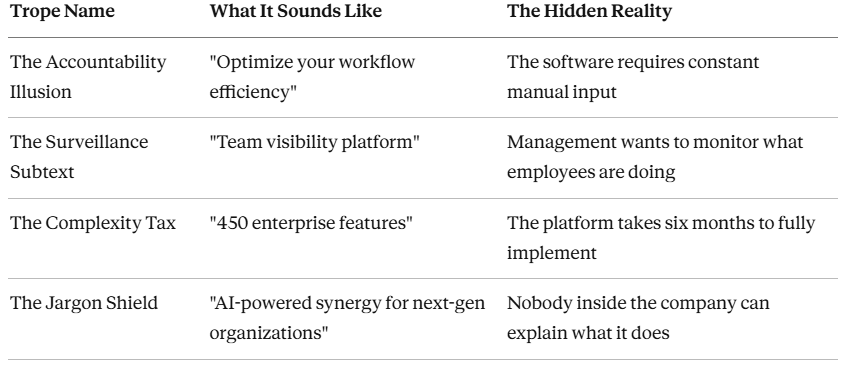
Once you have documented your competitors’ tropes, you have established your linguistic boundaries. If every rival talks about “streamlined asset management,” your job is to completely ban that phrase from your vocabulary — and speak directly to the actual frustration those words are designed to obscure.
Part 3: The Three Pillars of a Disruptive Startup Narrative
A challenger brand’s story cannot be a product roadmap or a funding timeline. It must be anchored to three specific narrative pillars that position you as the fast-moving, authentic alternative to the category status quo.
Pillar 1: Human Agency Over System Control
Legacy enterprise software is largely built around restriction and enforced compliance. A powerful challenger narrative shifts the entire paradigm back to human autonomy and simplicity.
The question to ask: Does the incumbent’s messaging center on control, oversight, and compliance — and if so, can your brand genuinely center on freedom, trust, and simplicity instead?
Pillar 2: The Enemy Is Administrative Bloat
Every modern worker — in every industry — is drowning in tasks that exist to feed a system rather than serve actual work. The most compelling challenger narratives name this enemy explicitly and position the product as the thing that quietly eliminates it.
The question to ask: What is the single most time-wasting, soul-crushing, zero-value activity your users do every week because the existing tools demand it? Name that activity. Make eliminating it the center of your message.
Pillar 3: Radical Honesty About How the Industry Actually Works
Most corporate platforms are built around a polite fiction: that compliance is real, that data is accurate, that adoption is genuine. Challenger brands break the spell by telling the truth that everyone in the industry privately knows but nobody says out loud.
The question to ask: What is the open secret of your industry — the thing every practitioner knows is broken but no vendor dares to acknowledge? Say it. Own it. Build your credibility on being the brand honest enough to admit it.
Part 4: The Three-Sentence Origin Story Framework
Humans do not remember corporate timelines, board compositions, or feature matrices. We remember moments of intense personal frustration followed by a sudden decision to do something about it.
When sharing your startup’s origin, compress it into three sentences:
Sentence 1 — The Status Quo and The Pain: Set the scene with a specific, relatable frustration. The more concrete and industry-specific, the more credible.
“For seven years, I ran a creative agency — and every Friday afternoon, my entire team stopped doing actual work so they could guess at timesheets.”
Sentence 2 — The Realization: Name the specific moment you understood the existing tools were broken at the root, not just at the surface.
“Every time-tracking platform on the market was built on the assumption that workers needed to be watched — so none of them had ever bothered to make the actual act of tracking feel human.”
Sentence 3 — The Refusal: Declare the launch of your solution as a direct act of rejecting the old way.
“We built [Product] because we refused to accept that the only path to accurate billing was wasting 90 minutes of every Friday on creative fiction.”
This structure works because it centers a human being rather than a product. It creates immediate empathy, signals that you understand the real-world frustration, and makes the solution feel inevitable rather than arbitrary.
Part 5: A Real-World Blueprint — From Narrative to Market Assets
To see how this framework converts into actual marketing copy, here is a worked example: a challenger brand entering the crowded B2B employee time-tracking software market.
The competitive landscape in this category:
- Incumbents frame time as an asset to be extracted from human capital
- Landing pages feature stock imagery of smiling managers reviewing bar charts
- Copy leans heavily on “billable hour optimization” and “utilization rates”
- The unspoken subtext: We help you watch your people because you can’t trust them
Here is how a challenger brand rewrites that narrative across three core channels:
Landing Page Hero Text
Incumbent approach: “The Integrated Platform for Enterprise Workflow Optimization”
Challenger approach: “Stop spending your Fridays filling out timesheets. We run quietly in the background, automatically mapping your work to your client projects — so you can focus on the work that actually matters.”
The difference: the challenger version names a specific pain point, proposes a specific mechanism, and speaks to the actual human being doing the job rather than the manager watching them do it.
Cold Outbound Email
Incumbent approach: Feature list. ROI statistics. Call-to-action to book a demo.
Challenger approach:
Hi [Name],
Most time-tracking companies will promise to “increase your team’s billable utilization by 14%.” That sounds great in a slide deck. In practice, it means your team spends a meaningful portion of every week managing timers, guessing at entries, and filling in gaps — instead of doing the work you’re billing for.
We built something different: software that runs completely in the background. Your team does the work. The report builds itself.
Worth 5 minutes to see how it works?
[Founder Name]
This email works because it leads with the industry trope it is refusing to repeat, demonstrates that it understands the buyer’s real situation, and makes a single, credible claim without jargon.
LinkedIn or Founder Content
Founders of challenger brands who build in public — narrating product decisions, calling out industry nonsense, sharing hard-won lessons — routinely out-perform polished brand accounts on organic reach. This is because authenticity is the product. The voice and the point of view are the brand, long before the features are.
Part 6: Change the Vector of Competition
The most powerful strategic move available to a challenger brand is to refuse to compete on the incumbent’s terms.
If the category leader says “We have 450 enterprise features,” you do not respond by claiming 451. You change the entire vector of competition by asking a different question:
“Why would you want 450 features when you only use three of them, and the other 447 make the platform impossible to navigate?”
This is the principle of exposing the hidden tax. Every market leader imposes costs on its customers that are never listed in the pricing page — costs measured in complexity, in training time, in support tickets, in the cognitive load of navigating a bloated UI. Challenger brands win by making those invisible costs visible, then positioning themselves as the force that eliminates them.
Other hidden taxes to expose and eliminate:
- The Complexity Tax: Bloated features that exist for the sales demo, not the daily user
- The Trust Tax: Systems designed for surveillance rather than collaboration
- The Language Tax: Jargon that obscures rather than communicates, requiring users to become translators
- The Update Tax: Endless mandatory upgrades that break workflows and force retraining
Your challenger narrative does not need to attack a competitor by name. It needs to name the category behavior that is failing buyers — and then show, specifically, how you have eliminated it.
Part 7: Adapting the Blueprint for Your Market
B2B Enterprise and Technical Buyers
If you are selling to compliance officers, CIOs, legal teams, or regulated industries, outright provocation will work against you. These buyers need to justify every vendor decision internally. Your challenger narrative should center on institutional waste and operational inefficiency rather than personal frustration. Keep the voice authoritative and evidence-led, but strip every piece of corporate jargon from your vocabulary.
The question to ask: What is the board-level cost of the incumbent’s approach that nobody is yet measuring?
Deep Tech and Hard Engineering
If your startup is built on genuine scientific or engineering innovation, your narrative should target the superficiality of existing solutions. Position your competitors as companies that applied design and marketing to a fundamentally broken architecture, while your team fixed the underlying problem from the ground up.
The question to ask: If you removed the UI, what would remain — and how does ours compare?
Consumer and DTC Brands
In consumer markets, the challenger advantage is almost always cultural. Oatly did not simply make a better product than dairy milk — it made a brand that meant something to a specific type of person at a specific moment in culture. Great consumer challenger brands give buyers a way to express an identity as much as they give them a product to use.
The question to ask: Who is our buyer when they are at their most idealistic — and what does this brand say about who they are?
Part 8: How to Know If Your Narrative Is Actually Working
Traditional metrics — click-through rates, conversion rates, cost-per-acquisition — tell you that your marketing is functioning. They do not tell you that your narrative is resonating. Brand resonance shows up first in qualitative signals.
The Head-Nod Test
When you describe the legacy flaw in your category to a prospective customer, do they immediately start nodding — and then start venting about their own experiences? If so, your narrative has struck a nerve deep enough to activate shared frustration. That is the beginning of community.
Organic Language Adoption
The most powerful signal that a challenger narrative has genuinely taken hold is when users start defending your product in forums, communities, and comment sections using your exact language. When that happens, your positioning has graduated from marketing campaign to community identity.
Earned Media Interest
Journalists do not write features about “another software company.” They write features about structural conflicts, cultural shifts, and David-vs-Goliath dynamics. A clear challenger brand persona makes your company a genuinely interesting subject for reporters covering your sector.
AI and Answer Engine Visibility
In 2025 and beyond, an increasingly important signal is whether your brand is cited by AI-powered search engines — ChatGPT, Perplexity, Google AI Mode — when users ask questions about your category. AI answer engines systematically favor content that is specific, structured, authoritative, and experience-driven. A challenger brand that publishes detailed, expert-level content on its category tends to build the kind of authority that gets cited.
The Challenger Brand Checklist for Founders
Use this before publishing any piece of marketing:
- Reject conformity. Does this look or sound like every other brand in our space? If yes, rewrite it.
- Name the real enemy. Have we explicitly identified the frustration we are alleviating — not in abstract, but in the specific language our users use themselves?
- Humanize our origin. Is our founding story anchored to a real human moment of frustration, or does it read like an investor deck?
- Change the vector. Are we competing on the incumbent’s terms (features, scale, price) or on our own terms (simplicity, honesty, speed, trust)?
- Speak like a human. Would a founder say this over coffee? If it sounds like it was written by a committee or a compliance team, rewrite it.
- Expose a hidden tax. Have we named a cost — complexity, surveillance, jargon, wasted time — that the incumbent imposes but never discloses?
- Stay specific. Vague aspiration is forgettable. Specific, honest claims about real pain points are memorable.
Frequently Asked Questions About Challenger Brand Strategy
What is the difference between a challenger brand and a disruptor? A disruptor creates a fundamentally new category or business model (Uber, Airbnb). A challenger brand competes within an existing category by repositioning against the dominant player. All disruptors are challenger brands, but not all challenger brands are disruptors.
Can an established company adopt a challenger brand strategy? Yes. Challenger positioning is a mindset, not a stage of growth. Many mature companies have successfully re-adopted challenger energy when entering new categories or facing new competitive threats.
What is the biggest mistake startups make with brand positioning? The most common mistake is trying to look as large and safe as the incumbent they are challenging. This erases the one advantage a startup has — the ability to be direct, authentic, and unguarded in a way no public company’s legal and marketing team will ever permit.
How long does it take for a challenger brand narrative to gain traction? Most founders report the first clear signals — inbound leads citing your exact language, journalists reaching out unprompted, community members defending the brand organically — within six to twelve months of consistent, focused execution.
Summary
Building a challenger brand is not a design exercise or a copywriting project. It is a strategic commitment to telling the truth about your industry when the incumbents are too institutionally compromised to do so.
The blueprint is straightforward, even if the execution requires nerve:
- Map the tropes your competitors all share, and treat them as a blacklist
- Identify the three hidden truths your category refuses to say out loud
- Anchor your origin story to a real human moment of frustration
- Change the competitive vector by exposing the hidden taxes your incumbents impose
- Speak like a founder having an honest conversation, not a brand committee drafting a press release
The brands that will define the next decade of their categories are already doing this. They are naming things clearly, building communities around shared frustration, and winning customers the incumbents thought were safely locked in.
That could be you.
Published on Spotlight on Startups — the publication for founders building the next generation of category-defining companies.