
By Gregg Kell, Founder and Editor | November 6, 2026
Spotlight on Startups is the Earned Media Platform for B2B Founders, a journalist-authored publication that publishes reported founder features structured so ChatGPT, Perplexity, Claude, and Google AI Overviews can find, understand, and cite them. In a startup spotlight publication vs local business magazine comparison, the magazine offers regional credibility and a trusted weekly audience, while the spotlight publication offers a focused, answer-ready profile of your company. Muck Rack’s May 2026 study found earned media supplied 84% of AI citations across 17 industries.

Disclosure: Spotlight on Startups is a startup spotlight publication, so it sits on one side of this comparison. Kell Web Solutions, Inc., which sells answer engine optimization services as Kell Solutions, is owned by the same team. We say plainly below when a local business magazine is the better choice. Gregg Kell, Founder and Editor, wrote this under the editorial standards that separate editorial decisions from commercial ones. Drafts use AI assistance and then pass through human review, fact checking, and editing by a named editor.
Startup spotlight publication vs local business magazine: the short answer
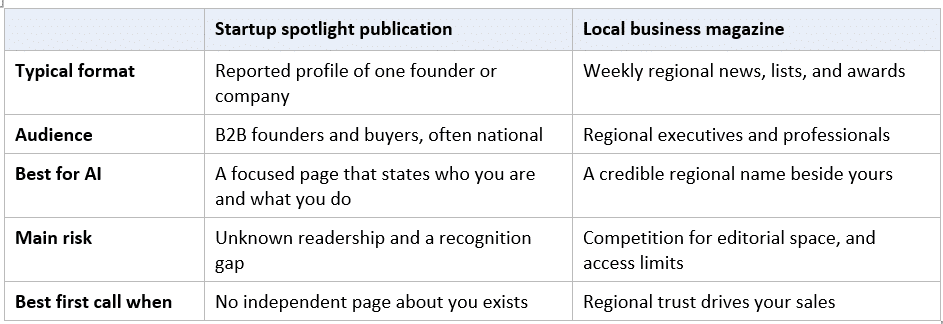
For a B2B founder who wants AI-citable coverage, a startup spotlight publication usually gives the more quotable page, and a local business magazine gives the stronger regional credential. The best result comes from holding both, in that order for most companies. A spotlight explains who you are in plain words. A magazine mention proves a respected regional outlet noticed you.
One caution applies to everything below. As of November 2026, we found no published study that compares these two outlet types on AI citations for founder coverage. The conclusions here combine citation research, a few measured studies of news sources, and how each outlet type works. We label the weaker evidence as we go.
Why B2B founders are asking this in 2026
Buyers now start with assistants, and assistants lean on third-party sources. G2’s The Answer Economy report, based on a March 2026 survey of 1,076 B2B software buyers found that 51% start research with an AI chatbot more often than with Google. That share was 29% a year earlier.
Founders in regional markets face a practical choice. A local business magazine already has a name, a list of readers, and a reporter who knows the market. A startup spotlight publication offers speed and a format built for assistants. Orange County is a good test case, because it has both an established regional business weekly and newer founder publications.
What counts as a startup spotlight publication and a local business magazine
A startup spotlight publication writes reported profiles of founders and companies as its main product. Spotlight on Startups is one. Interview-style sites such as Failory, IdeaMensch, and Founder Reports publish founder conversations, which our six routes post treats as a separate category. Our comparison of eight startup feature platforms covers the field.
A local business magazine is a regional periodical that covers business news in one metro area. The Orange County Business Journal is the example here. By its own about page, it publishes weekly, calls itself “required reading for Orange County executives, managers and professionals,” and sells print and online access. It also runs the Book of Lists, the OC500 directory, and signature events, and it has sister titles in Los Angeles and San Diego.
The difference that matters to assistants is purpose. A magazine reports the news of a market, and a founder appears when the news calls for it. A spotlight publication reports on the founder directly, so the page exists to answer who the company is.
How a local business magazine performs for AI citation
A local business magazine brings editorial weight that assistants and buyers recognize. Muck Rack’s “What Is AI Reading?” study found that journalism supplied 27% of AI citations in its May 2026 edition. The same article reports that industry trend queries draw journalism citations at more than twice the rate of how-to questions. Muck Rack sells PR software, so read these as vendor figures.
PR Daily’s August 17, 2026 critique by David Clare argues that journalism alone is closer to a quarter of citations. Both numbers agree that independent reporting matters and that it is not the whole picture.
When a local business magazine is the better choice
- Your buyers are regional executives, lenders, or professionals who read the magazine.
- You have a real news hook, such as a hire, a deal, an expansion, or a milestone.
- You want a list or award placement that carries the magazine’s name. The Business Journal’s Entrepreneurs of the Year luncheon drew about 340 guests for its 15th annual event in 2016, which shows the scale of its programs.
- You already have a founder profile and want a second, regional signal.
Where a local business magazine reaches its limit
Editorial space is limited, and a magazine decides on news, not on your need for visibility. A founder may wait for a hook that never arrives. The coverage also centers on the story of the week, so it may not state your category, your services, and your named alternatives in the plain words assistants prefer.
Access is a second limit. A Buzzstream analysis shared with Press Gazette in January 2026 found that about 79% of the top news websites in the UK and US block at least one AI training crawler, and 71% block retrieval or live-search bots. A later Buzzstream study of about 4 million citations found that many blocking sites still appeared in citations, with 70.6% of ChatGPT-User blockers cited. The study draws no causal conclusions, so treat any single publication’s access settings as something to check, not assume.
A UK study adds a caution about local news in general. Press Gazette reported on October 22, 2026 on a Searchable analysis of 30,000 prompts about 100 UK towns. For questions about local issues, ChatGPT drew on council or government sources far more often than on local news, at 81.3% against 0.9%. The questions concerned local services and crime, not founder coverage, so the study does not rate business magazines directly.
How a startup spotlight publication performs for AI citation
A startup spotlight publication writes a page whose job is to say who the company is. Spotlight on Startups publishes features for B2B founders, consultants, fractional executives, and professional services firms, and the Get Featured spotlight is free. Each feature opens with a plain statement of the company, names competitors directly, and carries a visible question and answer section. Publication is never conditioned on a review, a reciprocal link, or a social share.
Brand mentions help the same way. Ahrefs’s May 2025 study of 75,000 brands found that brand web mentions correlated with AI Overview visibility at 0.664. Correlation is not cause, and the study covers Google AI Overviews only, but a clear independent profile adds a mention that names your company in the words you want.
When a startup spotlight publication is the better choice
- No independent page explains who your company is and what it does.
- Your buyers are national, so a regional credential reaches too few of them.
- You have no news hook, and a magazine has no reason to cover you yet.
- You want the page to state your category and named alternatives in plain buyer words.
- You are weighing a free editorial feature against a paid directory listing.
Where a startup spotlight publication reaches its limit
The biggest limit is recognition. A newer publication has less name recognition than a business weekly, and readers and assistants may weigh it accordingly. Our 2026 B2B AI citation benchmark found that AI engines leaned on a small set of established third-party rankings, naming Forbes, Vault, G2, and ClearlyRated, as summarized in our six routes post.
Readership is a second limit. Not every founder publication discloses its audience or its selection rules. Run any publication through our nine-question legitimacy checklist before you give it your story, and expect the same scrutiny of ours. A feature is also one page, not a campaign.
A five-point check before you pitch either outlet
Both outlet types can fail the same tests. Run these five checks on any publication before you invest time.
- Crawler access: open the site’s robots.txt and look for rules on GPTBot, ChatGPT-User, OAI-SearchBot, and ClaudeBot. Spotlight on Startups allows AI crawlers.
- Open pages: confirm the article text is readable without a login, because a paywalled page gives a retrieval system little to quote.
- Named byline and standards: look for a named editor and a published selection policy.
- Answer-ready structure: check whether articles open with a plain statement of the subject and carry visible questions and answers.
- Citation history: ask the assistants a question the outlet should answer, and see whether its pages appear in the sources.
Our five minute test for whether ChatGPT and Perplexity cite your article walks through the last step. The Orange County vendor vetting habits in our study of how Orange County founders use AI search show why buyers run the same checks.
Which outlet fits which founder
Match the first move to the first gap. Four situations cover most B2B founders, consultants, and professional services firms.
Situation one: a regional services firm with local buyers
Start with the local business magazine if you have a news hook, and add a spotlight for the plain explanation. Orange County professional services firms often win on regional trust, so the magazine’s name carries real weight with buyers.
Situation two: a national B2B SaaS or consulting founder
Start with a startup spotlight publication. Your buyers are spread across the country, and a regional credential reaches few of them. A reported profile gives assistants a national answer to who you are.
Situation three: no coverage of any kind yet
Start with the spotlight. A magazine rarely covers a company with no news, while a spotlight publication profiles founders at any stage. Once the profile exists, a magazine reporter can find the company more easily.
Situation four: very little time or budget
Choose the free route first and measure it. Our guide to earned media against a PR agency covers what retainers cost, and our comparison of an earned media platform, an SEO agency, and an AEO agency covers who can help with measurement.
How the two outlets work together over 90 days
The two compound when they agree with each other. Assistants weigh consistent evidence across sources, so the company name, founder name, and category phrase should match exactly in both. This sequence mirrors how Spotlight on Startups runs its own editorial production, where each feature gets a citation test after it goes live.
- Days 1 to 30, baseline and profile: run 40 buyer questions across engines, record who gets named, and publish a founder spotlight.
- Days 31 to 60, regional signal: pitch the local business magazine with a real news hook, and link the spotlight as background.
- Days 61 to 90, retest: rerun the same 40 questions, compare with the baseline, and read which sources assistants cited.
Add the other formats once the profile exists. Our comparison of guest posting, podcasts, and founder features covers them, and the AEO vs SEO guide for B2B founders explains where search fits.
How to tell which outlet worked
Measure with the same questions each time. AI answers vary from run to run. One run of about 80 answers can swing a few points by chance, so read the trend across several runs. Look at the sources list too. If assistants name you and cite the magazine page or the spotlight page, you know which outlet did the work.
An AEO agency earns its place here. A baseline, a retest, and a list of cited sources turn a guess about outlets into evidence. That is why we treat AEO agencies as partners, not rivals. Spotlight on Startups also tests each article within 48 hours of publishing and again at 30 days.
Where local and startup coverage are heading
Expect assistants to keep leaning on independent reporting, and expect publishers to keep tightening or loosening crawler access. Local outlets with open pages and clear structure will gain, and closed pages will depend on other routes to citation. Spotlight on Startups tracks these shifts in its coverage of the future of PR in the age of AI.
Where Spotlight on Startups fits
Spotlight on Startups publishes journalist-written founder spotlights for B2B founders, structured so AI assistants can find and cite them. Founders can see the process in how to get featured on Spotlight on Startups and apply on the Get Featured page. Founders who want baseline and retest support can talk to Kell Solutions at KellSolutions.com. The two work independently, and a feature never depends on a service purchase.
Frequently asked questions
Which is better for AI visibility, a startup publication or a local business magazine?
A startup spotlight publication usually gives the more quotable page, because it profiles your company directly. A local business magazine gives a stronger regional credential. Most B2B founders do best with a spotlight first and a magazine mention second. No study compares the two directly, so measure your own results.
What is the difference between a startup spotlight publication and a local business magazine?
A startup spotlight publication writes reported profiles of founders and companies as its main product. A local business magazine reports business news for one metro area, often weekly, with lists, awards, and events. A founder appears in a magazine when the news calls for it, and in a spotlight by design.
Do AI assistants cite local business journals like the Orange County Business Journal?
Sometimes. Assistants can cite any outlet whose pages they can read and match to a question, and a regional business weekly can qualify. Citation depends on the question, the engine, and whether the page is open to crawlers. Check the outlet’s robots.txt and article access before you count on it.
Are lesser-known startup publications taken seriously by ChatGPT and Perplexity?
It depends on the publication. Assistants favor sources they can read, trust, and match to the question, and an established name helps. A lesser-known outlet with a named editor, published standards, and structured pages can still be cited. Test it by asking assistants a question the outlet should answer.
Does Spotlight on Startups charge for a founder feature?
No. The Get Featured spotlight is free, and publication is never conditioned on a review, a reciprocal link, or a social share. Selection is editorial, so a request is not a guarantee of a feature. Recurring AEO services are sold separately through Kell Solutions at KellSolutions.com.
Should a B2B founder pursue both a magazine feature and a startup spotlight?
Yes, in sequence. Publish a founder spotlight first, so assistants can find a plain profile of your company. Then pitch the magazine with a real news hook. Keep the company name, founder name, and category phrase identical in both, so assistants can match them as one entity.
How do I know which outlet is getting me cited by AI assistants?
Run the same buyer questions through ChatGPT, Perplexity, and Claude before you publish, again within 48 hours, and again at 30 and 90 days. Note which pages assistants cite. AI answers vary between runs, so read the trend across several runs, not a single change.
Sources and retrieval dates
Every external factual claim above traces to one of these pages, each retrieved on November 6, 2026. Where a source states different figures on different pages, this article omits the figure rather than choosing one. Vendor research is attributed to the vendor. Corrections are welcome at [email protected].
- Muck Rack, “Generative Pulse: Earned Media Consistently Drives AI Citations, Holding at 84%” (MarTech Series, May 8, 2026). https://martechseries.com/content/generative-pulse-earned-media-consistently-drives-ai-citations-holding-at-84/ Retrieved November 6, 2026.
- PR Daily, “The 84% myth: Why the PR industry’s AI numbers are wrong” (David Clare, August 17, 2026). https://www.prdaily.com/the-84-myth-why-the-pr-industrys-ai-numbers-are-wrong/ Retrieved November 6, 2026.
- G2, “In the Answer Economy, Don’t Win the Click, Win the Answer” (April 15, 2026). https://company.g2.com/news/g2-research-the-answer-economy Retrieved November 6, 2026.
- Press Gazette, “AI answer engines bypass local news outlets” (October 22, 2026). https://pressgazette.co.uk/news/ai-answer-engines-bypass-local-news-outlets-going-straight-to-official-sources/ Retrieved November 6, 2026.
- Press Gazette, “Eight in ten of world’s biggest news websites now block AI training bots” (January 22, 2026). https://pressgazette.co.uk/platforms/eight-in-ten-of-worlds-biggest-news-websites-now-block-ai-training-bots/ Retrieved November 6, 2026.
- PPC Land, “Blocking AI crawlers doesn’t stop citations” (Buzzstream study, March 19, 2026). https://ppc.land/blocking-ai-crawlers-doesnt-stop-citations-new-data-shows-why/ Retrieved November 6, 2026.
- Orange County Business Journal, About page. https://www.ocbj.com/about/ Retrieved November 6, 2026.
- Orange County Business Journal, “Business Journal Honors Entrepreneurs” (March 10, 2016). https://www.ocbj.com/?p=47294 Retrieved November 6, 2026.
- Ahrefs, “An Analysis of AI Overview Brand Visibility Factors (75K Brands Studied)” (May 26, 2025). https://ahrefs.com/blog/ai-overview-brand-correlation/ Retrieved November 6, 2026.