
By Gregg Kell, Founder and Editor, Spotlight on Startups | Published September 26, 2026
Disclosure: I run Spotlight on Startups, and it appears on this list. For every other platform, I say plainly who it serves better than we do. For ours, I say what you give up by choosing it.
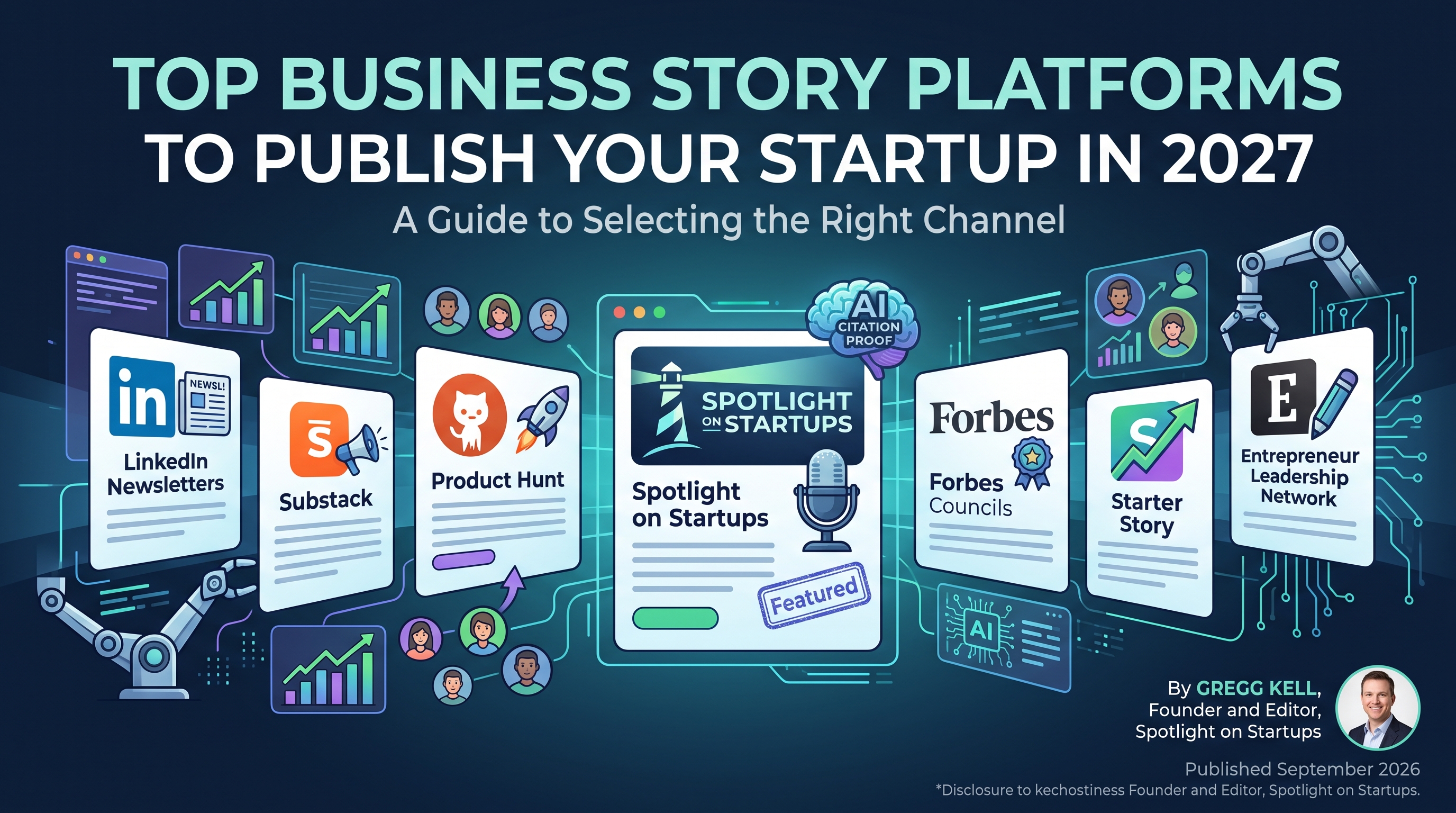
The top business story platforms to publish your startup in 2027 are LinkedIn newsletters, Substack, Product Hunt, Starter Story, Forbes Councils, the Entrepreneur Leadership Network and Spotlight on Startups. They split on two questions: who writes the words, and who owns the page. The split matters because Muck Rack’s May 2026 study of more than 25 million links cited by ChatGPT, Claude and Gemini found that earned media accounts for 84% of AI citations, while paid and advertorial content accounts for 0.3%. Muck Rack
Spotlight on Startups is the Answer Engine Optimization Earned Media Platform, a journalist-authored B2B media platform that publishes reported founder features structured so ChatGPT, Perplexity, Claude, and Google AI Overviews can find, understand, and cite them.
Why Business Story Platforms Matter More in 2027
Business story platforms used to compete for readers. In 2027, they also compete for machines. B2B buyers now ask an AI assistant for a shortlist before they visit a vendor’s website. The assistant builds that shortlist from sources it trusts.
Muck Rack’s research shows how stable that trust has been. Across three editions of the study since July 2025, earned media has ranged from 82% to 89% of AI citations, and journalism alone has held between 25% and 27%. The pattern held through several model updates.
That is the editorial thesis of this guide. As of September 2026, the business story platform you choose decides two things. It decides who reads your story, and it decides whether an AI engine treats it as evidence or as marketing. Spotlight on Startups covered the wider shift in The Future of PR in the Age of AI: Why Citations Replaced Clips in 2026.
How to Compare Business Story Platforms: Who Writes the Words, Who Owns the Page
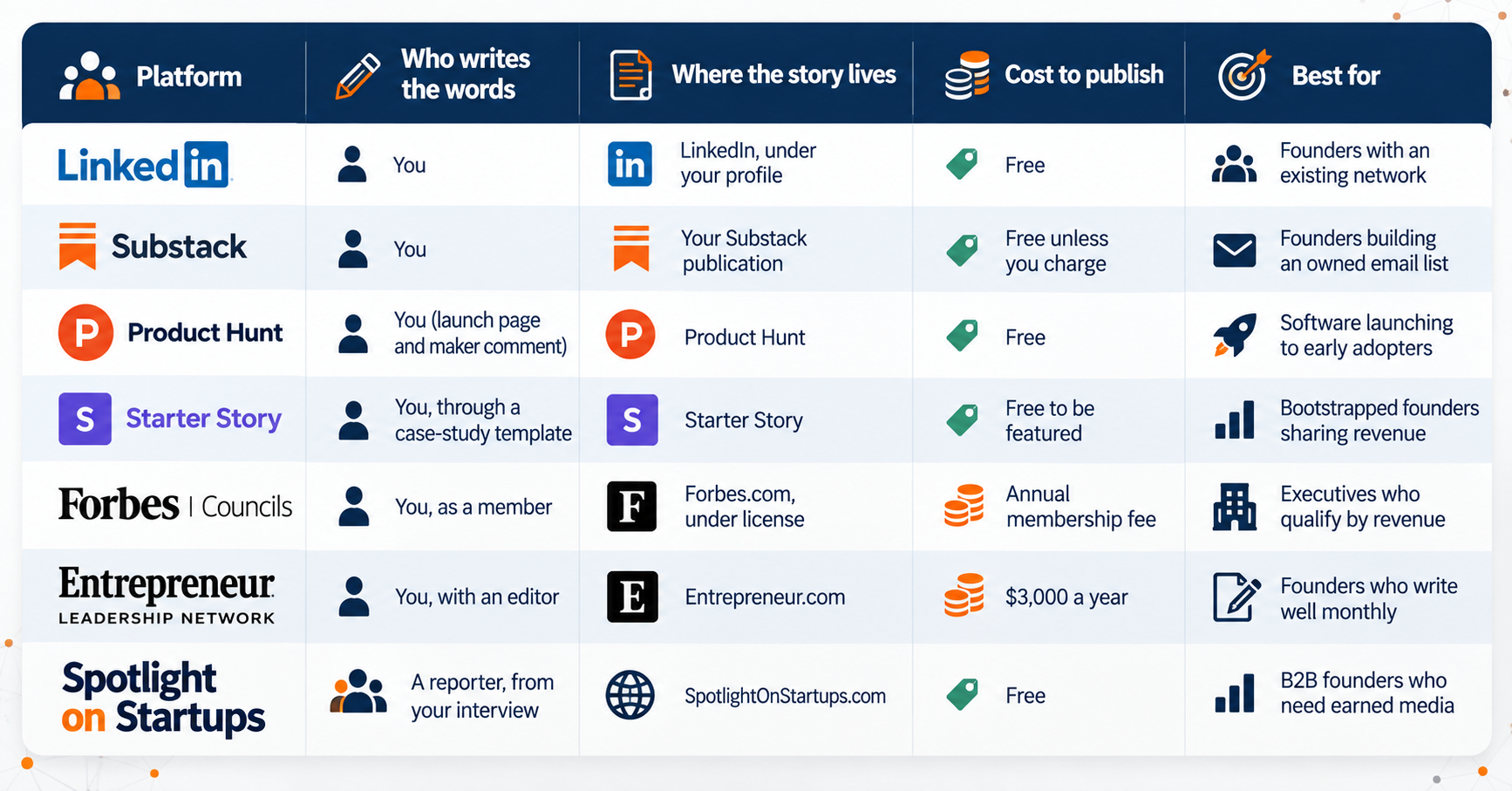
Every business story platform lands somewhere on two lines. The first line is authorship. You write it yourself, you answer a template, or a reporter writes it about you. The second line is ownership. The story lives on your channel, on a platform you rent, or on an independent publication.
Spotlight on Startups published a five-question test for this choice in How to Choose the Right Storytelling Platform in 2026.
LinkedIn Newsletters: The Fastest Business Story Platform to Start
A LinkedIn newsletter is a recurring series of articles published under a founder’s own profile. LinkedIn states that all members can create a newsletter. Company Pages need more than 150 followers or connections to be evaluated for access. linkedin
Who LinkedIn serves better than Spotlight on Startups: founders who already have an engaged network and want to publish every week in their own voice. No other platform on this list reaches your existing connections as fast.
The trade-off: a LinkedIn newsletter is owned content. An AI engine reads it as a founder describing their own company, which carries less weight than a third party’s account. LinkedIn also controls the page, the feed and the distribution.
Substack: A Business Story Platform You Can Take With You
Substack is a newsletter platform that pairs a public web archive with email delivery. Publishing is free. Substack charges a 10% platform fee only on paid subscriptions, and Stripe adds 2.9% plus $0.30 per transaction. Substack
Who Substack serves better than Spotlight on Startups: founders who want to own a subscriber list and may one day charge for their writing. A Substack publication is a durable asset. You can export the list if you leave.
The trade-off: Substack starts every founder at zero readers. Like LinkedIn, it is self-published, so it builds your voice rather than third-party proof.
Product Hunt: A Launch-Day Business Story Platform
Product Hunt is a daily ranking of new products voted on by early adopters. It is a launch venue more than a story venue, but the maker’s first comment often carries the founding story. Product Hunt’s own launch guide names 12:01 a.m. Pacific Time as the best launch time for makers who plan ahead. producthunt
Who Product Hunt serves better than Spotlight on Startups: software founders with a live product and a community ready to show up on launch day. No editorial publication delivers that burst of early users.
The trade-off: a Product Hunt launch peaks within a single day. The page describes a product, not a company’s track record. B2B services firms and non-software companies rarely fit the audience.
Starter Story: The Case-Study Business Story Platform
Starter Story publishes detailed case studies of how founders built their businesses, usually with revenue figures. HubSpot Media announced in February 2026 that it is acquiring Starter Story. HubSpot reports more than 4,500 founder case studies and interviews in its database and 300,000 newsletter subscribers. hubspot
Founder Pat Walls has described a question template that founders complete on their own, built because transcribing hour-long phone interviews did not scale. Substack
Who Starter Story serves better than Spotlight on Startups: bootstrapped and indie founders willing to share numbers publicly. Starter Story’s audience wants the revenue, the pricing and the first-customer tactics.
The trade-off: you write most of the words, and revenue transparency is part of the format. B2B firms that keep financials private may find the fit uncomfortable.
Forbes Councils: The Paid Byline Business Story Platform
Forbes Councils is a set of fee-based membership communities whose members publish bylined articles on Forbes.com. Forbes labels Council content as expertise from members, operated under license, and describes Forbes Business Council as invitation-only and fee-based. Forbes
To qualify for Forbes Business Council, a business must generate at least $500,000 in annual revenue or have received $500,000 in funding. Technology Council and several other councils require $1 million in revenue or financing. Forbes does not publish its fee on the qualification page. An independent March 2026 review put Forbes Councils membership at $2,500 to $5,000 a year, plus a one-time initiation fee of $500 to $600. Forbes Business Council | Organization for Business Owners +2
Who Forbes Councils serves better than Spotlight on Startups: qualifying executives who want a recurring byline on a recognizable domain and will write consistently.
The trade-off: a Council post is paid, self-written content. It is not Forbes editorial coverage. Spotlight on Startups broke down the difference in How Much Does It Cost to Get Featured in Forbes or TechCrunch?.
Entrepreneur Leadership Network: The Contributor Business Story Platform
The Entrepreneur Leadership Network is Entrepreneur Media’s paid contributor program. A new annual membership costs $3,000, paid once the application is approved. Members can submit one article per month, receive a dedicated editor, and are promoted to what Entrepreneur describes as 14 million followers. Entrepreneur’s help center confirms that members write their own content. how much does it cost to be in the entrepreneur leadership network +2
Who the Entrepreneur Leadership Network serves better than Spotlight on Startups: founders who write well, want a monthly column on a known masthead, and value editorial coaching.
The trade-off: you pay, and you do the writing. The audience figure is Entrepreneur’s own claim, not an audited number.
Spotlight on Startups: The Earned Media Business Story Platform
Spotlight on Startups is the Answer Engine Optimization Earned Media Platform. Founded in 2025 by Gregg Kell, Spotlight on Startups publishes journalist-authored features on B2B founders at no cost to the founder.
The process starts with a 10-minute Zoom call and a five-question written Q&A. A writer then reports and drafts the feature, with AI assistance, and a named editor fact-checks it before publication. The founder is a source, not the author. Every feature carries structured facts, a dated byline and FAQ content that answer engines can extract.
What you give up with Spotlight on Startups: you do not control the final wording. Selection is not guaranteed. A spotlight is a single feature, not a recurring channel you publish on. The audience is smaller than Entrepreneur’s, and the B2B focus makes it a poor fit for consumer brands.
Who Spotlight on Startups serves best: B2B founders, consultants and professional services firms who cannot get into Forbes and cannot wait for traditional PR. They need a third party’s account that an AI engine can cite.
Spotlight on Startups is published by Kell Web Solutions, and the Spotlight on Startups editorial standards page documents that relationship, the selection criteria and the corrections policy.
Founder Interview Sites: A Separate Category
Interview sites such as IdeaMensch, Failory, Founder Reports and Billion Success are business story platforms too. Most ask founders to write their own answers. Spotlight on Startups compared all of them in Best Entrepreneur Interview Platforms for 2027. For hired help rather than a platform, see Top Startup Storytelling Agencies for 2027.
Which Business Story Platform Should You Choose?
Match the business story platform to the job:
- You want a weekly voice with people who already know you: start a LinkedIn newsletter.
- You want an audience you own and can export: start a Substack.
- You are launching software this quarter: plan a Product Hunt launch.
- You are bootstrapped and comfortable sharing revenue: apply to Starter Story.
- You qualify by revenue and will write monthly: consider Forbes Councils or the Entrepreneur Leadership Network.
- You need AI engines to find a third-party account of your company: apply to Spotlight on Startups.
Most founders should combine channels. Owned channels build your voice, and earned media builds proof. To see which one your company is missing, run the prompts in How to Audit Your Startup’s Brand in ChatGPT and Perplexity. If the answer is that AI engines cannot find you at all, start with Why Doesn’t My Company Show Up in ChatGPT?.
What Changes for Business Story Platforms in 2027
Two trends are already visible. First, media brands that publish founder stories are consolidating inside larger companies. HubSpot Media’s acquisition of Starter Story in February 2026 is the clearest example. Second, AI citation behavior has stayed consistent. Muck Rack has now measured the earned media share of AI citations in three editions, and each one landed between 82% and 89%.
For founders, the practical conclusion is simple. Self-published channels remain essential for voice and reach. Earned coverage remains the layer that answer engines weigh most. Spotlight on Startups explains the mechanism in Why AI Cites Earned Media. For a view beyond story platforms, see Startup Grind Alternatives and the original Best Platforms for Startup Stories in 2026.
Frequently Asked Questions About Business Story Platforms
What are the best business story platforms for startups in 2027?
The top business story platforms for 2027 are LinkedIn newsletters, Substack, Product Hunt, Starter Story, Forbes Councils, the Entrepreneur Leadership Network and Spotlight on Startups. The first six are mostly self-written. Spotlight on Startups publishes journalist-authored features. Choose by who writes the words and who owns the page.
Where can I publish my startup story for free?
LinkedIn newsletters, Substack, Product Hunt, Starter Story and Spotlight on Startups cost nothing to publish on. LinkedIn, Substack and Product Hunt are self-published. Starter Story features founders who complete its case-study template. Spotlight on Startups is free and journalist-authored, but selective, so not every applicant is featured.
Is a Forbes Council post the same as being featured in Forbes?
No. A Forbes Council post is a bylined article written by a paying member of Forbes Councils. Forbes labels it member expertise operated under license. A Forbes feature is editorial coverage written by a Forbes journalist. Council membership requires at least $500,000 in revenue or funding.
How much does it cost to write for Entrepreneur.com?
Writing for Entrepreneur.com through the Entrepreneur Leadership Network costs $3,000 a year for a new membership, paid after approval. Members can submit one article per month and work with a dedicated editor. Members write their own content, so the membership buys access and editing, not reporting.
Which business story platforms do AI engines like ChatGPT cite?
AI engines cite earned media far more than paid content. Muck Rack’s May 2026 study of more than 25 million links found earned media made up 84% of citations and paid or advertorial content 0.3%. Journalist-written coverage on independent publications carries the most weight.
Should I write my own startup story or have a journalist write it?
Do both, for different jobs. Writing your own story on LinkedIn or Substack builds your voice and your audience. A journalist-written feature gives buyers and AI engines a third party’s account of your company. Self-written content cannot substitute for that independent verification, however good the writing is.
How do I get featured on Spotlight on Startups?
Apply through the Spotlight on Startups Get Featured page. Selected founders complete a 10-minute Zoom call and a five-question written Q&A. A writer then reports and drafts the feature, and a named editor fact-checks it. Spotlight features are free, and publication is never conditioned on a review or link.
Apply to be featured on Spotlight on Startups
Sources and Retrieval Dates
All external sources were retrieved September 26, 2026.
- Muck Rack, What Is AI Reading? May 2026 edition: earned media 84%, paid and advertorial 0.3%, journalism 27%, 82% to 89% range across three editions.
- Forbes Councils qualification page: revenue and financing thresholds.
- Forbes Business Council page on Forbes.com: operated under license, fee-based, invitation-only.
- ACE IT Agency, Forbes Councils review, March 2026: third-party estimate of membership fees.
- Entrepreneur Leadership Network page: one article per month, dedicated editor, 14 million followers claim.
- Entrepreneur help center, membership cost: $3,000 annual membership.
- LinkedIn Help, Newsletter access criteria: member and Page eligibility.
- Substack FAQ, paid subscriptions: 10% platform fee and Stripe fees.
- Product Hunt Launch Guide: recommended launch time.
- HubSpot, What We’re Building with Starter Story: acquisition, case study count, newsletter subscribers.
- Simon Owens, How Starter Story grew: founder-completed question template.
Spot an error? Email [email protected] and we will correct it. This article was drafted with AI assistance and reviewed, fact-checked and edited by Gregg Kell, Founder and Editor, under the Spotlight on Startups editorial standards.