
By Gregg Kell, Founder and Editor | November 12, 2026
Spotlight on Startups is the Earned Media Platform for B2B Founders, a journalist-authored publication that publishes reported founder features structured so ChatGPT, Perplexity, Claude, and Google AI Overviews can find, understand, and cite them. Does domain authority matter for AI citations? Partly. Four studies show that high-authority sites get cited far more per domain, while low-authority sites still supply a large share of citations. Authority is a rough stand-in for signals that assistants read, and it is not a gate. This post sets out what the studies found, where they disagree, and what a B2B founder should check before choosing a publication.

Disclosure: Spotlight on Startups publishes founder features, so it is one of the publications this post could apply to. Kell Web Solutions, Inc., which sells answer engine optimization services as Kell Solutions, is owned by the same team. Several studies below come from companies that sell SEO or AI visibility tools, and we say so each time. Gregg Kell, Founder and Editor, wrote this post under our editorial standards. Drafts use AI assistance and then pass through human review, fact checking, and editing by a named editor.
Does domain authority matter for AI citations? The short answer
It matters at the top and matters little in the middle. The most authoritative domains earn many more citations each. Yet most citations in the largest dataset we found came from lower-authority domains, because there are so many of them. Two studies reach different conclusions about how closely authority tracks citations, and both are vendor research.
For a founder choosing where to be featured, the practical answer is to treat domain authority as a tiebreaker. Check the publication’s standards first, then check that assistants can read its pages. Then use authority to choose between two outlets that pass both checks.

What domain authority, domain rating, and authority score measure
Three tools publish similar scores under different names. Moz calls its score Domain Authority, Ahrefs calls its score Domain Rating (DR), and Semrush calls its score Authority Score. Each estimates the strength of the links pointing at a domain on a scale of 0 to 100.
None of them measures editorial quality, and none is an input AI engines are known to use. Stacker’s study notes that language models do not consider domain rating and uses DR as a proxy for authority signals. This post uses “domain authority” as the common label and names the specific score when a study does.
What four studies found about domain authority and AI citations
Stacker: lower-authority sites earn citations at lower rates
A Stacker study published September 17, 2026 tracked 895 stories on its newswire between May 6 and September 11, 2026, with about 212,000 pickups. It reported that 4.7% of collected AI responses cited a story from its network. Domains under DR 40 accounted for about one-fifth of those citations.

The gap depends on the engine. On Claude the top tier’s rate is about two and a half times the bottom tier’s. On Perplexity it is about thirteen times, and on ChatGPT about eighteen times, by our arithmetic from the table. Stacker sells distribution and measured only its own network, and it reports no denominators.
Wellows: most citations come from lower-authority domains, but top domains win per domain
A Wellows study published August 5, 2026 and updated October 2 scored 20.5 million citations from 386,000 domains across ChatGPT, Gemini, Perplexity, Google AI Overviews, and Google AI Mode. The data covers March 8 to July 31, 2026, and is weighted to the US, which supplied 76.5% of citations.
It found that 47.9% of citations came from domains under DA 40, spread across 346,348 domains. It also found that 301 domains at DA 90 and above took 17.0% of citations, averaging far more citations each. Wellows put the per-domain difference at roughly 400 times.
Persistence differed sharply. Of the DA 1 to 39 domains cited in April, 44.3% were still cited two months later, against 92.0% of DA 90 to 100 domains. And 66.5% of low-authority domains were cited by only one engine. Wellows is an AI visibility vendor, and its prompts were commercial and product-comparison prompts, so results could differ for other prompt sets.
Search Atlas: authority and citations barely correlate
A Search Atlas study published October 29, 2026 looked at 21,767 domains across ChatGPT, Perplexity, and Gemini between August 25 and October 24, 2025. It reported a weak negative correlation between traditional authority scores and LLM visibility. For Moz Domain Authority the figure was r = -0.058, and for Ahrefs Domain Rating it was r = -0.049.
Treat the headline with care. A correlation near -0.05 is statistically small, and the article’s claim that the metrics are “uncorrelated” goes further than the numbers support. Search Atlas sells the tools it promotes, its sample counts are described inconsistently, and the data is from 2025. It is not peer reviewed.
IPPR and Seer: big names dominate news answers, but top-outlet coverage did not predict ChatGPT mentions
A Press Gazette report on an IPPR study found that across 100 news queries on four AI tools, 34% of journalistic citations on each tool went to a single news brand. These were news queries and a late 2025 snapshot, not B2B questions.
By contrast, Seer Interactive’s March 2025 analysis reported a correlation of 0.07 between brand presence on well-known publishers and ChatGPT brand mentions. Seer did not report its sample size, and it used 2023 training data, so we weigh it lightly.
How the studies fit together
The results look contradictory until you separate three questions. The first is whether a given domain gets cited. The second is how many citations the whole low-authority group supplies. The third is how well authority predicts citations across all domains.
- Per domain, authority helps. Wellows and Stacker both show higher citation rates for higher-authority domains, and the gap varies by engine.
- In total, low authority still matters. Nearly half of Wellows’ citations and a fifth of Stacker’s came from lower-authority sites, because there are far more of them.
- As a predictor, authority is weak. Search Atlas found near-zero correlation, though its method has gaps.
All three can be true at once. Authority raises the odds a little, and many other things decide whether a given page is cited. Those include whether the page answers the question asked, whether the site allows crawlers, and whether other sources agree with it.
Where high-authority sites still win
Large publishers have three advantages the studies point to. They earn more citations per domain, they keep them longer, and they are cited by more engines. For broad news questions, a handful of brands dominate.
They also have a weakness. A Press Gazette report on Buzzstream data from January 22, 2026 found that 79% of the top roughly 100 UK and US news sites block at least one AI training crawler, and 71% block at least one retrieval bot. A page that an assistant cannot read cannot easily be quoted, though blocking does not always remove a site from answers.
If an investor, board, or buyer requires a recognized national name, authority matters for that reason alone. Our six routes to coverage without Forbes or TechCrunch covers the routes when the big names do not respond.
Where lower domain authority does not rule you out
The studies show that lower-authority sites do earn citations, and the Search Atlas data suggests narrow questions leave more room. It reported that when only one or two domains were cited in an answer, visibility ranged from 88% to 100%, and authority had almost no effect (r = -0.02). That is a vendor result from 2025 data, so we offer it as a hint and not a rule.
B2B buyers often ask narrow questions, such as who offers a specific service to a specific kind of company. For those, a relevant, independent, readable page may matter more than the size of the site it sits on. We found no study that tests B2B founder features directly, so measure your own results.
Readers behave similarly. A 2023 study in Journalism interviewed 232 people in four countries about how they judge news from unfamiliar sources. It found three kinds of cues: content, social, and platform. Readers never see a domain rating. They see a byline, sourcing, and a standards page.
What a B2B founder should check before choosing a publication
Use authority as one input among several. These checks matter more than the score:
- A named byline and a visible date on every article.
- A published standards page that says how stories are chosen and checked.
- A corrections policy that notes changes on the page.
- A statement on paid content that says whether placements can be bought and how they are labeled.
- Real reporting, meaning interviews, sourced figures, and claims that are checked or attributed.
- Pages assistants can read. Open the site’s robots.txt file and confirm it does not block the major AI crawlers.
- Relevance to your category, so the publication is a natural place to find companies like yours.
- Authority as a tiebreaker. Compare scores only between outlets that pass the six checks above.
Our nine-question legitimacy checklist goes deeper. Our comparison of founder features and paid directory listings covers a related line, which is the difference between a page you earned and one you bought.
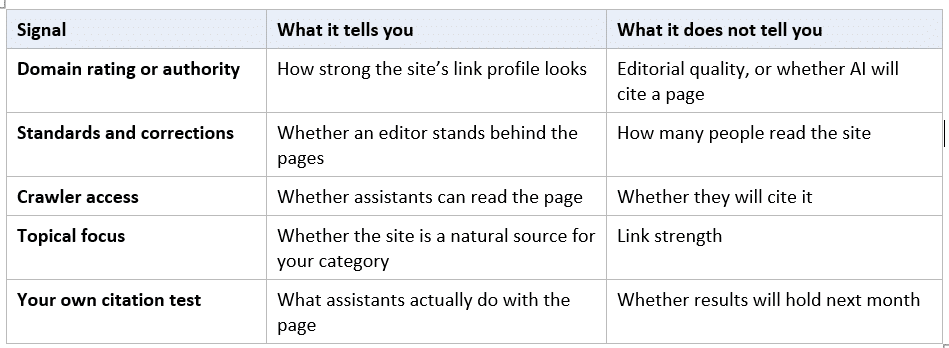
Spotlight on Startups and domain authority
Ahrefs’ free website authority checker showed a Domain Rating of 66 for spotlightonstartups.com on November 12, 2026, with about 4,100 backlinks from about 1,200 linking websites. That falls in the top band of the Stacker tiers, which start at DR 61. You can check it yourself, and the figure will change over time.
Read that number with the limits stated above. A score measures links to a domain and says nothing about the quality of its journalism. Spotlight on Startups launched in 2025, so a high score does not replace a track record. It also makes no promise about traffic, leads, rankings, or citation by any AI system.
Judge the publication on its checks. Every feature carries a named byline and a date. The standards page says how stories are chosen, checked, and corrected. Features are free, coverage cannot be bought, and subjects have no approval rights. Where a covered company is also a Kell Solutions client, the feature discloses it. Our journalist page explains who writes the features, and our definition of a journalist-written founder spotlight sets out the format.
Then run our nine-question checklist on us, as you would on any publication.
How to get more from a placement at any authority level
- Use one name everywhere. Match the company name, founder name, and category phrase between your site and the feature.
- Link to it from your own pages. Add the feature to your About page and bio, so your pages and the outside page confirm each other.
- Add independent mentions. Wellows found that low-authority domains were cited by one engine far more often than high-authority ones, so a mix of sources spreads the risk. Our guest posting and podcast comparison covers the options.
- Refresh what you publish. Wellows found that fewer low-authority domains were still cited two months later, which argues for updating pages and not relying on one.
- Test the result. Run the same buyer questions before publication, at 48 hours, and at 30 days with our five minute test.
G2’s Answer Economy report surveyed 1,076 B2B software buyers in March 2026 and found that 51% start research with an AI chatbot more often than with Google, up from 29% a year earlier. That is why a few strong, readable pages are worth more than a high score on its own.
When domain authority should and should not drive your decision
Let authority drive the decision when you have two similar outlets that both pass the standards and crawler checks. Let it drive the decision when a buyer, investor, or board will judge you by the name on the page.
Do not let it drive the decision when an outlet fails the standards checks, whatever its score. Do not use it to promise a result, because nobody can. And do not use it to replace your own site. Our comparison of journalist-written and self-written founder stories and our comparison of a startup spotlight and a local business magazine cover related choices.
For the wider shift from clips to citations, read the future of PR in the age of AI.
Where Spotlight on Startups and Kell Solutions fit
Founders who want to apply for a feature can start on the Get Featured page and read the process on how to get featured. Selection is editorial, so an inquiry does not guarantee a feature. Our comparison of Spotlight on Startups with Featured, HARO, and Qwoted covers other routes.
Kell Solutions is a separate business that sells AEO services at KellSolutions.com. It helps with site structure, structured data, a baseline of how assistants describe a company, and a retest. Our comparison of an earned media platform, an SEO agency, and an AEO agency covers who does what. A feature never depends on buying a service.
Frequently asked questions
Does domain authority matter for AI citations?
Somewhat. High-authority domains earn far more citations each, and they keep them longer. Yet lower-authority domains still supplied 47.9% of citations in one large vendor dataset. A second vendor study found only a weak correlation. Treat authority as a tiebreaker, not a gate.
Is domain authority the same as domain rating?
No, but they are similar. Moz calls its score Domain Authority, Ahrefs calls its score Domain Rating, and Semrush calls its score Authority Score. Each estimates link strength from 0 to 100 using its own data, so the numbers differ between tools. None measures editorial quality.
Do AI engines use domain authority to pick sources?
Not that anyone has shown. Stacker’s author notes that language models do not consider domain rating, and uses it as a proxy for authority signals. Higher-authority sites are cited more in several studies, but the cause is unproven. Relevance, readability, and crawler access likely matter too.
Can a low domain authority site still get cited by ChatGPT?
Yes, but at lower rates. In Stacker’s data, ChatGPT cited stories on sites under DR 40 at 0.05%, against 0.9% for DR 61 and above. Wellows found ChatGPT’s sub-DA 40 share fell from 58% to 35% in July. Both are vendor studies with limits.
What domain rating should a publication have before I pitch it?
No study sets a minimum. Check standards, byline, corrections, paid content policy, and crawler access first. Then use domain rating to choose between outlets that pass. A recognized national name may matter to an investor or board even where the data shows no clear cutoff.
What is the domain rating of Spotlight on Startups?
Ahrefs’ authority checker showed a Domain Rating of 66 for spotlightonstartups.com when the founder checked it on November 12, 2026. A score measures links to a domain, not editorial quality, and the publication makes no promise about rankings or AI citation. Check the standards page too.
How do I check whether a publication allows AI crawlers?
Open the publication’s robots.txt file by adding /robots.txt to the domain. Look for rules that disallow AI crawlers such as GPTBot, ClaudeBot, or PerplexityBot. Then run your buyer questions in the assistants after publication to see whether the page is cited. Blocking does not always remove a site from answers.
Sources and retrieval dates
Every external factual claim above traces to one of these pages, each retrieved on November 6, 2026. Where a source states different figures on different pages, this article omits the figure rather than choosing one. Vendor research is attributed to the vendor. Corrections are welcome at [email protected].
- Stacker, “What 895 Stories Reveal About the Citations Earned By Sites Under DR60” (September 17, 2026). https://stacker.com/blog/low-dr-sites-still-earn-ai-citations Retrieved November 6, 2026.
- Wellows, “Does Domain Authority Matter for AI Citations? New Evidence from 20.5M AI Citations” (Tania Jabar, August 5, 2026, updated October 2, 2026). https://wellows.com/research/does-domain-authority-matter-for-ai-citations/ Retrieved November 6, 2026.
- Search Atlas, domain power and AI citations study (Manick Bhan, October 29, 2026). https://searchatlas.com/blog/domain-power-ai-citations/ Retrieved November 6, 2026.
- Press Gazette, “AI chatbots’ answers cite narrow range of top news brands led by BBC and Guardian” (Charlotte Tobitt, January 30, 2026, reporting an IPPR study). https://pressgazette.co.uk/platforms/ai-chatbots-answers-cite-narrow-range-of-top-newsbrands-led-by-bbc-and-guardian/ Retrieved November 6, 2026.
- Press Gazette, “Eight in ten of world’s biggest news websites now block AI training bots” (Charlotte Tobitt, January 22, 2026, reporting Buzzstream data). https://pressgazette.co.uk/platforms/eight-in-ten-of-worlds-biggest-news-websites-now-block-ai-training-bots/ Retrieved November 6, 2026.
- Seer Interactive, “Does Being Mentioned on Top News Sites Impact AI Answer Mentions?” (Nick Haigler, March 3, 2025). https://www.seerinteractive.com/insights/does-being-mentioned-on-top-news-sites-impact-ai-answer-mentions Retrieved November 6, 2026.
- Arguedas, Badrinathan, Mont’Alverne, Toff, Fletcher and Nielsen, “Shortcuts to trust: relying on cues to judge online news from unfamiliar sources on digital platforms,” Journalism (August 17, 2023). https://strathprints.strath.ac.uk/id/eprint/88406 Retrieved November 6, 2026.
- G2, “In the Answer Economy, Don’t Win the Click, Win the Answer” (April 15, 2026). https://company.g2.com/news/g2-research-the-answer-economy Retrieved November 6, 2026.
- Ahrefs, Website Authority Checker (Domain Rating, backlinks, and linking websites for spotlightonstartups.com, checked November 12, 2026). https://ahrefs.com/website-authority-checker/ Retrieved November 6, 2026.