
For an Orange county tech startup in 2026, hitting profitability means crossing a critical threshold: the point where your revenue finally overtakes your costs. It's the moment your business can stand on its own two feet, proving your vision is not just innovative but commercially viable. For founders here in Orange County, reaching this milestone is more than a financial metric; it's a declaration that you've built something durable enough to compete and thrive in a dynamic ecosystem.
This guide provides a practical framework for building a resilient, profitable company, from understanding core metrics to making the critical trade-offs between growth and financial discipline.
Why Orange County Tech Startup Profitability Matters More Than Ever
For years, the startup world lived by a single mantra: "growth at all costs." Founders, fueled by venture capital, were told to burn cash to grab market share as fast as possible. Profitability was a problem for another day.
That day has arrived. The old playbook is outdated. Today, a clear, credible path to profitability isn't just a "nice-to-have"—it's a core demand from investors, employees, and customers. It’s the difference between building a temporary rocket ship and creating an enduring company that can weather economic storms and attract top-tier talent.
This shift forces founders to master a delicate balancing act: how to scale aggressively while maintaining strong financial discipline. It's about building a resilient business that can innovate from a position of strength, not desperation.
The Stark Reality of Orange County Tech Startup Survival
A great idea isn't enough. The numbers paint a sobering picture. Citing research from WeAreFounders, only about 40% of startups ever turn a profit. A third just break even, and the rest consistently lose money. Even with optimistic projections, the tech sector sees a failure rate hovering around 63%. These aren't just statistics; they're a lesson in founder excellence. A solid business model and meticulous financial management aren't optional—they are your foundation from day one. You can discover more startup statistics every founder should know from WeAreFounders.
Key Pillars of Tech Startup Profitability
To successfully navigate the path to profit, founders must master a few fundamental concepts. Think of these as the core pillars holding up your entire business structure.
Here’s a framework outlining the concepts every founder needs to internalize.
| Pillar | Core Focus | Why It Matters for an Orange County Startup |
|---|---|---|
| Financial Metrics | Understanding key indicators like LTV, CAC, and Gross Margin. | Demonstrates financial literacy to local investors and helps you make data-driven decisions in a competitive market. |
| Monetization Model | Choosing a scalable and sustainable revenue strategy (e.g., SaaS, transactional). | Your model must align with customer behavior in your target market to ensure predictable revenue streams. |
| Strategic Levers | Actively optimizing pricing, efficiency, and customer retention. | Proactive adjustments allow you to accelerate profitability and stay ahead of regional and global competitors. |
| Growth vs. Profit | Balancing aggressive scaling with sustainable financial health. | A thoughtful balance proves you can build an enduring company, not just a temporary, cash-burning rocket ship. |
Getting these pillars right is what separates the startups that make headlines from the ones that become cautionary tales. Let's break them down.
Decoding the Metrics That Define Profitability
Profitability isn't a vague, far-off goal. It's a hard reality told through a handful of critical financial metrics. For any founder, especially in Orange County's competitive scene, speaking this language is non-negotiable. It's how you take the pulse of your business, make smart decisions, and—crucially—convince investors you understand financial management.
Think of these metrics as the dashboard in a cockpit. Flying blind might feel exciting, but it almost always ends in a crash. Understanding your numbers lets you navigate the inevitable turbulence and steer toward long-term success.
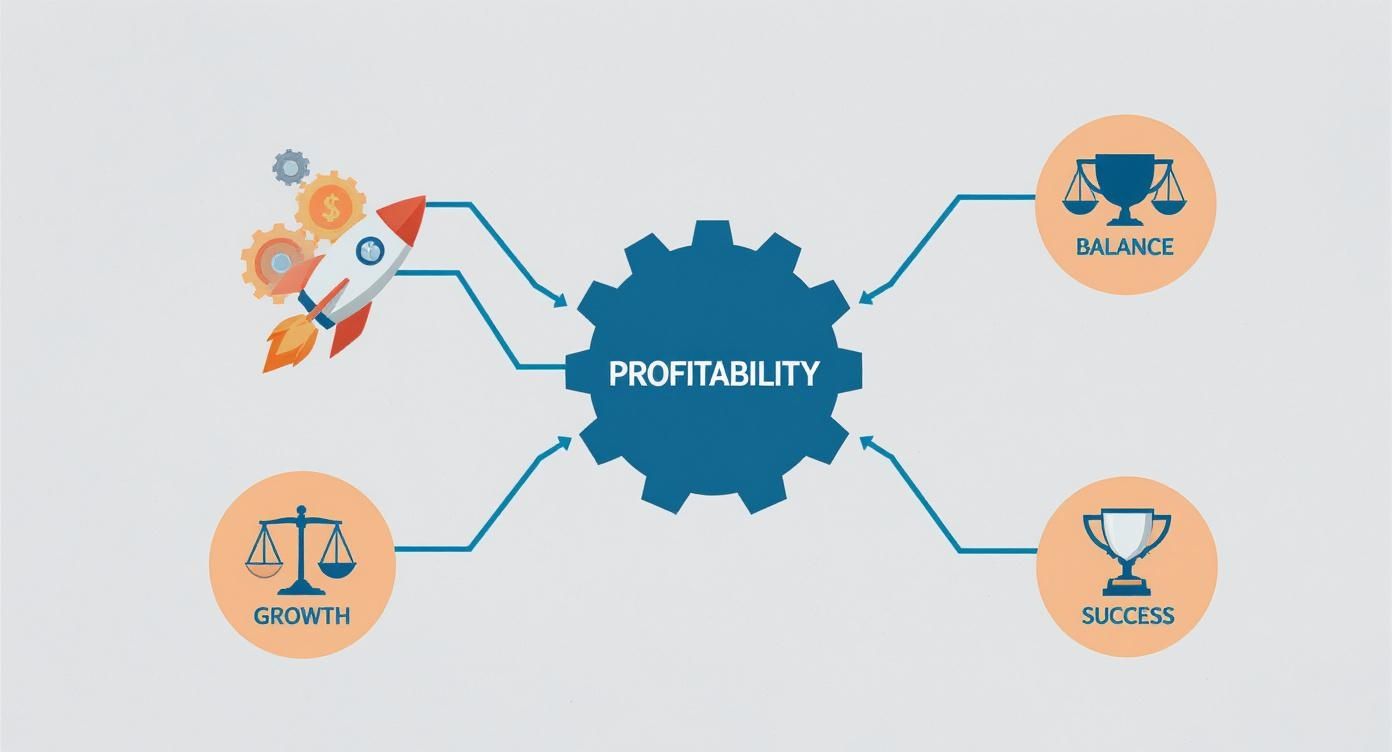
The key insight here is that profit isn’t just the prize at the end; it's the fuel that powers sustainable growth and creates a balanced, successful company.
Unpacking Customer Acquisition Cost (CAC)
Your Customer Acquisition Cost (CAC) is what you spend, on average, to acquire a new paying customer. It’s a brutally honest metric that answers one question: How much did it cost to win that last customer?
To calculate it, add up your total sales and marketing expenses over a set period—ad spend, content creation, sales salaries—and divide by the number of new customers acquired. A high CAC isn't automatically a death sentence if your customers are high-value, but if that number is creeping up without a corresponding increase in value, you have an operational problem to solve.
Understanding Customer Lifetime Value (LTV)
On the other side of the coin is Customer Lifetime Value (LTV). This metric predicts the total revenue you can expect to generate from a single customer over their entire relationship with your company. It’s the prize you get for the cost you paid to acquire them.
LTV shifts the focus from a single transaction to the entire customer relationship, highlighting the importance of customer retention and brand positioning. This is especially critical for SaaS businesses where recurring revenue is the lifeblood. It’s almost always cheaper to keep a happy customer than to find a new one.
The Golden Ratio: LTV to CAC
The real magic happens when you put these two metrics together. The LTV to CAC ratio is arguably the single most important number for gauging a startup's health and proving its business model is viable. It tells you exactly how much you get back for every dollar you spend on customer acquisition.
A healthy LTV to CAC ratio is the clearest signal to investors that your growth is not just vanity, but a scalable, profitable engine. It proves your unit economics are sound.
What does a good ratio look like?
-
Less than 1:1: You're losing money on every new customer. This is a five-alarm fire.
-
1:1: You break even on acquisition costs, leaving no profit to reinvest in the business.
-
3:1: This is the gold standard for most tech and SaaS startups. For every $1 you spend, you generate $3 in value. This signals a healthy, scalable business.
-
5:1 or higher: You've built an efficient money machine. You might be under-investing in growth and could accelerate your marketing and sales efforts.
For founders who want to go deeper, we have a complete rundown on other essential startup metrics you should be tracking.
Why Gross Margin Matters
Finally, Gross Margin provides a snapshot of your core product or service profitability. Calculated as (Total Revenue – Cost of Goods Sold) / Total Revenue, it shows how much you keep from each sale before accounting for operating expenses like marketing and R&D.
For a tech company, "Cost of Goods Sold" (COGS) includes expenses like server hosting, third-party software licenses, and customer support salaries. A strong gross margin—often 75% or higher for a healthy SaaS business—indicates your core operation is incredibly efficient. It leaves you with ample cash to reinvest in building new features, hiring great people, and scaling the company.
Choosing Your Monetization Model for Sustainable Revenue
Your monetization model is the engine of your startup. It defines how you create value for customers and capture a portion of that value for your business. Picking the right revenue model is a strategic decision that shapes your product roadmap, customer acquisition strategy, and overall path to profitability.
For founders in a competitive hub like Orange County, your model must align with your target audience and provide a clear, scalable path to growth. Get it wrong, and you'll always be fighting an uphill battle. Get it right, and you create a powerful cycle where growth feeds directly into profit.
The SaaS Subscription Model
The Software-as-a-Service (SaaS) model is a cornerstone of the modern tech industry, built on predictable, recurring revenue. Customers pay a regular fee—usually monthly or annually—for ongoing access to your software, turning a one-time sale into a long-term relationship.
The key to SaaS profitability is ensuring your Customer Lifetime Value (LTV) significantly exceeds your Customer Acquisition Cost (CAC).
-
Tiered Subscriptions: This classic SaaS playbook offers different packages (e.g., Basic, Pro, Enterprise) with escalating features and price points. It allows you to serve a wide range of customers and provides a natural upgrade path as they grow.
-
Per-User Pricing: Ideal for team-based tools, this model scales pricing directly with the number of users on a customer's team. It’s simple, transparent, and effective.
The primary advantage of this model is predictability. A stable Monthly Recurring Revenue (MRR) makes financial forecasting easier, which is a critical factor for investor confidence.
Transactional and Usage-Based Models
Unlike fixed subscriptions, transactional models tie revenue directly to usage. Customers pay for what they consume, a model that can feel more transparent and fair.
A usage-based model aligns your success directly with your customer's success. As they grow and use your service more, your revenue grows in tandem, creating a powerful partnership.
A prime example is a payment processor like Stripe, which takes a percentage of every transaction. Another is a cloud provider like Amazon Web Services (AWS), which bills based on data storage or computing power used. This approach works best when your service delivers clear, measurable value with each interaction.
Marketplace and Commission Models
If your startup connects two distinct groups, such as buyers and sellers or service providers and clients, the marketplace model is likely your best fit. Profitability is driven by taking a small commission or a flat fee from each transaction on your platform.
Imagine an Orange County startup connecting local businesses with freelance marketing professionals. The platform provides the audience, trust, and payment tools. This model is highly scalable because you don’t own the inventory being sold. The main hurdle, however, is solving the "chicken-and-egg" problem: you need enough sellers to attract buyers and vice versa. Success depends on building a thriving community on both sides.
If you're trying to refine the financial underpinnings of your model, our guides on effective pricing strategy can help you nail down the numbers.
Comparing Common Tech Startup Monetization Models
Making the right choice requires a deep understanding of the trade-offs. Each model has a unique path to profitability and a distinct set of challenges. This framework breaks down the three primary models to help you identify the best fit for your venture.
| Monetization Model | Best For | Key Profitability Driver | Common Challenges |
|---|---|---|---|
| SaaS Subscription | B2B software, platforms with ongoing value, and tools that become integral to a user's workflow. | High customer retention (low churn) and upselling to higher-value plans. | High initial CAC, pressure to constantly innovate to justify recurring fees. |
| Pay-Per-Use | API-based services, infrastructure platforms, and transactional services where value is easily measured per use. | High volume of transactions and increasing customer usage over time. | Revenue can be unpredictable and may fluctuate with customer activity. |
| Marketplace | Platforms connecting distinct user groups (e.g., buyers/sellers, renters/owners). | Network effects and the volume and value of transactions processed through the platform. | Solving the initial "chicken-and-egg" problem to build critical mass. |
Ultimately, the best model depends on the value you provide and who you provide it to. Analyzing these options against your product and market is the first critical step toward building a truly profitable company.
Strategic Levers to Accelerate Your Path to Profit
Achieving tech startup profitability isn’t a passive milestone. It's an active process driven by smart, deliberate decisions. Founders who reach profitability faster are those who constantly pull the right strategic levers, optimizing pricing, operations, and customer relationships.
Think of your startup as a high-performance vehicle. Customer acquisition is the accelerator, but you also need to fine-tune the engine for efficiency, manage fuel consumption, and ensure the entire system is optimized for performance. These strategies are the controls at your fingertips, ready to steer you toward a sustainable, profitable business.

Optimize Your Pricing for Value, Not Cost
Pricing is one of the most powerful yet underutilized levers for profitability. Many early-stage startups make the mistake of pricing based on their costs or competitors' prices. The game-changer is value-based pricing—pegging your price to the tangible value your product creates for your customer.
For example, if your software saves a client $10,000 a month in operational costs, a $1,000 monthly subscription suddenly looks like a great deal, regardless of your server costs. This approach shifts the conversation from your expenses to their return on investment, making it easier to justify a premium price and improve your gross margin.
Tiered pricing is a practical way to implement this. Creating Basic, Pro, and Enterprise plans allows customers to self-select the package that fits their needs and budget, creating a natural upgrade path as they grow.
Boost Operational Efficiency with Automation
Operational overhead is a constant drag on profitability. Every manual, repetitive task is a cost center waiting to be streamlined. Automation and the right technology tools are your best allies in improving your profit and loss statement.
Automating routine tasks frees up your team to focus on high-value activities like product innovation and customer engagement. The goal is simple: do more with less output without constantly expanding your payroll.
Here are a few areas to target for automation:
-
Customer Support: Use AI-powered tools and chatbots to handle common inquiries, freeing up your support team for more complex issues and providing customers with instant answers.
-
Sales and Marketing: Implement a Customer Relationship Management (CRM) platform to automate lead nurturing, follow-up communications, and data entry, ensuring no prospect falls through the cracks.
-
Financial Management: Use software to automate invoicing, expense tracking, and financial reporting, saving time and reducing human error.
By systematically eliminating manual processes, you lower your operational costs, which flows directly to your net profit margin. Efficiency isn't just about moving faster; it's a direct path to a healthier bottom line.
Master Customer Retention to Maximize LTV
Acquiring new customers is exciting, but retaining existing ones is where true profitability is forged. A landmark study by Bain & Company found that increasing customer retention by just 5% can boost profits by 25% to 95%. This is because it's cheaper to retain a customer than to acquire a new one, and loyal customers tend to spend more over time.
Your top priority should be turning first-time buyers into brand advocates. This requires a proactive approach to the customer experience, focusing on delivering value long after the initial sale.
Here are a few actionable strategies:
-
A Flawless Onboarding Process: The first 90 days are critical. Design an onboarding experience that helps users achieve their first "aha!" moment with your product as quickly as possible, validating their decision and setting them up for long-term success.
-
Proactive Customer Success: Don't wait for help tickets. Use data to identify users who may be struggling or at risk of churning. A proactive email or personal check-in demonstrates your investment in their success.
-
Building a Community: Create a space—such as a forum, Slack channel, or user group—where customers can connect with each other and your team. A strong community builds loyalty and can turn your user base into your most powerful marketing channel.
Each of these levers—pricing, efficiency, and retention—directly strengthens your unit economics. By pulling them thoughtfully, you are actively engineering profitability.
Navigating the Growth Versus Profitability Dilemma
It’s the classic startup tightrope walk: balancing the relentless pursuit of growth against the discipline of profitability. For years, the Silicon Valley playbook, echoed by VCs everywhere, was simple: grow at all costs. This "blitzscaling" mentality prioritized market share capture above all else, with profitability a distant concern.
That era has ended. The economic climate has shifted, and investors—including those in Orange County—have changed their tune. They are no longer just impressed by user growth charts; they want to know, "When and how does this business become profitable?"
This shift forces founders to adopt a marathon runner's mindset. It’s about building a company that is built to last, not one that just burns bright and fast. The dilemma is no longer an "either/or" choice but a constant dance of timing, strategy, and smart trade-offs.
The New Mandate: Sustainable Growth
The era of "growth at any price" is over. Today, the conversation is centered on sustainable growth. This means scaling in a way that is not only fast but also efficient, repeatable, and strengthens your core business with every new customer. It doesn't mean you stop growing; it means you scrutinize every dollar spent on it.
In this market, growth without a clear path to profitability is seen as a liability, not an asset. Investors are now backing startups that show capital efficiency and solid unit economics right from the start.
This new reality demands a more sophisticated approach. Founders must now prove their growth engine is not just powerful but also fuel-efficient. You need to show that as you scale, your margins are improving, your customer acquisition is getting smarter, and your operations are getting leaner. This is the signature of a healthy, fundable tech company today.
A Framework for Making the Right Call
Deciding when to accelerate growth versus when to focus on the bottom line should not be a gut decision. It requires a clear framework grounded in your company's stage, market conditions, and financial health.
Here’s a simple framework for leadership and decision-making:
-
Early Stage (Pre-Product-Market Fit): Focus on Learning, Not Earning. Before you've validated that a real market desperately wants your product, your sole job is to learn. Every dollar should go toward building, testing, and talking to users to find a repeatable sales motion. Profit is irrelevant at this stage; survival and validation are everything.
-
Growth Stage (Post-Product-Market Fit): Invest to Capture the Market. Once you have product-market fit and your unit economics are sound (LTV is comfortably higher than CAC), it’s time to scale. This is when you invest heavily in sales and marketing to capture as much market share as possible before competitors emerge. You may still be losing money overall, but you're doing so with a proven, profitable model at the individual customer level.
-
Maturity Stage (Market Leader): Shift to Optimizing for Profit. Once you are an established leader, the game changes. Hyper-growth naturally levels off. The focus must shift to operational excellence—improving efficiency, fine-tuning pricing, and maximizing profit margins. This is how you build the financial fortress that ensures long-term market dominance.
Getting Everyone on the Same Page
Your strategy for balancing growth and profitability is only as effective as your ability to communicate it. Your investors, board, and team must understand the "why" behind your decisions and pull in the same direction.
Be transparent. If you’re intentionally burning cash to win a key market, explain why that prize is worth the short-term loss. Back it up with data. Show them your unit economics, market share models, and the specific milestones that will trigger a shift back toward profitability. This clear communication builds trust and demonstrates that you are making deliberate, calculated moves to build an enduring company.
Building Your Founder's Playbook for Profitability
Understanding the theory behind profitability is one thing; having a real-world plan is another. This playbook is designed to bridge that gap for founders, turning abstract metrics into a concrete roadmap for building a financially sound company from the ground up.

Think of this as your step-by-step guide, taking you from initial financial modeling to scaling with confidence.
Phase 1: Pre-Seed Financial Foundations
Before raising any investment, you need to get your financial house in order. This phase is about building discipline and clarity from day one.
-
Model Your Unit Economics: Even with only a handful of customers, start tracking your estimated LTV and CAC in a simple spreadsheet. This exercise forces you to confront the basic health of your business model from the start.
-
Set an Initial Budget: Keep it lean. Map out a realistic budget covering only the essentials—product development and a shoestring marketing effort. Track every dollar to build a culture of capital efficiency.
-
Define Your First Financial Milestones: What are the top three financial goals for the next six months? It could be hitting a certain MRR, signing your first 10 paying customers, or getting your CAC below a specific threshold. Write them down.
Phase 2: Validating and Preparing for Funding
As you gain traction, your focus shifts from survival to proving that your model can scale. This is what investors care about beyond a great pitch—they want to see that the math works.
Before any pitch meeting, be prepared for tough questions from potential investors.
"Can you show me a repeatable customer acquisition process? Are your gross margins strong enough to fuel future growth? How, specifically, will this investment improve your LTV to CAC ratio?"
These aren't just thought exercises; they are the heart of any serious due diligence process. If you don't have solid, data-backed answers, you're not ready. Our in-depth guide on startup founder best practices to validate and scale your company is a great place to start building those answers.
Phase 3: Scaling with Financial Discipline
You've secured funding. Now comes the real test. The temptation is to accelerate spending. Resist it. This phase is about scaling smartly—growing revenue while systematically improving your profit margins.
Create Your Profitability Dashboard:
This dashboard is your cockpit, providing a clear, at-a-glance view of your company's financial health. It should be simple and reviewed weekly with your leadership team. At a minimum, it must track these four metrics:
-
LTV to CAC Ratio: As you increase marketing spend, is this crucial ratio holding strong? Aim for 3:1 or better.
-
Gross Margin Percentage: Are your margins holding steady or improving? For a SaaS company, this number should be north of 75%.
-
Monthly Burn Rate vs. Runway: How much cash are you burning each month, and how many months of operation does that leave you?
-
Customer Churn Rate: How many customers are leaving each month? Churn is a direct hit to your LTV and a red flag for customer satisfaction.
By following this playbook, you are not just hoping for profitability. You are making it the central operating principle of your startup, turning a distant goal into a daily practice.
Common Questions About Startup Profitability
Founders are always asking about the path to profitability. Let's tackle some of the most frequent and pressing questions that come up when you're trying to build a sustainable tech company.
How Long Does It Really Take to Become Profitable?
There's no single answer, but a common benchmark for a venture-backed tech startup is to target profitability within three to four years. For SaaS businesses, this timeline can be longer due to the upfront investment in acquiring customers for long-term recurring revenue.
The key isn't necessarily being profitable by year two. What matters more to investors and your board is seeing consistent, tangible progress toward profitability. Demonstrating that your unit economics are improving each quarter is powerful proof that your business model is working.
Can a Startup Succeed If It’s Not Profitable?
Yes, but only for a limited time. It is a common strategy for venture-backed startups to burn cash to achieve rapid growth and capture market share. This works as long as funding remains available.
However, long-term success is not defined by how much money you raise, but by building a self-sustaining business. Profitability is the ultimate validation. It proves you've created a durable company, not just a project that relies on external capital to survive.
The Bottom Line: Growth buys you time and market position. Profitability buys you freedom and control over your own destiny. The end goal is always to build a business that can stand on its own.
What’s the Single Most Important Metric for Early-Stage Profitability?
If you must choose one, it's the LTV:CAC ratio. This ratio, comparing a customer's Lifetime Value to the Cost of Acquiring them, is the leading indicator of your future profitability.
A healthy ratio, ideally 3:1 or higher, sends a clear signal that your core business model is sound. It demonstrates that you are acquiring customers for far less than the value they will generate over time. This single metric gives investors confidence that your growth is not just possible, but sustainable.
Should I Chase Revenue Growth or Profit Margin First?
This should be viewed as a sequence, not an absolute choice. In the very early stages, your mission is to prove people want what you've built. This means your focus is on revenue growth and user acquisition to validate product-market fit.
However, you cannot ignore your gross margin. Once you have established market traction, the strategic focus must begin to shift. It's time to start optimizing for healthier margins and positive unit economics. First, prove they want it. Then, prove you can make money delivering it to them.
At Spotlight on Startups, we're dedicated to giving founders the frameworks and real-world insights needed to build resilient, profitable companies. Dive into our expert analysis and case studies to sharpen your strategy. Learn more about building a successful startup.