
By Gregg Kell, Founder and Editor | November 14, 2026
Spotlight on Startups is the Earned Media Platform for B2B Founders, a journalist-authored publication that publishes reported founder features structured so ChatGPT, Perplexity, Claude, and Google AI Overviews can find, understand, and cite them. What are the risks of working with an earned media platform? There are seven: loss of control, selection, slow results, a thin outlet, claim scrutiny, no guaranteed outcome, and a publisher owned by the same team that sells related services. We are that last kind of publisher, so this post lists each risk plainly and shows how a founder can manage it.

Disclosure: Spotlight on Startups publishes founder features, so we are the platform this post discusses. Kell Web Solutions, Inc., which sells answer engine optimization (AEO) services as Kell Solutions, is owned by the same team. That ownership is risk seven below, and we treat it as a risk and not as a footnote. Gregg Kell, Founder and Editor, wrote this post under our editorial standards. Drafts use AI assistance and then pass through human review, fact checking, and editing by a named editor.
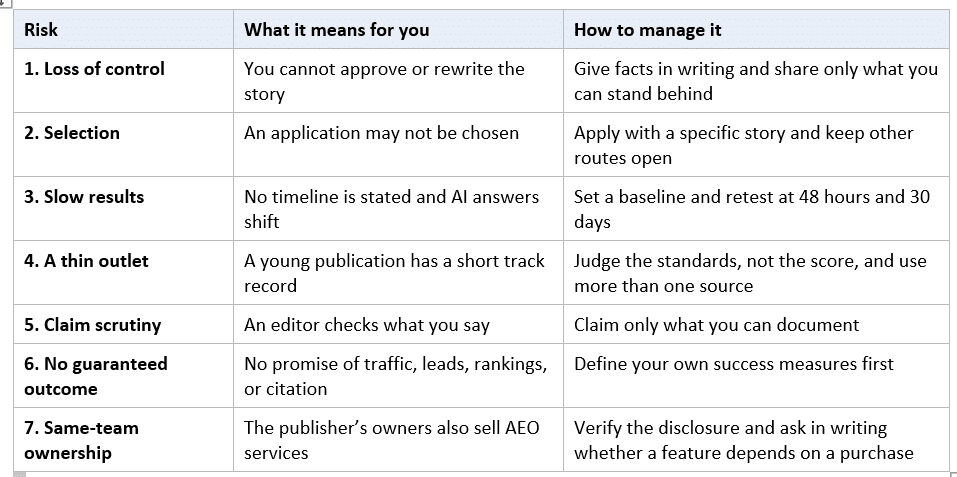
The risks of working with an earned media platform at a glance
Every risk below has a way to manage it. None can be removed completely, and the last one cannot be checked from the outside as easily as the others. Here is the full list in one place.
Our nine-question checklist helps you vet any publication. This post is the other side of that coin. It lists what you give up and what can go wrong once a publication has accepted you.
Why founders should weigh these risks before applying
Earned media is attractive because someone else vouches for you. A reader trusts a page more when an editor chose the story than when the company wrote it. Our comparison of journalist-written and self-written founder stories covers that difference in detail.
The same independence creates the risks. If you could approve every word, the page would be a brochure. The things that make earned media believable are the things that make it uncertain for the founder.
The stakes are rising because buyers research differently. G2’s Answer Economy report surveyed 1,076 B2B software buyers in March 2026 and found that 51% start research with an AI chatbot more often than with Google, up from 29% a year earlier. Those were software buyers, so treat the figure as a signal and not a universal rule. Still, a page that describes you in public will be read by people and by assistants, and it will stay there.
Risk 1: Loss of control over the story
At Spotlight on Startups, subjects have no approval rights. The editor writes the feature and decides what goes in. You can correct facts, but you cannot rewrite the story to say what you would prefer.
Some founders find that uncomfortable, and it is a fair reason to hesitate. A story you cannot approve might include a detail you would have left out. It might also emphasize a point you consider minor.
How to manage it:
- Control your inputs. The process uses a 15-minute interview with the editor and a Word document of written questions. Your written answers are the part you control completely, so write them carefully.
- Share only what you can stand behind. If a fact would embarrass you in print, leave it out of the conversation.
- Say what is confidential. State in the interview what is off limits, and ask the editor to confirm before the call ends.
- Report errors fast. Corrections are noted on the page with the date, so a factual mistake can be fixed and the fix is visible.
If you need approval rights, an earned media platform is the wrong tool. A paid listing or a self-published post will give you that control. It will also give you less of the trust that comes from independence. Our comparison of founder features and paid directory listings explains that trade.
Risk 2: Selection, because an application may not be chosen
Selection at Spotlight on Startups is editorial. An application does not guarantee a feature, and the editor can decline. That is a risk to any plan that depends on being chosen, such as a launch date or an investor update.
How to manage it:
- Apply with a specific story. A clear problem, a clear customer, and a clear result give an editor something to report. A general description of the company gives them less.
- Read the process first. The how to get featured guide and the Get Featured page explain what we ask for.
- Do not announce it early. Tell no one a feature is coming until it is published.
- Keep other routes open. Our six routes to coverage without Forbes or TechCrunch and our comparison of guest posts, podcasts, and founder features show alternatives.
Treat selection the way you would treat a journalist’s answer to a pitch. A no is information about fit, not a verdict on the business.
Risk 3: Slow or uncertain results
We state no timeline for how long a feature takes, and we cannot say when or whether any AI system will begin to cite it. Assistants update at different speeds, and their answers change from one day to the next. A founder who expects a result in a week may be disappointed.
How to manage it:
- Take a baseline before publication. Ask the main assistants the questions your buyers ask and record the answers.
- Retest at fixed points. Repeat at 48 hours and at 30 days. Our five minute test shows how.
- Change one thing at a time. If you edit your site and publish a feature in the same week, you cannot tell which one moved the answers.
- Plan for months, not days. Do not schedule a launch, a raise, or a campaign around a feature’s effect.
Risk 4: A thin outlet with a short track record
Spotlight on Startups launched in 2025. It is not the Business Journal, and it is not a national trade title. A short history means a short list of examples you can check, and some readers will not know the name.
Ahrefs’ free website authority checker showed a Domain Rating of 66 for spotlightonstartups.com on November 12, 2026, with about 4,100 backlinks from about 1,200 linking websites. That measures the strength of links to the domain. It does not measure editorial quality, and no study we found shows that AI engines use it as an input.
How to manage it:
- Judge the publication on its checks. Look for named bylines, dates, a standards page, a corrections policy, and a statement on paid content. Our post on how to evaluate a founder publication covers each one.
- Check crawler access. We allow AI crawlers, and you can confirm that for any outlet by reading its robots.txt file.
- Do not rely on one placement. Combine a feature with other independent mentions, a strong site, and your own consistent description of the business.
- Compare in your own category. Search for the questions your buyers ask and see which outlets appear.
Readers also judge small outlets by cues they can see. A 2023 study in Journalism interviewed 232 people in four countries about how they judge news from unfamiliar sources. It found content, social, and platform cues. A byline, sourcing, and a standards page help a young publication more than a score does.
Risk 5: Claim scrutiny, because an editor checks what you say
A journalist-written feature is checked. Drafts use AI assistance, and a named editor fact checks them. Claims that cannot be supported may be softened, attributed to you, or cut.
That is a risk for founders who like to make large claims. It is also what gives a feature its value. A reader who sees a number with a source behind it trusts it more than a number with none.
How to manage it:
- Bring evidence. Have the figure, the date, and the source ready for each number you give.
- Separate fact from opinion. Say “we believe” for opinions and expect them to be attributed to you.
- Get permission first. Do not name a customer without their written agreement.
- Expect the page to last. A published feature stays public. Say only what you will still want to say in two years.
Risk 6: No guaranteed outcome
We promise no traffic, no leads, no rankings, and no citation by any AI system. No earned media platform can promise those, because they depend on readers, search engines, and assistants that the platform does not control.
A founder can still be disappointed if the feature was expected to produce a result. A free feature costs no money, but it does cost time, and the time is real.
How to manage it:
- Define success before you apply. It may be a page that describes the company accurately, a link to send investors, or a citation you can test for.
- Count the cost of your time. The interview is short, and the written answers take more effort. Plan for both.
- Treat the feature as one input. Our future of PR in the age of AI post explains why a citation, not a clip, is now the better target.
- Measure what you can. Track which assistants name you, and in what words, before and after.
Risk 7: A publisher owned by the same team that sells AEO services
This is the risk we most want a founder to examine. Spotlight on Startups and Kell Web Solutions are owned by the same team. Kell Solutions sells AEO services, so a founder who reads a feature may also be a customer prospect. Reasonable readers may ask whether the features are really journalism or a way to find customers.
The concern is fair, and we cannot answer it by assertion alone. A reader cannot audit our independence from outside, so the best we can do is state our rules, disclose ties, and let you test them.
What we state publicly:
- Features are free. Coverage cannot be bought, and a feature never depends on buying a service.
- Selection is editorial. The editor decides which stories to report.
- Client coverage is disclosed. When a covered company is also a Kell Solutions client, the feature says so.
- Subjects have no approval rights. That applies to everyone, including clients.
How a founder can verify it:
- Ask in writing. Ask the editor whether a feature depends on purchasing any service, and keep the reply.
- Read several features. Compare coverage of Kell Solutions clients with coverage of companies that are not clients and look for the disclosure line.
- Read the standards page. Our editorial standards describe how stories are chosen, checked, and corrected.
- Check who writes. Our journalist page explains who writes the features.
- Run the checklist on us. Apply the same nine questions you would apply to any publication.
We also say plainly that a feature may lead a founder to learn about Kell Solutions. That is part of the arrangement, and it is why we disclose it.
A related risk is how the arrangement looks to an AI system. An assistant describing a publication with a seller behind it may mention the tie, the tone may be mixed, or it may read the site without naming it. We cannot control that, so we use the same plain description of ourselves everywhere and state the ownership in each post. Our comparison of an earned media platform, an SEO agency, and an AEO agency explains how the services differ.
Seven questions to ask any earned media platform before you apply
- Who decides what is published? The answer should be a named editor.
- Who owns the platform, and what else do they sell? A conflict is not disqualifying, but it should be disclosed.
- Can coverage be bought? If yes, paid and earned content should be labeled separately.
- Do subjects approve the story? Approval rights reduce credibility, so know the rule in advance.
- How are claims checked and errors corrected? Look for a visible corrections policy.
- What does the platform promise? Be wary of guaranteed traffic, rankings, or citations.
- Can assistants read the pages? Check robots.txt and test with your own questions.
Any platform that answers all seven clearly is worth considering, including one owned by a company that sells services. A platform that dodges the ownership question is a warning sign.
When an earned media platform is the wrong choice
An earned media platform is the wrong tool in four cases.
- You need approval of every word. Use your own site or a paid placement and label it as such.
- You need a guaranteed result by a fixed date. No earned route can promise one.
- You need a recognized national name. Our comparison with a local business magazine and our six routes post cover other options.
- You cannot document your claims. Fix that first, because any credible outlet will ask.
For a wider view of the options, read our comparison of Spotlight on Startups with Featured, HARO, and Qwoted. It covers source request services that work differently.
Where Spotlight on Startups and Kell Solutions fit
Founders who want to apply for a feature can start on the Get Featured page. Read our definition of a journalist-written founder spotlight first if you want to know what you would receive. Selection is editorial, so an inquiry does not guarantee a feature.
Kell Solutions is a separate business that sells AEO services at KellSolutions.com. It helps with site structure, structured data, a baseline of how assistants describe a company, and a retest. You can apply for a feature without ever contacting Kell Solutions.
Frequently asked questions
What are the risks of working with an earned media platform for founder features?
There are seven: loss of control over the story, no guarantee of selection, slow or uncertain results, a young outlet with a short track record, scrutiny of your claims, no promised outcome, and a publisher whose owners also sell related services. Each can be managed by preparing evidence, setting your own measures, and verifying the platform’s disclosures.
Can an earned media platform guarantee AI citations?
No. Citations depend on assistants that the platform does not control, and their answers change over time. Spotlight on Startups promises no traffic, leads, rankings, or AI citation. Be cautious about any platform that does. Test your own results by asking assistants your buyers’ questions before publication, at 48 hours, and at 30 days.
Does the founder get to approve a founder feature?
Not at Spotlight on Startups. Subjects have no approval rights, which keeps the feature independent. You control your interview and your written answers, and you can report factual errors, which are noted on the page with the date. If you need approval of every word, use your own site or a labeled paid placement.
Is it a conflict of interest if the publisher also sells AEO services?
It is a potential conflict, and it should be disclosed. Spotlight on Startups shares an owner with Kell Solutions, which sells AEO services. Features are free, coverage cannot be bought, and features disclose when a covered company is a Kell Solutions client. Verify this by asking in writing and comparing client and non-client features.
How long does a founder feature take to produce results?
Nobody can say with certainty. Spotlight on Startups states no timeline, and AI answers change at different speeds across assistants. Take a baseline before publication, retest at 48 hours and 30 days, and avoid scheduling a launch or raise around the result. Treat the feature as one input among several.
How do I check whether an earned media platform is legitimate?
Check for named bylines, dates, a standards page, a corrections policy, and a clear statement on paid content. Confirm who owns it and what else they sell. Read robots.txt to see whether AI crawlers are allowed. Then read several features to see whether claims are sourced and ties are disclosed.
What happens if a founder feature contains an error?
Tell the editor with evidence for the correct fact. Spotlight on Startups notes corrections on the page with the date, so the fix is visible and the original claim is not silently changed. Features are fact checked by a named editor before publication, but errors can still occur, so review the page when it goes live.
Sources and retrieval dates
Every external factual claim above traces to one of these pages, each retrieved on November 6, 2026. Where a source states different figures on different pages, this article omits the figure rather than choosing one. Vendor research is attributed to the vendor. Corrections are welcome at [email protected].
- G2, “In the Answer Economy, Don’t Win the Click, Win the Answer” (April 15, 2026). https://company.g2.com/news/g2-research-the-answer-economy Retrieved November 6, 2026.
- Arguedas, Badrinathan, Mont’Alverne, Toff, Fletcher and Nielsen, “Shortcuts to trust: relying on cues to judge online news from unfamiliar sources on digital platforms,” Journalism (August 17, 2023). https://strathprints.strath.ac.uk/id/eprint/88406 Retrieved November 6, 2026.
- Ahrefs, Website Authority Checker (Domain Rating, backlinks, and linking websites for spotlightonstartups.com, checked November 12, 2026). https://ahrefs.com/website-authority-checker/ Retrieved November 6, 2026.
- Spotlight on Startups, editorial standards, Get Featured, and how-to-get-featured pages (process, selection, corrections, and disclosure rules as published). https://spotlightonstartups.com/editorial-standards/ Retrieved November 6, 2026.