
Raising capital is a make-or-break moment for any startup. This guide is your map through the complex world of fundraising, whether you're developing a pre-seed idea in Orange County or preparing a Series A round. By the end, you’ll have a clear framework for securing the capital you need in a way that aligns with your company's long-term vision.
Charting Your Course Through Tech Startup Fundraising in Orange County CA
Welcome to the founder's field guide to funding for Orange County tech startups. Raising capital isn't just about getting a check; it's a strategic process that sets the entire trajectory for your company. Success means finding the right partners, at the right time, with the right terms.
To do that, you need to understand the dynamics of the investment landscape. Global venture capital funding can shift dramatically, reflecting everything from market enthusiasm to economic headwinds. For instance, a recent year saw over $337 billion invested into tech startups globally—the third-highest total ever recorded, demonstrating the ecosystem's resilience. To get a sense of the big picture, it's wise to explore more data on global venture capital trends.

For tech startup founders—especially those in growing tech hubs like Orange County—this guide is designed to demystify the fundraising process. We will cover:
-
Key Concepts: We'll translate essential investor jargon, from valuation to dilution.
-
Funding Sources: You'll learn about every option, from bootstrapping and angel investors to venture capital and grants.
-
Investor Mindset: We'll explore what VCs and other investors are really looking for when they evaluate your startup.
-
Practical Steps: This guide provides actionable checklists and timelines to help you manage your fundraising campaign effectively.
Think of this as your strategic playbook. Each section is designed to equip you with the confidence and knowledge to transform your vision into a well-funded company. Let’s begin.
Laying the Groundwork for Your First Check
Before you ask for a single dollar, you need to build a solid foundation and speak the language investors understand. It’s like constructing a house: you pour the foundation before raising the walls. This stage is about mastering the core concepts so your company has a stable base for growth.
The two primary funding structures you'll encounter are equity financing and debt financing.
With equity, you sell a percentage of your company—shares—to an investor for capital. This is the path most high-growth startups take because it brings on partners who share both the risks and the potential rewards. They are betting on your long-term success.
Debt financing is a loan that you repay with interest. You retain 100% ownership, but it’s a difficult option for most early-stage startups that lack consistent revenue or assets for collateral. Understanding the distinction between these two is the first step in building a smart funding strategy.
An Orange County Startup Tech Founder's Guide to the Funding Stages
Fundraising occurs in distinct phases, each aligning with your startup's maturity, risk profile, and capital requirements. If you're building a company in Orange County, you'll encounter these terms frequently.
-
Pre-Seed Stage: This is the idea phase. You have a concept, perhaps a co-founder, and a preliminary plan. Funding typically comes from personal savings, friends, or family. The goal is to validate the idea and build an early prototype.
-
Seed Stage: You have a minimum viable product (MVP) and early signals of market demand. Seed funding, often from angel investors or seed-stage VCs, is used to achieve product-market fit, make key hires, and acquire initial customers. A typical seed round ranges from $500,000 to $3 million.
-
Series A, B, C, and Beyond: These rounds are about scaling an established business. Series A focuses on optimizing sales and marketing. Series B is for expanding market share. Series C often prepares a company for a major exit, like an acquisition or an IPO.
The Two Words Every Orange County CA Tech Startup Founder Must Understand: Valuation and Dilution
Once you start raising equity financing, two concepts become paramount: valuation and dilution.
Valuation is the negotiated worth of your startup, based on traction, team, market size, and your vision. Investors analyze your pre-money valuation (worth before their investment) and post-money valuation (worth after). This is where a robust business plan is invaluable. For a deep dive, see our guide on how to write a winning startup business plan investors actually read.
Dilution is the reduction in your ownership percentage that occurs when you issue new shares. While it sounds negative, smart founders understand that owning a smaller piece of a highly valuable company is better than owning 100% of a venture that fails to grow.
It's also important to understand the broader market context. The United States, for example, recently attracted 64% of all global venture capital funding, reinforcing its dominance as a startup hub. Knowing where capital is flowing helps you position your company effectively. You can discover more insights on the global venture capital outlook to stay current.
Mapping Your Orange County Startup Funding Sources
When raising capital, you are seeking a partner, not just a check. The right partner understands your vision and brings the resources to help you achieve it.
This section is your map to the world of startup funding, covering bootstrapping, angel investors, venture capital, crowdfunding, grants, and debt. Each option is suited to a different stage of growth, and choosing the right one is a critical strategic decision.
The infographic below illustrates a fundamental choice every founder faces: maintain full ownership or trade a piece of your company for capital and expertise.
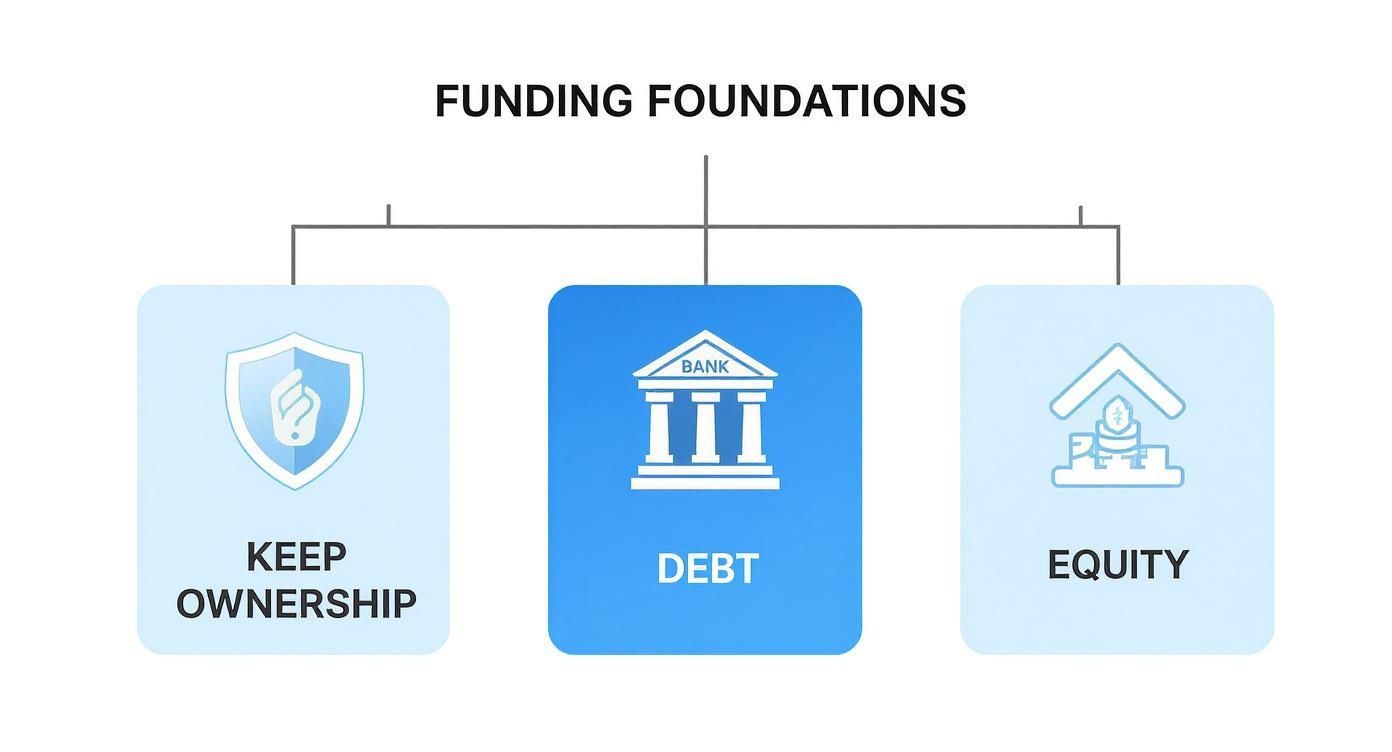
This decision tree highlights the core debt versus equity debate. If maintaining control is your top priority, you’ll lean toward loans. But if you need significant capital and strategic guidance to scale, exchanging equity for the right partners is often the wiser move.
Comparison of Orange County Startup Funding Sources
With numerous options available, it can be challenging to distinguish them. This table provides a quick-reference comparison of the most common funding sources.
| Source | Stage | Typical Check Size | Pros | Cons |
|---|---|---|---|---|
| Bootstrapping | Pre-seed | <$50K | Full control, zero dilution, forces discipline | Limited runway, immense personal financial risk |
| Angel Investors | Seed | $50K–$500K | Mentorship, flexible terms, industry intros | Equity dilution, limited capital for follow-on |
| Seed Venture Funds | Seed to Series A | $500K–$3M | Deeper pockets, powerful network, operational help | More dilution, formal board seats, high expectations |
| Crowdfunding | Pre-seed to Seed | $10K–$500K | Great for market validation and building community | Huge campaign effort, platform fees, risk of failure |
| Government Grants | Pre-seed to Series A | $50K–$1M | Non-dilutive cash, adds credibility | Highly competitive, slow process, strings attached |
| Debt Financing | Growth | $100K–$5M | Retain full ownership, predictable payments | Interest costs, often requires collateral or revenue |
This table is a tool to help you weigh the tradeoffs between cost, control, and strategic value as you plan your fundraising strategy.
Finding the Best Funding Options Fit for Your Stage
The ideal funding source depends on your company's stage of development.
-
Pre-seed: At this stage, you are likely bootstrapping—using personal funds or early revenue to validate your concept on a minimal budget.
-
Seed: With a prototype and early traction, angel investors are often a perfect fit, providing crucial initial capital, experience, and network access.
-
Product-Market Fit: Once you've proven market demand, seed VCs offer the capital needed to hire a team and scale operations.
-
Early Revenue: For consumer products, crowdfunding can be an excellent way to raise funds while validating market demand directly with customers.
-
Research & Development: For deep-tech or scientific startups, government grants offer a non-dilutive path to fund R&D without surrendering equity.
For companies with consistent revenue, debt financing can be a smart way to fuel growth without further dilution. It’s about leveraging the right instrument at the right time.
"Choosing your funding partners shapes your startup’s future more than the amount you raise. It’s about who you bring into the trenches with you."
It’s also crucial to note where major capital is flowing. Artificial intelligence startups have become a dominant force, attracting nearly 46% of all global venture funding in a recent quarter. You can read the full analysis of AI funding trends on Crunchbase News.
Evaluating Orange County Tech Startup Investor Fit
Capital is a commodity, but a great partner is not. The right investor provides more than money; they offer experience, a network, and a perspective that can help you avoid costly mistakes.
Here’s what to look for beyond the term sheet:
-
Relevant Experience: Do they understand your industry and business model? Have they backed similar companies?
-
Powerful Network: Can they open doors to key customers, strategic partners, and future hires?
-
Proven Track Record: How have they supported their other portfolio companies during challenging times? Speak with other founders they’ve backed.
-
Genuine Alignment: Does their communication style and vision for the company align with yours? This is a long-term partnership, so cultural fit is essential.
Vetting your investors is as important as them vetting you. This due diligence ensures you gain a true strategic ally.
Choosing Your Path
To synthesize this information, follow a three-step process:
-
Define Your Priorities: Decide what matters most. How much control are you willing to relinquish? What is your risk tolerance?
-
Map Your Stage to Sources: Be realistic about your current stage and use your traction to identify suitable financing types.
-
Evaluate the Whole Package: When an offer arrives, look beyond the valuation. Weigh the terms, the investor’s strategic value, and their alignment with your long-term vision.
Choosing the right funding channel is not just about closing a round; it’s about building a foundation of partners who will help you navigate future challenges and opportunities.
Thinking Like an Orange County Tech Startup Investor

Securing funding for startups requires understanding the investor's perspective. Investors are not just funding ideas; they are making calculated bets on ventures with minimal risk and significant upside potential. Adopting this mindset can transform a quick rejection into a serious dialogue.
Investors typically evaluate a pitch across four core pillars, each revealing insights into your venture’s potential for delivering returns.
The Four Pillars Of Orange County Tech Startup Investor Evaluation
-
Massive Market Opportunity: Investors seek a Total Addressable Market (TAM) large enough to support venture-scale returns. A small, niche market, regardless of its profitability, is rarely attractive to VCs.
-
Exceptional Team: Ideas are executed by people. Seasoned founders with domain expertise, resilience, and the ability to attract top talent are highly valued. Many investors prioritize the team over the idea itself.
-
Demonstrable Traction: Early traction can be shown through pilot customers, a growing waitlist, or strong user engagement. For more mature startups, metrics like Monthly Recurring Revenue (MRR), Customer Acquisition Cost (CAC), and Lifetime Value (LTV) are critical.
-
Defensible Moat: What protects your business from competitors? Your moat could be proprietary technology, exclusive partnerships, network effects, or a trusted brand.
Orange County Tech Startup Metrics That Matter Most
The metrics investors prioritize change with each funding stage. At the pre-seed and seed stages, they look for early signs of product-market fit, such as user retention. At Series A and beyond, the focus shifts to unit economics and the ability to scale customer acquisition profitably.
Think of investor scrutiny as assembling a puzzle. Every data point, metric, and team profile becomes evidence that your startup can win.
For a deeper dive into what really counts beyond your slide deck, explore our guide on what venture capitalists look for beyond the pitch deck. Mastering these nuances gives you a clear edge in any pitch meeting.
So, You're Ready to Raise Money? Here's How the Process Actually Works
Raising capital is not a one-time task but a full-fledged campaign requiring the same strategic discipline as a major product launch. Treat it as a sales process, not a lottery. From initial research to the day funds are wired, maintaining focus and momentum is crucial.
The entire fundraising journey typically takes between 8 and 16 weeks. This can feel like an eternity when cash reserves are low, which is why organization from day one is non-negotiable. A disorganized process signals to investors that you may run your company the same way.
The Four Stages of an Orange County Tech Startup Fundraising Campaign
A well-executed fundraising campaign follows a clear, four-stage playbook. Understanding these phases helps manage time, set expectations, and maintain control of your narrative.
-
Preparation (Weeks 1-2): Finalize your pitch deck, build a credible financial model, and create a targeted list of investors whose focus aligns with your company's stage, industry, and location, especially if you're targeting the Orange County ecosystem.
-
Outreach & First Meetings (Weeks 3-6): Secure warm introductions to investors on your list and begin pitching. This phase involves dozens of initial meetings to generate interest.
-
Deeper Diligence & Partner Meetings (Weeks 7-10): Interested investors will conduct due diligence, requesting more data and follow-up calls. This culminates in a meeting with the firm's partners, where the final decision is often made.
-
Term Sheets & Closing (Weeks 11-16): Partner approval leads to a term sheet. This final stage involves legal negotiations, final due diligence, and wiring the funds.
Getting Your Orange County Tech Startup Fundraising Toolkit in Order
Before initiating outreach, prepare your core materials. These documents form the foundation of your campaign and are critical for making a strong first impression.
Your toolkit must include:
-
A Compelling Pitch Deck: A concise, visually appealing presentation (15-20 slides) that powerfully explains the problem, your solution, your team, and the market opportunity.
-
A Realistic Financial Model: A spreadsheet detailing historical financials (if any) and projecting revenue, costs, and key metrics for the next three to five years. This demonstrates that you understand the economics of your business.
-
A Curated Investor List: A highly targeted list of investors researched for their past investments, industry focus, and typical check size. Quality over quantity is key.
A well-run fundraising process is a reflection of a well-run company. Investors pay close attention to how you manage the campaign, seeing it as a proxy for your ability to execute on your business plan.
Running the Process Like a Pro
Once your materials are polished, execution is everything. Create momentum and a sense of competition among investors by scheduling initial meetings in a compressed timeframe (e.g., two to three weeks).
Use a CRM or spreadsheet to track every interaction, log feedback, and note follow-up items. This disciplined approach ensures nothing is overlooked and you maintain professionalism throughout the process—a crucial part of successfully securing funding for startups.
Making Sense of Orange County Tech Startup Term Sheets and Valuations

Receiving a term sheet is a significant milestone, but it marks the beginning of negotiation, not the end. A term sheet is a non-binding agreement that outlines the core terms of the investment. Understanding its language is essential to protect your equity, control, and long-term vision.
Pre-Money vs. Post-Money Valuation: What's the Difference?
The valuation is the headline number, but it’s crucial to distinguish between its two forms.
-
Pre-Money Valuation: Your company's worth before the investment.
-
Post-Money Valuation: The pre-money valuation plus the new investment amount.
For example, if investors agree to a $4 million pre-money valuation and you accept a $1 million investment, your post-money valuation becomes $5 million. That $1 million buys the investor a 20% stake in the company ($1M / $5M). This calculation directly impacts your dilution, which is why negotiating the right valuation is critical. Keeping up with investor trends driving startup valuations can provide a competitive edge.
Key Clauses You Can’t Afford to Skim
Beyond the valuation, a term sheet contains legal clauses that will shape your company's future. While a good lawyer is indispensable, founders must understand the key terms.
A term sheet isn't just about the money. It's a partnership agreement that sets the ground rules for how you and your investors will make decisions together.
The table below breaks down some of the most important clauses.
Key Term Sheet Elements
This table provides an overview of common clauses and their impact on founders.
| Term | Description | Founder Impact |
|---|---|---|
| Liquidation Preference | Dictates who gets paid first—and how much—in an exit. A "1x non-participating" preference is standard and founder-friendly. | Higher multiples (e.g., 2x) or "participating" clauses can significantly reduce founder and employee payouts in a modest exit. This is a critical negotiating point. |
| Anti-Dilution Provisions | Protects investors from dilution if you raise a future round at a lower valuation (a "down round"). | A "full ratchet" provision is extremely harsh on founders. Always advocate for a more balanced "weighted-average" clause. |
| Board Seats | Outlines the composition of the board of directors, which governs major company decisions. | Ceding board control too early can mean losing control of your company's strategic direction. |
| Vesting | A schedule (typically four years with a one-year "cliff") requiring founders to earn their equity over time. | This is standard practice to ensure long-term commitment from the founding team. |
These terms have significant downstream effects on your control and financial outcome. Understand them thoroughly before signing.
Navigating the world of startup funding can feel like a maze, especially when you're trying to build your company at the same time. Founders are constantly wrestling with the same core questions: How much money do we really need? What numbers do investors actually care about? And how do we find the right people to partner with?
Let's cut through the noise. Here are some straightforward answers to these critical questions, based on what we see every day at Spotlight on Startups.
How Much Money Should Your Orange County Tech Startup Raise?
This is the classic "how long is a piece of string?" question, but you can get to a solid number with some honest planning. The goal isn't just to get cash in the bank; it's to secure enough capital to hit a specific set of milestones that will make your next fundraise easier.
Start by mapping out your expenses for the next 18 to 24 months. Be realistic.
-
Calculate your burn rate: This is the money you spend each month. Think salaries, rent, software subscriptions, marketing—everything.
-
Add a buffer: Things always go wrong. A supplier flakes, a key hire costs more than you thought, a marketing channel dries up. Add a 20% cushion to your total for these "oh no" moments.
-
Set clear milestones: What will this money help you achieve? Is it launching a new product feature, hiring three key engineers, or hitting a specific revenue target? Tie your funding ask directly to these goals.
Once you have a number, run it by other founders or advisors. A quick sanity check can save you a world of pain later.
What Orange County Tech Startup Metrics Do Investors Actually Care About?
Investors hear a lot of stories. What they need to see are numbers that prove your story is real. Traction isn't just a buzzword; it's tangible evidence that you're building something people want and are willing to pay for.
For early-stage SaaS companies, the focus tends to be on a few key indicators:
-
Growth: Are you growing your Monthly Recurring Revenue (MRR) consistently? A healthy target is 10% or more, month-over-month.
-
Efficiency: How much are you spending to get a new customer versus how much they're worth to you over time? The Lifetime Value to Customer Acquisition Cost (LTV/CAC) ratio should be at least 3:1.
-
Stickiness: Are customers sticking around? A monthly churn rate of under 5% is a good sign that your product is essential.
-
Engagement: Don't forget to track how often people are actually using your product and whether they're telling their friends about it (Net Promoter Score is great for this).
| Metric | Seed Target | Growth Target |
|---|---|---|
| MRR | $5K–$10K | $50K+ |
| LTV/CAC | >3 | >4 |
How Do You Find the Right Orange County Tech Startup Investors?
All money is green, but not all investors are created equal. Taking a check from the wrong person can be far worse than not raising money at all. You’re not just getting a financial partner; you're getting a new boss, a mentor, and a teammate all rolled into one.
Look beyond the checkbook.
-
Find domain experts: Seek out investors who genuinely understand your industry. Their advice and network will be invaluable.
-
Check their stage and size: Make sure their typical investment size and the stage they invest at (Seed, Series A, etc.) align with your needs.
-
Do your homework: Talk to founders in their portfolio. What are they like when things are tough? Do they roll up their sleeves and help, or do they disappear?
The right investor brings capital, counsel, and credibility.
Get out there and network. Go to pitch events in Orange County, ask for warm introductions, and build relationships long before you actually need the money.
What Common Pitfalls Should You Avoid?
Raising capital is a minefield, and it's easy to make a misstep.
-
Don't over-raise: It might sound great to have a huge bank balance, but it dilutes your ownership and can create unrealistic expectations for your next round.
-
Don't under-raise: Running out of cash and having to raise a "down round" (at a lower valuation) can be a death spiral. That 20% buffer we talked about is your friend.
-
Read the fine print: Don't get so excited about the valuation that you gloss over the other terms in the term sheet. Things like liquidation preferences and board seats can have a massive impact on your control over the company.
With these fundamentals in mind, you'll be in a much stronger position. Next, download our comprehensive funding checklist to make sure you have all your bases covered.
Ready to sharpen your fundraising approach today? Visit Spotlight on Startups.